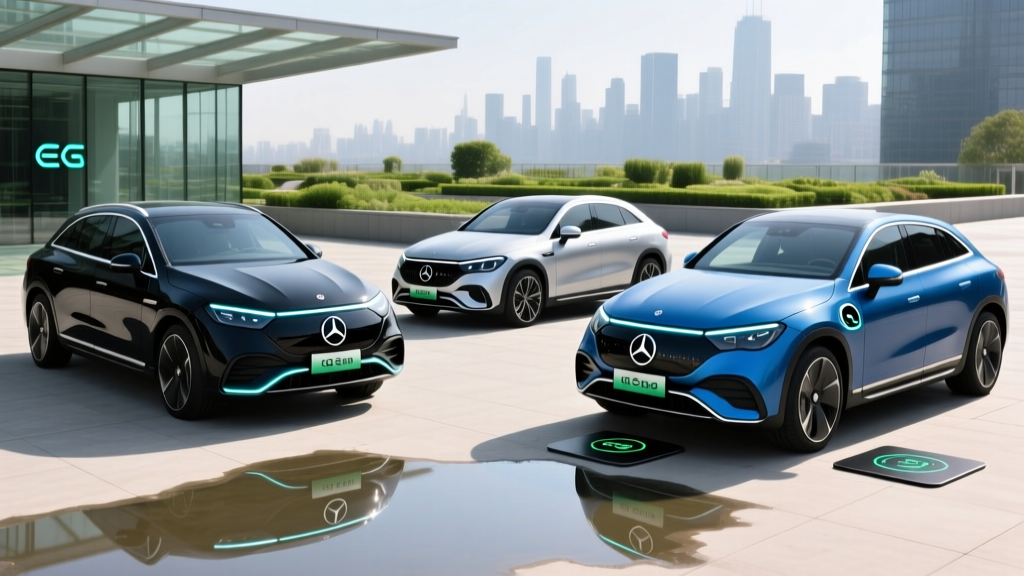
The short answer: Mercedes-Benz currently sells five fully electric models in the U.S. under the EQ badge — the EQB compact SUV, EQE sedan and SUV, and EQS sedan and SUV. EPA range spans from 205 miles (EQB 350 4MATIC) to 390 miles (EQS 450+ sedan). Base MSRPs run from roughly $53,000 to over $105,000. Most do not qualify for the $7,500 federal §30D tax credit due to battery-sourcing rules and MSRP caps. Real-world ownership costs favor these EVs over their gas counterparts primarily on fuel and maintenance savings, but insurance and depreciation can offset some of that advantage. Home Level 2 charging is strongly recommended; public-only charging makes ownership noticeably more expensive and less convenient.
The Current Mercedes-Benz Electric Lineup at a Glance
Mercedes has committed heavily to battery-electric vehicles, and the 2026 model year reflects a mature EQ lineup built on dedicated EV architectures (EVA2 for the large sedans/SUVs, MFA2 for the compact EQB). Here is what is actually on sale and what the numbers look like before you set foot in a dealership.
| Model | EPA Range | Battery (usable kWh) | Peak DC Charge | 10–80% DC Time | 0–60 mph | Base MSRP |
|---|---|---|---|---|---|---|
| EQB 300 4MATIC | 251 mi | 66.5 kWh (NMC) | 100 kW | ~32 min | 7.7 sec | $53,050 |
| EQE 350+ | 305 mi | 90.6 kWh (NMC) | 170 kW | ~28 min | 6.2 sec | $75,050 |
| EQE SUV 350 4MATIC | 279 mi | 90.6 kWh (NMC) | 170 kW | ~28 min | 6.4 sec | $77,900 |
| EQS 450+ | 390 mi | 118 kWh (NMC) | 200 kW | ~31 min | 5.9 sec | $105,550 |
| EQS SUV 450+ | 330 mi | 118 kWh (NMC) | 200 kW | ~31 min | 6.3 sec | $106,350 |
Sources: EPA fueleconomy.gov, Mercedes-Benz USA. All figures reflect 2026 model year data where published; carryover from latest confirmed model year where 2026 specifics are pending.
Real-World Range Reality Check: The EQS 450+ sedan's 390-mile EPA estimate is among the highest of any EV sold today. In real-world highway driving at 75 mph in moderate temperatures, expect roughly 330–350 miles. In cold weather (below 30°F), that can drop to 270–300 miles due to battery resistance and cabin heating demands. The smaller EQB, with its 251-mile EPA figure, realistically delivers 200–220 miles on the highway and potentially 170–190 miles in freezing conditions. Plan your road trips around the lower number.
What Does the Reader Need to Decide About a Mercedes-Benz EV?
Most shoppers researching electric cars Mercedes-Benz models are weighing three decisions simultaneously: whether to go electric at all, whether Mercedes specifically is the right luxury EV brand, and whether the total cost of ownership justifies the premium price tag.
The core decision factors are:
- Daily driving distance and road-trip frequency. If your commute is under 60 miles round-trip and you take a handful of road trips per year, any EQ model covers your needs comfortably. If you regularly drive 300+ miles between charging stops, only the EQS sedan has the range buffer to do it without a midway top-up.
- Home charging access. This is the single biggest ownership variable. A Level 2 home charger (240V, typically 48A / 11.5 kW) adds roughly 30–45 miles of range per hour of charging, meaning any EQ model replenishes fully overnight. Without home charging, you will rely on public DC fast chargers or workplace Level 2 — which costs more per mile and demands schedule flexibility.
- Passenger and cargo needs. The EQB offers an optional third row (best for small children), while the EQS SUV provides genuine three-row adult seating. The EQE sedan sacrifices rear headroom compared to the SUV variants.
- Technology expectations. Mercedes' MBUX Hyperscreen (standard on EQS, optional on EQE) is a 56-inch curved glass display spanning the dashboard. It is visually impressive, but some drivers find the touch-capacitive climate controls less intuitive than physical buttons. Drive Pilot, Mercedes' Level 3 conditional automation system, is available in select states (Nevada, California) but only at speeds below 40 mph in heavy traffic on approved highways.
SAE Automation Level — Drive Pilot: Mercedes-Benz Drive Pilot is certified as SAE Level 3, meaning the driver can legally disengage from active driving in specific geo-fenced conditions (approved highways, under 40 mph, heavy traffic). This is a meaningful step above Level 2 systems like Tesla Autopilot or GM Super Cruise, which require continuous driver attention. However, Level 3 is not full self-driving — you must be ready to resume control within ~10 seconds when prompted, and the system will not operate on surface streets, in rain, or above its speed threshold.
Mercedes-Benz EV vs Gas: Cost and Efficiency Compared
Let's put concrete numbers to the EV-versus-gas question by comparing the EQE 350+ against its closest internal-combustion sibling, the E 350 sedan. Both are midsize luxury sedans with comparable interior volume and feature content.
| Metric | EQE 350+ (EV) | E 350 (Gas) |
|---|---|---|
| Base MSRP | $75,050 | $60,500 |
| EPA Efficiency | 87 MPGe (35 kWh/100 mi) | 26 MPG combined |
| Fuel/Energy Cost per Mile | $0.045 (home, $0.13/kWh) / $0.14 (DCFC) | $0.13 (premium at $3.50/gal) |
| Annual Fuel/Energy (12,000 mi) | $540 (home) / $1,680 (all DCFC) | $1,560 |
| Scheduled Maintenance (Annual Avg) | ~$200 (cabin filter, tire rotation) | ~$650 (oil, filters, brakes) |
| 5-Year Total Fuel + Maintenance | $3,700 (home) / $9,400 (DCFC) | $11,050 |
| Federal Tax Credit (§30D) | $0–$7,500 (see eligibility below) | $0 |
The math: The EQE 350+ carries a ~$14,500 higher base MSRP than the E 350. Over five years and 60,000 miles, the EQE saves roughly $7,350 on fuel and maintenance (assuming predominantly home charging). That narrows the gap to about $7,150 before factoring in any tax credit. If the EQE qualifies for even a partial §30D credit, the five-year cost gap shrinks further. However, higher insurance premiums on EVs (typically 15–25% more than comparable gas models) and steeper first-year depreciation can claw back $2,000–$4,000 of that savings.
For the EQS versus an S 500, the calculus is similar but the dollar figures are larger — the EV saves more on fuel in absolute terms but the purchase premium is also greater. The EQB, as the most affordable entry point, is the easiest to justify financially against a GLB 250.
Federal Tax Credit Eligibility for Mercedes-Benz EVs
This is where many Mercedes EV buyers encounter disappointment. The IRS §30D clean vehicle credit offers up to $7,500, but eligibility hinges on three criteria that most Mercedes models struggle to meet in 2026:
- MSRP cap: Sedans must be under $55,000; SUVs, vans, and trucks under $80,000. This eliminates the EQE sedan, EQS sedan, and EQS SUV immediately. The EQE SUV and EQB may qualify if their as-configured price stays under $80,000.
- Battery sourcing: A percentage of critical minerals and battery components must be sourced from the U.S. or free-trade-agreement countries. Mercedes sources battery cells primarily from CATL (China) and Farasis Energy, which has complicated §30D eligibility. As of early 2026, most EQ models do not meet the full critical-minerals threshold.
- Buyer income cap: Adjusted gross income must not exceed $300,000 (married filing jointly), $225,000 (head of household), or $150,000 (single).
Practical takeaway: Do not assume a $7,500 credit when budgeting for a Mercedes-Benz EV. Verify eligibility on the specific VIN through the IRS portal or your tax professional before signing a purchase agreement. The point-of-sale transfer option (allowing the dealer to apply the credit as a down-payment reduction) is available if you do qualify.
Charging at Home and on the Road: What to Expect
Every current Mercedes EQ model uses the CCS1 connector for DC fast charging and the J1772 connector for Level 2 AC charging. Mercedes has announced adoption of the NACS (Tesla-style) connector for future models, but 2026 vehicles still ship with CCS1. A NACS adapter for Supercharger access may be available through Mercedes dealers; verify compatibility before purchasing a third-party adapter.
| Level | Power (kW) | Miles Added per Hour | Full Charge Time (EQE 350+) | Typical Location |
|---|---|---|---|---|
| Level 1 (120V) | 1.4 kW | ~3–4 mi/hr | ~65 hours | Standard outlet |
| Level 2 (240V, 48A) | 11.5 kW | ~32–38 mi/hr | ~9.5 hours | Home / workplace |
| DC Fast (EQE/EQB) | 100–170 kW peak | ~200–350 mi/hr (peak) | 10–80% in ~28–32 min | Electrify America, EVgo, Ionity |
| DC Fast (EQS) | 200 kW peak | ~350–450 mi/hr (peak) | 10–80% in ~31 min | Electrify America, EVgo |
Charging curve reality: The "200 kW peak" figure on the EQS is not sustained for the entire session. Like all EVs, the charge rate tapers significantly above 80% state of charge (SoC) to protect battery health. A typical EQS session from 10–80% averages roughly 140–150 kW, not the full 200 kW. The 10–80% time of ~31 minutes is accurate, but expect 80–100% to take an additional 25–35 minutes on DC fast charging. For road trips, plan to charge to 80% and move on — it is faster than waiting for a full charge.
Home charging installation: A Level 2 home charger installation typically costs $800–$2,500 total (charger hardware: $400–$700; electrician labor and permit: $400–$1,800). If your home's electrical panel needs an upgrade from 100A to 200A service, add $1,500–$3,500. This is a near-essential investment for Mercedes EV ownership — Level 1 trickle charging at 3 miles per hour is impractical for a vehicle with a 90+ kWh battery.
Common Misconceptions About Mercedes-Benz EVs
| Myth | Fact |
|---|---|
| "Mercedes EVs get the full $7,500 tax credit." | Most do not, due to battery-sourcing rules and MSRP caps. Verify per VIN before purchase. |
| "The EQS charges at 200 kW the whole time." | 200 kW is the peak rate. Sustained average from 10–80% is ~140–150 kW, tapering sharply above 80%. |
| "I can charge on a regular outlet — it'll just take overnight." | Level 1 adds ~3–4 miles per hour. Fully recharging a 90 kWh EQE battery on 120V takes roughly 65 hours — nearly three days. |
| "The battery will need replacing in 5–8 years." | Mercedes warranties the HV battery for 10 years / 155,000 miles against dropping below 70% capacity. Industry data shows NMC batteries typically retain 85–90% capacity at 100,000 miles with normal use. |
| "Drive Pilot means the car drives itself." | Drive Pilot is SAE Level 3 — it operates only under 40 mph on approved highways in specific states, and you must be prepared to resume control within seconds. |
| "I can use Tesla Superchargers directly." | Current EQ models have CCS1 connectors. Supercharger access requires a Mercedes-approved NACS adapter — not all Supercharger stalls support non-Tesla vehicles even with an adapter. |
Real-World Ownership: What First-Time EV Buyers Must Know
Cold-weather range loss is real and significant. In temperatures below 30°F, expect 20–30% range reduction across all EQ models. The EQS with its heat pump handles this better than the EQB, which uses a less efficient resistive heating system in some trims. Preconditioning the battery while plugged in (using the Mercedes me app to warm the cabin and battery before departure) mitigates some of this loss and preserves range.
Insurance costs more. Luxury EVs carry higher insurance premiums than their gas counterparts — typically 15–25% more, driven by higher repair costs, specialized parts, and elevated vehicle values. Get an insurance quote on the specific EQ model and trim before finalizing your purchase. The difference can be $500–$1,200 per year depending on your profile and state.
Tire wear accelerates. EVs are heavier and deliver instant torque, both of which wear tires faster than gas vehicles. Expect to replace tires every 25,000–35,000 miles rather than the 40,000–50,000 miles typical for ICE vehicles. Budget $1,200–$2,000 per set for the OEM-spec Michelin or Pirelli tires these models require.
Maintenance is minimal but not zero. There are no oil changes, no spark plugs, no transmission fluid. Brake pads last significantly longer thanks to regenerative braking (often 80,000+ miles). But cabin air filters, brake fluid checks, coolant system service, and wiper fluid still require attention. Mercedes recommends service intervals of roughly 1 year / 10,000 miles for its EVs.
Battery warranty specifics: Mercedes-Benz provides a high-voltage battery warranty of 10 years or 155,000 miles (whichever comes first), guaranteeing that the battery will retain at least 70% of its original usable capacity. If degradation exceeds 30% within that window, Mercedes will repair or replace the battery at no cost. This is competitive with BMW's 8-year/100,000-mile warranty and slightly better than some rivals. Keep documentation of all charging habits and service visits — they support any future warranty claim.
Decision Framework: Which Mercedes-Benz EV Is Right for You?
Choose the EQB 300 4MATIC if: You want the most affordable entry into a Mercedes EV, need a compact SUV with optional third-row seating for small children, have a daily commute under 50 miles, and can install a Level 2 charger at home. It is the most likely model to stay under the $80,000 SUV MSRP cap for tax credit purposes.
Choose the EQE 350+ if: You want a midsize luxury sedan with strong range (305 mi EPA), value the MBUX Hyperscreen option, and primarily drive solo or with one passenger. It is the sweet spot for daily commuting and occasional road trips, though the $75,050+ price puts it in a competitive segment against the BMW i5 and Tesla Model S.
Choose the EQE SUV 350 4MATIC if: You need SUV cargo space and all-wheel drive, want the same powertrain as the EQE sedan but with more practicality, and your as-configured price stays under $80,000 to preserve potential §30D eligibility.
Choose the EQS 450+ sedan if: Maximum range is your top priority (390 mi EPA is class-leading), you want the full luxury flagship experience with standard Hyperscreen and available Drive Pilot, and the $105,000+ price tag fits your budget without relying on a tax credit.
Choose the EQS SUV 450+ if: You need three-row seating for adults, want the longest-range luxury EV SUV available, and budget is not a primary constraint. This is the electric equivalent of the GLS — big, comfortable, and expensive.
Consider a Mercedes plug-in hybrid (e.g., S 580e, GLC 350e) instead if: You lack home charging access, frequently drive in areas with sparse public charging infrastructure, or want to reduce your carbon footprint without committing to full-electric ownership. PHEVs offer 30–50 miles of electric-only range for daily commutes plus a gas engine for longer trips, eliminating range anxiety entirely.
Frequently Asked Questions
Do Mercedes-Benz electric cars qualify for the $7,500 federal tax credit?
Most do not qualify for the full credit in 2026. The §30D credit requires that a percentage of battery critical minerals and components be sourced from the U.S. or free-trade-agreement countries, and most Mercedes EQ models use cells from suppliers that do not meet this threshold. Additionally, sedans must have an MSRP below $55,000 and SUVs below $80,000 to be eligible at all. Always verify eligibility for the specific VIN through the IRS clean vehicle credit page before purchasing.
How long does it take to charge a Mercedes EQ at home?
On a 48-amp Level 2 home charger (11.5 kW), the EQE 350+ with its 90.6 kWh battery charges from empty to full in roughly 9.5 hours. The EQS with its 118 kWh battery takes approximately 12 hours. Most owners charge from 20–80% overnight (roughly 5–7 hours), which is sufficient for daily use and gentler on battery longevity.
Can I charge a Mercedes EQ at a Tesla Supercharger?
Not natively. Current EQ models use the CCS1 connector, while Tesla Superchargers use the NACS connector. Mercedes has indicated that a NACS adapter will be offered, enabling access to Supercharger stalls that support non-Tesla vehicles. Availability and compatibility vary — confirm with your dealer before relying on Supercharger access for travel planning.
What happens if the battery degrades significantly?
Mercedes warranties the high-voltage battery for 10 years or 155,000 miles, guaranteeing at least 70% of original usable capacity. Real-world data from similar NMC batteries in other EVs shows typical degradation of 10–15% over 100,000 miles with normal charging habits (avoiding frequent 100% charges, minimizing DC fast charging when possible). A full battery replacement outside of warranty would cost an estimated $15,000–$25,000 depending on the model, though this is rare within the first decade of ownership.
Are Mercedes EQ models good in winter?
They are competent but affected by cold like all EVs. Expect 20–30% range loss below 30°F. The EQS models feature a heat pump that improves cabin heating efficiency and reduces range impact compared to resistive heaters. All 4MATIC models provide capable all-wheel drive for snow and ice. Preconditioning the battery and cabin while plugged in (via the Mercedes me app) before departure is the single most effective step to preserve winter range.
Is a Mercedes plug-in hybrid a better choice than a full EV?
It depends on your situation. If you have reliable home charging, a daily commute within the EQ range, and access to DC fast charging for road trips, a full EV offers lower running costs and a smoother driving experience. If you lack home charging, live in a charging-desert area, or regularly tow or drive 400+ miles in a day, a Mercedes PHEV like the GLC 350e (with ~35 miles of electric range and a gas backup) may be the more practical electrified choice.