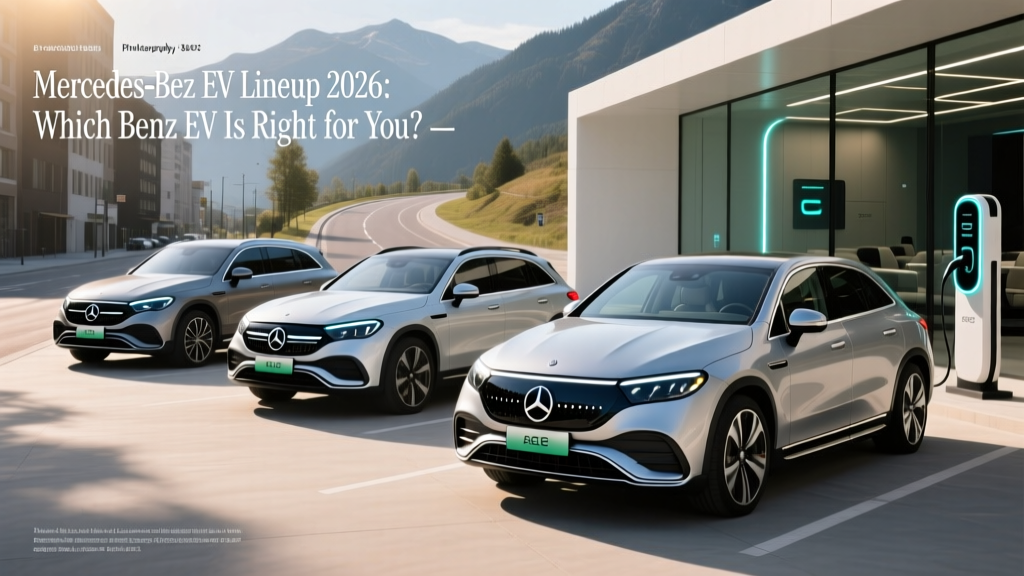
The short answer: Mercedes-Benz currently sells four battery-electric models in the U.S. under the EQ sub-brand: the compact EQB (EPA 251 mi, from ~$54,200), the midsize EQE Sedan (EPA 305 mi, from ~$76,050), the flagship EQS Sedan (EPA 390 mi, from ~$105,550), and the EQS SUV (EPA 305–330 mi, from ~$105,550). All use NMC battery chemistry, CCS1 connectors (with NACS adapters available), and support DC fast charging from 170–200 kW. The best Benz EV for most buyers is the EQE 350+ Sedan — it balances range, charging speed, and daily usability without the six-figure price tag of the EQS models. However, none of these models currently qualify for the full §30D federal tax credit due to battery-sourcing and MSRP-cap rules, so plan your budget accordingly.
The 2026 Mercedes-Benz EV Lineup at a Glance
Mercedes-Benz has committed heavily to electrification through its EQ division. As of the 2026 model year, the U.S. lineup focuses on luxury sedans and crossovers built on dedicated EV platforms (EVA2 for the EQE/EQS). The smaller EQA and the larger EQG (electric G-Wagen) have been announced for global markets but remain limited or unreleased in the U.S. as of early 2026.
| Model | EPA Range | Battery (usable kWh) | Peak DC Charge | 10–80% Time | 0–60 mph | Base MSRP |
|---|---|---|---|---|---|---|
| EQB 300 4MATIC | 251 mi | 66.5 kWh (NMC) | 100 kW | ~32 min | 7.7 sec | $54,200 |
| EQE 350+ Sedan | 305 mi | 90.6 kWh (NMC) | 170 kW | ~31 min | 6.2 sec | $76,050 |
| EQE 350 4MATIC SUV | 279 mi | 90.6 kWh (NMC) | 170 kW | ~31 min | 6.4 sec | $78,050 |
| EQS 450+ Sedan | 390 mi | 118.0 kWh (NMC) | 200 kW | ~31 min | 5.9 sec | $105,550 |
| EQS 450 4MATIC SUV | 330 mi | 118.0 kWh (NMC) | 200 kW | ~31 min | 5.7 sec | $105,550 |
Sources: EPA fueleconomy.gov, Mercedes-Benz USA press materials. Range figures are EPA estimates; real-world results vary with temperature, speed, and terrain.
Real-World Range: What the EPA Sticker Doesn't Tell You
Mercedes-Benz EQ models tend to deliver range figures closer to their EPA estimates than some competitors, thanks to strong thermal management and slippery aerodynamics (the EQS Sedan has a drag coefficient of just 0.20). But physics still applies.
EQS 450+ Sedan: EPA 390 mi. Expect ~320–340 mi in mixed real-world driving at 70 mph. In sub-freezing winter conditions (20–30°F), plan for 260–290 mi — roughly a 25–30% reduction. Highway-only driving at 80+ mph drops range to ~300 mi.
EQE 350+ Sedan: EPA 305 mi. Real-world mixed: ~260–280 mi. Cold weather: ~210–240 mi. This is adequate for most commutes and moderate road trips but requires planning for 300+ mile stretches.
EQB 300: EPA 251 mi. Real-world: ~210–230 mi mixed. This is the lineup's range weak point — highway road trips will require frequent stops.
The EQS's massive 118 kWh battery gives it a genuine edge for long-distance driving. On a Mercedes-Benz EQS road trip from Los Angeles to Las Vegas (~270 miles), you'll arrive with roughly 50–80 miles of buffer in mild weather — no charging stop needed. The EQE can handle the same trip but arrives with minimal margin.
Charging Speed and Infrastructure: CCS, NACS, and the Curve
All current U.S.-market Benz EV models ship with a CCS1 charge port. Mercedes-Benz has confirmed NACS (Tesla-style) adoption for future models starting around 2025–2026, and a CCS-to-NACS adapter is available for accessing Tesla Supercharger stalls. Here's what charging looks like in practice:
| Level | Power | Speed (EQE/EQS) | Speed (EQB) | Use Case |
|---|---|---|---|---|
| Level 1 (120V) | ~1.4 kW | ~4 mi/hr | ~3 mi/hr | Emergency/overnight trickle |
| Level 2 (240V, 48A) | ~11.5 kW | ~33 mi/hr | ~22 mi/hr | Home daily charging |
| DC Fast (peak) | 170–200 kW | ~180 mi in 15 min (EQS) | ~90 mi in 15 min | Road trips |
Understanding the charge curve: The "200 kW" peak on the EQS is not sustained. The battery accepts peak rate only between roughly 10–30% State of Charge (SoC). Above 50%, the rate tapers to ~100 kW, and above 80%, it drops further to ~50 kW to protect the NMC cells. This is why the 10–80% time (~31 minutes) is the more useful metric than peak kW.
Preconditioning matters. The MBUX navigation system will automatically precondition the battery when you navigate to a DC fast charger, warming or cooling the pack to optimize charge acceptance. If you arrive at a charger without preconditioning (e.g., using a third-party app), expect slower initial charge rates — especially in cold weather, where an un-preconditioned pack might accept only 50–80 kW initially instead of the rated 200 kW.
Cost of Ownership: Benz EV vs. Gas Mercedes
The purchase price of a Benz EV is steep, but the operating costs tell a different story. Here's a five-year comparison between the EQE 350+ and a comparably equipped E-Class (gas):
| Cost Factor (5 Years) | EQE 350+ Sedan | E 350 Sedan (Gas) |
|---|---|---|
| Purchase Price (MSRP) | $76,050 | $62,550 |
| Federal Tax Credit (§30D) | $0–$3,750* | $0 |
| Fuel/Energy (15,000 mi/yr) | $4,200 (home L2 @ $0.14/kWh) | $11,250 (22 MPG @ $3.30/gal) |
| Maintenance | ~$1,800 | ~$4,500 |
| Insurance (avg.) | ~$14,400 | ~$11,400 |
| 5-Year Total (excl. depreciation) | ~$92,700–$96,450 | ~$89,700 |
*The EQE's §30D credit eligibility depends on battery-component and critical-mineral sourcing. As of 2026, most Mercedes-Benz EQ models do not meet the full $7,500 threshold due to non-U.S./non-FTA-country battery sourcing. Some trims may qualify for $3,750 (critical minerals only). Check the latest IRS §30D guidance and confirm with your dealer before purchase.
The EV saves roughly $7,000–$9,500 on fuel and maintenance over five years, but the higher purchase price and insurance premiums (EV insurance runs 15–25% higher for luxury models) largely offset those savings. The EQE breaks even on operating costs around year 4–5 if you charge primarily at home. Public DC fast charging at $0.40–$0.60/kWh erodes savings significantly — at those rates, "fuel" cost approaches gasoline.
Tax Credits and Incentives: What Actually Applies
This is where many Benz EV buyers encounter disappointment. The §30D federal tax credit has strict requirements that most Mercedes-Benz EQ models struggle to meet:
- MSRP Cap: Sedans must be under $55,000; SUVs/vans/pickups under $80,000. This eliminates the EQS Sedan and most EQE trims. The EQB (SUV classification, under $80K) passes.
- Buyer Income Cap: AGI must not exceed $150K (single), $225K (head of household), or $300K (joint). Many Mercedes buyers exceed these thresholds.
- Battery Sourcing: Battery components must be manufactured or assembled in North America (phasing percentages increase annually). Critical minerals must be sourced from the U.S. or FTA partners. Mercedes sources cells from CATL (China) and other suppliers, limiting eligibility.
- Point-of-Sale Transfer: If eligible, the credit can be applied at purchase rather than at tax filing — reducing out-of-pocket cost immediately.
Bottom line: Do not assume you'll receive $7,500. Verify eligibility on the IRS website and with your dealer for the specific model year and trim you're buying. State incentives (California, Colorado, New York, etc.) may stack on top — check your local energy agency.
Common Misconceptions About Benz EVs
| Myth | Fact |
|---|---|
| "All Mercedes EVs get 400 miles of range." | Only the EQS 450+ Sedan hits 390 EPA. The EQE gets 305, and the EQB gets just 251. Always check the specific model. |
| "They charge as fast as a Tesla." | Tesla Model 3/Y peak at 250 kW; the EQS peaks at 200 kW and the EQB at just 100 kW. Expect 10–80% in ~31 minutes for EQE/EQS, ~32 minutes for EQB — slower than Tesla's ~18 minutes. |
| "The battery will need replacing in 5 years." | Mercedes provides an 8-year/100,000-mile high-voltage battery warranty with a capacity-retention threshold (typically 70% of original capacity). NMC batteries in well-managed thermal systems degrade ~1.5–2.5% per year in moderate climates. |
| "I can use Tesla Superchargers directly." | Current Benz EVs have CCS ports. You need a Mercedes-approved CCS-to-NACS adapter to access Superchargers. Native NACS ports are expected on future models. |
| "EVs cost nothing to maintain." | No oil changes or spark plugs, but tire wear is 20–30% faster (heavier vehicle, instant torque), cabin air filters need replacement, brake fluid flushes still apply, and the 12V auxiliary battery still needs periodic replacement. |
Decision Framework: Which Benz EV Should You Buy?
Choose the EQB 300 if: You want the most affordable entry into a Mercedes EV, need a compact luxury crossover with optional third-row seating, primarily drive under 150 miles/day, and have reliable home Level 2 charging. Accept that road-trip charging will be slow (100 kW peak) and range is limited.
Choose the EQE 350+ Sedan if: You want the best balance of range (305 mi EPA), daily luxury, and reasonable pricing in the lineup. This is the sweet-spot Benz EV for commuters and moderate road trippers. The rear-wheel-drive 350+ is the efficiency pick; the 4MATIC versions trade ~25 miles of range for all-wheel-drive traction.
Choose the EQS 450+ Sedan if: Range is your top priority, you regularly drive 300+ miles between charges, and budget is not a primary constraint. The 118 kWh battery and 0.20 Cd aerodynamics make this the best long-distance EV Mercedes offers. The Hyperscreen interior is a tech showcase.
Choose the EQS SUV if: You need three rows, maximum cargo space, and flagship luxury in an electric package. Range drops to 305–330 mi due to the taller, heavier body. Best for families who want electric without sacrificing space.
Skip the Benz EV lineup and look elsewhere if: You need sub-$50,000 pricing (consider Hyundai Ioniq 5, Tesla Model 3), you need guaranteed full §30D tax credit eligibility (consider GM or Ford models with U.S.-sourced batteries), or you need the fastest possible DC charging (Hyundai/Kia E-GMP platform charges 10–80% in ~18 minutes at 350 kW chargers).
What First-Time Benz EV Buyers Need to Know
Home charging is nearly mandatory. Without a Level 2 home charger (240V, ~$500–$1,500 for equipment plus $800–$2,500 for electrician installation, potentially more if your panel needs a 200A upgrade), daily EV ownership becomes a chore of public charging. Budget $1,500–$4,000 for a complete home charging setup.
The MBUX EV intelligence is strong. Mercedes' navigation system provides accurate range predictions that factor in elevation, temperature, traffic, and driving style — among the best in the industry. Trust the onboard range estimator; it's typically within 5–10% of actual results.
Regenerative braking is configurable. Use the steering-wheel paddles to select from D+ (coast), D (mild regen), D- (moderate), and D Auto (adaptive, uses radar and map data). D Auto is excellent for highway driving but doesn't provide true one-pedal driving to a complete stop — Mercedes stops short of full hold, unlike Nissan Leaf or Tesla's Hold mode.
Dealer experience varies. Mercedes-Benz dealerships are independently owned, and EV knowledge among sales staff ranges from excellent to minimal. Come prepared with your own research on charging, tax credits, and range. Ask specifically about the charger installation partner the dealer recommends and whether they offer a complimentary home charging assessment.
Frequently Asked Questions
Does Mercedes-Benz make an electric G-Wagon?
The EQG (electric G-Class) has been announced globally with a ~116 kWh battery, four individual motors, and an estimated range of roughly 240–280 miles (WLTP). U.S. availability and EPA figures are expected later in 2026. Pricing is anticipated above $150,000.
Is the Mercedes EQE better than a Tesla Model S?
Depends on priorities. The EQE 350+ offers superior interior materials, ride comfort, and cabin quietness. The Tesla Model S offers longer range (EPA 402 mi), faster charging (250 kW peak), access to the Supercharger network natively, and a lower starting price (~$79,990). For pure luxury feel, the EQE wins. For range and charging infrastructure, Tesla leads.
How long does a Mercedes EV battery last?
Mercedes warranties its high-voltage batteries for 8 years or 100,000 miles, whichever comes first, with a minimum capacity retention of approximately 70%. Real-world data from early EQS owners suggests ~2–3% degradation per year in moderate climates. After 8 years, expect roughly 78–84% of original capacity. Full battery replacement, if ever needed out of warranty, is estimated at $15,000–$25,000 depending on the model.
Can I charge a Benz EV at Tesla Superchargers?
Yes, but with an adapter. Mercedes-Benz offers a CCS-to-NACS adapter that enables access to Tesla's Supercharger network. Charge speeds will be limited by the vehicle's onboard acceptance rate (170–200 kW for EQE/EQS, 100 kW for EQB), not the Supercharger's capability. Native NACS ports are expected on future Mercedes EV models.
What's the cheapest Mercedes-Benz EV?
The EQB 300 4MATIC starts at approximately $54,200 for the 2026 model year. It's also the most likely Benz EV to qualify for at least partial §30D credit (classified as an SUV, under the $80,000 MSRP cap), though battery-sourcing requirements may still limit the credit to $3,750 or $0 depending on the production batch.