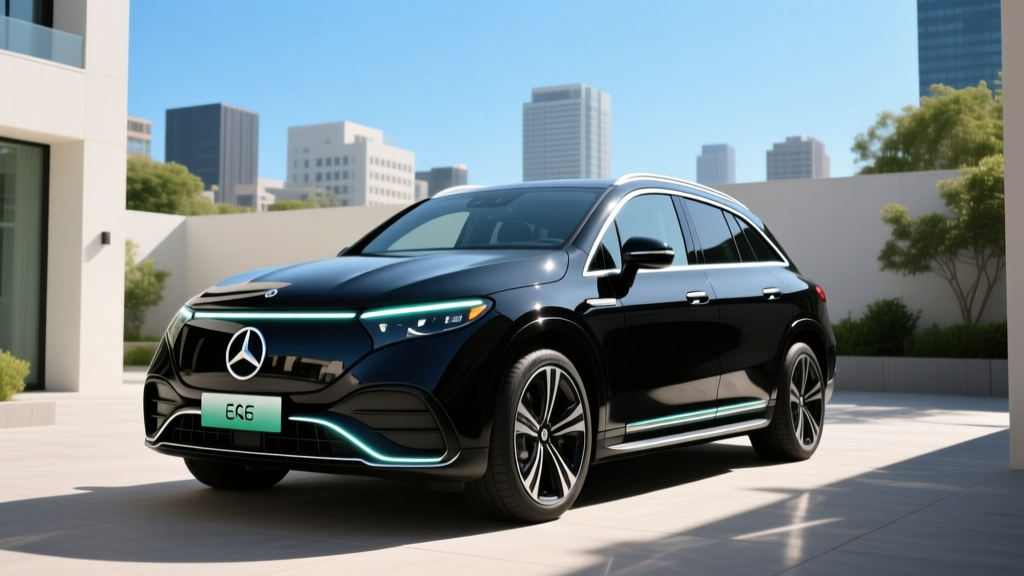
The Real Math Behind Mercedes-Benz EV Lease Deals in 2026
If you've been browsing Mercedes-Benz EV lease deals, you've likely seen eye-catching monthly payments on the EQE 350+ or EQS 450+. But a low lease payment only tells part of the story. Electric vehicle ownership involves a different cost structure than a gas-powered Mercedes — lower fuel and maintenance expenses, but often higher insurance premiums, steeper depreciation, and complex federal tax credit eligibility rules that can make or break the deal.
This guide dissects the true 5-year cost of leasing and owning a 2026 Mercedes-Benz EV, using the 2026 EQE 350+ Sedan (MSRP $74,900) and 2026 EQS 450+ Sedan (MSRP $104,400) as reference points. We'll cover the federal §30D tax credit (and why most Mercedes EVs don't qualify for the full amount), real-world charging costs versus premium gasoline, maintenance savings, insurance realities, and depreciation trends that matter if you plan to buy out your lease.
5-Year Total Cost of Ownership: Mercedes-Benz EV vs. Gas Equivalent
To evaluate whether a Mercedes-Benz EV lease deal makes financial sense, we need a complete 5-year cost picture. Below is a comparison between the 2026 EQE 350+ and a similarly priced gas-powered Mercedes E 350 (MSRP ~$62,000, 255 hp turbo I-4, EPA 24/33 mpg combined 27 mpg). Both are driven 12,000 miles/year.
| Cost Category | 2026 EQE 350+ (EV) | 2026 E 350 (Gas) | Notes |
|---|---|---|---|
| Purchase/Lease Cost | $74,900 (MSRP) | $62,000 (MSRP) | EV commands ~$12,900 premium at base |
| Fuel / Electricity | $3,240 | $8,880 | EV: $0.135/kWh home avg, 3.2 mi/kWh; Gas: $3.70/gal, 27 mpg combined |
| Maintenance | $1,800 | $4,500 | EV: cabin filter, tire rotation, brake fluid; Gas: oil, filters, brakes, spark plugs |
| Insurance (5-yr total) | $14,400 | $10,800 | EV premiums ~33% higher on average |
| Federal Tax Credit | -$0 to $3,750 | $0 | Most MB EVs face battery-sourcing restrictions in 2026 |
| Estimated Depreciation | $33,700 (45%) | $24,800 (40%) | EVs currently depreciate faster; lease absorbs this risk |
| Net 5-Year Cost | ~$58,640 | ~$61,380 | EV slightly cheaper net — but savings depend on credit eligibility |
The headline: over five years, the EQE 350+ can cost slightly less than its gas counterpart if you qualify for at least a partial tax credit and charge primarily at home. But the margin is thin — roughly $2,700 over 60 months — and it evaporates if you rely heavily on public DC fast charging at $0.40-$0.60/kWh or if your insurance quotes come in above average.
Federal Tax Credit Eligibility: Why Most Mercedes-Benz EVs Face Limits
The federal EV tax credit under IRS §30D offers up to $7,500 for qualifying new EVs. However, as of 2026, the credit is split into two halves — $3,750 for meeting critical-mineral sourcing requirements and $3,750 for battery-component sourcing — and most Mercedes-Benz EVs assembled in Bremen, Germany face restrictions on both halves due to supply-chain rules.
- MSRP Cap: Vans, SUVs, and pickup trucks ≤ $80,000; Sedans and other vehicles ≤ $55,000. The EQE Sedan ($74,900) exceeds the sedan cap. The EQS ($104,400+) exceeds all caps.
- Buyer Income Limits (AGI): $300,000 joint / $225,000 head of household / $150,000 single filer.
- Battery Component Sourcing: 100% of battery components must be manufactured or assembled in North America (2026 requirement) — $3,750 half.
- Critical Minerals: 80% of critical minerals must be sourced from the U.S. or FTA partners (2026 requirement) — $3,750 half.
- Final Assembly: Must occur in North America. Most Mercedes-Benz EQ models are assembled in Germany — disqualifying them entirely unless assembled at the Vance, Alabama plant (EQS SUV and EQE SUV only).
- Point-of-Sale Transfer: Eligible buyers can transfer the credit to the dealer at purchase, reducing the purchase price directly. For leases, the credit technically goes to the lessor (Mercedes-Benz Financial Services), who may pass it through as a capitalized-cost reduction — but this is at the lessor's discretion.
What this means for Mercedes-Benz EV lease deals: The EQE Sedan and EQS Sedan are assembled in Germany and exceed MSRP caps, making them ineligible for §30D. The EQE SUV and EQS SUV, assembled in Vance, Alabama, may qualify for partial or full credit depending on battery-sourcing compliance in the specific model year. Mercedes-Benz Financial Services has historically passed lease credits through to consumers as cap-cost reductions, effectively lowering monthly payments — but always confirm this in writing before signing.
Charging Costs vs. Premium Gasoline: The Per-Mile Reality
One of the strongest arguments for a Mercedes-Benz EV is the fuel-cost advantage — but the savings depend heavily on how and where you charge.
| Charging/Fueling Method | Rate | Cost Per Mile | Annual Cost (12,000 mi) |
|---|---|---|---|
| Home Level 2 (national avg electricity) | $0.135/kWh | $0.042/mi | $504 |
| Home with time-of-use (off-peak) | $0.08/kWh | $0.025/mi | $300 |
| Public Level 2 (ChargePoint, etc.) | $0.25/kWh | $0.078/mi | $936 |
| DC Fast Charging (Electrify America) | $0.48/kWh | $0.150/mi | $1,800 |
| E 350 Gas (premium, 27 mpg combined) | $3.70/gal | $0.137/mi | $1,644 |
The EQE 350+ achieves approximately 3.2 miles per kWh in mixed driving (EPA combined 89 MPGe). At the national average residential electricity rate of $0.135/kWh, that translates to roughly $0.042 per mile — a 69% savings versus premium gasoline in the E 350. Even at public DC fast-charging rates, the per-mile cost is only marginally higher than gas.
However, a critical nuance: the EQE's 90.6 kWh battery and 170 kW peak DC charging rate means a 10-80% session takes approximately 32 minutes at peak power. The charging curve tapers significantly above 80%, meaning that last 20% can take nearly as long as the first 60%. On road trips, plan for 35-40 minute stops to reach 80% and skip the taper zone.
Maintenance Savings: Where the EV Advantage Is Clear
Electric vehicles eliminate many routine maintenance items that add up over five years of Mercedes-Benz ownership. The EQE has no engine oil, no transmission fluid (the single-speed reducer uses sealed lubricant), no spark plugs, no timing chain, and no exhaust system. Regenerative braking significantly extends brake-pad life — many EV owners report original brake pads at 60,000+ miles.
| Service Item | EQE 350+ (EV) | E 350 (Gas) |
|---|---|---|
| Oil Changes | None | 5-10 changes × $150-$250 = $750-$2,500 |
| Brake Pads (front) | Likely not needed (regen) | $600-$900 replacement |
| Transmission Fluid | Sealed, no service | $300-$500 at 40k mi |
| Air/Cabin Filters | $100-$200 (cabin only) | $200-$400 (engine + cabin) |
| Coolant | Check at 5yr/60k | Flush at 40k: $200-$350 |
| Tire Rotation | $50-$80 × 5 = $250-$400 | $50-$80 × 5 = $250-$400 |
| Estimated 5-yr Total | $1,200-$1,800 | $3,500-$5,000 |
The maintenance gap is significant: roughly $2,000-$3,000 in savings over five years. One caveat — EV tires tend to wear 15-25% faster than on gas vehicles due to higher curb weight (the EQE 350+ weighs approximately 5,400 lbs) and instant torque. Budget for a tire replacement around 35,000-45,000 miles, with a set of four Mercedes-spec EV tires running $1,200-$1,800.
Insurance Costs: The Uncomfortable Truth
EV insurance premiums are consistently higher than equivalent gas vehicles, and luxury EVs like Mercedes-Benz models sit at the upper end. Industry data shows EV insurance costs 20-35% more than comparable ICE vehicles, driven by several factors:
- Higher repair costs: EV-specific components (battery packs, power electronics, high-voltage wiring) require specialized training and facilities. A minor collision that damages battery cooling lines can escalate repair bills significantly.
- Higher vehicle values: The EQE's $74,900 MSRP means higher comprehensive and collision coverage premiums than a $62,000 E 350.
- Limited repair network: Fewer body shops are certified for high-voltage Mercedes-Benz repairs, which can extend rental-car reimbursement periods and increase claim costs.
- Total-loss thresholds: Battery damage that exceeds 60-70% of vehicle value can trigger a total-loss declaration, even in moderate collisions.
For a 2026 EQE 350+, expect annual insurance premiums of $2,600-$3,200 depending on your driving record, ZIP code, and coverage levels — compared to $1,900-$2,400 for the E 350. That's an additional $500-$800 per year, or $2,500-$4,000 over five years, that partially offsets fuel and maintenance savings. Always get insurance quotes before signing a lease.
Depreciation and Resale Value: Why Leasing Makes Sense for Mercedes EVs
Depreciation is the single largest ownership cost for any vehicle, and luxury EVs have experienced steeper depreciation curves than their gas counterparts in recent years. Several factors drive this:
- Rapid technology advancement: Newer EVs with longer range and faster charging make 2-3 year-old models feel dated faster than gas cars.
- Tesla price wars: Aggressive Tesla pricing since 2023 reset consumer expectations for what an EV should cost, compressing resale values across the segment.
- Battery health uncertainty: Used-EV buyers discount for unknown long-term battery degradation, even though Mercedes-Benz warranties the EQ battery for 10 years/155,000 miles (whichever comes first) against falling below 70% capacity.
- Federal credit effect: When new buyers receive a $7,500 credit, the effective new price is lower, which pulls used values down correspondingly.
Industry data from sources like Kelley Blue Book and iSeeCars shows luxury EVs depreciating 40-55% over five years, compared to 35-45% for luxury gas sedans. The EQS, with its six-figure MSRP, has been among the steepest depreciators — some 2023 models have lost over 50% of value within two years.
This is precisely why leasing a Mercedes-Benz EV is often the smartest financial move. A lease transfers depreciation risk to Mercedes-Benz Financial Services. If the EQE depreciates more than the residual value predicts, that's the lessor's problem, not yours. Current 2026 Mercedes-Benz EV lease deals often feature residuals set at 50-55% for 36-month leases, which is relatively conservative — meaning your buyout option at lease-end may actually be above market value, giving you the flexibility to walk away.
Decision Framework: Should You Lease a Mercedes-Benz EV?
- You have reliable home Level 2 charging access (240V, 40-48A circuit)
- You drive 10,000-15,000 miles/year (within typical lease limits)
- You want to avoid depreciation risk on a rapidly evolving technology
- The lease deal includes a cap-cost reduction from the lessor passing through available tax credits
- You value the driving experience — instant torque, cabin quietness, one-pedal driving — enough to justify a modest cost premium
- You cannot charge at home and would rely on public DC fast charging exclusively
- You drive 20,000+ miles/year (lease overage penalties of $0.20-$0.30/mile add up fast)
- Federal tax credit eligibility is critical to your math, and the specific Mercedes model doesn't qualify
- You plan to keep the vehicle 8-10 years (depreciation eventually levels out, making purchase more economical long-term)
Frequently Asked Questions
How much does it really cost to own a Mercedes-Benz EV over 5 years?
Based on our analysis of the 2026 EQE 350+, the net 5-year cost is approximately $58,000-$62,000 including purchase price, electricity, insurance, maintenance, and depreciation, minus any applicable tax credits. This is roughly comparable to — or slightly less than — a gas E 350 over the same period, with savings concentrated in fuel and maintenance but offset by higher insurance and depreciation.
Do I qualify for the federal tax credit on a Mercedes-Benz EV?
It depends on the specific model and your income. The EQE Sedan and EQS Sedan are assembled in Germany and exceed MSRP caps, making them ineligible. The EQE SUV and EQS SUV (assembled in Alabama) may qualify for partial credit ($3,750-$7,500) if battery-sourcing requirements are met. Your adjusted gross income must be below $300,000 (joint), $225,000 (head of household), or $150,000 (single). Always verify eligibility on the IRS §30D page and confirm with a tax professional before relying on the credit.
How much do I save on fuel and maintenance with a Mercedes-Benz EV?
Charging at home at the national average electricity rate, the EQE 350+ costs approximately $500-$650/year in electricity versus $1,600-$1,800/year in premium gasoline for the E 350 — saving roughly $1,000-$1,200 annually. Maintenance savings add another $400-$600/year from eliminated oil changes, fewer brake replacements, and simpler drivetrain service. Combined, expect $1,500-$1,800 in annual operating savings.
Are Mercedes-Benz EVs more expensive to insure?
Yes. Expect insurance premiums 20-35% higher than a comparable gas Mercedes-Benz, primarily due to higher repair costs for battery and high-voltage components, elevated vehicle values, and a smaller network of certified repair facilities. For the EQE 350+, budget $2,600-$3,200/year depending on your profile. Get quotes from multiple insurers before committing.
How well do Mercedes-Benz EVs hold their value?
Luxury EVs, including Mercedes-Benz EQ models, currently depreciate faster than their gas counterparts — typically 40-55% over five years versus 35-45% for gas luxury sedans. This makes leasing the preferred acquisition strategy, as it transfers depreciation risk to the lessor. The EQS has seen particularly steep depreciation due to its high starting price and rapid EV market evolution.
What happens to the tax credit on a Mercedes-Benz EV lease?
Under §30D, when you lease (rather than purchase), the tax credit legally goes to the lessor — Mercedes-Benz Financial Services — because the vehicle is classified as a commercial purchase under §45W. Many lessors pass this through as a capitalized-cost reduction, effectively lowering your monthly payment. However, this is not guaranteed. Ask your dealer to confirm in writing whether the lease offer reflects any passed-through credit before signing.