Quick Answer: A Mercedes-Benz EV car in 2026 means choosing from the EQB compact SUV (~$53,000, EPA 250 mi), the EQE sedan (~$75,000, EPA 305 mi), the EQE SUV (~$78,000, EPA 279 mi), the flagship EQS sedan (~$105,000, EPA 390 mi), and the EQS SUV (~$106,000, EPA 330 mi). None currently qualify for the full $7,500 federal §30D tax credit due to battery-sourcing rules, though point-of-sale lease credits may apply. Expect real-world highway range 15–25% below EPA stickers and DC fast charging from 170 kW (EQB) to 200 kW (EQS). Home Level 2 charging is strongly recommended — public-only ownership adds $1,200–$2,000/year in extra charging costs versus fueling a comparable gas Mercedes.
The 2026 Mercedes-Benz EV Lineup at a Glance
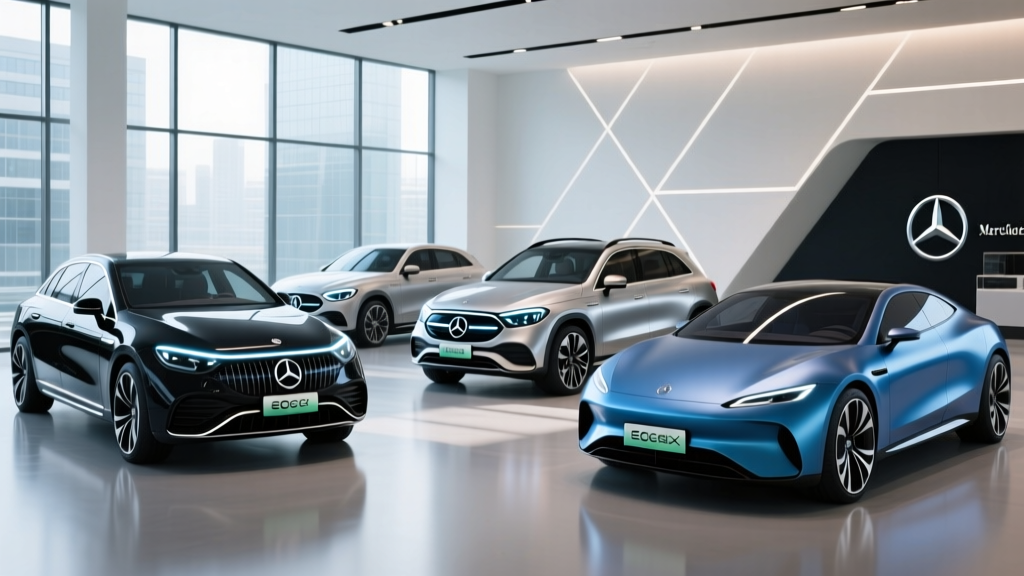
Mercedes-Benz has consolidated its electric portfolio around the EVA and EVA2 platforms. The entry-level EQA has been discontinued for the U.S. market, leaving the EQB as the most accessible Mercedes-Benz EV car available. Here is how the current lineup stacks up on paper:
| Model | Body | Battery (kWh usable) | Chemistry | EPA Range | Peak DC kW | 10–80% Time | 0–60 mph | Base MSRP |
|---|---|---|---|---|---|---|---|---|
| EQB 300 4MATIC | Compact SUV | 66.5 | NMC | 250 mi | 100 kW | ~32 min | 7.7 sec | $53,050 |
| EQE 350+ | Sedan | 90.6 | NMC | 305 mi | 170 kW | ~32 min | 5.5 sec | $74,900 |
| EQE 350 4MATIC SUV | Mid-size SUV | 90.6 | NMC | 279 mi | 170 kW | ~32 min | 6.4 sec | $77,900 |
| EQS 450+ | Flagship Sedan | 118.0 | NMC | 390 mi | 200 kW | ~31 min | 5.9 sec | $104,900 |
| EQS 450 4MATIC SUV | Flagship SUV | 118.0 | NMC | 330 mi | 200 kW | ~31 min | 5.7 sec | $105,900 |
All models use nickel-manganese-cobalt (NMC) lithium-ion cells. Mercedes has not adopted LFP chemistry for its U.S. lineup, prioritizing energy density for the luxury segment. Battery warranties cover 8 years or 100,000 miles, with a capacity-retention threshold of 70% — consistent with industry norms but worth tracking via the Mercedes me app's State of Health (SoH) readout.
Real-World Range: What the EPA Sticker Doesn't Tell You
EPA vs. Reality: The EQS 450+ sedan's 390-mile EPA rating is best-in-class for luxury sedans, but real-world highway driving at 75 mph typically yields 300–330 miles. In cold weather (below 30°F), expect a further 15–20% reduction, bringing usable range to roughly 250–280 miles. The EQB, with its smaller 66.5 kWh pack and boxier shape, realistically delivers 190–210 miles on the highway in mild weather and as low as 160 miles in winter conditions.
These numbers matter if your commute is long or you road-trip frequently. The EQE and EQS sedans benefit from Mercedes' heat pump (standard on 2025+ models), which recovers waste heat from the drivetrain to warm the cabin — reducing cold-weather range loss by roughly 8–10% compared to resistive heating. The EQB still relies on a PTC heater in most trims, which draws more from the battery in winter.
Preconditioning is critical for fast charging. If you navigate to a DC fast charger using the MBUX system, the car preheats the battery to the optimal temperature window (roughly 35–40°C), enabling the advertised peak charge rate. Without preconditioning — say, if you pull into a charger cold — peak power may be limited to 60–80 kW for the first 5–10 minutes until the pack warms up, adding real time to your stop.
Charging Speed and Infrastructure: What Owners Need
Mercedes-Benz EV cars use the CCS1 connector for DC fast charging as of the 2026 model year. While Mercedes has committed to NACS (Tesla's connector) for future models, current owners rely on CCS-compatible networks — Electrify America, EVgo, and ChargePoint — or use a CCS-to-NACS adapter for Tesla Supercharger access where supported.
| Charging Level | Power (kW) | EQE/EQS Miles Added per Hour | EQB Miles Added per Hour | Typical Use Case |
|---|---|---|---|---|
| Level 1 (120V) | 1.4 kW | ~4–5 mi/hr | ~3–4 mi/hr | Emergency / trickle |
| Level 2 (240V, 48A) | 11.5 kW | ~35–40 mi/hr | ~28–32 mi/hr | Home overnight |
| DC Fast (EQE/EQS) | 170–200 kW peak | ~180 mi in 15 min | N/A | Road trips |
| DC Fast (EQB) | 100 kW peak | N/A | ~90 mi in 15 min | Road trips |
The charge-curve reality: Peak kW is not sustained kW. The EQS 450+ hits 200 kW only between roughly 10–30% State of Charge (SoC), then tapers to ~120 kW by 50%, and drops below 50 kW past 80%. This is why manufacturers quote 10–80% times rather than 0–100%. Charging to 100% on DC fast charging can add 20–30 minutes beyond the 80% mark — plan accordingly on road trips and aim to charge in the 10–80% window for efficiency.
Cost Breakdown: Buying, Charging, and Owning a Mercedes-Benz EV
Luxury EV ownership involves more than the sticker price. Here is a 5-year total cost of ownership (TCO) comparison between the EQE 350+ sedan and a comparably priced gas-powered Mercedes E 350 (MSRP ~$62,000), assuming 12,000 miles/year, home Level 2 charging at $0.14/kWh, and premium gasoline at $3.80/gallon.
| Cost Category | EQE 350+ (EV) | E 350 (Gas) | 5-Year Difference |
|---|---|---|---|
| Purchase Price (MSRP) | $74,900 | $62,000 | +$12,900 (EV) |
| Federal Tax Credit (§30D) | $0 (sourcing rules) | $0 | — |
| Fuel/Energy (5 yrs) | $4,200 | $10,640 | −$6,440 (EV saves) |
| Maintenance (5 yrs) | $2,100 | $4,800 | −$2,700 (EV saves) |
| Insurance (5 yrs) | $12,500 | $9,500 | +$3,000 (EV costs more) |
| Estimated Depreciation | $33,700 (45%) | $24,800 (40%) | +$8,900 (EV loses more) |
| Total 5-Year Cost | $93,600 | $86,940 | +$6,660 (EV) |
The EV saves substantially on fuel and maintenance — no oil changes, fewer brake replacements thanks to regenerative braking, and lower per-mile energy cost. However, the higher purchase price, steeper depreciation (luxury EVs lose value faster than gas counterparts, per current market data), and higher insurance premiums (typically 15–25% more for luxury EVs) offset those savings over five years. At year seven or eight, the math begins to shift in the EV's favor, especially if gas prices rise.
Home charging installation is an additional upfront cost. A Level 2 home charger (e.g., ChargePoint Home Flex or Emporia Vue) costs $500–$800 for the unit, plus $800–$2,500 for professional electrical installation (240V/60A circuit). If your home's electrical panel needs an upgrade from 100A to 200A service, add $1,500–$3,000. Total home charging setup: $1,300–$6,300 depending on your panel and wiring distance.
Federal Tax Credit: Why Most Mercedes-Benz EVs Miss the $7,500
Under the current IRS §30D rules, a new clean vehicle must meet three stringent tests to qualify for the full $7,500 credit: final assembly in North America, critical-mineral sourcing thresholds, and battery-component manufacturing thresholds. As of 2026, no Mercedes-Benz EV car sold in the U.S. meets the battery-sourcing requirements — the cells are predominantly sourced from CATL and other suppliers that trigger the foreign entity of concern (FEOC) restrictions.
§30D Credit Requirements (2026):
- ✅ Final assembly in North America — Some EQS models assembled in Alabama; others imported from Germany
- ❌ Critical minerals ≥80% from U.S. or FTA partners — Most Mercedes packs fall short
- ❌ Battery components ≥100% free of FEOC sourcing — Current cells do not qualify
- ✅ MSRP under $55,000 (sedans) or $80,000 (SUVs) — EQB qualifies on price; EQE/EQS exceed caps
- ✅ Buyer income under $150K single / $300K joint — Varies by buyer
Lease loophole: If you lease rather than buy, the §45W commercial clean vehicle credit may allow the leasing company to pass through a $7,500 reduction to your monthly payment — regardless of sourcing rules or income caps. This is the most reliable way to capture a federal incentive on a Mercedes-Benz EV car today. Confirm with your dealer whether the lease incentive is being applied as a capitalized-cost reduction.
Mercedes-Benz EV vs. Gas and Hybrid: Who Should Buy What?
| Factor | Mercedes EQE 350+ (EV) | Mercedes E 350 (Gas) | Mercedes GLE 350e (PHEV) |
|---|---|---|---|
| EPA Range / MPGe | 305 mi / 95 MPGe | 24 MPG combined | 48 mi EV + 56 MPGe |
| Annual Fuel Cost (12K mi) | ~$840 | ~$2,130 | ~$1,100 (mixed) |
| Home Charging Needed? | Strongly recommended | No | Recommended for EV mode |
| Performance (0–60) | 5.5 sec | 6.1 sec | 6.5 sec |
| Maintenance Burden | Low | Moderate | Moderate–High (two systems) |
| Cold-Weather Penalty | 15–25% range loss | Minimal | Reduced EV range |
| Best For | Home chargers, daily commuters | Road-trippers, no home charging | Short commutes + long trips |
The PHEV GLE 350e is a compelling middle ground if you cannot install a home charger or frequently drive in regions with sparse DC fast-charging infrastructure. Its 48-mile electric-only range covers most daily errands, and the gas engine eliminates range anxiety on longer drives. However, you carry the maintenance burden of both an internal combustion engine and an electric drivetrain.
Common Misconceptions About Mercedes-Benz EVs
| Myth | Fact |
|---|---|
| "The EQS gets 390 miles in real driving." | EPA 390 mi is a lab test. Expect 300–330 mi highway, less in cold weather or with aggressive driving. Source: fueleconomy.gov |
| "I don't need a home charger — public stations are everywhere." | Public DC charging costs $0.30–$0.50/kWh vs. $0.10–$0.16/kWh at home. Exclusive public charging adds $1,200–$2,000/year vs. home charging and can be unreliable in charging deserts. |
| "EV batteries need replacing every few years." | Mercedes warranties the pack for 8 years/100,000 miles at ≥70% capacity. Industry data shows NMC packs typically lose 10–15% capacity over 150,000 miles with proper care (avoiding frequent 100% charges and DC fast charging in extreme cold). |
| "All Mercedes EVs qualify for the $7,500 tax credit." | None currently qualify for purchase credits due to battery-sourcing rules. Lease credits via §45W may apply. |
| "Fast charging always hits the advertised kW." | Peak rates apply only in a narrow SoC window (typically 10–30%). Average charging power across a 10–80% session is 60–70% of the peak. Preconditioning via navigation is essential. |
Decision Framework: Which Mercedes-Benz EV Car Is Right for You?
Choose the EQB if: You want the most affordable entry into a Mercedes-Benz EV car, need a compact SUV with optional third-row seating, and your daily driving is under 150 miles. Budget: ~$53K–$62K. Accept the slower 100 kW DC charging and ~200-mile real-world highway range.
Choose the EQE 350+ if: You want a mid-size luxury sedan with genuine 280+ mile real-world range, strong 170 kW charging, and daily-commute comfort. Budget: ~$75K–$90K. Best for home-charger owners who road-trip 2–4 times per year.
Choose the EQS 450+ if: You want flagship luxury with the longest range in the lineup (~330 mi real-world highway), the fastest charging (200 kW peak), and cutting-edge tech (Hyperscreen, rear-axle steering). Budget: ~$105K–$130K. Best for high-mileage luxury buyers who want to minimize charging stops.
Choose the GLE 350e PHEV instead if: You lack home charging access, live in a region with extreme winters or charging deserts, or need one vehicle for both daily electric commuting and long gasoline road trips without compromise.
Skip the Mercedes EV lineup and consider a Tesla, BMW iX, or Hyundai Ioniq 5 if: Federal tax credit eligibility is a priority (several competitors qualify), you want NACS-native Supercharger access without an adapter, or your budget is under $50K.
Frequently Asked Questions
What is the cheapest Mercedes-Benz EV car available in 2026?
The EQB 300 4MATIC starts at $53,050 MSRP. It is a compact SUV with 250 miles of EPA range, a 66.5 kWh NMC battery, and 100 kW peak DC fast charging. It is the only Mercedes EV that falls under the §30D MSRP cap for SUVs ($80,000), though battery-sourcing rules still prevent credit eligibility on purchases.
Can I charge a Mercedes-Benz EV at a Tesla Supercharger?
Current Mercedes-Benz EV cars use CCS1 connectors. Tesla Superchargers use NACS. You can use a CCS-to-NACS adapter (available from Mercedes and third-party suppliers for ~$200–$250) at Supercharger stations that have been opened to non-Tesla vehicles via the "Open Supercharging" program. Check the Tesla app for station compatibility before relying on this for a road trip.
How long does a Mercedes-Benz EV battery last?
Mercedes warranties the high-voltage battery for 8 years or 100,000 miles, guaranteeing at least 70% of original capacity. Based on NMC chemistry degradation data from similar platforms, expect roughly 10–15% capacity loss at 150,000 miles under normal use. Replacement cost for an EQS pack is estimated at $20,000–$30,000 out of warranty, though few owners have needed this.
Is a Mercedes-Benz EV car good in cold weather?
Expect 15–25% range reduction in sub-freezing temperatures. The EQE and EQS (2025+ models) include a heat pump that mitigates cabin-heating energy draw, but battery chemistry itself slows in the cold, reducing both range and charge speed. Always precondition the battery before DC fast charging in cold weather, and plan for 20–30% longer charging stops in winter.
Should I buy or lease a Mercedes-Benz EV?
Leasing is currently the financially superior path for most buyers. Through the §45W commercial clean vehicle credit, the leasing company may pass through $7,500 as a capitalized-cost reduction, sidestepping the battery-sourcing and income restrictions that disqualify purchases. Leasing also shields you from the steeper depreciation luxury EVs currently experience. Confirm the incentive is applied before signing.
How does Mercedes-Benz EV insurance compare to gas models?
Insurance premiums for Mercedes-Benz EV cars run 15–25% higher than comparable gas models, driven by higher repair costs (specialized high-voltage components, aluminum body panels, and sensor recalibration after collisions). Expect annual premiums of $2,200–$3,000 for an EQE, depending on your driving record, location, and coverage level. Shop quotes from EV-friendly insurers like Geico, Progressive, and Tesla Insurance before purchasing.
Sources: EPA range and efficiency data via fueleconomy.gov; Mercedes-Benz USA official specifications via mbusa.com; federal tax credit rules via irs.gov. Pricing and credit eligibility reflect 2026 model-year information and are subject to change. Consult a tax professional for personal credit eligibility.