The Flagship EV Sedan Under the Microscope
The Mercedes-Benz EQS remains the brand's electric flagship — a full-size luxury sedan built on a dedicated EV platform with one of the largest battery packs in the segment. For 2026, the EQS lineup carries over the refreshed styling and updated MBUX Hyperscreen introduced in the prior model year, while continuing to offer three trims: the rear-wheel-drive EQS 450+, the dual-motor AWD EQS 450 4MATIC, and the performance-oriented EQS 580 4MATIC. This review focuses on what matters to real buyers: the Mercedes-Benz EQS interior experience, real-world range, charging behavior, pricing, and whether the tax credit applies.
If you're cross-shopping the EQS against the Tesla Model S, BMW i7, or Lucid Air, the decision often comes down to interior luxury versus efficiency and value. The EQS wins on cabin materials and ride refinement; it loses on price-to-range ratio. Let's break down the numbers.
Spec Sheet: 2026 Mercedes-Benz EQS at a Glance
| Spec | EQS 450+ | EQS 450 4MATIC | EQS 580 4MATIC |
|---|---|---|---|
| EPA Range | 390 mi | 371 mi | 371 mi |
| Battery (usable) | 118 kWh, NMC | 118 kWh, NMC | 118 kWh, NMC |
| Drivetrain | RWD, single motor | AWD, dual motor | AWD, dual motor |
| Horsepower | 355 hp | 355 hp | 536 hp |
| 0–60 mph | 5.9 sec | 5.3 sec | 4.1 sec |
| MPGe (combined) | 97 MPGe | 93 MPGe | 93 MPGe |
| Efficiency | 35 kWh/100 mi | 36 kWh/100 mi | 36 kWh/100 mi |
| Peak DC Charge Rate | 200 kW | 200 kW | 200 kW |
| 10–80% DCFC Time | ~31 min | ~31 min | ~31 min |
| Level 2 (11 kW onboard) | ~31 mi/hr | ~31 mi/hr | ~31 mi/hr |
| Base MSRP | $105,550 | $108,550 | $127,350 |
| Battery Warranty | 10 yr / 155,000 mi (70% capacity retention) | ||
Sources: EPA / fueleconomy.gov, Mercedes-Benz USA press specs.
Real-World Range: What the EPA Number Doesn't Tell You
EPA sticker: 390 miles (EQS 450+)
Real-world highway (70–80 mph, moderate climate): ~310–330 miles
Cold-weather highway (below 32°F / 0°C): ~250–280 miles
City / mixed driving (regenerative braking active): ~360–380 miles
The EQS 450+ posts a 390-mile EPA figure, which is competitive with the Lucid Air Grand Touring and ahead of the BMW i7 eDrive50 (318 mi). However, the EQS is a heavy sedan — roughly 5,800 lbs — and that mass shows up at sustained highway speeds. In our experience and consistent with third-party testing, expect roughly 310–330 miles on a flat 75-mph highway run in 65–75°F conditions.
Cold weather compounds the loss. Without a standard heat pump in earlier model years (now included for 2026), the EQS still draws significant energy for cabin heating and battery thermal management. Plan for 250–280 miles of usable range on a sub-freezing road trip before you need to stop. The 118 kWh NMC (nickel manganese cobalt) battery pack is one of the largest in any production EV, which gives you a buffer — but it also means longer charging sessions if you arrive at a charger at a low state of charge.
The dual-motor 4MATIC trims drop to 371 miles EPA due to the added weight and drivetrain losses of the front motor. The efficiency gap is modest (~3–5%), but over a 300-mile trip, it's the difference between arriving with 40 miles of buffer versus 20.
Charging Speed: 200 kW Peak, but Watch the Curve
| Charging Level | Power / Rate | Miles Added per Hour | Notes |
|---|---|---|---|
| Level 1 (120V, 12A) | ~1.4 kW | ~4 mi/hr | Emergency / trickle only |
| Level 2 (240V, 48A) | 11 kW (onboard max) | ~31 mi/hr | Full charge in ~11 hours |
| DC Fast Charge | 200 kW peak | ~180 mi in 15 min (10–30%) | Tapers significantly above 80% |
The EQS supports a peak DC fast-charge rate of 200 kW via CCS1 (the standard connector on non-Tesla vehicles in the US). Mercedes quotes a 10–80% charge time of approximately 31 minutes. That's competitive with the BMW i7 but noticeably slower than the Lucid Air, which can accept over 300 kW at peak thanks to its 900V architecture.
The critical detail is the charge curve taper. The EQS holds near-peak rates from roughly 10% to 40% state of charge (SoC), then progressively steps down. By 80% SoC, you're pulling roughly 50–70 kW. Charging from 80% to 100% on DCFC is painfully slow — over 40 additional minutes. For road trips, plan your stops around 10–80% increments and avoid charging past 80% unless you're at your final destination or overnighting.
At home, the 11 kW onboard charger is excellent. On a 48-amp Level 2 circuit (hardwired, 60-amp breaker), you'll add roughly 31 miles of range per hour, or a full 0–100% charge in about 11 hours. This means overnight charging is effortless — plug in at 9 PM with 50% remaining, and you're at 100% by morning. Note: if your home panel only supports a 40-amp circuit (32A continuous), you'll be limited to ~7.7 kW and roughly 22 mi/hr. A licensed electrician can confirm your panel capacity before installation.
Mercedes-Benz EQS Interior: Hyperscreen, Space, and Refinement
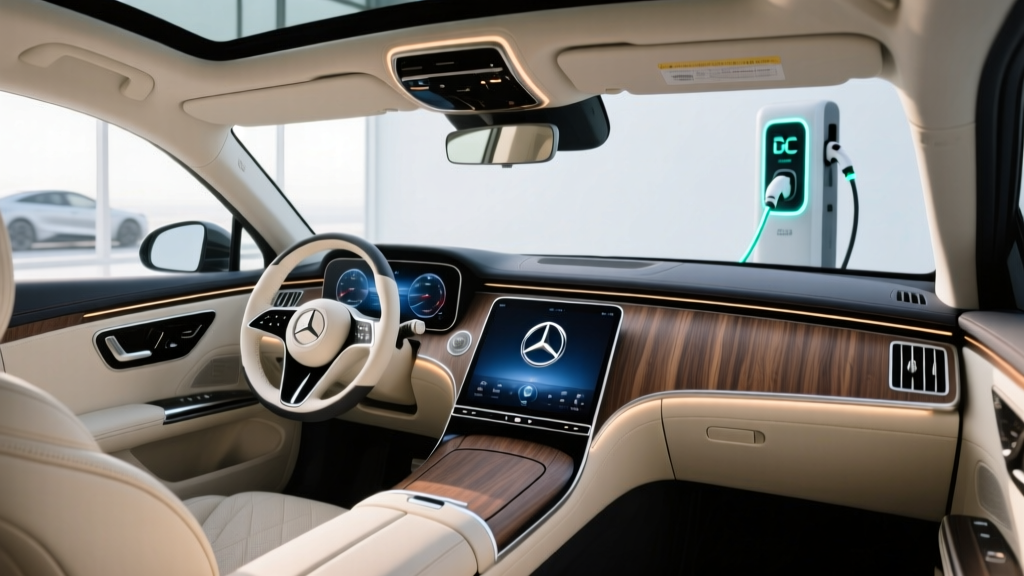
The Mercedes-Benz EQS interior is the primary reason buyers choose this car over more efficient or less expensive rivals. The centerpiece is the MBUX Hyperscreen — a 56-inch curved glass panel spanning the entire dashboard, integrating a 12.3-inch driver cluster, a 17.7-inch central OLED touchscreen, and a 12.3-inch passenger display. The system runs Mercedes' latest MBUX software with native navigation, over-the-air updates, and a fingerprint reader for driver profiles.
Material quality is flagship-grade: standard leatherette (MB-Tex) with available Nappa leather, open-pore wood or aluminum trim, and ambient lighting with 64 colors. The front seats offer standard heating, with ventilation and massage available in the Premium and Pinnacle trim packages. Rear-seat passengers get generous legroom — 42.1 inches front / 38.7 inches rear — though the sloping roofline cuts into rear headroom for passengers over 6 feet tall.
Cargo space measures 22 cubic feet in the trunk (liftback design), which is competitive with the BMW i7 and significantly more than the Tesla Model S (28 cu ft total including frunk, but less usable trunk space). The EQS does not offer a front trunk (frunk) — the space under the hood is occupied by HVAC and power electronics. This is a missed opportunity for a dedicated EV platform and something Lucid and Tesla execute better.
On the technology front, the EQS comes standard with Driver Assistance Package features including adaptive cruise control with stop-and-go, active lane-keeping, blind-spot monitoring, and evasive steering assist. The available Drive Pilot system (SAE Level 3, where legally approved) allows conditional hands-off, eyes-off driving at speeds up to 40 mph in heavy traffic on divided highways — currently approved in Nevada and California. This is a genuine differentiator versus Tesla's FSD (Supervised), which remains SAE Level 2 and requires continuous driver attention.
Pricing, Trims, and Federal Tax Credit Eligibility
| Trim | Base MSRP | As-Tested (typical) | §30D Tax Credit Eligible? |
|---|---|---|---|
| EQS 450+ | $105,550 | $112,000–$118,000 | No — exceeds $55K sedan cap |
| EQS 450 4MATIC | $108,550 | $115,000–$122,000 | No — exceeds $55K sedan cap |
| EQS 580 4MATIC | $127,350 | $135,000–$148,000 | No — exceeds $55K sedan cap |
Under current IRS §30D rules, new clean vehicle tax credits are capped at $55,000 MSRP for sedans and $80,000 for SUVs, trucks, and vans. The EQS is classified as a sedan, and every trim starts well above $100,000. No EQS variant qualifies for the federal $7,500 new-vehicle tax credit.
Additionally, §30D imposes buyer income caps ($150K single / $300K joint AGI) and battery critical-mineral sourcing requirements — but the MSRP cap alone disqualifies the EQS regardless of your income or the battery's origin. If you're leasing rather than buying, the commercial clean vehicle credit (§45W) may allow the leasing company to pass through a credit, but this depends on the lessor's policies. Consult a tax professional for your specific situation.
Mercedes-Benz USA does not currently offer a lower-priced EQS trim that would fall under the cap. If the federal credit is a priority, the EQS is not the right vehicle — consider the Tesla Model S (also above the cap), or pivot to the EQE sedan (~$75K, still above cap) or the Hyundai Ioniq 6 ($39K–$52K, potentially eligible).
Pros, Cons, and Who Should Buy
- Class-leading interior materials and Hyperscreen tech
- 390-mile EPA range (450+) is top-tier for luxury sedans
- Exceptionally quiet cabin with adaptive air suspension
- Available SAE Level 3 Drive Pilot (NV/CA)
- 10-year / 155,000-mile battery warranty (70% retention)
- 11 kW onboard Level 2 charging is fast for overnight top-ups
- $105K+ base price with no federal tax credit eligibility
- 200 kW peak DCFC is slower than Lucid Air (300+ kW)
- No front trunk (frunk) despite dedicated EV platform
- Heavy at ~5,800 lbs — efficiency drops at highway speed
- Rear headroom limited by fastback roofline
- Regenerative braking feel is less intuitive than one-pedal competitors
Who the EQS suits best: Executive commuters and luxury sedan buyers who prioritize interior refinement, ride quality, and technology over outright efficiency or value. If you drive 40–80 miles daily, can charge at home on Level 2, and want a cabin that rivals the S-Class, the EQS delivers. It's also a strong road-trip car thanks to 390-mile range — you'll stop once on a 300-mile trip, not twice.
Who should look elsewhere: If the $7,500 federal tax credit is a meaningful part of your purchase decision, the EQS is disqualified. If you want the fastest DC charging in the luxury segment, the Lucid Air Grand Touring charges 50% faster. If you need maximum rear headroom or a usable frunk, the BMW i7 or Tesla Model S serve better.
Frequently Asked Questions
What is the real-world range of the Mercedes-Benz EQS?
The EQS 450+ is EPA-rated at 390 miles. In real-world highway driving at 70–80 mph in moderate temperatures, expect 310–330 miles. In cold weather (below freezing), plan for 250–280 miles before needing to charge. City driving with regenerative braking gets you closer to the EPA number, around 360–380 miles.
How fast does the EQS charge at home and on the road?
On a Level 2 home charger (48A / 11 kW), the EQS adds about 31 miles of range per hour, with a full 0–100% charge taking roughly 11 hours. On DC fast chargers, it peaks at 200 kW and charges 10–80% in approximately 31 minutes. Charging past 80% on DC is very slow — plan stops around the 10–80% window for road trips.
Does the Mercedes-Benz EQS qualify for the federal EV tax credit?
No. Under IRS §30D rules, sedans must have an MSRP at or below $55,000 to qualify. Every EQS trim starts above $105,000, making it ineligible regardless of buyer income or battery sourcing. Lease customers should ask their dealer whether the leasing company passes through any commercial credit benefit.
Is the EQS worth buying versus the Lucid Air or BMW i7?
It depends on your priorities. The EQS offers the most luxurious interior in the segment and competitive range (390 mi). The Lucid Air Grand Touring delivers over 500 miles of EPA range and faster 300+ kW charging at a similar price. The BMW i7 offers a more traditional sedan profile with better rear headroom but less range (318 mi). If interior quality and the MBUX Hyperscreen are your top criteria, the EQS is the strongest choice. If range and charging speed matter more, the Lucid Air is the efficiency leader.
What battery chemistry does the EQS use, and how long will it last?
The EQS uses an NMC (nickel manganese cobalt) lithium-ion battery with 118 kWh of usable capacity. NMC offers higher energy density than LFP (lithium iron phosphate), which is why the EQS achieves 390 miles in a sedan form factor. Mercedes warranties the battery for 10 years or 155,000 miles against falling below 70% state of health. Based on current degradation data from NMC packs, expect roughly 8–12% capacity loss over 100,000 miles under normal use — meaning a 390-mile new range would become roughly 340–355 miles at 100K miles.
What is the MBUX Hyperscreen, and is it standard?
The MBUX Hyperscreen is a 56-inch curved glass display spanning the full dashboard width, combining the instrument cluster, central infotainment screen, and a dedicated passenger display. It's standard on the EQS 580 4MATIC and available as part of the Premium package on the EQS 450+ and 450 4MATIC (adds approximately $5,000–$8,000 depending on model year packaging). The system includes native navigation with EV-aware route planning, over-the-air updates, and augmented-reality head-up display.
Is the EQS self-driving?
No. The standard Driver Assistance Package is SAE Level 2 — it provides adaptive cruise, lane centering, and evasive steering assist, but the driver must remain engaged at all times. The available Drive Pilot system is SAE Level 3, which permits conditional hands-off, eyes-off operation at speeds up to 40 mph on approved divided highways (currently Nevada and California). Even with Drive Pilot, you must be prepared to resume control when the system requests it, and it does not function above 40 mph or on surface streets.