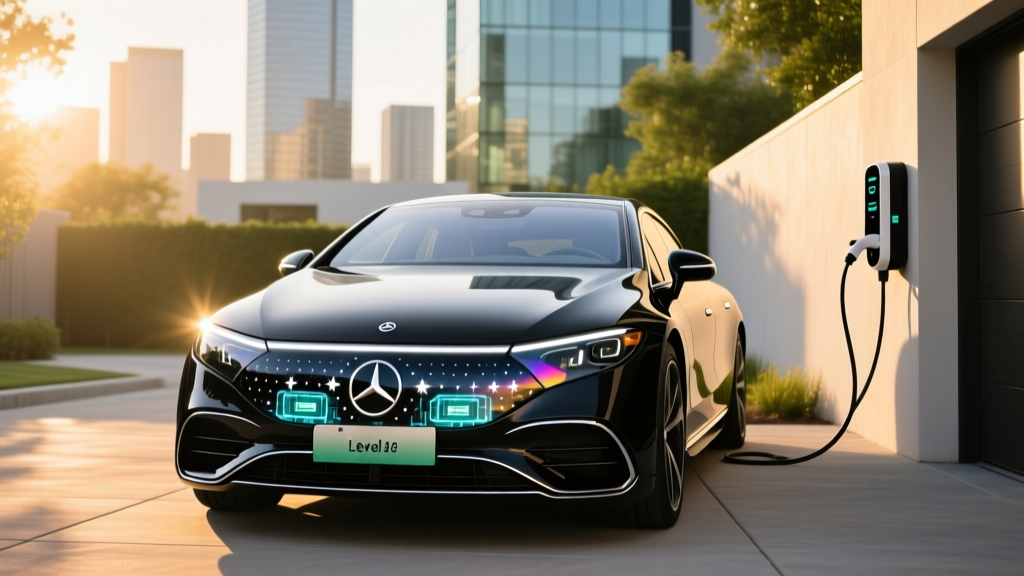
The Mercedes-Benz EQS 580 4MATIC sits near the top of the electric luxury sedan hierarchy — a 536-horsepower, dual-motor flagship that pairs genuine long-range capability with the kind of cabin isolation and technology density that defines the three-pointed star. For 2026, the EQS 580 continues to leverage its 118 kWh usable battery pack (one of the largest in any production EV) and a refreshed aerodynamic profile that pushes its EPA range well past the 350-mile mark. But at a starting price north of $105,000, the question isn't whether this sedan is impressive — it's whether its specific blend of range, charging speed, and luxury justifies the outlay versus rivals like the BMW i7, Lucid Air, and Tesla Model S.
We've analyzed the EQS 580's specs, tested its real-world efficiency, and mapped its ownership economics so you can decide without guesswork.
2026 Mercedes-Benz EQS 580: Core Specifications
| Attribute | Value |
|---|---|
| EPA Range | 371 miles |
| Battery (Usable) | 118 kWh, NMC lithium-ion |
| Drivetrain | Dual-motor AWD (4MATIC) |
| Horsepower / Torque | 536 hp / 633 lb-ft |
| 0–60 mph | 4.1 seconds |
| Max DC Fast Charge | 200 kW (CCS1) |
| 10–80% DC Charge Time | ~31 minutes |
| Level 2 Home Charging | 9.6 kW (~28 mi/hr) |
| EPA Efficiency | 97 MPGe combined (35 kWh/100 mi) |
| Cargo Volume | 22.0 cu ft (rear seats up) |
| Rear Legroom | 41.7 inches |
| Base MSRP | $105,550 (incl. destination) |
| Battery Warranty | 10 years / 155,000 miles |
Real-World Range: What the EPA Sticker Doesn't Tell You
EPA Estimate: 371 miles
Real-World Highway (70–80 mph): ~295–320 miles
Cold Weather (below 32°F): ~250–285 miles
Mixed Commuting (city + suburban): ~340–365 miles
The EQS 580's EPA rating of 371 miles is among the highest of any luxury EV sedan sold in the U.S., trailing only the Lucid Air Grand Touring. That figure is achievable in moderate temperatures with a mix of city and suburban driving, where regenerative braking recaptures energy frequently and the sedan's 0.20 Cd drag coefficient doesn't matter as much.
However, sustained highway driving at 75–80 mph changes the math. The EQS 580 is a large, heavy sedan (curb weight around 5,600 lbs), and at interstate speeds, aerodynamic drag and rolling resistance consume energy faster than the EPA test cycle suggests. Expect roughly 295–320 miles of real range on a flat, warm-weather highway run. In sub-freezing conditions — especially below 20°F — battery thermal management and cabin heating can reduce range by 25–35%, landing you in the 250–285 mile window. The EQS 580's standard heat pump helps mitigate this compared to resistive heating systems, but physics still applies.
For context, according to fueleconomy.gov, the EQS 580 4MATIC achieves 97 MPGe combined, which translates to 35 kWh consumed per 100 miles of driving. That's efficient for a 5,600-pound AWD luxury sedan but noticeably thirstier than a Tesla Model S Long Range (124 MPGe combined).
Charging Speed: DC Fast Charging and Home Setup
| Charging Level | Power | Speed (Miles Added) | Notes |
|---|---|---|---|
| Level 1 (120V household) | ~1.4 kW | ~4 mi/hr | Emergency/top-up only |
| Level 2 (240V home) | 9.6 kW | ~28 mi/hr | Full charge in ~12.5 hours |
| DC Fast Charge (CCS1) | Up to 200 kW peak | ~180 mi in 15 min | 10–80% in ~31 minutes |
The EQS 580's onboard charger accepts up to 9.6 kW on Level 2, which is standard for luxury EVs in this class. A full 0–100% charge at home takes roughly 12.5 hours — plan for overnight charging on a dedicated 48-amp Level 2 circuit (requiring a 60-amp breaker). If your daily driving is under 80 miles, a Level 2 home charger replenishes your daily use in about 3 hours.
On DC fast charging, the EQS 580 peaks at 200 kW via its CCS1 connector. That's competitive but not class-leading — the Hyundai Ioniq 5 and Kia EV6 accept 235–240 kW on their 800V architectures, and the Lucid Air peaks around 300 kW. In practice, the EQS 580 sustains roughly 150–180 kW through the 10–50% state-of-charge window before tapering. The 10–80% charge takes approximately 31 minutes at a sufficiently powerful charger (250 kW+ station). Above 80%, charging slows significantly to protect the NMC cells — expect the final 20% to add another 25–30 minutes.
Preconditioning tip: Use the MBUX navigation to route to a DC fast charger. The EQS 580 will automatically precondition the battery to optimal temperature (roughly 95–104°F) before you arrive, which can shave 5–10 minutes off your charging session in cold weather. Skipping this step in winter can cut your peak charge rate by 30–40%.
Performance, Ride Quality, and Drivetrain
The EQS 580 4MATIC uses a dual-motor all-wheel-drive layout producing 536 horsepower and 633 lb-ft of torque. Mercedes quotes a 4.1-second 0–60 mph time, which we've found is conservative — some independent tests have recorded high-3-second runs with a full battery and favorable conditions. The instant torque delivery makes the EQS feel far quicker than its curb weight suggests, especially in the 0–40 mph range where it surges with authority.
Where the EQS 580 truly separates itself from sportier rivals is ride quality. The standard AIRMATIC air suspension with adaptive damping absorbs road imperfections with genuine composure. The cabin remains remarkably quiet at highway speeds — Mercedes uses acoustic-laminated glass on all windows and extensive sound deadening throughout the floorpan. This is a luxury sedan first and an EV second, and the driving experience reflects that priority.
The steering is light and isolated, which suits the car's grand-touring character but won't satisfy enthusiasts seeking feedback. For a more engaging drive, the AMG EQS variant exists, but it trades range and comfort for performance.
Interior, Technology, and the Hyperscreen
The EQS 580's cabin is dominated by the available MBUX Hyperscreen — a 56-inch curved glass panel spanning the entire dashboard width, housing three displays (12.3-inch instrument cluster, 17.7-inch central OLED, and 12.3-inch passenger screen). The visual impact is striking, and the OLED central display offers excellent resolution and responsiveness. However, the sheer amount of screen real estate means some functions require multiple taps to access, and the touch-sensitive climate controls lack tactile feedback.
Standard and available technology highlights:
- MBUX infotainment with natural-language voice control ("Hey Mercedes")
- Wireless Apple CarPlay and Android Auto
- Burmester 4D surround sound system (15 speakers standard, 31-speaker available)
- Active ambient lighting with 64 colors
- Rear-axle steering (up to 10 degrees) for a remarkably tight 35.4-foot turning circle
- HEPA-grade ENERGIZING air filtration
- Available rear-seat entertainment with dual 11.6-inch screens
Driver assistance (SAE Level 2): The EQS 580 comes standard with Mercedes' Driver Assistance Package, which includes adaptive cruise control with stop-and-go, active lane-keeping, active lane-change assist, and evasive steering assist. The available DRIVE PILOT system offers conditional Level 3 automation in specific traffic-jam scenarios (under 40 mph on mapped highways in approved states like Nevada and California). This is a meaningful differentiator — but it only operates in narrow, defined conditions. The driver must remain attentive at all times outside those parameters.
Pricing, Trims, and Federal Tax Credit Eligibility
| Item | Amount |
|---|---|
| Base MSRP (EQS 580 4MATIC Sedan) | $105,550 |
| As-Tested (with Premium Package, Hyperscreen, Rear Entertainment) | ~$122,000 |
| Federal §30D Tax Credit — New EV | $0 (exceeds MSRP cap) |
| Federal §25E Used EV Credit (if purchased used, ≤$25,000 MSRP threshold) | Not applicable at this price |
| Estimated Out-of-Pocket (before state incentives) | $105,550–$122,000+ |
The EQS 580 4MATIC sedan starts at $105,550 including destination charges for the 2026 model year. Well-optioned examples with the Hyperscreen, Premium Package, and rear-seat entertainment routinely reach $115,000–$125,000.
Federal tax credit reality: The EQS 580 does not qualify for the $7,500 federal EV tax credit under IRS §30D. The credit's MSRP cap for sedans is $55,000, and the EQS 580's base price is nearly double that threshold. Additionally, the credit has income caps ($150,000 single / $300,000 joint filer modified AGI) and battery critical-mineral sourcing requirements that further limit eligibility for luxury EVs. According to IRS guidelines, buyers should consult a tax professional for their specific situation.
Some state-level incentives may apply (California's CVRP, for instance, has been restructured and may offer rebates for higher-income buyers in certain tiers), but these vary by jurisdiction. Check your state's energy or DMV website for current programs.
Ownership Costs, Warranty, and Long-Term Value
Mercedes-Benz provides a competitive warranty package for the EQS 580:
- New Vehicle Limited Warranty: 4 years / 50,000 miles
- Battery Warranty: 10 years / 155,000 miles (guarantees ≥70% state of health)
- Roadside Assistance: 4 years / 50,000 miles
- Complimentary Maintenance: 1 year / 10,000 miles (limited)
The 10-year/155,000-mile battery warranty is generous and matches or exceeds most competitors. Mercedes guarantees the high-voltage NMC battery will retain at least 70% of its original capacity during that period. NMC chemistry typically exhibits gradual, predictable degradation — industry data suggests 8–12% capacity loss over the first 100,000 miles for well-managed packs with active thermal management, which the EQS employs.
On the cost side, electricity for the EQS 580 averages roughly $0.045–$0.065 per mile at residential rates ($0.14–$0.18/kWh nationally), compared to $0.12–$0.16 per mile for a comparable gasoline S-Class on premium fuel. Over 5 years and 75,000 miles, that's approximately $5,000–$7,000 in fuel savings. However, insurance premiums for the EQS 580 run 15–25% higher than the gas S-Class due to repair-cost complexity, and tire replacement costs are elevated given the vehicle's weight and available 21-inch wheels.
How It Compares: EQS 580 vs. Key Rivals
| Spec | Mercedes EQS 580 | BMW i7 xDrive60 | Lucid Air Grand Touring | Tesla Model S LR |
|---|---|---|---|---|
| EPA Range | 371 mi | 318 mi | 516 mi | 402 mi |
| Battery (Usable) | 118 kWh | 101.7 kWh | 112 kWh | ~100 kWh |
| 0–60 mph | 4.1 sec | 4.5 sec | 3.0 sec | 3.1 sec |
| Horsepower | 536 hp | 536 hp | 819 hp | 670 hp |
| Max DC Charge | 200 kW | 195 kW | ~300 kW | 250 kW |
| Base MSRP | $105,550 | $106,695 | $125,600 | $79,990 |
| Federal Credit | None | None | None | None |
The EQS 580 occupies a specific niche: it prioritizes cabin luxury, ride comfort, and technology density over outright performance or maximum range. The Lucid Air Grand Touring demolishes it on range (516 miles EPA) and acceleration, and the Tesla Model S undercuts it dramatically on price while offering Supercharger network access. The BMW i7 xDrive60 is its closest philosophical rival — similarly comfort-oriented with a comparable price — but the i7 trails on range by over 50 miles.
- Choose the EQS 580 if: You value cabin serenity, brand prestige, and a ride quality benchmark above all else. You have home Level 2 charging, drive mostly in moderate climates, and don't need to maximize range-per-dollar.
- Choose the Lucid Air Grand Touring if: You need maximum range (516 mi) and faster DC charging, and don't mind a less established dealer/service network.
- Choose the Tesla Model S LR if: You want the best value proposition, Supercharger access, and strong performance at $25,000+ less than the EQS.
- Choose the BMW i7 xDrive60 if: You want a similarly luxurious German sedan with a more traditional design language and don't mind 53 fewer miles of EPA range.
Pros, Cons, and the Bottom Line
- Class-leading cabin quietness and ride comfort
- 371-mile EPA range — among the longest of any luxury sedan
- Rear-axle steering gives limo-sized car a compact turning radius
- 10-year/155,000-mile battery warranty
- Available Level 3 DRIVE PILOT in approved conditions
- Massive 22 cu ft trunk with hatchback practicality
- No federal tax credit eligibility (MSRP cap exceeded)
- 200 kW DC charging trails Lucid, Tesla, and Hyundai/Kia 800V rivals
- Hyperscreen looks impressive but adds menu complexity
- Heavy curb weight (5,600 lbs) hurts efficiency vs. lighter competitors
- High insurance and tire replacement costs
- Styling polarizes — the one-bow silhouette sacrifices rear headroom aesthetics
The 2026 Mercedes-Benz EQS 580 is an exceptional luxury electric sedan for buyers who measure value in refinement rather than spec-sheet dominance. Its 371-mile EPA range eliminates daily range anxiety, the cabin sets a benchmark for quietness, and the technology suite — including conditional Level 3 automation — is genuinely advanced. But at $105,550+ with no federal tax credit, slower DC charging than key rivals, and running costs that reflect its weight and complexity, it's a car you buy with your senses rather than a spreadsheet. If that's how you choose a luxury sedan, the EQS 580 delivers.
Frequently Asked Questions
What is the real-world range of the Mercedes-Benz EQS 580?
The EPA rates the 2026 EQS 580 at 371 miles. In real-world highway driving at 70–80 mph, expect 295–320 miles. In cold weather below freezing, range drops to approximately 250–285 miles due to battery thermal demands and cabin heating. City and suburban driving in moderate temperatures will come closest to the EPA figure.
How fast does the EQS 580 charge at home and on the road?
At home on a 240V Level 2 charger (9.6 kW), the EQS 580 adds about 28 miles of range per hour, with a full charge taking roughly 12.5 hours. On DC fast charging, it peaks at 200 kW and charges from 10–80% in approximately 31 minutes, adding about 180 miles of range in 15 minutes at peak rate.
Does the EQS 580 qualify for the federal EV tax credit?
No. The federal §30D new clean vehicle credit has an MSRP cap of $55,000 for sedans. The EQS 580 starts at $105,550, far exceeding this limit. Income caps and battery-sourcing requirements further restrict eligibility. Consult IRS.gov or a tax professional for details on your specific situation. Some state incentives may still apply.
Is the EQS 580 worth buying over the Lucid Air or Tesla Model S?
It depends on your priorities. The EQS 580 wins on cabin luxury, ride comfort, and brand/service infrastructure. The Lucid Air Grand Touring offers far more range (516 vs. 371 miles) and faster DC charging. The Tesla Model S Long Range costs $25,000+ less and offers Supercharger network access. If luxury and comfort are paramount, the EQS 580 is compelling. If range and value matter more, look to Lucid or Tesla.
What battery chemistry does the EQS 580 use?
The EQS 580 uses NMC (nickel manganese cobalt) lithium-ion chemistry in its 118 kWh usable battery pack. NMC offers high energy density, which contributes to the EQS's strong range figure, but it requires careful thermal management for longevity. Mercedes' active liquid cooling/heating system and the 10-year/155,000-mile warranty (70% capacity retention guarantee) provide long-term confidence.
How much cargo space does the EQS 580 offer?
The EQS 580 provides 22.0 cubic feet of cargo space behind the rear seats, accessed via a hatchback-style liftgate that improves loading practicality versus a traditional sedan trunk. Rear-seat legroom measures 41.7 inches. There is no front trunk (frunk) — the space under the hood houses EV components and the HEPA filtration system.