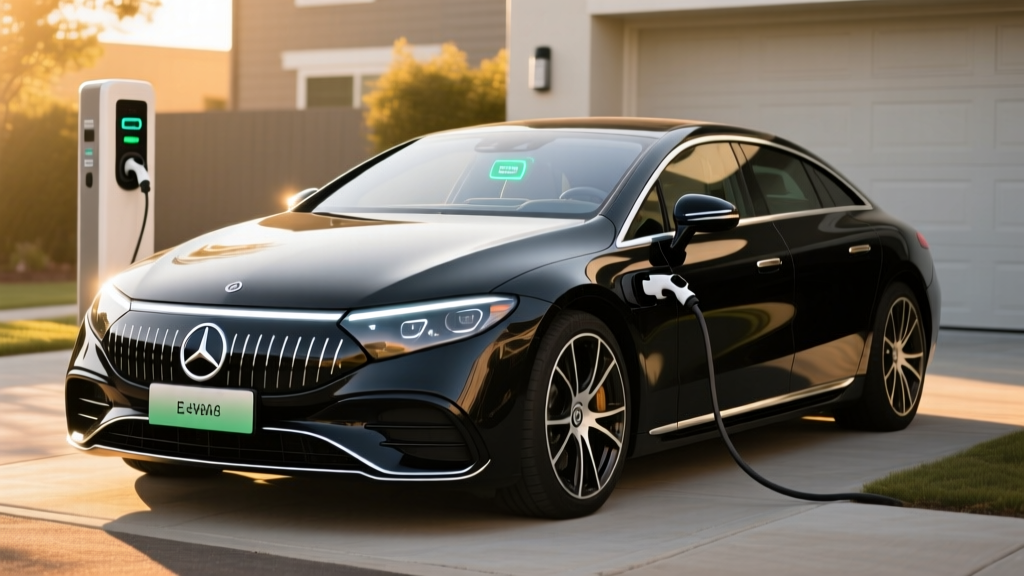
The Mercedes-Benz EQS 580 4MATIC occupies a peculiar space in the luxury EV sedan segment: it delivers flagship comfort, cutting-edge hyperscreen tech, and genuine long-range capability — yet it faces stiff competition from the Tesla Model S, Lucid Air, and BMW i7. For 2026, the EQS 580 4MATIC carries forward with its 118 kWh (usable) NMC battery pack, dual-motor all-wheel drive, and a starting price that pushes well into six figures. This review breaks down every spec that matters to a real buyer — from sustained DC fast-charging curves to cold-weather range loss — so you can decide whether Mercedes' electric S-Class earns a spot in your garage.
Quick Verdict: Who the EQS 580 4MATIC Is For
The EQS 580 4MATIC is best suited for luxury-sedan buyers who prioritize ride comfort, cabin silence, and technology density over outright performance or value. It excels as a daily commuter and long-distance cruiser, particularly for owners who can charge at home and don't regularly need more than 300 miles of real-world highway range. It is not the sportiest EV in its class, nor the most efficient per dollar, but it remains one of the most refined.
Choose the EQS 580 4MATIC if: You want a serene, tech-forward luxury sedan with excellent ride quality, strong DC charging speeds, and a proven 8-year battery warranty.
Look elsewhere if: You need maximum range (Lucid Air Grand Touring), sport-sedan dynamics (Porsche Taycan, Tesla Model S Plaid), or a lower entry price (BMW i5, Mercedes EQE).
Range, Battery & Efficiency
The 2026 EQS 580 4MATIC uses a lithium-ion NMC (nickel manganese cobalt) battery pack with a gross capacity of approximately 120 kWh and a usable capacity of 118 kWh. This is one of the largest passenger-EV batteries on the market, and it underpins the sedan's strong range figures.
| Spec | Value |
|---|---|
| EPA Estimated Range | 371 miles |
| Battery (Usable) | 118 kWh, NMC chemistry |
| Efficiency (EPA Combined) | 97 MPGe / 35 kWh/100 mi |
| Drivetrain | Dual-motor AWD (4MATIC) |
| Horsepower | 536 hp (439 lb-ft torque) |
| 0–60 mph | 4.1 seconds |
| Battery Warranty | 10 years / 155,000 miles (70% SoH) |
| Base MSRP | ~$127,350 (incl. destination) |
EPA Range vs. Real World: The EPA rates the EQS 580 4MATIC at 371 miles. In mixed real-world driving — highway speeds of 70–75 mph, moderate climate control use — expect approximately 310–340 miles. In cold weather (below 32°F), range can drop to 260–290 miles due to battery resistance and cabin heating demands. City driving with regenerative braking can push results closer to or slightly above the EPA figure. The EQS includes a heat pump as standard, which mitigates cold-weather losses compared to resistive-heater EVs.
Efficiency at 97 MPGe combined (roughly 35 kWh per 100 miles) is respectable for a 5,800-pound luxury sedan, though the lighter Lucid Air Grand Touring achieves significantly higher MPGe thanks to its smaller, lighter battery and superior aerodynamics. For context, the EPA's fueleconomy.gov listing confirms these figures for the current model year.
Charging Speed: DC Fast, Level 2 & Charge Curve Reality
Charging is where the EQS 580 4MATIC's large battery becomes both an asset and a consideration. A bigger battery means more range, but it also means longer charge sessions if the charge rate doesn't scale proportionally.
| Charging Level | Power / Rate | Time / Range Added |
|---|---|---|
| DC Fast Charge (peak) | 200 kW (CCS/NACS adapter) | 10–80% in ~31 minutes |
| DC Sustained (10–60%) | ~170–200 kW average | ~200 miles in 15 min |
| Level 2 (Home / Public AC) | 9.6 kW (40A) / 11.5 kW (48A) | ~28–34 miles per hour |
| Level 1 (120V Household) | 1.4 kW | ~4 miles per hour |
The EQS 580 4MATIC peaks at 200 kW on a DC fast charger. In practice, the charge curve is strong through 60% state of charge (SoC), then tapers progressively. The 10–80% session takes approximately 31 minutes at a capable 350 kW station (the car will only draw what it can accept). This is competitive with the BMW i7 but slower than the Hyundai Ioniq 5's 800V architecture, which can do 10–80% in roughly 18 minutes at 240 kW.
For home charging, the onboard charger supports up to 11.5 kW on a 48-amp Level 2 circuit. That means a full 0–100% charge takes about 11 hours — practical for overnight top-ups. Most owners will rarely charge from zero; a typical 200-mile daily replenishment takes roughly 6 hours at 11.5 kW. A dedicated 60-amp circuit with a hardwired Level 2 station (such as a ChargePoint Home Flex or Tesla Wall Connector with J1772 adapter) is recommended for the best home experience.
Connector note: The 2026 EQS uses the CCS1 connector natively. Mercedes-Benz has committed to NACS adoption, and a factory NACS port or OEM adapter is available for Tesla Supercharger access. Confirm your specific vehicle's connector at purchase.
Performance, Ride & Driving Dynamics
The dual-motor 4MATIC powertrain produces 536 horsepower and 439 lb-ft of torque, launching the EQS 580 to 60 mph in 4.1 seconds. That's quick by any sedan standard, though the Tesla Model S Dual Motor matches it and the Model S Plaid obliterates it. The EQS isn't tuned for track work — it's tuned for isolation.
The standard AIRMATIC air suspension delivers an exceptionally compliant ride, absorbing road imperfections with a composure that justifies the "S-Class" lineage. Rear-axle steering (standard on the 580, up to 10 degrees) dramatically improves low-speed maneuverability — the turning circle shrinks to a compact-car-like 35.4 feet, a remarkable feat for a 208-inch sedan.
Regenerative braking offers multiple modes, including a true one-pedal driving option (D Auto) that uses navigation and sensor data to modulate regen intelligently. The system is among the smoothest in the industry, rarely producing the abrupt deceleration that plagues lesser implementations.
Interior, Cargo & Technology
The cabin is where the EQS makes its strongest case. The available MBUX Hyperscreen spans 56 inches across the dashboard, combining a 12.3-inch instrument cluster, a 17.7-inch central OLED touchscreen, and a 12.3-inch passenger display under a single glass panel. It's visually stunning, though some users find the capacitive-touch climate controls less intuitive than physical buttons.
| Dimension | Measurement |
|---|---|
| Front Legroom | 41.7 inches |
| Rear Legroom | 42.0 inches |
| Cargo Volume (Trunk) | 22.0 cu ft |
| Cargo (Rear Seats Folded) | 63.0 cu ft |
| Frunk | None |
Rear-seat space is generous — this is a chauffeur-grade sedan — and the trunk is deep and practical at 22 cubic feet. However, there is no front trunk (frunk), which is a missed opportunity for additional storage.
On the driver-assistance front, the EQS includes Mercedes' Driver Assistance Package as standard: adaptive cruise with stop-and-go, active lane-keeping, evasive steering assist, and automated lane changes. This is an SAE Level 2 system — the driver must remain attentive and keep hands near the wheel. It is not autonomous driving. Mercedes has also been developing its Drive Pilot system (SAE Level 3, conditional automation in specific traffic-jam scenarios), but availability in the US remains limited to certain states and conditions. Check current Mercedes press releases for Drive Pilot expansion.
ADAS Limitation Notice: The EQS driver-assistance features are SAE Level 2. You must remain engaged, monitor the road, and be prepared to take over immediately. No current consumer Mercedes-Benz system permits hands-off, eyes-off driving in general conditions.
Pricing, Trims & Federal Tax Credit Eligibility
The 2026 EQS 580 4MATIC starts at approximately $127,350 including destination. A well-equipped example with the AMG Line package, Hyperscreen, and Executive Rear Seat Package can reach $145,000–$155,000. The EQS 450+ (single-motor RWD) starts lower, around $105,550, for buyers who don't need AWD or the 536-hp output.
| Trim | Base MSRP | Federal §30D Credit | Effective Price |
|---|---|---|---|
| EQS 450+ (RWD) | ~$105,550 | Not eligible (MSRP cap exceeded) | ~$105,550 |
| EQS 580 4MATIC | ~$127,350 | Not eligible (MSRP cap exceeded) | ~$127,350 |
| EQS 580 SUV 4MATIC | ~$110,000 | Potentially eligible (SUV MSRP cap: $80,000 — exceeded) | ~$110,000 |
Tax credit reality check: Under IRS §30D rules, the federal EV tax credit has an MSRP cap of $55,000 for sedans and $80,000 for SUVs/trucks/vans. The EQS 580 4MATIC sedan, at ~$127,350, does not qualify for the federal purchase credit. Additionally, buyer income caps apply ($300,000 joint / $150,000 individual AGI), and battery critical-mineral and component sourcing requirements must be met. Always verify current eligibility on IRS.gov and consult a tax professional before making a purchase decision based on credit assumptions.
Some states offer their own EV incentives that may apply regardless of MSRP — check your state's energy or DMV website for current programs.
Warranty & Long-Term Ownership
Mercedes-Benz provides a competitive warranty package for the EQS lineup:
- New Vehicle Limited Warranty: 4 years / 50,000 miles
- High-Voltage Battery Warranty: 10 years / 155,000 miles (guarantees minimum 70% state of health)
- Powertrain (e-motors, reduction gear): Covered under battery warranty period
- Corrosion Protection: 4 years / 50,000 miles (perforation)
The 10-year/155,000-mile battery warranty is strong and aligns with or exceeds most competitors. Mercedes guarantees the pack will retain at least 70% of its original usable capacity during the warranty period. If degradation exceeds that threshold, Mercedes will repair or replace modules to restore capacity. Full battery-pack replacement costs out of warranty are estimated in the $25,000–$35,000 range based on industry data for packs of this size, though this is a worst-case scenario that rarely materializes within normal ownership timelines.
EQS 580 4MATIC vs. Key Competitors
| Spec | Mercedes EQS 580 4MATIC | Tesla Model S Dual Motor | Lucid Air Grand Touring | BMW i7 xDrive50 |
|---|---|---|---|---|
| EPA Range | 371 mi | 402 mi | 516 mi | 318 mi |
| Battery (usable) | 118 kWh (NMC) | ~100 kWh | 112 kWh | 101.7 kWh (NMC) |
| DC Fast Charge (peak) | 200 kW | 250 kW | ~220 kW | 195 kW |
| 10–80% Time | ~31 min | ~27 min | ~30 min | ~34 min |
| 0–60 mph | 4.1 sec | 3.1 sec | 3.0 sec | 4.5 sec |
| Horsepower | 536 hp | 670 hp | 819 hp | 536 hp |
| Base MSRP | ~$127,350 | ~$79,990 | ~$125,600 | ~$124,200 |
| Federal Credit | No (MSRP cap) | Yes (potential) | No (MSRP cap) | No (MSRP cap) |
The EQS 580 4MATIC trades outright range and acceleration for cabin refinement, ride quality, and Mercedes' dealer/service network. The Lucid Air Grand Touring dominates on range. The Tesla Model S wins on performance, charging speed, and price. The BMW i7 is the closest rival in character, offering similarly plush dynamics at a comparable price point.
Pros
- Exceptional ride comfort and cabin isolation
- Class-leading rear-seat legroom (42.0 in)
- Strong 371-mi EPA range with real-world usability
- Competitive 200 kW DC fast charging
- 10-year/155,000-mile battery warranty
- Rear-axle steering for tight maneuverability
- Hyperscreen is visually impressive and feature-rich
Cons
- High MSRP eliminates federal tax credit eligibility
- No front trunk (frunk)
- Heavy at ~5,800 lbs — affects tire wear and efficiency
- Capacitive-touch controls can frustrate
- Outpaced by rivals in 0–60 and MPGe
- Depreciation steeper than ICE S-Class historically
FAQ: Mercedes-Benz EQS 580 4MATIC
What is the real-world range of the EQS 580 4MATIC?
Expect 310–340 miles in mixed highway/city driving at moderate temperatures. In cold weather (below freezing), plan for 260–290 miles. City-heavy driving with regen can approach or exceed the 371-mile EPA figure.
How fast does it charge at home and on the road?
On a DC fast charger, it peaks at 200 kW and goes from 10–80% in about 31 minutes. At home on a 48-amp Level 2 station (11.5 kW), you'll add roughly 32 miles of range per hour, or a full charge in about 11 hours.
Does the EQS 580 4MATIC qualify for the federal EV tax credit?
No. Under current IRS §30D rules, sedans with an MSRP above $55,000 are ineligible. The EQS 580 4MATIC starts at approximately $127,350, well above the cap. State-level incentives may still apply — check your local programs.
Is the EQS 580 worth it vs. the Lucid Air or Tesla Model S?
If your priorities are cabin luxury, ride isolation, and Mercedes brand ownership, yes. If maximum range (Lucid) or performance-per-dollar (Tesla) matter more, those rivals are stronger choices. Test-drive all three before deciding.
How long will the battery last?
Mercedes warranties the high-voltage battery for 10 years or 155,000 miles at a minimum 70% state of health. Based on NMC degradation curves and industry data, most owners will see 10–15% capacity loss over the first 100,000 miles under normal use patterns.
Does it have self-driving capability?
No. The EQS includes SAE Level 2 driver-assistance features (adaptive cruise, lane-keeping, automated lane changes). The driver must remain attentive. Mercedes' Level 3 Drive Pilot system, which allows conditional hands-off driving in specific traffic-jam scenarios, has limited US availability — check current Mercedes announcements for expansion details.