The Verdict: A Luxury Cruiser With Class-Leading Range
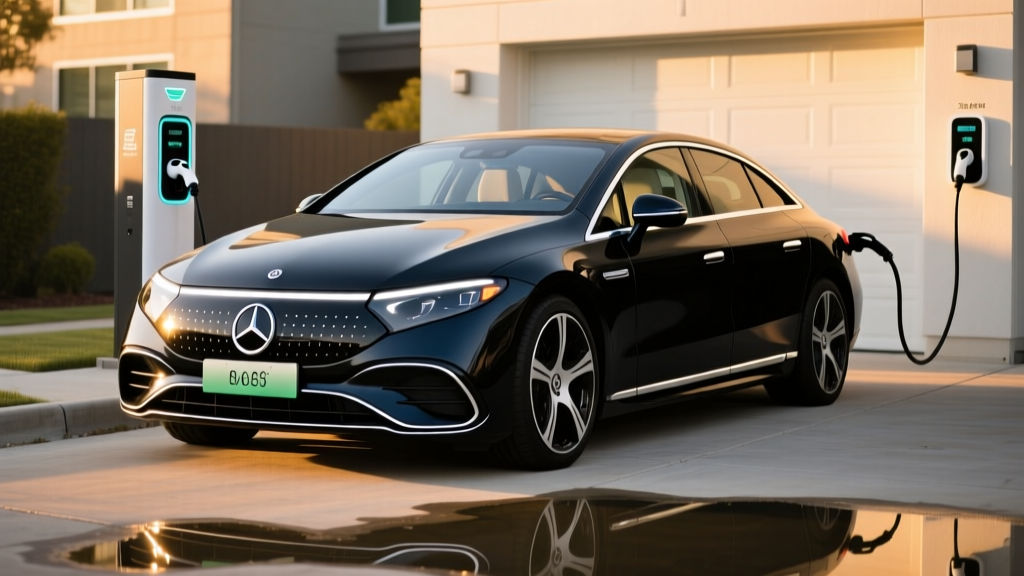
The 2026 Mercedes-Benz EQS 450+ sedan occupies a rare position in the electric luxury segment: it prioritizes efficiency and distance over brute acceleration. With an EPA-estimated 390 miles of range from a 118 kWh (usable) battery pack, the rear-wheel-drive EQS 450+ outdistances nearly every luxury EV sedan on the market — including the Tesla Model S Long Range (402 mi EPA) and the BMW i7 eDrive50 (318 mi EPA). But the EQS story is more nuanced than a single range figure. This is a car built for long-distance comfort, whisper-quiet highway cruising, and an interior experience that justifies its six-figure asking price. It is not, however, the quickest sedan in its class, and its tax-credit situation demands careful attention.
Below, we break down every number that matters — from real-world range expectations and DC fast-charging curves to total cost of ownership and the specific §30D tax-credit hurdles that affect this model.
Range, Battery, and Efficiency: The Numbers That Matter
The EQS 450+ uses a 120 kWh gross / 118 kWh usable lithium-ion battery pack with NMC (nickel manganese cobalt) chemistry. Mercedes has not transitioned the EQS to LFP (lithium iron phosphate) — a chemistry found in some lower-cost EVs — because the energy density of NMC remains essential for packaging 118 usable kWh beneath a sedan floorpan while preserving interior space.
EPA Estimated: 390 miles
Real-World Highway (70 mph, mild weather): ~320–345 miles
Real-World City/Mixed: ~350–375 miles
Cold Weather (below 32°F, highway): ~265–300 miles
The EQS 450+ achieves its strong EPA number partly through an exceptionally low drag coefficient (Cd 0.20). Highway speeds erode range in all EVs, and cold weather compounds this by 15–30% due to cabin heating demands and reduced battery chemistry efficiency. The standard heat pump mitigates some cold-weather loss, but buyers in northern climates should plan for ~280 miles of usable winter highway range.
Efficiency on the combined EPA cycle rates at 97 MPGe, translating to roughly 35 kWh per 100 miles driven. That figure is remarkable for a 5,600-pound luxury sedan and reflects both the aerodynamic optimization and Mercedes' silicon-carbide inverter technology, which reduces energy loss during power conversion.
| Spec | Value |
|---|---|
| EPA Range | 390 miles |
| Battery (Usable / Gross) | 118 kWh / 120 kWh, NMC |
| Efficiency | 97 MPGe combined (35 kWh/100 mi) |
| Drivetrain | Rear-wheel drive (single motor) |
| Horsepower / Torque | 355 hp / 419 lb-ft |
| 0–60 mph | 5.9 seconds |
| Max DC Fast Charge | 200 kW (CCS1) |
| 10–80% DC Charge Time | ~31 minutes |
| Level 2 Home Charge Rate | 9.6 kW (~28 mi/hr) |
| Base MSRP | $105,550 (incl. destination) |
| Battery Warranty | 8 years / 100,000 miles |
Charging Speed: DC Fast Charging and Home Setup
The EQS 450+ charges via CCS1 connector on DC fast-charging infrastructure. Its peak charge rate is 200 kW — competitive with the BMW i7 but below the Lucid Air's 300+ kW capability. The charging curve matters more than the peak number: the EQS sustains roughly 170–195 kW between 10% and 50% state of charge, then tapers progressively. From 50–80%, expect rates closer to 100–130 kW. This taper is standard for NMC packs protecting long-term battery health, but it means the back half of a charging session takes noticeably longer.
| Level | Power | Speed (approx.) | Use Case |
|---|---|---|---|
| Level 1 (120V) | 1.4 kW | ~4 mi/hr | Emergency / overnight trickle |
| Level 2 (240V, 40A) | 9.6 kW | ~28 mi/hr | Home / workplace daily charging |
| DC Fast (CCS1) | Up to 200 kW | 10–80% in ~31 min | Road trips, public fast chargers |
For home charging, the onboard 9.6 kW AC charger replenishes the 118 kWh pack from empty in roughly 12.5 hours. Most owners will arrive home with 30–50% remaining and wake to a full battery. A 48-amp Level 2 home charger (requiring a 60-amp dedicated circuit) is the practical minimum for daily ownership of a battery this large. Installation typically costs $800–$2,500 depending on panel proximity and local permitting — budget for a potential panel upgrade if your home has a 100-amp service.
One practical note: the EQS uses CCS1, not NACS (Tesla's connector). As of 2026, Mercedes-Benz has not yet transitioned new vehicles to NACS in North America. Adapters for Tesla Superchargers exist but add a step. Plan your road-trip charging around Electrify America, EVgo, and ChargePoint DC fast-charging networks for the most seamless experience.
Performance and Driving Dynamics
The EQS 450+ sends 355 horsepower and 419 lb-ft of torque to the rear wheels via a single permanently excited synchronous motor. The 0–60 mph time of 5.9 seconds is adequate for highway merging and confident passing, but it trails the dual-motor EQS 450 4MATIC (5.3 sec) and significantly trails performance-oriented competitors like the Tesla Model S Plaid (1.99 sec) or even the Porsche Taycan 4S (3.8 sec).
This is by design. The 450+ trim prioritizes efficiency — that single-motor RWD layout is what enables the 390-mile EPA figure. The instant torque delivery of an electric motor means real-world acceleration feels brisker than the 5.9-second number suggests, particularly in the 0–40 mph urban range where the EQS surges forward effortlessly.
Ride quality is where the EQS truly distinguishes itself. Standard AIRMATIC air suspension with adaptive damping absorbs highway imperfections with a plushness that few EVs match. Rear-axle steering (standard, up to 10 degrees) shrinks the car's 17.4-foot length in parking lots and tightens its turning circle to a manageable 35.4 feet. Cabin noise levels at 70 mph are among the lowest measured in any production vehicle — a combination of acoustic glass, foam-filled tires, and the absence of an internal combustion engine.
Interior, Cargo, and Technology
The EQS cabin centers on the available MBUX Hyperscreen — a 56-inch curved glass panel spanning the full dashboard width, housing three displays (12.3-inch instrument cluster, 17.7-inch central OLED, 12.3-inch passenger screen). It is visually stunning, though some drivers find the reliance on touch controls for climate and seat functions distracting while driving. Physical shortcut buttons exist for key functions, which helps.
Passenger space is generous. Rear legroom measures 42.0 inches — limousine territory — aided by the EV-dedicated EVA2 platform's flat floor. Front headroom is 40.4 inches. The cabin seats five comfortably, though the center rear position is best for shorter trips due to the contour of the seatback.
Cargo volume behind the rear seats is 22.0 cubic feet — competitive with the BMW 7 Series and significantly larger than the Porsche Taycan's rear trunk (though the Taycan adds a front trunk). The EQS lacks a frunk; the space beneath the hood houses HVAC and power-electronics components. A power liftgate is standard, and the rear seats fold 40/20/40 for longer items.
Driver assistance falls under Mercedes' Driver Assistance Package, which includes adaptive cruise control with stop-and-go, active lane-keeping, automated lane changes, and route-based speed adaptation. This is an SAE Level 2 system — the driver must remain fully engaged, hands on or near the wheel, and eyes on the road. Mercedes also offers DRIVE PILOT (SAE Level 3) in select markets for low-speed highway traffic jams up to 40 mph, but availability in the U.S. remains limited to specific approved highway segments in Nevada and California as of 2026.
Pricing, Trims, and Federal Tax Credit Eligibility
The 2026 EQS 450+ starts at $105,550 including destination charge. Key trim and option tiers include:
| Trim / Configuration | MSRP | §30D Federal Credit |
|---|---|---|
| EQS 450+ Sedan (RWD) | $105,550 | $0 — exceeds MSRP cap |
| EQS 450 4MATIC Sedan (AWD) | $108,550 | $0 — exceeds MSRP cap |
| EQS 580 4MATIC Sedan | $127,350 | $0 — exceeds MSRP cap |
| EQS SUV 450+ (for reference) | $105,550 | $0 — exceeds MSRP cap |
Critical tax-credit note: The EQS sedan does not qualify for the IRS §30D Clean Vehicle Credit. Under current federal rules, sedans must have an MSRP at or below $55,000 to be eligible. The EQS sedan, starting at $105,550, far exceeds this cap. (SUVs and trucks face a higher $80,000 cap, but the EQS sedan is classified as a car, not an SUV.) Additionally, buyer income limits apply ($150,000 single / $300,000 joint for modified AGI), and battery critical-mineral and component sourcing requirements must be met. Always verify current eligibility at IRS.gov or with a qualified tax professional before making purchase decisions based on incentive assumptions.
Options that push as-tested pricing well beyond $120,000 include the MBUX Hyperscreen ($8,950), the Executive Rear Seat Package with reclining and massage ($4,500+), and the AMG Line exterior package. A well-equipped EQS 450+ typically lands between $115,000 and $130,000 before any state-level incentives.
Warranty and Long-Term Battery Outlook
Mercedes-Benz covers the EQS high-voltage battery for 8 years or 100,000 miles, whichever comes first, against defects and capacity loss below 70% of original capacity. The basic vehicle warranty runs 4 years / 50,000 miles, and roadside assistance is included for 4 years with unlimited mileage.
NMC battery degradation in the EQS platform has been modest based on early fleet data. Most owners report 2–5% capacity loss over the first 50,000 miles, with the curve flattening significantly thereafter. Mercedes' thermal management system — active liquid cooling and heating — is critical to this longevity. Best practices for maximizing battery health include:
- Setting the daily charge limit to 80% and reserving 100% for road trips
- Using preconditioning (via the Mercedes me app) before DC fast charging to warm the battery to optimal temperature
- Avoiding prolonged storage at very high or very low state of charge
- Minimizing repeated DC fast charging when Level 2 is available for daily needs
A full battery replacement for the EQS, if needed out of warranty, is estimated at $20,000–$30,000+ based on current NMC pack pricing and Mercedes service data. This is a worst-case scenario — very few EV batteries require full replacement within their warranted lifespan.
How the EQS 450+ Compares to Key Rivals
| Spec | EQS 450+ | Tesla Model S LR | BMW i7 eDrive50 | Lucid Air Pure |
|---|---|---|---|---|
| EPA Range | 390 mi | 402 mi | 318 mi | 419 mi |
| Battery (usable) | 118 kWh | ~100 kWh | 101.7 kWh | 118 kWh |
| 0–60 mph | 5.9 sec | 3.1 sec | 5.5 sec | 3.5 sec |
| Max DC Charge | 200 kW | 250 kW | 195 kW | 220 kW |
| Base MSRP | $105,550 | $79,990 | $106,695 | $74,900 |
| §30D Credit | No | No (sedan cap) | No | No |
The Lucid Air Pure offers more range and more power for significantly less money — and it's the efficiency king of this group at 4.5 mi/kWh. But the Lucid's interior materials, dealership network, and service infrastructure do not yet match Mercedes' established luxury ecosystem. The Tesla Model S offers performance and Supercharger access but its interior quality and ride refinement fall well short of the EQS. The BMW i7 provides comparable luxury but trails on range by 72 miles EPA.
- Class-leading 390-mi EPA range among traditional luxury sedans
- Exceptionally quiet, comfortable highway ride with air suspension
- Massive 118 kWh battery with proven thermal management
- Rear-axle steering for surprising maneuverability
- MBUX Hyperscreen is visually spectacular
- Generous rear-seat legroom (42.0 in)
- No federal §30D tax credit — exceeds $55K sedan MSRP cap
- 200 kW peak DC charge rate trails Tesla and Lucid
- 5.9-sec 0–60 is leisurely for the price point
- No front trunk (frunk)
- Hyperscreen touch-only climate controls can distract
- CCS1 connector, not NACS — Supercharger adapter required
Who Should Buy the EQS 450+?
- You prioritize ride comfort, cabin quietness, and long-distance cruising over acceleration
- You regularly drive 200–350 miles between charges and want range buffer
- You value Mercedes-Benz dealer service infrastructure and luxury brand prestige
- Rear-seat passenger comfort is a priority (executive transport, family)
- You can charge at home with Level 2 and don't rely exclusively on public fast charging
- You want sub-4-second acceleration — consider the Model S Plaid, Taycan, or Lucid Air
- Tax-credit eligibility is a key part of your purchase equation — no luxury sedan above $55K qualifies
- You want NACS / Tesla Supercharger access natively — wait for Mercedes' NACS transition or use an adapter
- Cargo versatility matters more than range — consider the EQS SUV or Rivian R1S
The EQS 450+ is the luxury EV for buyers who measure a car's worth in miles of serene, effortless cruising rather than quarter-mile times. If that philosophy matches yours, and you can accommodate the pricing without a federal credit, the EQS delivers a driving experience that very few electric vehicles — and very few cars at any price — can replicate.
Frequently Asked Questions
What is the real-world range of the 2026 Mercedes-Benz EQS 450+?
The EPA rates the EQS 450+ at 390 miles. In real-world highway driving at 70 mph in mild temperatures, expect 320–345 miles. City and mixed driving yields closer to 350–375 miles. In freezing temperatures with highway speeds, range drops to approximately 265–300 miles due to cabin heating demands and reduced battery efficiency. The standard heat pump helps but cannot fully offset cold-weather losses.
How fast does the EQS 450+ charge at home and on the road?
On a Level 2 home charger (240V, 40A), the EQS charges at 9.6 kW, adding roughly 28 miles of range per hour — a full charge from empty takes about 12.5 hours. On a DC fast charger, the peak rate is 200 kW, achieving a 10–80% charge in approximately 31 minutes. The charge curve tapers above 50% SoC, so plan for longer stops if charging past 80%.
Does the EQS 450+ qualify for the federal EV tax credit?
No. Under current IRS §30D rules, sedans must have an MSRP at or below $55,000 to qualify. The EQS 450+ starts at $105,550, well above the cap. Buyer income limits and battery-sourcing requirements add further restrictions. Always verify current rules at IRS.gov. Some state incentives may still apply, and leasing structures may allow dealers to pass through commercial credits as reduced lease payments.
Is the EQS 450+ worth buying over the Tesla Model S or Lucid Air?
It depends on priorities. The EQS wins on ride comfort, cabin quietness, build quality, and dealer service infrastructure. The Model S wins on performance (3.1 sec 0–60), Supercharger access, and price ($79,990 vs. $105,550). The Lucid Air Pure wins on range (419 mi EPA), efficiency, and price ($74,900). If luxury refinement and long-distance comfort are paramount, the EQS justifies its premium. If value and performance matter more, the Lucid and Tesla are stronger choices.
What is the battery warranty on the EQS 450+?
Mercedes-Benz warrants the high-voltage battery for 8 years or 100,000 miles against defects and capacity loss below 70% of original capacity. Real-world degradation data from early EQS owners suggests 2–5% loss over the first 50,000 miles with normal charging habits. Out-of-warranty battery replacement is estimated at $20,000–$30,000+.
Does the EQS 450+ have a frunk (front trunk)?
No. The space under the hood is occupied by HVAC components, the onboard charger, and power electronics. All cargo goes in the 22.0-cubic-foot rear trunk, which features a power liftgate and 40/20/40 split-folding rear seats.
Sources: EPA Fueleconomy.gov, IRS §30D Clean Vehicle Credit, Mercedes-Benz USA.