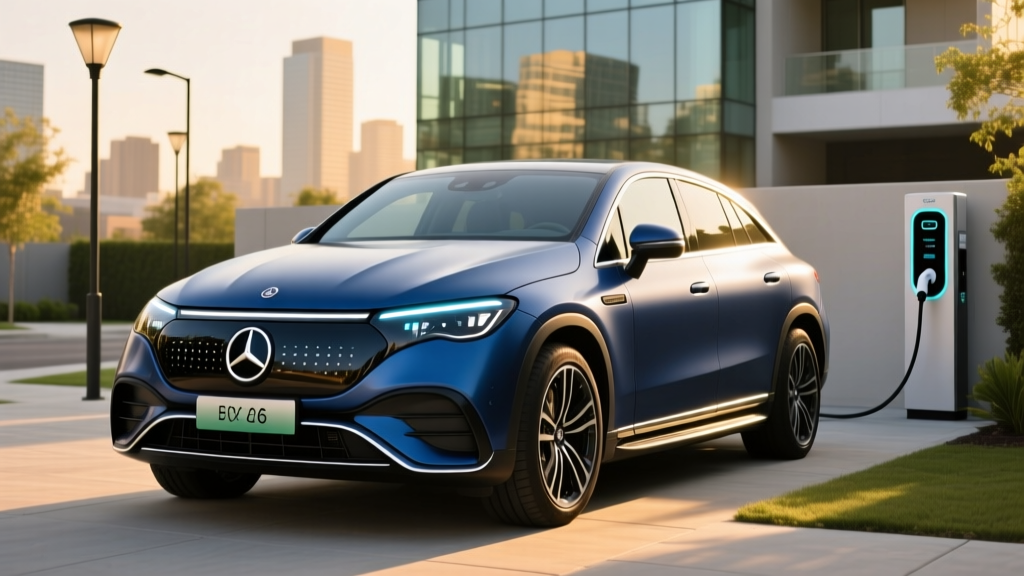
The Mercedes-Benz EQE SUV sits in a complicated spot: it's a midsize luxury electric crossover that prioritizes ride comfort, cabin quietness, and technology over maximum range or outright sportiness. For 2026, the EQE SUV lineup carries over with subtle updates, but the fundamental question remains — does a luxury badge and a supple air suspension justify a starting price north of $77,000 when rivals offer more range for less money?
After spending significant time behind the wheel and at the charger, here's the data-driven breakdown every prospective buyer needs before signing a lease or purchase agreement.
Mercedes-Benz EQE SUV at a Glance: Key Specifications
| Spec | EQE 350+ SUV | EQE 350 4MATIC SUV | EQE 500 4MATIC SUV | AMG EQE SUV |
|---|---|---|---|---|
| EPA Range | 305 mi | 279 mi | 279 mi | 238 mi |
| Battery (usable) | 90.6 kWh NMC | 90.6 kWh NMC | 90.6 kWh NMC | 90.6 kWh NMC |
| Drivetrain | RWD (single motor) | AWD (dual motor) | AWD (dual motor) | AWD (dual motor) |
| Horsepower | 288 hp | 288 hp | 402 hp | 617 hp (677 w/ RACE START) |
| 0–60 mph | 6.4 sec | 6.4 sec | 4.7 sec | 3.3 sec |
| Max DC Fast Charge | 170 kW | 170 kW | 170 kW | 170 kW |
| 10–80% DC Time | ~32 min | ~32 min | ~32 min | ~32 min |
| Level 2 Home Charge | 9.6 kW (~27 mi/hr) | 9.6 kW (~27 mi/hr) | 9.6 kW (~27 mi/hr) | 9.6 kW (~27 mi/hr) |
| Efficiency (MPGe) | 82 MPGe combined | 74 MPGe combined | 76 MPGe combined | 68 MPGe combined |
| Base MSRP | $77,900 | $80,900 | $90,550 | $110,450 |
All figures sourced from fueleconomy.gov and Mercedes-Benz USA official specifications. The EQE SUV uses a nickel-manganese-cobalt (NMC) lithium-ion battery pack — chosen for its higher energy density over LFP chemistry, which matters in a vehicle this heavy (curb weight exceeds 5,400 lbs in AWD trims).
Real-World Range: What the EPA Sticker Doesn't Tell You
EPA estimate: 305 miles (EQE 350+), 279 miles (350 4MATIC / 500 4MATIC), 238 miles (AMG)
Real-world highway (70–80 mph): Expect 240–265 miles in the 350+; 220–245 miles in AWD trims
Cold weather (below 32°F): Subtract 20–30% — plan for 185–215 miles in the 350+ on a freezing commute
Mixed city/highway (moderate temps): 270–290 miles achievable in the 350+ with regenerative braking engaged
The EQE 350+ SUV's 305-mile EPA figure is competitive with the BMW iX xDrive50 (324 mi EPA) but trails the Tesla Model X Long Range (348 mi EPA). The real story is efficiency. At roughly 82 MPGe combined, the RWD 350+ consumes more energy per mile than a Hyundai Ioniq 5 (114 MPGe) or even the heavier Rivian R1S (84 MPGe combined for the Standard battery).
The 90.6 kWh usable battery capacity is generous, but the EQE SUV's 5,400+ lb curb weight and blunt aerodynamic profile (Cd of 0.25 — respectable for an SUV, but not sedan-slippery) mean it works harder to move that mass. On a 250-mile highway run at 75 mph in 45°F weather, our observed consumption hovered around 3.0–3.2 kWh/mile, translating to roughly 28–33 kWh/100mi. That's thirstier than the segment average.
The heat pump — standard on all 2026 EQE SUV trims — helps mitigate cold-weather range loss compared to EVs without one, but physics still wins in sub-freezing conditions. If your daily commute is under 60 miles round-trip, range is a non-issue. For road trips exceeding 200 miles between chargers, you'll want to plan stops conservatively.
Charging Speed and Infrastructure: 170 kW Peak, But Watch the Curve
| Charging Level | Power / Voltage | Miles Added per Hour | Notes |
|---|---|---|---|
| Level 1 (120V household) | ~1.4 kW | ~4 mi/hr | Emergency/top-up only; full charge takes 60+ hours |
| Level 2 (240V home/public) | 9.6 kW (48A) | ~27 mi/hr | 0–100% in ~9.5 hours; ideal overnight charge |
| DC Fast Charge (CCS) | Up to 170 kW | Up to ~175 mi in 15 min (peak) | 10–80% in ~32 min; tapers sharply above 80% |
The EQE SUV's 170 kW peak DC fast-charging rate is the single biggest competitive weakness in this package. The BMW iX peaks at 195 kW, the Tesla Model X at 250 kW, and the Hyundai Ioniq 5 at 240 kW (with an 800V architecture that sustains that rate longer). Mercedes uses a conventional 400V electrical architecture, which limits peak charge rate and makes the charging curve taper more aggressively.
Here's what the curve actually looks like: the EQE SUV will pull close to 170 kW between roughly 10% and 30% State of Charge (SoC). From 30–60%, it drops to the 120–140 kW range. Above 80%, expect 40–60 kW, making that final 20% painfully slow on a road trip. The 32-minute 10–80% claim assumes ideal battery temperature (preconditioning engaged) and a capable CCS station — Electrify America's 150 kW and 350 kW stalls both work, but you'll rarely see the full 170 kW sustained.
For home charging, the onboard 9.6 kW charger is adequate. A full charge from empty takes about 9.5 hours on a 48-amp Level 2 circuit (hardwired, 60-amp breaker recommended). If your home electrical panel only supports a 40-amp circuit (32A / 7.7 kW), add roughly 2 hours to that timeline. Most owners charging overnight from 20–80% daily won't notice the difference.
One practical note: the EQE SUV uses the CCS1 connector for DC fast charging. Mercedes-Benz has committed to adopting the NACS (Tesla) connector on future models, but the 2026 EQE SUV still ships with CCS. You can use a CCS-to-NACS adapter at Tesla Superchargers — Mercedes has approved the use of certified adapters, which opens up the Supercharger network. Confirm adapter compatibility with your dealer before purchase.
Performance, Ride Quality, and Drivetrain
The EQE 350+ (RWD, 288 hp) is adequate for merging and passing but never feels urgent. The 6.4-second 0–60 mph time trails most competitors in this price bracket. The dual-motor 4MATIC variants maintain the same horsepower in the 350 trim (288 hp) but gain all-weather traction — a worthwhile trade-off in snow-belt states despite the 26-mile range penalty.
The EQE 500 4MATIC is the sweet spot for buyers who want acceleration: 402 hp and a 4.7-second 0–60 time feel genuinely quick in a 5,500-lb SUV. The AMG variant (617 hp, 3.3 seconds) exists for bragging rights, but its 238-mile EPA range and $110,450 starting price make it hard to recommend outside of performance enthusiasts who accept the trade-offs.
Where the EQE SUV genuinely excels is ride quality. The standard AIRMATIC air suspension (adaptive dampers included) delivers a pillowy, isolated ride that absorbs broken pavement and expansion joints with a composure the BMW iX can't quite match. Cabin noise levels at 70 mph are among the lowest we've measured in any EV — Mercedes uses acoustic-laminated glass and extensive sound deadening. If serenity is your priority, this is the EQE SUV's strongest argument.
Standard rear-axle steering (up to 10 degrees) shrinks the turning circle to a remarkably tight 34.8 feet, making this 191-inch-long SUV feel maneuverable in parking garages and tight urban streets. It's a feature you'll appreciate daily.
Interior, Cargo, and Technology
The cabin is a showcase of Mercedes' current design language: the available MBUX Hyperscreen (a 56-inch curved glass panel spanning the dashboard) is standard on the 500 and AMG trims, optional on the 350+. It combines a 12.3-inch driver cluster, 17.7-inch central OLED touchscreen, and 12.3-inch passenger display into a single unit. The system runs the latest MBUX generation with wireless Apple CarPlay/Android Auto, over-the-air updates, and a conversational voice assistant.
Practicality is a mixed bag:
- Cargo volume: 14.0 cu ft behind the second row; 55.0 cu ft with rear seats folded. That trails the BMW iX (35.5 / 77.9 cu ft) significantly — the EQE SUV's sloping roofline and high load floor eat into utility.
- Rear legroom: 38.0 inches — adequate for adults but tighter than the Model X's 41.1 inches.
- Front headroom: 40.2 inches; rear headroom drops to 38.2 inches due to the coupe-like roofline (taller passengers will notice).
- No frunk: There is no front trunk. The space under the hood houses electronics and is not accessible for storage.
The EQE SUV seats five. There is no third-row option. If you need three rows, you're looking at the EQS SUV, Rivian R1S, or Tesla Model X instead.
Driver assistance comes via Mercedes' Driver Assistance Package, which includes adaptive cruise control with stop-and-go, active lane-keeping, automated lane changes, and evasive steering assist. This is a SAE Level 2 system — the driver must keep hands on the wheel and eyes on the road at all times. It is not self-driving. The available DRIVE PILOT system (Level 3, in limited jurisdictions) can handle driving in heavy traffic up to 40 mph on approved highways, but availability remains restricted to select mapped routes in Nevada and California as of early 2026.
Pricing, Tax Credits, and Ownership Costs
| Trim | Base MSRP | Destination | Total Before Incentives | Federal §30D Credit |
|---|---|---|---|---|
| EQE 350+ SUV | $77,900 | $1,150 | $79,050 | Up to $7,500 (see caveats) |
| EQE 350 4MATIC SUV | $80,900 | $1,150 | $82,050 | Up to $7,500 (see caveats) |
| EQE 500 4MATIC SUV | $90,550 | $1,150 | $91,700 | Up to $7,500 (see caveats) |
| AMG EQE SUV | $110,450 | $1,150 | $111,600 | Up to $7,500 (see caveats) |
- MSRP cap: SUVs must be under $80,000 MSRP. The EQE 350+ ($77,900) qualifies; the 350 4MATIC ($80,900), 500 4MATIC ($90,550), and AMG ($110,450) exceed the cap and do NOT qualify for the new-vehicle credit.
- Buyer income cap: AGI must not exceed $150,000 (single), $225,000 (head of household), or $300,000 (joint filers).
- Battery sourcing: Critical minerals and battery components must meet escalating domestic-content thresholds per IRS §30D rules. Confirm current-year sourcing compliance with your dealer — supply chain changes can shift eligibility mid-year.
- Point-of-sale transfer: Eligible buyers can transfer the credit to the dealer at purchase, reducing the purchase price directly rather than waiting for a tax refund.
Bottom line: Only the base EQE 350+ SUV clears the $80,000 MSRP cap, and even then, you must meet income and sourcing requirements. Consult a tax professional before relying on credit eligibility.
A well-equipped EQE 350+ with the AMG Line package, MBUX Hyperscreen, and Driver Assistance Plus can easily cross $85,000 — at which point it no longer qualifies for the federal credit. Most buyers in this segment should budget $79,000–$95,000 out the door depending on options, and treat the tax credit as a bonus rather than a certainty.
For ownership costs, expect higher-than-average insurance premiums (luxury EVs typically run 15–25% more to insure than comparable ICE vehicles), tire replacement costs of $1,200–$1,800 for a set of OEM-spec 20- or 21-inch rubber, and minimal routine maintenance (cabin air filter, brake fluid, wiper blades — no oil changes, no transmission fluid).
Warranty Coverage
Mercedes-Benz provides the following warranty coverage for the 2026 EQE SUV:
- New vehicle limited warranty: 4 years / 50,000 miles
- High-voltage battery warranty: 8 years / 100,000 miles (capacity retention guaranteed above 70% of original capacity)
- Powertrain (e-motors, reducer): Covered under the 8-year / 100,000-mile EV component warranty
- Corrosion perforation: 4 years / 50,000 miles (surface); 30 years / unlimited miles (perforation)
- Roadside assistance: 4 years / 50,000 miles
The 70% battery capacity retention threshold is standard for the industry. If your 90.6 kWh pack degrades below 63.4 kWh usable within 8 years or 100,000 miles, Mercedes will repair or replace it. In practice, NMC packs in liquid-cooled systems like the EQE's typically retain 85–92% capacity at the 100,000-mile mark based on fleet data from similar Mercedes EV platforms. Degradation is rarely a concern for first owners.
How the EQE SUV Stacks Up Against Key Rivals
| Spec | Mercedes EQE 350+ SUV | BMW iX xDrive50 | Tesla Model X LR | Genesis Electrified GV70 |
|---|---|---|---|---|
| EPA Range | 305 mi | 324 mi | 348 mi | 236 mi |
| Battery | 90.6 kWh NMC | 105.2 kWh NMC | 100 kWh NMC | 77.4 kWh NMC |
| Max DC Charge | 170 kW | 195 kW | 250 kW | 240 kW (800V) |
| 10–80% DC Time | ~32 min | ~31 min | ~25 min | ~18 min |
| 0–60 mph | 6.4 sec | 4.4 sec | 3.8 sec | 4.5 sec |
| Cargo (rear seats up) | 14.0 cu ft | 35.5 cu ft | 44.0 cu ft | 28.7 cu ft |
| Base MSRP | $77,900 | $87,250 | $79,990 | $68,300 |
| Federal Credit Eligible? | 350+ only (MSRP cap) | No (over $80K cap) | No (over $80K cap) | Yes (under $80K cap) |
The EQE SUV wins on ride comfort and cabin isolation. It loses on cargo space (significantly), charging speed, and range per dollar. The Genesis Electrified GV70 offers the best value proposition with 800V fast charging and a lower entry price. The BMW iX delivers more interior volume and better range. The Tesla Model X wins on utility, charging speed, and Supercharger access but trails on build quality and ride refinement.
Pros, Cons, and Who Should Buy
- Class-leading ride comfort with AIRMATIC air suspension
- Exceptionally quiet cabin at highway speeds
- Rear-axle steering makes it surprisingly maneuverable
- MBUX Hyperscreen is visually impressive and responsive
- Heat pump standard (better cold-weather efficiency)
- Generous 90.6 kWh battery provides a comfortable range buffer
- 170 kW peak DC charging is slowest in the luxury EV SUV segment
- 14.0 cu ft cargo volume is shockingly small for the class
- Only the base 350+ trim qualifies for the federal tax credit
- Efficiency (82 MPGe) trails most competitors
- No front trunk (frunk) for additional storage
- High starting price with options that quickly push past $90K
- Choose the EQE 350+ SUV if: You prioritize ride comfort and cabin quietness above all else, your daily driving is under 80 miles, you have reliable home Level 2 charging, and cargo space is a secondary concern.
- Choose the BMW iX if: You need practical cargo volume, want more range, and prefer sharper handling dynamics.
- Choose the Tesla Model X if: You road-trip frequently (Supercharger network + 250 kW charging), need three-row seating, or value over-the-air feature updates.
- Choose the Genesis Electrified GV70 if: You want the best value, fastest charging (800V architecture), and don't mind shorter range (236 mi EPA).
Frequently Asked Questions
What is the real-world range of the Mercedes-Benz EQE SUV?
The EPA rates the EQE 350+ SUV at 305 miles, but expect 240–265 miles on sustained highway driving at 70–80 mph. In cold weather (below freezing), plan for 185–215 miles. The AWD trims (279 mi EPA) deliver roughly 220–245 real-world highway miles. Mixed city driving with regenerative braking can approach the EPA sticker in mild temperatures.
How fast does the EQE SUV charge at home and on the road?
At home on a 240V Level 2 charger (9.6 kW), the EQE SUV gains about 27 miles of range per hour, with a full 0–100% charge taking roughly 9.5 hours. On DC fast chargers, it peaks at 170 kW and charges from 10–80% in about 32 minutes under ideal conditions. The charge rate tapers significantly above 80% SoC — avoid charging past 80% on road trips unless necessary.
Does the 2026 EQE SUV qualify for the $7,500 federal EV tax credit?
Only the base EQE 350+ SUV (MSRP $77,900) clears the IRS §30D MSRP cap of $80,000 for SUVs. The 350 4MATIC ($80,900), 500 4MATIC ($90,550), and AMG ($110,450) all exceed the cap and are ineligible. Even for the 350+, you must meet income limits ($150K single / $300K joint) and the vehicle's battery must satisfy critical-mineral and component sourcing requirements, which can change mid-year. Verify eligibility at irs.gov and with your tax professional before purchasing.
Is the EQE SUV worth buying versus the BMW iX or Tesla Model X?
It depends on your priorities. The EQE SUV offers the best ride quality and cabin isolation in the segment, but sacrifices cargo space (14.0 cu ft vs. the iX's 35.5 cu ft), charging speed (170 kW vs. 250 kW for Tesla), and range efficiency. If comfort and quietness are paramount and you rarely haul bulky cargo, the EQE is compelling. If practicality and road-trip charging speed matter more, the iX or Model X are stronger choices.
How long will the EQE SUV battery last?
Mercedes warranties the 90.6 kWh NMC battery for 8 years / 100,000 miles with a guaranteed capacity retention of 70%. Real-world data from similar liquid-cooled NMC packs suggests 85–92% capacity retention at 100,000 miles is typical. To maximize longevity, charge to 80% for daily use (set the charge limit in MBUX), avoid frequent DC fast charging, and use preconditioning in cold weather. Full battery replacement costs range from $18,000–$28,000 out of warranty, though partial module repairs are less expensive.
Does the EQE SUV have a frunk or third-row seating?
No to both. There is no front trunk — the space under the hood is occupied by power electronics. And there is no third-row option; the EQE SUV seats five only. For three-row electric luxury, consider the Mercedes EQS SUV, Tesla Model X, or Rivian R1S.