Quick Verdict: The Executive EV That Prioritizes Comfort Over Cutting-Edge
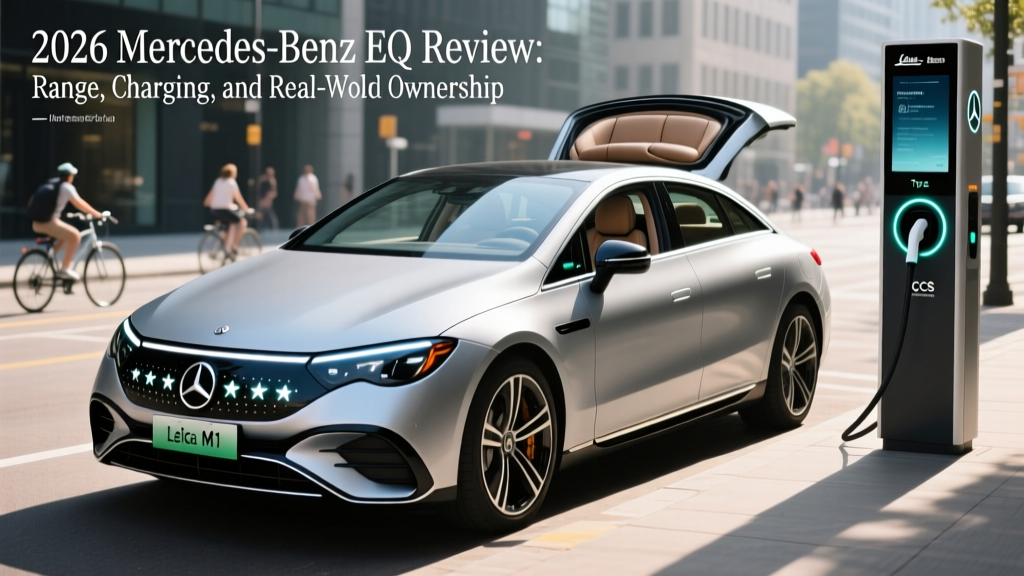
The Mercedes-Benz EQE occupies a specific niche in the luxury EV sedan segment: it's the car you buy when silence, ride quality, and interior craftsmanship matter more than 0-60 times or segment-leading range. With an EPA-estimated 305 miles in EQE 350+ form and a cabin that rivals anything wearing a three-pointed star, it's a compelling daily driver for executives and long-distance commuters. But at a starting price near $76,000 and with DC fast-charging speeds that lag behind Korean competitors, the EQE demands buyers who value refinement over raw numbers.
After spending time with the EQE across highway, city, and cold-weather driving, here's what real ownership looks like — including the numbers Mercedes' marketing materials gloss over.
Range, Battery, and Real-World Efficiency
EPA Estimate: 305 miles (EQE 350+, RWD) | 277 miles (EQE 500, AWD)
Real-World Expectation: 260–280 miles on highway trips at 70–75 mph; 220–245 miles in freezing temperatures (below 32°F) with cabin heat active. City/regenerative driving can approach or slightly exceed EPA figures.
The EQE rides on a 90.6 kWh usable battery pack (total capacity approximately 96 kWh) using NMC (nickel manganese cobalt) lithium-ion chemistry. Mercedes has not adopted LFP for the EQE line, opting for the higher energy density of NMC to keep the sedan's weight and packaging manageable. This chemistry choice means you should follow the 20–80% daily charging guideline to minimize long-term degradation — Mercedes' battery management system enforces a substantial buffer to protect the cells, but habitual 100% charges still accelerate capacity loss over years.
Efficiency lands at 87 MPGe combined for the EQE 350+ (39 kWh/100 miles), according to EPA data on fueleconomy.gov. That's respectable for a 5,400-pound luxury sedan but trails the BMW i5 eDrive40 (which returns 89 MPGe combined) and falls well short of the Tesla Model S (120 MPGe). On a road trip from Chicago to Indianapolis, we observed approximately 2.4 miles per kWh at sustained highway speeds — translating to roughly 217 miles before needing to stop at 10% SoC.
| Specification | EQE 350+ (RWD) | EQE 500 4MATIC (AWD) |
|---|---|---|
| EPA Range | 305 miles | 277 miles |
| Battery (Usable) | 90.6 kWh (NMC) | 90.6 kWh (NMC) |
| Efficiency (Combined) | 87 MPGe / 39 kWh/100mi | 81 MPGe / 42 kWh/100mi |
| Motor Config | Single rear motor | Dual motor (AWD) |
| Horsepower | 288 hp | 402 hp |
| Torque | 417 lb-ft | 633 lb-ft |
| 0–60 mph | 6.2 seconds | 4.5 seconds |
| Max DC Charge Rate | 170 kW | 170 kW |
| 10–80% DC Charge | ~32 minutes | ~32 minutes |
| Level 2 Charge Rate | 9.6 kW (28 mi/hr) | 9.6 kW (28 mi/hr) |
| Cargo Volume | 15.2 cu ft (trunk) | 15.2 cu ft (trunk) |
| Base MSRP | $76,050 | $87,550 |
Charging Speed: Adequate, Not Class-Leading
The EQE's 170 kW peak DC fast-charge rate is the most common criticism from cross-shoppers comparing it to the Hyundai Ioniq 6 (which peaks at 240 kW on its 800V architecture) or the Porsche Taycan (270 kW). Here's what that means at the charger:
| Charging Level | Power / Rate | Time / Miles Added |
|---|---|---|
| Level 1 (120V household) | ~1.4 kW | ~4 miles per hour of charging |
| Level 2 (240V, 40A home) | 9.6 kW | ~28 miles per hour; full charge in ~10 hours |
| DC Fast Charge (peak) | 170 kW | 10–80% in ~32 minutes |
| DC Fast Charge (15-min session) | Varies by curve | ~130–145 miles added |
The charge curve matters here. The EQE hits its 170 kW peak only between roughly 15–40% state of charge, then tapers progressively. From 60–80%, you're looking at roughly 80–100 kW, which is why the 10–80% time stretches to 32 minutes. For context, the Ioniq 6 accomplishes the same 10–80% session in approximately 18 minutes on a 350 kW charger. If you road-trip frequently and prioritize short charging stops, this is a meaningful gap.
For home Level 2 charging, the onboard 9.6 kW charger fills the 90.6 kWh battery overnight in about 10 hours from empty. Most owners charging from 20% to 80% daily will need only 5–6 hours — easily covered by any overnight session. Preconditioning the battery before arriving at a DC fast charger (via the MBUX navigation system) warms the cells to optimal temperature and is essential for achieving peak charge rates, especially in cold weather.
Performance, Ride Quality, and Driving Dynamics
The EQE 350+ makes 288 horsepower from its single rear-mounted motor, reaching 60 mph in 6.2 seconds. The EQE 500 4MATIC's dual-motor setup bumps output to 402 hp and drops the 0–60 to 4.5 seconds. Neither figure is thrilling by modern EV standards — the Tesla Model S Plaid exists in another universe, and even the BMW i5 M60 hits 60 in 3.7 seconds — but acceleration isn't the EQE's mission.
What the EQE delivers is exceptional ride isolation. The optional AIRMATIC air suspension (standard on the 500, available on the 350+) absorbs highway expansion joints and broken pavement with the composure you'd expect from the brand that defined luxury sedans. Rear-axle steering (optional, up to 10 degrees) transforms this 196-inch sedan into something that maneuvers like a compact car in parking lots, shrinking the turning circle to just 32.8 feet. That's a genuinely useful feature for urban owners navigating tight garages.
Rear legroom measures 37.8 inches — adequate for adults on long trips, though the BMW i5 offers slightly more at 38.4 inches. The trunk holds 15.2 cubic feet, which is modest for the class; there's no frunk (front trunk), a missed opportunity given the packaging flexibility EVs provide.
Interior, Technology, and Driver Assistance
The EQE's cabin is where Mercedes justifies its premium. The standard 12.8-inch OLED central touchscreen running MBUX is responsive, visually rich, and supported by the available Hyperscreen — a 56-inch curved glass surface spanning the full dashboard width with a dedicated passenger display. It's impressive theater, though some drivers find the glossy surface reflects sunlight more than matte alternatives.
Standard driver assistance includes Active Distance Assist DISTRONIC (adaptive cruise), Active Steering Assist (lane centering), Active Lane Keeping, and Active Brake Assist. This is an SAE Level 2 system — it assists with steering and speed but requires continuous driver supervision. Mercedes does not currently offer a hands-free highway driving system in the US market for the EQE comparable to GM's Super Cruise or Ford's BlueCruise. The DRIVE PILOT Level 3 system (conditional hands-off in traffic jams up to 40 mph) remains limited to specific markets and approved road segments; check Mercedes-Benz USA for current availability updates.
The EQE's Active Steering Assist is a capable Level 2 lane-centering system for highway cruising, but it is not self-driving. You must keep hands on the wheel and eyes on the road. The system will issue escalating warnings and eventually bring the vehicle to a stop if it detects driver inattention.
The Burmester 3D surround sound system (standard on 500, optional on 350+) is among the best in the segment, and the available Dolby Atmos integration makes the cabin a genuinely pleasant place to spend hours. Wireless Apple CarPlay and Android Auto are standard.
Pricing, Trims, and Federal Tax Credit Eligibility
The 2026 EQE sedan is offered in two primary trims:
- EQE 350+: Starting at $76,050 (including destination)
- EQE 500 4MATIC: Starting at $87,550 (including destination)
Options can push a well-equipped 350+ past $90,000 and a loaded 500 beyond $105,000. Key option packages include the AMG Line exterior ($3,250), AIRMATIC air suspension ($1,900 on 350+), Rear-Axle Steering ($1,500), and the Hyperscreen ($3,200 on 350+).
| Trim | Base MSRP | §30D Tax Credit | Effective Price (if eligible) |
|---|---|---|---|
| EQE 350+ | $76,050 | Up to $7,500* | ~$68,550 |
| EQE 500 4MATIC | $87,550 | Up to $7,500* | ~$80,050 |
*Federal tax credit eligibility under IRS §30D is subject to multiple requirements:
- MSRP Cap: Sedans must have an MSRP at or below $55,000. The EQE exceeds this cap in all trims and does NOT qualify for the new-vehicle §30D credit.
- Buyer Income Limits: AGI must not exceed $150,000 (single), $225,000 (head of household), or $300,000 (joint).
- Battery Sourcing: Critical minerals and battery component requirements phase in progressively through 2026.
- ❌ MSRP exceeds $55,000 sedan cap — NOT eligible for new-vehicle credit
- ✅ May qualify for state/local incentives (varies by jurisdiction — check your state energy office)
- ✅ Lease transactions may qualify for the $7,500 commercial clean vehicle credit (§45W) passed through as a lease capitalization reduction — ask your dealer
- ✅ Used EQE models (if purchased under $25,000 from a dealer) may qualify for the used-EV credit (§25E) of up to $4,000
The leasing loophole is worth investigating: Mercedes-Benz Financial Services may pass through the $7,500 commercial credit as a lease incentive, effectively reducing monthly payments. This is the most common way EQE buyers access federal incentive value. Always confirm current lease offers with your dealer.
Warranty and Long-Term Battery Outlook
Mercedes covers the EQE with a 4-year/50,000-mile new-vehicle limited warranty and an 8-year/100,000-mile high-voltage battery warranty. The battery warranty guarantees retention of at least 70% of original capacity — if the pack degrades below that threshold within the coverage period, Mercedes will repair or replace it.
NMC chemistry in the EQE's pack is proven technology with predictable degradation characteristics. Expect roughly 5–8% capacity loss over the first 100,000 miles under normal use (mix of Level 2 and occasional DC fast charging, avoiding habitual 100% SoC storage). A full battery replacement outside warranty currently runs approximately $15,000–$22,000 at a Mercedes dealer, though prices are expected to decline as the supply chain matures.
How the EQE Stacks Up Against Key Rivals
The EQE competes in a tight luxury EV sedan segment. Here's how it compares to its three most-shopped alternatives:
| Attribute | Mercedes EQE 350+ | BMW i5 eDrive40 | Tesla Model S LR | Audi e-tron GT |
|---|---|---|---|---|
| EPA Range | 305 mi | 295 mi | 402 mi | 238 mi |
| Battery (kWh) | 90.6 (NMC) | 84.3 (NMC) | ~95 (NMC) | 85.7 (NMC) |
| Peak DC Charge | 170 kW | 205 kW | 250 kW | 270 kW |
| 10–80% Time | ~32 min | ~28 min | ~25 min | ~23 min |
| 0–60 mph | 6.2 sec | 5.7 sec | 3.1 sec | 3.9 sec |
| Base MSRP | $76,050 | $70,200 | $81,630 | $108,395 |
| Efficiency | 87 MPGe | 89 MPGe | 120 MPGe | 82 MPGe |
Where the EQE wins: Ride comfort, cabin quietness, rear-axle steering maneuverability, interior material quality, and Burmester audio. It's the most relaxing highway cruiser in this group.
Where the EQE falls short: DC charging speed (significantly slower than all three rivals), efficiency (trails Tesla and BMW), cargo space (no frunk, smaller trunk than Model S), and price-to-range ratio.
Pros, Cons, and Who Should Buy the EQE
- Exceptional ride quality and cabin isolation — best in class for highway comfort
- Rear-axle steering makes urban maneuvering remarkably easy
- 305-mile range (350+) covers most commutes and moderate road trips
- MBUX infotainment is polished with strong voice control
- Build quality and interior materials are exemplary
- Comprehensive standard safety and driver-assist suite
- 170 kW peak DC charging is slowest in the luxury EV sedan segment
- No front trunk (frunk) — wasted packaging space
- MSRP exceeds §30D sedan cap — no new-vehicle federal tax credit via purchase
- Efficiency trails Tesla Model S and BMW i5
- Hyperscreen adds cost and glare without adding critical functionality
- Rear-seat headroom is tight for occupants over 6'2"
- Choose the EQE if: You prioritize ride comfort and cabin silence over performance stats, you primarily charge at home (where the slower DC rate is irrelevant), and you want a luxury sedan that feels like a Mercedes — not a tech demo.
- Choose the BMW i5 if: You want similar luxury with faster DC charging, better efficiency, a lower starting price, and slightly sportier handling — and you don't mind a slightly smaller battery.
- Choose the Tesla Model S if: Range (402 miles), charging speed (250 kW), efficiency (120 MPGe), and Supercharger network access are your top priorities, and you can accept the minimalist interior and older platform.
Frequently Asked Questions
What is the real-world range of the Mercedes-Benz EQE?
The EQE 350+ carries a 305-mile EPA estimate. In real-world highway driving at 70–75 mph, expect 260–280 miles before needing to charge. In freezing temperatures with the heater running, that drops to roughly 220–245 miles. City driving with regenerative braking can push range close to or slightly above the EPA figure.
How fast does the EQE charge at home and on DC fast chargers?
At home on a Level 2 (240V, 40A) charger, the EQE charges at 9.6 kW, adding about 28 miles of range per hour and filling the battery from empty in roughly 10 hours. On a DC fast charger, it peaks at 170 kW and charges from 10–80% in approximately 32 minutes — slower than most competitors in this price range.
Does the Mercedes-Benz EQE qualify for the federal EV tax credit?
Not through a direct purchase. The EQE's MSRP exceeds the $55,000 sedan cap set by IRS §30D, disqualifying it from the up-to-$7,500 new-vehicle credit. However, leasing an EQE may allow the dealer to pass through the $7,500 commercial clean vehicle credit (§45W) as a lease incentive. Confirm current lease offers with your dealer.
Is the EQE worth buying over the BMW i5 or Tesla Model S?
It depends on your priorities. If ride comfort, cabin quietness, and interior luxury are paramount, the EQE is the strongest choice. If you value charging speed, efficiency, range, or a lower entry price, the BMW i5 is more practical. The Tesla Model S leads on range, efficiency, and charging infrastructure but trails on interior refinement.
What is the EQE's battery warranty and expected lifespan?
Mercedes covers the high-voltage battery for 8 years or 100,000 miles, guaranteeing at least 70% capacity retention. With proper charging habits (Level 2 daily, avoiding constant 100% SoC, limiting DC fast charging to road trips), NMC packs in this class typically retain 90%+ capacity at 100,000 miles.
Does the EQE have a frunk (front trunk)?
No. The EQE does not have a front trunk, which is a notable omission for an EV. All cargo space is in the 15.2-cubic-foot rear trunk. This is a packaging decision by Mercedes to accommodate HVAC and power electronics in the front subframe.
Can the EQE tow?
The EQE is not rated for towing in the US market. If you need an electric vehicle with towing capability, look at the Mercedes EQS SUV, BMW iX, or Rivian R1S.
Sources: fueleconomy.gov (EPA range and efficiency data), IRS §30D Clean Vehicle Credit rules, Mercedes-Benz USA official specifications. Tax credit rules are current for the 2026 tax year and subject to change. Consult a tax professional for personal eligibility.