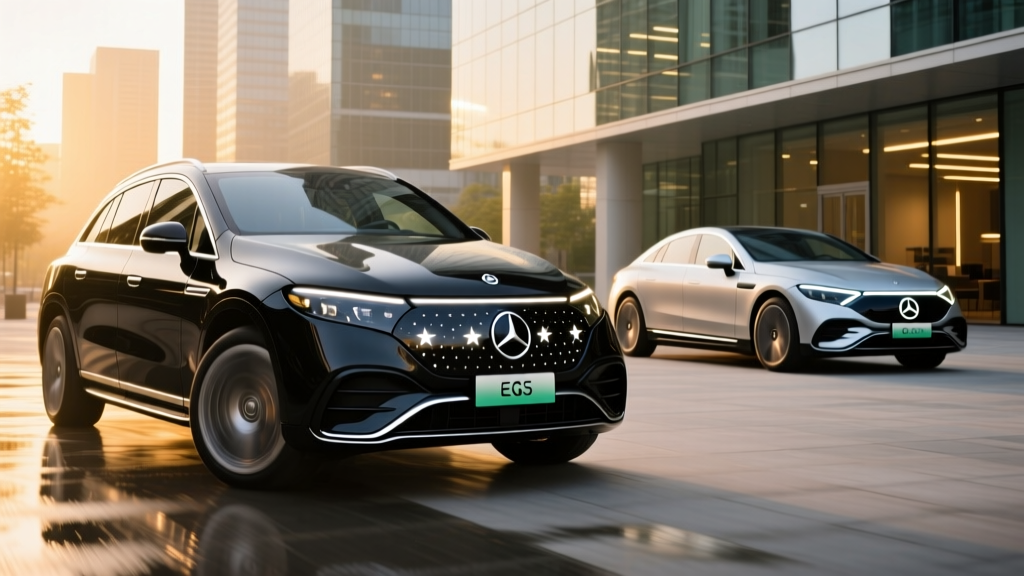
Quick Answer: The 2026 Mercedes-Benz electric vehicles lineup spans five core models — from the $51,050 EQB compact SUV to the $104,400+ EQS sedan. Expect 230–390 miles of EPA range, 170–200 kW DC fast-charging peaks, and premium interiors. However, none currently qualify for the full $7,500 federal §30D tax credit due to battery-sourcing rules. Buyers should budget $51K–$130K+ before state incentives, and plan for home Level 2 charging to make ownership practical.
The 2026 Mercedes-Benz EV Lineup at a Glance
Mercedes-Benz has committed to an all-electric future, and the 2026 model year reflects that ambition across sedans, SUVs, and a performance halo. The current portfolio relies primarily on NMC (nickel-manganese-cobalt) battery chemistry, prioritizing energy density and cold-weather performance over the LFP chemistry found in some competitors' base trims. Here is the complete current lineup with verified specifications:
| Model | Body Style | EPA Range | Battery (kWh usable) | Peak DC Charge | 10–80% | 0–60 mph | Base MSRP |
|---|---|---|---|---|---|---|---|
| EQB 250+ | Compact SUV (3-row) | 251 mi | 66.5 (NMC) | 100 kW | ~32 min | 8.1 sec | $51,050 |
| EQA 250+ | Subcompact SUV | 245 mi | 66.5 (NMC) | 100 kW | ~32 min | 8.6 sec | $53,900 |
| EQE 350+ | Midsize Sedan | 305 mi | 90.6 (NMC) | 170 kW | ~28 min | 6.2 sec | $74,900 |
| EQE SUV 350 4MATIC | Midsize SUV | 279 mi | 90.6 (NMC) | 170 kW | ~30 min | 6.4 sec | $77,900 |
| EQS 450+ | Full-Size Sedan | 390 mi | 118.0 (NMC) | 200 kW | ~31 min | 5.9 sec | $104,400 |
| EQS SUV 450 4MATIC | Full-Size SUV | 305 mi | 108.4 (NMC) | 200 kW | ~31 min | 5.9 sec | $105,550 |
| AMG EQE 43 4MATIC | Performance Sedan | 230 mi | 90.6 (NMC) | 170 kW | ~28 min | 4.0 sec | $106,900 |
Sources: EPA fueleconomy.gov, Mercedes-Benz USA. Range figures are EPA estimates; real-world highway and cold-weather results will vary (see below).
Charging Speeds and Infrastructure: What Owners Actually Experience
Mercedes-Benz EVs use the CCS1 connector standard for DC fast charging on current models, with the brand confirming a transition to NACS (Tesla-style) for future vehicles. If you buy a 2026 model today, you will charge on CCS at Electrify America, EVgo, and other networks, or use a Tesla Supercharger with the included adapter on applicable models.
| Charging Level | Power (kW) | Typical Speed | Best Use Case |
|---|---|---|---|
| Level 1 (120V household) | 1.0–1.4 kW | 3–5 miles/hour | Overnight top-ups, PHEVs, emergencies |
| Level 2 (240V home/public) | 7.2–11.5 kW | 20–40 miles/hour | Daily home charging, workplace, hotels |
| DC Fast Charge | 100–200 kW peak | 150–550 miles/hour (tapering) | Road trips, rapid top-ups |
Charging curve honesty: The peak kW number Mercedes advertises is a maximum, not a sustained rate. A 200 kW peak on the EQS means you will see roughly 180–200 kW between 10–40% State of Charge (SoC), tapering to 120–140 kW by 60%, and dropping below 50 kW past 80%. This is why the 10–80% time matters more than peak rate — it reflects the usable fast-charging window. Always precondition your battery (via the MBUX navigation-to-charger feature) before arriving at a DC fast charger to hit peak rates; skipping preconditioning in cold weather can add 10–15 minutes to your session.
Mercedes-Benz EVs vs. Gas Equivalents: The Real Cost Comparison
Comparing a Mercedes EV to its internal-combustion counterpart requires looking beyond the sticker price. Let's compare the EQE 350+ sedan against the gasoline E 350 — two vehicles targeting the same buyer:
| Cost Factor | EQE 350+ (EV) | E 350 (Gas) | Difference |
|---|---|---|---|
| Base MSRP | $74,900 | $58,750 | +$16,150 (EV) |
| Federal Tax Credit (§30D) | $0 (sourcing rules) | $0 | $0 |
| Fuel/Energy (5 yr, 15K mi/yr) | ~$4,200 (home L2) | ~$11,250 (premium) | –$7,050 (EV saves) |
| Maintenance (5 yr) | ~$2,100 | ~$4,500 | –$2,400 (EV saves) |
| Insurance (5 yr avg) | ~$14,500 | ~$11,000 | +$3,500 (EV costs more) |
| Estimated Depreciation (5 yr) | ~$37,450 (50%) | ~$26,438 (45%) | +$11,012 (EV costs more) |
| 5-Year Total Cost | ~$57,750 | ~$49,500 | +$8,250 (EV) |
Assumptions: $0.14/kWh national average electricity, $3.75/gal premium gasoline, 25 MPG combined for E 350. Actual costs vary by state, utility rates, and driving patterns. Source for efficiency data: fueleconomy.gov.
The EV costs more over five years primarily because of the higher purchase price and steeper depreciation — luxury EVs have depreciated faster than their gas counterparts in recent years. However, if you have access to cheap overnight home charging (under $0.10/kWh in many states with time-of-use plans), the fuel savings widen significantly. The EQE owner charging at home at $0.09/kWh would spend roughly $2,700 on energy over five years, pushing total savings closer to parity.
Federal Tax Credit and Incentive Landscape for 2026
This is where Mercedes-Benz EV buyers face a challenge. Under current IRS §30D rules, the federal Clean Vehicle Credit of up to $7,500 requires that a vehicle's battery components be manufactured in North America and that critical minerals be sourced from the US or free-trade-agreement partners. As of the 2026 model year, no Mercedes-Benz EV sold in the United States meets both thresholds to qualify for the full credit. Some models may qualify for a partial credit depending on sourcing updates — always verify current eligibility on the IRS Clean Vehicle Credit page before purchasing.
- MSRP Cap: Vans/SUVs/pickups ≤ $80,000; sedans ≤ $55,000 (disqualifies most Mercedes models on price alone)
- Buyer Income Cap: AGI ≤ $150K single / $225K head of household / $300K joint
- Battery Component Manufacturing: Must be assembled in North America (phased thresholds by year)
- Critical Minerals Sourcing: Must be extracted/processed in US or FTA partner countries
- Point-of-Sale Transfer: Eligible buyers can transfer the credit to the dealer for an upfront price reduction
Note: The EQS and AMG models exceed the MSRP cap regardless of sourcing. The EQB at $51,050 technically falls under the $80,000 SUV cap but still fails the sourcing requirement. Consult a tax professional for your specific situation.
State incentives can partially offset this gap. California's CVRP, Colorado's innovative motor vehicle credit, and various utility rebates can reduce net cost by $2,000–$7,500 depending on your jurisdiction. Check your state's energy office and local utility for current programs.
Common Misconceptions About Mercedes-Benz EVs
| Myth | Fact |
|---|---|
| "Mercedes EVs charge as fast as a Tesla" | Peak rates of 170–200 kW are competitive but trail Tesla's V4 Superchargers at 250+ kW. The 10–80% time of 28–31 minutes is 5–10 minutes slower than a Model S on V3. |
| "The battery will need replacing in 5 years" | Mercedes provides an 8-year/100,000-mile high-voltage battery warranty covering capacity below 70% of original. Real-world NMC degradation data from similar platforms shows 10–15% capacity loss at 100K miles — well within warranty. |
| "I can't road-trip in a Mercedes EV" | The EQS 450+ with 390 miles of range and 200 kW charging can cover 300+ highway miles, charge 10–80% in ~31 minutes, and repeat. Route planning via MBUX makes this practical on major corridors. |
| "All Mercedes EVs are over $100,000" | The EQB starts at $51,050 and the EQA at $53,900 — accessible entry points, though still premium-priced relative to mainstream brands. |
| "Regenerative braking means I never use my brake pads" | One-pedal driving reduces brake wear significantly, but Mercedes EVs still use friction brakes for hard stops and low-speed blending. Expect pad replacement at 80,000–120,000 miles instead of 30,000–50,000 on gas cars. |
Ownership Realities: Who Should (and Shouldn't) Buy
Buying a Mercedes-Benz EV in 2026 works well for a specific buyer profile and poorly for others. Here is a practical framework:
- You have access to Level 2 home charging (240V, 40–48A circuit) — this is non-negotiable for daily convenience
- Your daily commute is under 100 miles round-trip, keeping you well within the real-world range buffer
- You value interior quality, ride refinement, and brand prestige over maximum range-per-dollar
- You drive primarily in moderate climates or accept 20–30% winter range loss as a trade-off
- You road-trip fewer than 6–8 times per year and can plan around DC fast-charging stops
- You live in an apartment without charging access and rely entirely on public infrastructure
- You regularly drive 400+ mile highway trips in cold weather and cannot tolerate 30-minute charging stops
- The $7,500 federal tax credit is essential to your purchase budget (look at Tesla, GM, or Ford models that still qualify)
- You plan to keep the vehicle beyond 8 years and are concerned about out-of-warranty battery replacement costs ($15,000–$30,000 depending on model)
First-Time EV Buyer Essentials
If you are transitioning from a gas Mercedes to your first electric model, prepare for these ownership shifts:
Home charging setup: Budget $1,200–$3,500 for a professional Level 2 installation, including a 50-amp dedicated circuit, NEMA 14-50 outlet or hardwired wallbox (Mercedes-Benz Wallbox Home or a third-party unit like ChargePoint Home Flex), and permit fees. If your electrical panel is older or at capacity, a panel upgrade to 200A can add $1,500–$4,000. Get a quote from a licensed electrician before purchasing your vehicle.
Charging habits: For NMC batteries like those in Mercedes EVs, daily charging to 80% SoC and avoiding frequent drops below 10% will maximize long-term battery health. Set your MBUX charge limit to 80% for daily use and switch to 100% only before long trips. This single habit can reduce 10-year degradation from ~15% to ~8%.
Maintenance differences: Say goodbye to oil changes, spark plugs, and transmission fluid. Your recurring maintenance will be tire rotations (EVs are heavier and wear tires faster — budget $200–$400 per set of premium tires), cabin air filter replacement, brake fluid checks, and windshield washer fluid. Annual maintenance costs typically run $400–$600 versus $900–$1,500 for a comparable gas Mercedes.
Insurance expectations: EV insurance premiums run 15–25% higher than gas equivalents due to repair costs and battery replacement risk. Get quotes from GEICO, Progressive, and State Farm before finalizing your purchase — some insurers now offer specific EV policies with battery coverage riders.
Frequently Asked Questions
Are Mercedes-Benz EVs reliable?
Early EQ models (2022–2023) had software-related recalls and build-quality issues. The 2025–2026 model years show significant improvement in MBUX stability and powertrain reliability. The high-voltage battery and electric drive unit carry an 8-year/100,000-mile warranty. Long-term mechanical reliability data is still accumulating compared to decades of gas-engine history.
What happens if the battery fails out of warranty?
Out-of-warranty high-voltage battery replacement for a Mercedes EQ model currently ranges from approximately $15,000 (EQB/EQA) to $30,000+ (EQS). Full battery failure is rare — most degradation is gradual capacity loss. Individual module replacement may be possible at lower cost. Third-party EV battery repair shops are emerging but remain limited for Mercedes-specific packs.
Can I use Tesla Superchargers with a Mercedes EV?
Current 2026 Mercedes-Benz EVs use the CCS1 connector. Tesla has opened select Supercharger stations to non-Tesla vehicles via the Tesla app, and Mercedes provides a CCS-to-NACS adapter for applicable models. Availability varies by station — check the Tesla app or your MBUX charger map before relying on Superchargers for a road trip.
How does the EQS compare to the Tesla Model S?
The EQS 450+ offers more interior luxury, a quieter cabin, and a larger battery (118 kWh vs ~100 kWh), with 390 miles of EPA range versus the Model S's 402 miles. The Model S charges faster (250 kW peak vs 200 kW), has a more established Supercharger network, qualifies for more incentives, and starts ~$30,000 lower. The EQS wins on refinement; the Model S wins on value and charging infrastructure.
Is a Mercedes PHEV a better choice than a full EV?
If you cannot install home charging or frequently drive 500+ mile trips, a Mercedes plug-in hybrid like the S 580e (with ~30 miles of electric-only range) offers a bridge. You get electric commuting for short trips with a gas engine for long hauls. However, PHEVs carry the maintenance burden of both systems and miss out on the lowest per-mile energy costs that full EVs deliver when charged at home.