The Quick Answer: Is a Mercedes-Benz Electric Vehicle Right for You?
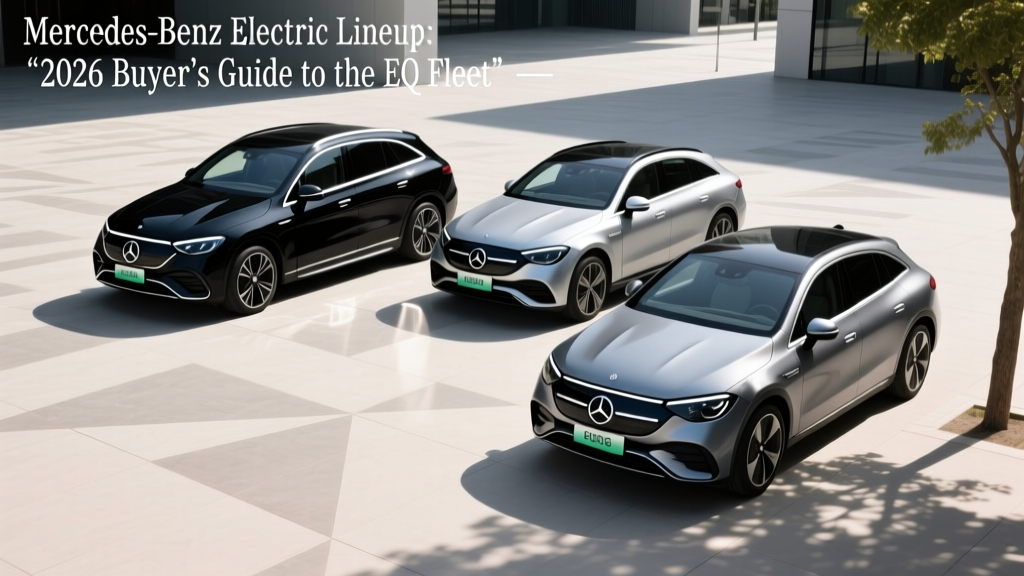
If you're shopping for a Mercedes-Benz electric vehicle in 2026, you're choosing from the EQ lineup — spanning the compact EQA crossover (EPA est. ~250 mi), the midsize EQE sedan and SUV (~230–300 mi), and the flagship EQS sedan and SUV (~300–390 mi). Expect to spend $54,000 to $130,000+ before incentives, charge at up to 200 kW on DC fast chargers (10–80% in roughly 28–32 minutes), and pay significantly less per mile to "fuel" than a comparable gasoline Mercedes — provided you can charge at home. The federal §30D tax credit of up to $7,500 may apply depending on your income, the vehicle's MSRP, and battery-sourcing compliance, which varies by model year and trim. Luxury EV buyers should weigh the premium interior, ride refinement, and MBUX tech against higher insurance costs, faster luxury-segment depreciation, and the reality that public charging infrastructure remains inconsistent outside major metro areas.
The 2026 Mercedes-Benz Electric Lineup at a Glance
Mercedes-Benz organizes its battery-electric vehicles under the EQ sub-brand. As of the 2026 model year, the lineup covers four primary nameplates available in the U.S. market. Here's how they stack up on paper and in practice:
| Model | Body Style | Battery (kWh usable) | EPA Range (mi) | Max DC Charge (kW) | 10–80% DCFC | 0–60 mph | Starting MSRP |
|---|---|---|---|---|---|---|---|
| EQB 300 4MATIC | Compact SUV (3-row) | 66.5 (NMC) | ~245 | 100 kW | ~32 min | 6.8 sec | ~$54,000 |
| EQE 350+ Sedan | Midsize Sedan | 90.6 (NMC) | ~305 | 170 kW | ~32 min | 5.6 sec | ~$75,000 |
| EQE 350 4MATIC SUV | Midsize SUV | 90.6 (NMC) | ~270 | 170 kW | ~32 min | 6.4 sec | ~$78,000 |
| EQS 450+ Sedan | Full-Size Sedan | 108.4 (NMC) | ~390 | 200 kW | ~31 min | 5.9 sec | ~$105,000 |
| EQS 580 4MATIC SUV | Full-Size SUV | 108.4 (NMC) | ~305 | 200 kW | ~31 min | 4.4 sec | ~$130,000 |
Sources: fueleconomy.gov, Mercedes-Benz USA. Figures reflect 2026 model-year estimates and may vary by trim and options.
Real-World Range: What the EPA Sticker Doesn't Tell You
The EQS 450+ sedan's 390-mile EPA figure is impressive, but plan for roughly 310–340 miles on sustained highway driving at 70–80 mph, and 250–290 miles in sub-freezing temperatures due to battery thermal demands and cabin heating. The smaller EQB, with its 245-mile EPA rating, realistically delivers 190–210 miles on a cold winter highway stretch. Always budget a 15–25% buffer below EPA for road trips.
Mercedes-Benz Electric vs Gasoline: The Cost Comparison
Comparing the EQE 350+ sedan to the gasoline E 350 sedan reveals where electric ownership saves — and where it doesn't. Both are midsize luxury sedans, but their cost profiles diverge sharply.
| Factor | 2026 EQE 350+ Sedan (EV) | 2026 E 350 Sedan (Gas) |
|---|---|---|
| Starting MSRP | ~$75,000 | ~$58,000 |
| Federal Tax Credit (§30D) | Up to $7,500 (if eligible) | $0 |
| Effective Starting Price | ~$67,500 | ~$58,000 |
| Energy/Fuel Cost per Mile | ~$0.04–0.06 (home L2) | ~$0.14–0.18 (premium gas) |
| Annual "Fuel" Cost (12,000 mi) | ~$480–$720 | ~$1,680–$2,160 |
| Annual Maintenance | ~$300–$500 | ~$800–$1,200 |
| 5-Year Total Fuel + Maint. | ~$3,900–$6,100 | ~$12,400–$16,800 |
Over five years, the EQE saves roughly $6,000–$10,000 in fuel and maintenance. But the higher purchase price, even after the tax credit, means the break-even point depends on how long you hold the vehicle and your local electricity rates. Drivers paying $0.30+/kWh on public DC fast chargers exclusively will see those savings shrink considerably.
Charging the Mercedes-Benz Electric Fleet: Home and Public
Every current Mercedes-Benz electric model uses the NACS (North American Charging Standard) connector, giving native access to the Tesla Supercharger network — a significant practical advantage over the CCS1 connector still used by some competitors. Mercedes also supports Plug & Charge on compatible Electrify America and EVgo stations for seamless authentication.
| Level | Power | Miles Added per Hour | Use Case |
|---|---|---|---|
| Level 1 (120V) | ~1.4 kW | ~3–5 mi/hr | Emergency / trickle |
| Level 2 (240V, 48A) | ~11.5 kW | ~30–40 mi/hr | Overnight home charging |
| DC Fast (200 kW peak) | Up to 200 kW | ~180+ mi in 15 min | Road trips |
Home Charging Installation: What to Budget
A Level 2 home charger (Wallbox, ChargePoint, or Mercedes-branded wallbox) requires a 240V/50A circuit. Here's what installation typically costs:
| Item | Low End | High End |
|---|---|---|
| Level 2 Charger (hardware) | $400 | $750 |
| Electrician labor | $600 | $2,000 |
| Permit & inspection | $50 | $300 |
| Panel upgrade (if needed) | $1,500 | $4,000 |
| Total (no panel upgrade) | $1,050 | $3,050 |
| Total (with panel upgrade) | $2,550 | $7,050 |
Homes built before 2000 often need a panel upgrade from 100A to 200A service. Get a quote from a licensed electrician before purchasing — this is the single most variable cost in EV ownership setup.
Charging Curve Reality Check
Mercedes quotes a peak DC fast-charge rate of 200 kW on the EQS. That peak is sustained only between roughly 10–40% State of Charge (SoC). Above 60%, the rate tapers to ~100 kW, and above 80% it drops further to protect battery longevity. This is why the 10–80% time (~31 minutes) is the meaningful metric — not the peak kW number. On a road trip, plan stops around the 20–80% window for maximum charging efficiency.
Federal Tax Credit: Does a Mercedes-Benz Electric Qualify?
The IRS §30D Clean Vehicle Credit offers up to $7,500, but eligibility is far from guaranteed for Mercedes-Benz electric models. Here's the current checklist:
- MSRP Cap: Sedans must be under $55,000; SUVs/pickups/vans under $80,000. This eliminates the EQE sedan, EQS sedan, and EQS SUV from the credit. The EQB SUV may qualify depending on trim pricing.
- Buyer Income Cap: Modified AGI must not exceed $300,000 (joint), $225,000 (head of household), or $150,000 (single).
- Battery Sourcing: Critical minerals and battery components must meet phased-in domestic/free-trade-partner sourcing thresholds. This requirement tightens annually — verify current-year compliance on irs.gov.
- Point-of-Sale Transfer: Eligible buyers can transfer the credit to the dealer for an immediate price reduction at purchase.
In practice, most Mercedes-Benz electric models exceed the MSRP cap. The EQB 300 4MATIC SUV is the strongest candidate for credit eligibility. Always confirm with your dealer and a tax professional before counting on the credit in your purchase math.
Common Misconceptions About Mercedes-Benz Electric Vehicles
| Myth | Fact |
|---|---|
| "The battery will need replacing in 5 years." | Mercedes covers the high-voltage battery for 8 years/100,000 miles against defects and excessive degradation (below 70% capacity). Real-world data from NMC packs shows typical degradation of 5–10% over 5 years with normal use. |
| "I can charge to 100% at a DC fast charger in 20 minutes." | The 10–80% time is ~31 minutes. Charging from 80–100% can add another 20–30 minutes as the rate tapers to protect the battery. Plan accordingly. |
| "Electric Mercedes models drive themselves." | Mercedes' Drive Pilot system is SAE Level 3 — but only on specific mapped highways at speeds under 40 mph in approved regions. The standard Driver Assistance Package is Level 2, meaning you must remain fully engaged with hands on or near the wheel at all times. |
| "I'll save money immediately." | Higher upfront cost, luxury insurance premiums (often 15–25% above gas equivalents), and faster depreciation in the luxury segment mean savings take 4–6+ years to materialize for most buyers. |
| "All public chargers are broken." | Reliability varies. Tesla Superchargers (now NACS-native for Mercedes) average 95%+ uptime. Electrify America and EVgo have improved but still experience 5–15% failure rates depending on location. Apps like PlugShare show real-time status. |
Real-World Ownership: What First-Time Buyers Must Know
Beyond the spec sheet, these practical factors determine whether a Mercedes-Benz electric vehicle fits your life:
Home Charging Access Is Non-Negotiable for Most Owners
Without Level 2 home charging, owning a luxury EV becomes significantly more expensive and inconvenient. Public DC fast charging costs $0.30–$0.50/kWh in most markets — roughly 3–5× the cost of home charging at $0.10–$0.15/kWh. If you live in an apartment or lack garage access, investigate workplace charging or nearby public Level 2 options before committing.
Cold Weather Demands a Range Buffer
NMC battery packs in the EQ lineup lose 20–35% of range in sustained sub-30°F conditions. The EQS sedan's 390-mile EPA rating can drop to ~260 miles on a frigid January highway run. Mercedes includes a heat pump on most trims, which mitigates cabin-heating energy draw, but physics still governs the battery's electrochemistry. Preconditioning the battery while plugged in (via the Mercedes me app) recovers some of this loss.
Insurance Costs More — Plan For It
Luxury EVs carry higher insurance premiums due to elevated repair costs, specialized parts, and higher vehicle values. Expect quotes 15–25% above the gasoline equivalent. Get a quote from your insurer before signing a purchase agreement — this can add $400–$900/year to your ownership cost.
Maintenance Is Lower, But Not Zero
EVs eliminate oil changes, spark plugs, and transmission fluid. You'll still need cabin air filters, brake fluid checks (regen braking extends pad life dramatically, but calipers can corrode from underuse), tire rotations (EVs wear tires 15–20% faster due to instant torque and heavier curb weight), and windshield washer fluid. Budget $300–$500/year for scheduled maintenance.
Decision Framework: Which Mercedes-Benz Electric Model Fits?
Choose the EQB if:
- You need three rows (occasional use) in a compact footprint
- You want the lowest entry price and best chance at the §30D tax credit
- Your daily commute is under 100 miles and you charge at home
- You accept 100 kW max DC charging (slower road-trip stops)
Choose the EQE Sedan if:
- You prioritize driving dynamics and a car-like ride over SUV practicality
- You want 300+ miles of EPA range without stepping to the flagship price
- You mostly drive solo or with one passenger
Choose the EQE SUV if:
- You need cargo space and a higher seating position
- You want the EQE's 90.6 kWh battery with AWD traction
- You accept ~35 miles less range than the sedan variant
Choose the EQS Sedan if:
- Range is your top priority (390 mi EPA is class-leading)
- You want the full Hyperscreen, rear-axle steering, and executive rear seats
- Budget is not a primary constraint
Choose the EQS SUV if:
- You need three full rows with adult-capable third-row space
- You want flagship luxury with towing capability (up to 3,500 lbs)
- You value presence and space over maximum range efficiency
Frequently Asked Questions
What is the cheapest Mercedes-Benz electric vehicle in 2026?
The EQB 300 4MATIC starts around $54,000 before destination and options. It's the entry point into the EQ lineup and the model most likely to qualify for the federal tax credit, potentially reducing the effective price to ~$46,500 for eligible buyers.
How long does a Mercedes-Benz EV battery last?
Mercedes warranties the high-voltage battery for 8 years or 100,000 miles against capacity falling below 70%. Based on NMC chemistry track records across the industry, expect 85–92% capacity retention at 100,000 miles with normal charging habits (avoiding frequent 100% charges and deep discharges). Full battery replacement, if ever needed outside warranty, currently costs $15,000–$25,000+ depending on the model.
Can I use Tesla Superchargers with a Mercedes-Benz electric vehicle?
Yes. Current Mercedes-Benz EQ models come equipped with the NACS connector, providing native access to Tesla's Supercharger network without an adapter. This adds over 15,000 fast-charging stalls nationwide to your charging options.
Is the Mercedes-Benz EQS actually 390 miles of range?
The EPA rates the EQS 450+ sedan at approximately 390 miles. In real-world mixed driving, expect 330–360 miles. On sustained highway trips at 75 mph, plan for ~310–340 miles. In cold weather (below 30°F), budget 250–290 miles. These are normal variances for any EV — the EQS still offers one of the longest real-world ranges in the luxury segment.
Does Mercedes-Benz offer any plug-in hybrids alongside the EQ line?
Yes. The S 580e plug-in hybrid sedan offers roughly 40 miles of electric-only range paired with a gasoline engine, providing a bridge for buyers not ready to commit to a full BEV. PHEVs are worth considering if you lack reliable home charging but want some electric-only daily commuting.
What does a Mercedes-Benz electric vehicle cost to insure?
Expect annual premiums of $2,200–$3,800 depending on model, driver profile, and state. The EQS SUV typically costs the most to insure due to its MSRP and repair complexity. Always get a personalized quote before purchasing — luxury EV insurance can be a significant line item.
For the latest tax credit rules, consult IRS.gov Clean Vehicle Credits. For safety ratings, check NHTSA and IIHS. Specifications and pricing are subject to change; verify with your local Mercedes-Benz dealer.