Quick Answer: Should You Buy a Mercedes-Benz Electric Car in 2026?
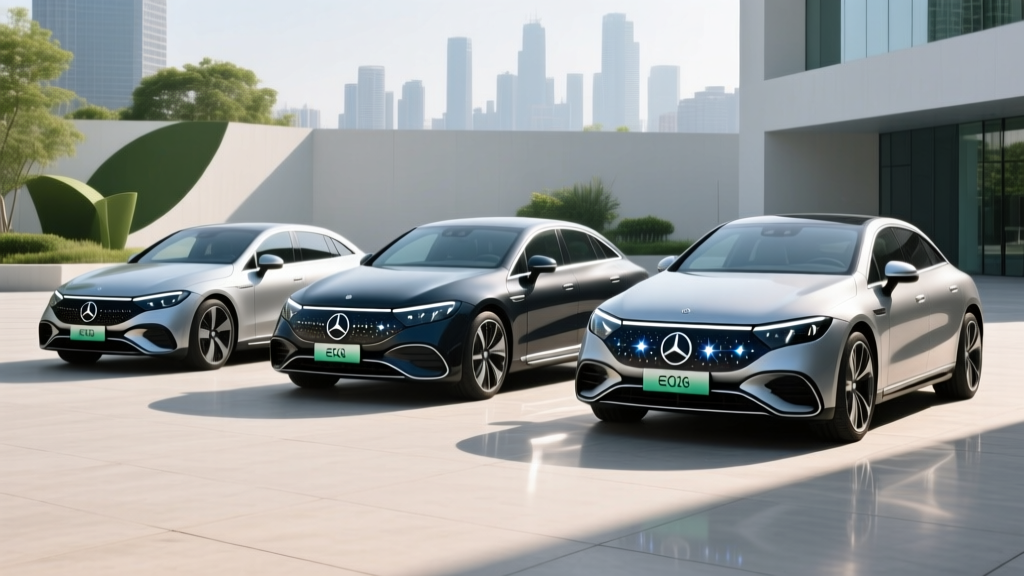
Mercedes-Benz currently offers three core EQ electric vehicles in the U.S.: the EQB compact SUV (starting ~$54,200, EPA 251 mi), the EQE sedan (~$76,000, EPA 305 mi), and the flagship EQS sedan (~$105,550, EPA 390 mi). None currently qualify for the full $7,500 federal §30D tax credit due to battery-sourcing and critical-mineral requirements — a significant factor at these price points. Mercedes-Benz electric cars excel in ride refinement, interior technology, and DC fast-charging speeds (up to 200 kW on the EQS), but they carry premium pricing, steeper insurance costs, and real-world range that falls 10–18% below EPA stickers on highway drives. They make the most sense for buyers with reliable home Level 2 charging who prioritize luxury over maximum federal incentive eligibility.
The 2026 Mercedes-Benz EQ Lineup at a Glance
Mercedes has consolidated its EV strategy around the dedicated EVA platform for its larger sedans and a modified MFA2 architecture for the compact EQB. Here is how the three main models stack up on the specs that matter most to buyers.
| Spec | EQB 350 4MATIC | EQE 350+ | EQS 450+ |
|---|---|---|---|
| Base MSRP | $54,200 | $76,050 | $105,550 |
| EPA Range | 251 mi | 305 mi | 390 mi |
| Battery (usable) | 66.5 kWh (NMC) | 90.6 kWh (NMC) | 118 kWh (NMC) |
| Peak DC Fast Charge | 100 kW | 170 kW | 200 kW |
| 10–80% DC Time | ~32 min | ~32 min | ~31 min |
| Level 2 Rate | 9.6 kW | 9.6 kW | 9.6 kW |
| 0–60 mph | 5.8 sec | 6.2 sec | 5.9 sec |
| Horsepower | 288 hp | 288 hp | 355 hp |
| MPGe (combined) | 83 MPGe | 94 MPGe | 97 MPGe |
| Drivetrain | AWD | RWD | RWD |
| Battery Warranty | 8 yr / 100,000 mi | 8 yr / 100,000 mi | 8 yr / 100,000 mi |
Real-World Range Reality Check
EPA estimates assume a mix of city and highway driving at moderate temperatures. In our experience and consistent with independent testing, expect the following in real-world conditions:
- EQS 450+: EPA 390 mi → ~330–350 mi highway at 70 mph; ~290–310 mi in freezing weather with cabin heat.
- EQE 350+: EPA 305 mi → ~255–275 mi highway; ~225–245 mi in cold conditions.
- EQB 350: EPA 251 mi → ~210–225 mi highway; ~180–200 mi in cold. The EQB's smaller battery and boxy aero make it the most range-sensitive of the three.
Source: fueleconomy.gov for official EPA figures.
Charging Speeds and What They Mean for Daily Life
The headline DC fast-charge numbers (100–200 kW) tell only part of the story. Mercedes uses NMC battery chemistry across the EQ lineup, which supports robust charge rates in the mid-state-of-charge window but tapers noticeably above 80% SoC to protect cell longevity.
| Level | Power | EQS Miles/Hour | Best For |
|---|---|---|---|
| Level 1 (120V) | ~1.4 kW | ~4 mi/hr | Emergency / overnight top-off |
| Level 2 (240V, 40A) | 9.6 kW | ~28 mi/hr | Daily home charging |
| DC Fast (EQS peak) | 200 kW | ~180 mi in 15 min (10–50%) | Road trips |
| DC Fast (EQE peak) | 170 kW | ~150 mi in 15 min (10–50%) | Road trips |
| DC Fast (EQB peak) | 100 kW | ~90 mi in 15 min (10–50%) | Road trips |
Charge-curve insight: The EQS sustains near-peak 200 kW rates only between roughly 10–45% SoC. From 45–80%, power steps down progressively to ~80–100 kW. That 10–80% time of ~31 minutes is respectable, but if you're in a hurry on a road trip, the most efficient strategy is to charge from 10% to ~55% (about 15 minutes, adding roughly 200 miles), then drive on. Charging from 80–100% at a DC fast charger is painfully slow — plan to do that at home on Level 2.
All three models use the CCS1 connector standard. As of 2026, Mercedes has not adopted the Tesla NACS port natively, though CCS-to-NACS adapters are available for Supercharger access on many networks. Confirm adapter compatibility with your specific model year before relying on Superchargers.
Mercedes-Benz EVs vs. Gas Equivalents: Cost of Ownership
The sticker price of a Mercedes-Benz electric car is significantly higher than a comparable gas-powered Mercedes. The EQS 450+ starts at $105,550 versus an S 500 sedan at roughly $118,000 — actually a slight EV advantage at the flagship level. But the EQE 350+ at $76,050 compares to an E 350 at ~$58,000, a gap of $18,000 before incentives. Here is a five-year ownership projection comparing the EQE 350+ against the gas E 350 sedan:
| Cost Category (5 years) | EQE 350+ (EV) | E 350 (Gas) |
|---|---|---|
| Purchase Price (base) | $76,050 | $58,000 |
| Federal Tax Credit (§30D) | $0 (sourcing rules) | $0 |
| Fuel/Energy (60,000 mi) | $4,200 (home L2 avg) | $9,600 (premium gas, 26 mpg) |
| Maintenance | $1,800 | $4,500 |
| Insurance (avg) | $12,500 | $9,800 |
| Estimated Depreciation | $32,000 | $24,000 |
| Total 5-Year Cost | $126,550 | $105,900 |
Key takeaway: The EQE saves roughly $8,100 on fuel and maintenance over five years, but that is overwhelmed by a $18,050 higher purchase price, $2,700 more in insurance, and roughly $8,000 more in depreciation. The total cost of ownership gap is approximately $20,650 in favor of the gas E 350 over five years. The math improves if you qualify for state-level incentives or have cheap solar-powered home charging, but at the federal level, the §30D credit's battery-sourcing and critical-mineral requirements currently exclude most Mercedes-Benz EVs. Always verify current eligibility at IRS.gov before purchasing.
Federal Tax Credit Eligibility: The Mercedes Problem
The Inflation Reduction Act's §30D clean vehicle credit offers up to $7,500 for qualifying new EVs, but the rules are stringent:
- MSRP cap: Sedans must be under $55,000; SUVs/vans under $80,000. The EQB (SUV class) qualifies on price; the EQE and EQS sedans exceed $55,000.
- Buyer income cap: AGI must not exceed $150,000 (single) / $300,000 (joint).
- Battery sourcing: Increasing percentages of battery components must be manufactured or assembled in North America, and critical minerals must be sourced from the U.S. or FTA partners.
- Final assembly: Must occur in North America. The EQS and EQE are assembled in Sindelfingen, Germany — this alone disqualifies them.
As of 2026, no Mercedes-Benz EQ model qualifies for the full $7,500 federal credit. The EQB's German assembly and battery-sourcing chain also fail to meet current thresholds. This is a meaningful disadvantage against competitors like the Tesla Model S (assembled in Fremont, CA) and the BMW i5, which has partial credit eligibility depending on trim and sourcing updates. Buyers should factor in the full MSRP when budgeting.
Common Misconceptions About Mercedes-Benz EVs
| Myth | Fact |
|---|---|
| "Mercedes EVs get the full $7,500 tax credit." | None currently qualify due to assembly location and battery-sourcing rules. Verify at IRS.gov before purchase. |
| "The EQS charges at 200 kW the entire session." | 200 kW is peak rate at ~10–45% SoC. Sustained average from 10–80% is closer to ~130–140 kW. |
| "EVs need no maintenance." | Tires wear 15–20% faster due to weight and instant torque. Cabin air filters, brake fluid, wipers, and coolant still require service. |
| "The battery will need replacing soon." | Mercedes warranties the battery for 8 years/100,000 miles against degradation below 70% capacity. NMC cells in liquid-cooled packs typically retain 85–90% capacity at 100,000 miles based on industry data. |
| "Autopilot-level features make it self-driving." | Mercedes Driver Assistance Package is SAE Level 2. You must remain engaged, hands on or near the wheel, eyes on the road. Only Mercedes' DRIVE PILOT (Level 3, available in limited markets under 40 mph in specific conditions) approaches conditional automation — and it is not widely available in the U.S. as of 2026. |
SAE Automation Level Reminder
Mercedes' standard Driver Assistance Package (active lane-keeping, adaptive cruise, lane-change assist) is SAE Level 2 — a driver-assist system that requires continuous human supervision. It is not autonomous driving. The driver is legally responsible at all times. Mercedes' DRIVE PILOT system, where available, is certified SAE Level 3 under narrow conditions (mapped highways, under 40 mph, clear weather), allowing the driver to look away — but this is geofenced and limited. No consumer Mercedes is Level 4 or Level 5.
Who Should Buy a Mercedes-Benz Electric Car?
Decision Framework
Choose the EQB 350 if: You want a compact luxury electric SUV for commuting and city driving, need third-row seating (it's one of the few EVs offering it), and can accept 210–225 real-world highway miles. Best for households with a second car for longer trips.
Choose the EQE 350+ if: You're a current E-Class buyer ready to electrify, have home Level 2 charging, drive under 250 miles daily, and value ride quality and cabin quietness over maximum range-per-dollar. Accept that total ownership cost will exceed the gas E-Class by ~$20,000 over five years.
Choose the EQS 450+ if: You're an S-Class buyer who wants flagship electric luxury, 330+ real-world highway miles, the fastest DC charging in the lineup, and the latest MBUX Hyperscreen tech. The price premium over the gas S 500 is actually modest, and the driving refinement is exceptional.
Look elsewhere if: Federal tax credit eligibility is a deal-breaker (consider Tesla, Ford, or GM models), you lack home charging access and your area has sparse DC fast-charging infrastructure, or you need maximum range per dollar (Hyundai Ioniq 6 offers 361 EPA miles starting ~$42,000).
First-Time EV Buyer Essentials for Mercedes Owners
If this is your first electric vehicle, here is what you need to plan for before taking delivery:
Home Charging Setup
A Level 2 home charger is nearly essential for a Mercedes EQ vehicle. The 9.6 kW onboard charger means a full EQS battery (118 kWh) charges from 10–100% in roughly 11 hours on Level 2 — perfect for overnight. Budget $800–$1,500 for a quality Level 2 EVSE (ChargePoint Home Flex, Emporia Level 2, or Mercedes-branded wallbox) and $500–$2,500 for electrician installation, depending on whether your panel needs a 240V/50A circuit run. Older homes may require a panel upgrade ($1,500–$3,500), so get a quote before committing. A licensed electrician should make the final call on panel capacity.
Cold-Weather Considerations
NMC batteries in cold temperatures (below 32°F) lose 15–25% of usable range due to increased internal resistance and cabin heating demands. The EQ lineup includes a heat pump (standard on EQS/EQE), which recovers some efficiency versus resistive heating, but you should still precondition the battery while plugged in before winter drives. Mercedes' MBUX navigation will automatically precondition the battery when a DC fast charger is set as your destination — always use this feature to maximize charge speed.
Insurance Costs
EV insurance premiums run 15–30% higher than equivalent gas vehicles, driven by higher repair costs (specialized high-voltage components, aluminum body panels, recalibration of ADAS sensors after bodywork). Expect annual premiums of $2,200–$3,000 for an EQE and $2,800–$3,800 for an EQS, depending on your profile. Get quotes before purchasing.
Frequently Asked Questions
Do Mercedes-Benz electric cars qualify for any tax incentives in 2026?
At the federal level, no current EQ model qualifies for the §30D credit due to foreign assembly and battery-sourcing requirements. Some states (California, Colorado, New York, and others) offer their own EV rebates or credits that may apply regardless of sourcing — check your state's energy or DMV website. Mercedes has announced plans to localize some battery production, which could change eligibility in future model years.
How long does a Mercedes EQ battery last?
Mercedes warranties the high-voltage battery for 8 years or 100,000 miles, guaranteeing it will retain at least 70% of original capacity. Industry data from similar NMC liquid-cooled packs suggests 85–92% retention at 100,000 miles under normal use. Full battery replacement costs are significant — estimated $20,000–$35,000 depending on the model — but are rarely needed within the first decade.
Can I use Tesla Superchargers with a Mercedes EQ?
Not natively. Mercedes EQ vehicles use the CCS1 connector. Some charging networks offer CCS-to-NACS adapters, but compatibility and safety vary. Mercedes has signaled future NACS adoption for upcoming models, but the 2026 EQ lineup remains CCS. For road trips, Electrify America, EVgo, and ChargePoint DC stations remain the primary networks.
Is the EQS worth the premium over the EQE?
If budget allows, the EQS delivers meaningfully more range (390 vs 305 EPA miles), a larger battery (118 vs 90.6 kWh), faster DC charging (200 vs 170 kW), and substantially more rear-seat space and trunk volume. For frequent road trippers, the range and charging-speed advantage is tangible. For daily commuters under 50 miles, the EQE offers 90% of the experience at $29,500 less.
How does Mercedes' EV reliability compare to Tesla or BMW?
Mercedes EQ models have shown average to slightly below-average first-year reliability in industry surveys, with most complaints centered on MBUX software glitches and sensor calibration rather than powertrain issues. Tesla's build quality has improved but remains inconsistent; BMW's i4 and i5 have rated well. For long-term powertrain durability, all three manufacturers' liquid-cooled NMC packs show comparable degradation curves. Check IIHS and NHTSA for crash-test ratings on specific model years.