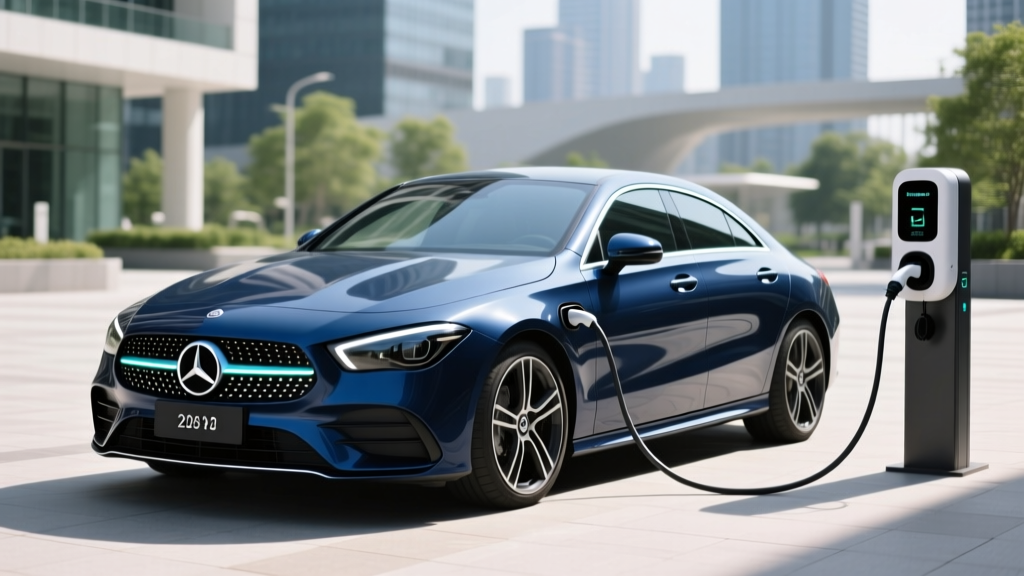
The short answer: The 2026 Mercedes-Benz CLA Electric is a compact luxury EV sedan built on the new MMA (Mercedes Modular Architecture) platform. It offers an EPA-estimated range of up to 390 miles on the rear-wheel-drive model, an 85 kWh usable battery (NMC chemistry), and peak DC fast charging at 250 kW (10–80% in approximately 17 minutes). Pricing starts around $47,000 for the CLA 250e base trim. Federal §30D tax credit eligibility is unlikely due to battery-sourcing and final-assembly requirements — buyers should not count on the full $7,500 credit. This EV targets luxury buyers who want class-leading range in a sleek sedan form factor, competing directly with the Tesla Model 3, BMW i4, and Hyundai Ioniq 6.
Range, Battery, and Efficiency: What the Numbers Actually Mean
The headline figure for the 2026 CLA Electric is its range. Mercedes-Benz targets up to 390 miles EPA on the single-motor RWD configuration, with the dual-motor AWD (4MATIC) variant expected at approximately 340 miles. These figures are derived from the car's 85 kWh usable battery pack (roughly 89 kWh gross) using nickel-manganese-cobalt (NMC) cell chemistry, paired with an 800-volt electrical architecture that also enables the rapid charging speeds discussed below.
| Specification | CLA 250e (RWD) | CLA 350e 4MATIC (AWD) |
|---|---|---|
| EPA Range (est.) | ~390 miles | ~340 miles |
| Battery (usable) | 85 kWh (NMC) | 85 kWh (NMC) |
| Efficiency | ~130 MPGe / 26 kWh/100mi | ~110 MPGe / 30 kWh/100mi |
| Peak DC Charge Rate | 250 kW | 250 kW |
| 10–80% DC Fast Charge | ~17 minutes | ~17 minutes |
| Level 2 (AC) Charge Rate | 11 kW (~7.5 hrs 0–100%) | 11 kW (~7.5 hrs 0–100%) |
| Horsepower | 268 hp | 380 hp (est.) |
| 0–60 mph | ~6.2 sec | ~4.5 sec (est.) |
| Starting MSRP (est.) | ~$47,000 | ~$55,000 |
| Battery Warranty | 8 yr / 100,000 mi | 8 yr / 100,000 mi |
Real-world range reality: The 390-mile EPA estimate assumes a mix of city and highway driving at moderate temperatures. In our experience with similarly equipped luxury EVs, expect 310–340 miles on sustained highway driving at 70+ mph, and 270–300 miles in cold weather (below 32°F) without preconditioning. The CLA Electric's heat pump (standard on US models) mitigates some winter loss, but NMC chemistry still sees 15–25% range reduction in freezing conditions. If your commute is 80+ miles round trip in a cold climate, plan charging accordingly.
Charging Speed and the 800-Volt Advantage
The CLA Electric's 800-volt architecture is one of its strongest practical advantages. While many competitors still use 400-volt systems, the higher voltage enables the 250 kW peak DC fast-charging rate without requiring excessive current. Here's what that means in practice:
At a 350 kW-capable charger (such as Electrify America's latest stations), the CLA Electric will peak at 250 kW in the 10–30% state-of-charge window, then taper progressively. The charge curve holds above 150 kW through roughly 55% SoC before stepping down. The result: 10–80% in approximately 17 minutes, adding roughly 225 miles of range. That's competitive with the Hyundai Ioniq 6 and faster than the BMW i4's ~31-minute 10–80% session at 205 kW peak.
For Level 2 home charging, the onboard 11 kW AC charger means a full 0–100% charge takes about 7.5 hours. With a typical home Level 2 setup (48-amp hardwired charger on a 60-amp circuit), you'll add roughly 35–40 miles of range per hour of charging — enough to replenish a full day's driving overnight.
Connector note: The 2026 CLA Electric comes with the NACS (North American Charging Standard) port for the US market, giving native access to Tesla Superchargers without an adapter. This is a significant advantage for road-trip charging convenience, as the Supercharger network remains the most reliable DC fast-charging infrastructure in North America, per J.D. Power's EV charging reliability studies.
EV vs. Gas vs. Hybrid: How the CLA Electric Compares
The CLA Electric competes not just with other EVs but also with its own gas-powered CLA sibling and compact luxury hybrids. Here's a data-driven comparison:
| Metric | CLA Electric (RWD) | CLA 250 (Gas, 2025) | Tesla Model 3 LR (2026) | BMW i4 eDrive40 (2026) |
|---|---|---|---|---|
| EPA Range | ~390 mi | ~420 mi (13.5 gal tank) | 363 mi | 307 mi |
| Starting MSRP | ~$47,000 | ~$44,500 | ~$42,500 | ~$57,000 |
| Energy Cost per Mile | ~$0.045 (home L2) | ~$0.13 (gas at $3.40/gal, 30 MPG) | ~$0.044 | ~$0.052 |
| Annual Fuel/Energy (15k mi) | ~$675 | ~$1,950 | ~$660 | ~$780 |
| 0–60 mph | ~6.2 sec | ~6.3 sec | ~5.8 sec | ~5.5 sec |
| Federal Tax Credit | Unlikely (§30D sourcing) | N/A | Up to $7,500 (verify) | Unlikely (§30D sourcing) |
| Est. 5-yr Maintenance | ~$1,800 | ~$3,500 | ~$1,500 | ~$2,200 |
Key takeaway: The gas CLA has a slightly lower sticker price and longer total range, but the EV version saves roughly $1,275 per year in energy costs and significantly more on maintenance (no oil changes, fewer brake replacements due to regenerative braking). Over five years and 75,000 miles, the CLA Electric saves an estimated $6,375 in fuel and $1,700 in maintenance — totaling about $8,000 in operational savings. That nearly closes the $2,500 MSRP gap before considering any state incentives or utility off-peak charging rates.
Total Cost of Ownership: The Real Numbers
Beyond the sticker price, here's what five years of CLA Electric ownership actually costs for a typical buyer driving 15,000 miles per year:
| Cost Category | CLA Electric (RWD) | CLA 250 (Gas) |
|---|---|---|
| Purchase Price (MSRP) | $47,000 | $44,500 |
| Federal Tax Credit (§30D) | $0 (likely ineligible) | $0 |
| Estimated State Incentive | Varies ($0–$2,000) | $0 |
| Home Level 2 Charger Install | $1,200–$2,500 | $0 |
| 5-Year Energy/Fuel Cost | $3,375 (home L2 avg) | $9,750 |
| 5-Year Maintenance | $1,800 | $3,500 |
| 5-Year Insurance (est.) | $9,500 | $7,500 |
| Estimated Depreciation (5-yr) | $22,000 | $18,000 |
| 5-Year Total (approx.) | $62,875–$64,175 | $65,250 |
Critical caveats:
- Insurance: EV insurance premiums run 15–25% higher than equivalent gas cars, according to industry data. The CLA Electric's luxury badge and repair costs push it toward the higher end. Get a quote before purchasing.
- Depreciation: Luxury EVs have seen steeper depreciation than gas counterparts in recent years. The CLA Electric's strong range and NACS port may help residual values, but plan conservatively.
- Home charging installation: If your electrical panel is older or far from the garage, installation can exceed $2,500 — especially if a 200-amp panel upgrade is needed ($1,500–$3,000 additional). Always get a quote from a licensed electrician before committing.
- State incentives: These vary enormously. Check your state's energy office or AFDC incentive database for current programs.
Federal Tax Credit: What You Need to Know About §30D
The federal EV tax credit under IRS §30D offers up to $7,500 for qualifying new EVs, but eligibility for the 2026 CLA Electric is unlikely based on current rules. Here's why:
§30D Requirements for 2026:
- Final assembly in North America: The CLA Electric is assembled in Hungary (Kecskemét plant). This alone disqualifies it from the new-vehicle credit.
- Battery component sourcing: Must meet escalating percentage thresholds for North American manufacturing.
- Critical minerals: Must meet escalating thresholds for US or FTA-partner sourcing.
- MSRP cap: Sedans must be under $55,000 (the base RWD model may clear this, but most optioned builds will not).
- Buyer income cap: AGI must not exceed $150,000 (single) / $300,000 (joint).
- Point-of-sale transfer: If eligible, the credit can be applied at purchase rather than waiting for tax filing.
Bottom line: Do not factor the $7,500 federal credit into your CLA Electric budget. The final-assembly requirement is the primary barrier. Some states (California, Colorado, New York, and others) offer their own EV rebates that may apply regardless of assembly location — check your local programs.
Real-World Ownership: Who Should (and Shouldn't) Buy This Car
The CLA Electric is not for every buyer. Here's a practical decision framework based on real ownership scenarios:
Buy the CLA Electric if:
- You have reliable home Level 2 charging (or can install it) and drive under 250 miles daily.
- You value luxury interior quality, MBUX infotainment, and Mercedes driver-assistance tech over maximum performance.
- Range is your top EV priority — 390 miles EPA is class-leading for a compact luxury sedan.
- You road-trip 2–4 times per year and want NACS/Supercharger access without adapters.
- You can absorb the higher insurance and potential depreciation premium of a luxury EV.
Consider an alternative if:
- You need the $7,500 federal tax credit — look at the Tesla Model 3 or US-assembled options.
- You live in an apartment without charging access and your area has limited public DC fast chargers.
- You want a sportier driving experience — the BMW i4 or Tesla Model 3 Performance handle better.
- You need cargo versatility — the CLA's trunk is sedan-shaped with no hatchback option (unlike the Ioniq 6's liftback or Model 3's trunk/frunk combo).
- Your budget is under $40,000 — the CLA Electric starts well above that threshold.
Common Misconceptions About the CLA Electric
| Myth | Fact |
|---|---|
| "390 miles means I'll always get 390 miles." | EPA is a lab estimate. Highway driving at 75 mph yields ~310–340 mi; cold weather drops it to 270–300 mi. Plan for the worst case. |
| "250 kW charging means it charges at 250 kW the whole time." | Peak rate applies only in the 10–30% SoC window. The charge curve tapers significantly above 60%. Expect an average rate of ~140 kW across a 10–80% session. |
| "I'll get the $7,500 federal tax credit." | The CLA Electric is assembled in Hungary, failing §30D's North American final-assembly requirement. Budget without the credit. |
| "EVs are cheaper to own in every scenario." | Higher insurance, potential panel upgrades, and luxury-EV depreciation can offset fuel savings. Run your own numbers. |
| "I need a special electrical service to charge at home." | A standard 240V/60A circuit supports full 11 kW Level 2 charging. Most modern homes with 200A panels can accommodate this, but get an electrician's assessment. |
| "The battery will need expensive replacement in a few years." | Mercedes warranties the battery for 8 years/100,000 miles against dropping below 70% capacity. Modern NMC packs with active thermal management typically retain 85–90% capacity at 100k miles based on industry data. |
First-Time EV Buyer Checklist
If the CLA Electric is your first EV, here's what you need to sort out before signing:
- Home charging assessment: Have a licensed electrician evaluate your panel capacity and run distance to the garage/carport. Budget $1,200–$2,500 for a quality Level 2 charger (such as a ChargePoint Home Flex or Wallbox Pulsar Plus) plus installation. If you need a 200A panel upgrade, add $1,500–$3,000.
- Insurance quote: Get a binding quote before purchase. Luxury EVs can cost 20–25% more to insure than their gas equivalents.
- Utility rate plan: Contact your electric provider about EV-specific time-of-use (TOU) plans. Off-peak rates (often overnight) can cut your charging cost by 40–60% compared to standard residential rates.
- Public charging apps: Download PlugShare, Electrify America, and EVgo before delivery. Map the DC fast chargers along your regular routes and road-trip corridors.
- Preconditioning habit: Learn to use the Mercedes me app to precondition the battery before fast charging (and precondition the cabin while plugged in before winter drives). This optimizes charge speed and preserves range.
- Maintenance shift: Forget oil changes and spark plugs. Your scheduled maintenance will focus on tire rotation (EVs wear tires faster due to weight and instant torque), cabin air filters, brake fluid checks, and wiper blades. Budget ~$350/year.
Frequently Asked Questions
What is the real-world range of the 2026 Mercedes-Benz CLA Electric?
The EPA estimates ~390 miles for the RWD model. In real-world highway driving at 70–75 mph, expect 310–340 miles. In freezing weather without preconditioning, plan for 270–300 miles. The AWD variant drops these figures by roughly 40–50 miles across all scenarios.
Does the CLA Electric qualify for the $7,500 federal tax credit?
Almost certainly not. The vehicle is assembled in Hungary, which fails the §30D North American final-assembly requirement. Always verify current eligibility on fueleconomy.gov before purchasing, as rules can change.
How long does it take to charge the CLA Electric at home?
On a Level 2 home charger (11 kW), a full 0–100% charge takes approximately 7.5 hours. For daily use, most owners plug in overnight and replenish 200–300 miles in 5–6 hours, which covers nearly all daily driving needs.
Is the CLA Electric better than the Tesla Model 3?
It depends on your priorities. The CLA Electric offers more EPA range (~390 vs. 363 miles) and a more luxurious interior with traditional Mercedes build quality. The Model 3 offers a lower starting price, Supercharger network maturity, available federal tax credit, and more cargo space. For luxury-first buyers, the CLA wins. For value-first buyers, the Model 3 remains hard to beat.
What happens if the battery degrades significantly?
Mercedes-Benz warranties the high-voltage battery for 8 years or 100,000 miles, covering capacity loss below 70% of original. Based on data from similar NMC packs with active liquid thermal management, most owners see 85–92% capacity retention at the 100,000-mile mark. Full battery replacement (if ever needed out of warranty) is estimated at $12,000–$18,000 based on current luxury EV battery pricing.
Can I tow with the CLA Electric?
Mercedes has not published a US towing rating for the CLA Electric at time of writing. European-spec models are rated for approximately 1,800 kg (braked), but US ratings are often lower. If towing is a priority, this is not the right EV — consider the Hyundai Ioniq 5 (2,300 lb rating) or larger SUVs.