The Quick Answer: Is a Mercedes-Benz AMG Electric Worth It?
If you're researching a Mercedes-Benz AMG electric vehicle in 2026, you're looking at three core models: the EQE 43/53 AMG ($107,000–$130,000), the EQS 450/53 AMG ($128,000–$165,000), and the flagship GT 63 4MATIC+ ($180,000+). These deliver 469–751 horsepower, EPA ranges of 230–305 miles, and 10–80% DC fast charging in 28–31 minutes at peak rates up to 200 kW. They qualify for zero federal tax credits due to MSRP caps and battery sourcing rules. Choose an AMG electric if you want supercar-level acceleration with daily-driver comfort and have reliable home Level 2 charging. Skip it if maximum range-per-dollar or federal incentives are your priority.
2026 Mercedes-Benz AMG Electric Lineup at a Glance
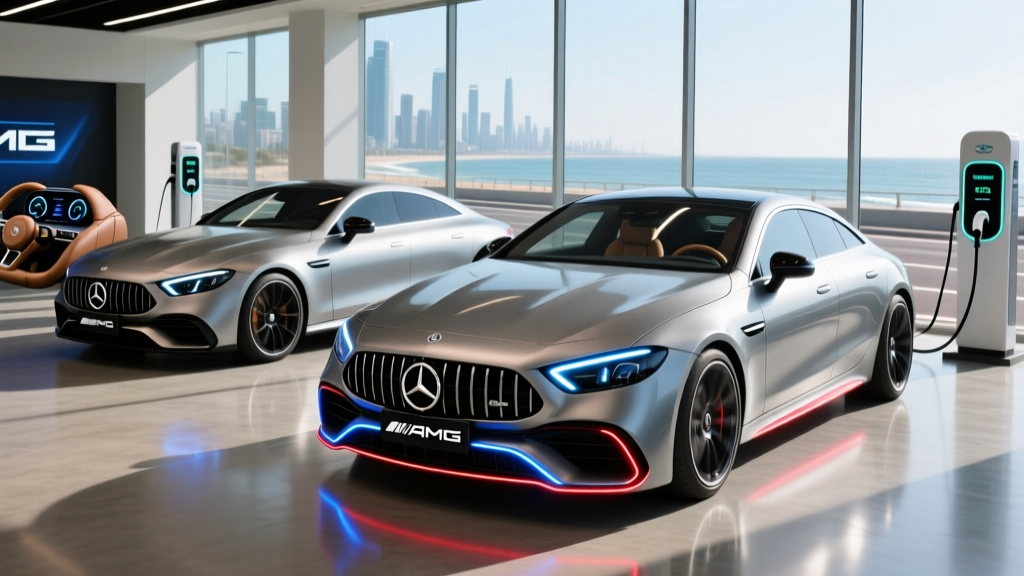
Mercedes-AMG's electric portfolio spans three distinct vehicle classes, each tuned for a different flavor of performance. All share AMG-specific drive modes (Slippery, Comfort, Sport, Sport+, Race), rear-axle steering, and AMG Ride Control+ adaptive damping. Here's how the numbers stack up across the current lineup.
| Specification | EQE 43 AMG | EQE 53 AMG | EQS 53 AMG | GT 63 4MATIC+ |
|---|---|---|---|---|
| Base MSRP | $107,900 | $124,900 | $148,700 | $182,500 |
| Horsepower | 469 hp | 617 hp | 649 hp (751 w/ AMG Dynamic Plus) | 751 hp |
| 0–60 mph | 4.0 sec | 3.2 sec | 3.4 sec (2.7 w/ Dynamic Plus) | 2.7 sec |
| Usable Battery | 90.6 kWh (NMC) | 90.6 kWh (NMC) | 108.4 kWh (NMC) | 94.4 kWh (NMC) |
| EPA Range | 230 mi | 230 mi | 277 mi | 268 mi |
| MPGe (combined) | 73 MPGe | 70 MPGe | 78 MPGe | 72 MPGe |
| Max DC Charge Rate | 170 kW | 170 kW | 200 kW | 200 kW |
| 10–80% DC Charge | ~31 min | ~31 min | ~31 min | ~28 min |
| Level 2 Rate | 9.6 kW | 9.6 kW | 9.6 kW | 11 kW |
| Drivetrain | AWD | AWD | AWD | AWD |
| Battery Warranty | 10 yr / 155,000 mi | 10 yr / 155,000 mi | 10 yr / 155,000 mi | 10 yr / 155,000 mi |
Real-World Range vs. EPA Sticker
AMG performance tuning trades efficiency for power. Expect the following real-world range from these EPA figures:
- Highway driving (70–75 mph): Subtract 15–20%. The EQE 53 AMG's 230 EPA miles drops to roughly 185–195 miles at sustained highway speed.
- Cold weather (below 32°F): Subtract an additional 20–30%. An EQS 53 AMG rated at 277 miles may deliver 195–220 miles in freezing temperatures without preconditioning.
- Sport/Race mode driving: Aggressive acceleration and high-speed regen cycling can reduce range by 25–35% versus Comfort mode.
- DC charging taper: Peak 170–200 kW holds only from roughly 10–40% SoC. Above 80%, charge rate drops below 50 kW, adding 15+ minutes for the final 20%.
AMG Electric vs. Gas AMG: The Real Cost Comparison
The most common question from AMG buyers: does going electric actually save money versus a gas-powered E 63 S or GT 63? Let's run the numbers over a 5-year / 60,000-mile ownership period, comparing the EQE 53 AMG against the gasoline AMG E 63 S.
| Cost Category | EQE 53 AMG (Electric) | AMG E 63 S (Gas) |
|---|---|---|
| Base MSRP | $124,900 | $119,600 |
| Federal Tax Credit (§30D) | $0 (exceeds MSRP cap, sourcing fails) | N/A |
| Estimated Insurance (5 yr) | $18,500 | $16,200 |
| Energy/Fuel (60k mi) | $4,800 (home L2 @ $0.14/kWh) | $12,600 (premium @ $4.50/gal, 16 MPG) |
| Maintenance (5 yr) | $2,100 (tires, cabin filter, fluid top-offs) | $6,800 (oil, brakes, filters, spark plugs) |
| Estimated Depreciation (5 yr) | $62,450 (~50%) | $53,820 (~45%) |
| Total 5-Year Cost | $137,850 | $133,620 |
The verdict: The EQE 53 AMG costs roughly $4,200 more over five years, driven primarily by steeper depreciation and higher insurance premiums. However, you save approximately $7,800 on fuel and $4,700 on maintenance. If your electricity rate is below $0.10/kWh (common with time-of-use plans in the Midwest and South), the energy savings widen to nearly $10,000, nearly closing the gap. The electric AMG wins on daily operating cost but loses on residual value — a pattern consistent across luxury EVs in 2026.
Charging an AMG Electric: What You Actually Need
AMG electric models demand robust home charging infrastructure. Here's what ownership looks like in practice.
Home Level 2 Charging (The Daily Reality)
All AMG electrics support 9.6–11 kW Level 2 AC charging via J1772/NACS connector. A full charge from 10% takes:
- EQE AMG (90.6 kWh): ~9.5 hours at 9.6 kW
- EQS AMG (108.4 kWh): ~11.5 hours at 9.6 kW
- GT 63 (94.4 kWh): ~8.5 hours at 11 kW
This means overnight charging works perfectly — plug in at 10 PM, wake up to a full battery. But you need a dedicated 50-amp circuit (60-amp breaker) installed by a licensed electrician. Expect $1,200–$3,500 for the circuit and a quality Level 2 station (ChargePoint Home Flex, Emporia Level 2, or the Mercedes-Benz Home Wallbox at $649). If your home has a 100-amp electrical panel, a panel upgrade to 200 amps may be required — adding $2,000–$4,000.
DC Fast Charging on Road Trips
AMG models peak at 170–200 kW on DC fast chargers using CCS1 (or NACS via adapter on 2025+ models). On a Tesla Supercharger V3 or Electrify America 350 kW station, the charge curve looks like this:
- 10–40% SoC: Sustains near peak (160–195 kW), adding ~150 miles in 15 minutes
- 40–60% SoC: Tapers to 100–130 kW
- 60–80% SoC: Drops to 60–80 kW
- 80–100% SoC: Trickle charge below 40 kW — avoid unless necessary
Practical road-trip strategy: charge from 10% to 70% (~25 minutes) and drive on. Don't wait for 80%+ — the taper makes it inefficient.
Public Charging Access
As of 2026, Mercedes-Benz AMG electric owners can access the Tesla Supercharger network via NACS adapter (included with 2025+ models or available as a $200 accessory for older CCS-equipped vehicles). This adds over 17,000 Supercharger stalls to the existing Electrify America, EVgo, and ChargePoint networks. For AMG owners in rural areas or the Mountain West, Supercharger access is a significant reliability upgrade over CCS-only networks.
Federal Tax Credits: Why AMG Electrics Don't Qualify
This is the single biggest financial surprise for prospective AMG EV buyers. Under current IRS §30D rules, none of the Mercedes-Benz AMG electric models qualify for the $7,500 federal tax credit. Here's why:
§30D Eligibility Requirements vs. AMG Models
- MSRP Cap: Sedans must be under $55,000; SUVs/trucks under $80,000. Every AMG electric starts above $107,000. ❌ Fails.
- Buyer Income Cap: AGI ≤ $150K single / $300K joint. Many AMG buyers exceed this, though it varies. ⚠️ Varies.
- Battery Sourcing: Critical minerals and battery components must meet escalating North American/free-trade-partner thresholds. Mercedes sources NMC cells primarily from CATL (China) and LG Energy Solution (Poland/US), with 2026 mineral sourcing still partially failing the critical-minerals test. ❌ Fails.
- Final Assembly: Must be in North America. The EQE and EQS are assembled in Sindelfingen, Germany; the GT is assembled in Affalterbach, Germany. ❌ Fails.
Bottom line: Budget the full MSRP. No federal credit, and most state incentives (California's CVRP, Colorado's innovative motor vehicle credit) also have MSRP caps that exclude AMG models. Consult a tax professional for your specific situation.
Common Misconceptions About AMG Electric Vehicles
| Myth | Fact |
|---|---|
| "AMG electric cars don't feel like real AMGs" | The EQS 53 with Dynamic Plus Package hits 0–60 in 2.7 seconds with 751 hp and AMG-tuned torque vectoring. The instantaneous torque delivery actually outperforms the gas E 63 S off the line. The sound is synthetic (AMG Sound Experience), which is divisive — some owners love it, others disable it. |
| "The battery will need replacing in 5 years" | NMC batteries in AMG models carry a 10-year/155,000-mile warranty against degradation below 70% capacity. Industry data shows NMC packs losing roughly 8–12% capacity over 100,000 miles under normal use. A replacement battery, if ever needed out of warranty, costs $18,000–$28,000 — but most owners will never face this. |
| "I can charge on any standard outlet" | Level 1 charging (120V, 1.4 kW) adds roughly 3–4 miles per hour. Fully recharging a 90.6 kWh EQE AMG battery from empty would take 65+ hours. Level 1 is an emergency trickle only — you need Level 2 for daily ownership of a large-battery performance EV. |
| "Maintenance-free means zero costs" | No oil changes, but AMG electrics eat tires. The EQE 53 AMG weighs 5,600 lbs with 617 hp of instant torque. Expect to replace high-performance tires (Michelin Pilot Sport EV, Pirelli P Zero) every 18,000–25,000 miles at $1,600–$2,400 per set. Brake wear is minimal thanks to regen, but tire cost is the hidden ownership expense. |
| "All-electric means I'll never visit a dealer" | Mercedes still requires annual cabin-filter replacements, brake-fluid flushes (every 2 years), coolant checks for the thermal management system, and software updates. Budget ~$400–$600/year in dealer visits. |
Decision Framework: Which AMG Electric Is Right for You?
Choose Based on Your Driving Pattern
Choose the EQE 43 AMG if:
- You want AMG badge prestige and 469 hp without the $130K+ price tag
- Your daily commute is under 150 miles round-trip
- You value rear-axle steering and adaptive damping over raw 0–60 times
- Budget target: ~$108K before options
Choose the EQE 53 AMG if:
- You want sub-3.5-second 0–60 performance in a mid-size luxury sedan
- You regularly drive in Sport+ mode and want the 617 hp dual-motor setup
- You have a garage with a 50A circuit for overnight Level 2 charging
- Budget target: ~$125K–$140K with AMG Night Package and Pinnacle Trim
Choose the EQS 53 AMG if:
- You need full-size luxury space (rear-seat comfort, 22 cu ft trunk) with performance
- The 277-mile EPA range gives you enough cushion for 200+ mile highway trips
- You want the MBUX Hyperscreen (56-inch glass dash) as standard
- Budget target: ~$149K–$170K with Executive Rear Seat Package
Choose the GT 63 4MATIC+ (EV) if:
- You're cross-shopping a Porsche Taycan Turbo GT or Tesla Model S Plaid
- 751 hp, 2.7-second 0–60, and AMG Active Ride Control are non-negotiable
- You accept the ~268-mile range as a trade-off for the performance envelope
- Budget target: $182K+ and you're not incentive-dependent
Skip the AMG electric lineup entirely if:
- You lack home charging access — public-only charging a 90+ kWh battery is expensive ($0.35–$0.48/kWh at DC stations = $35–$55 per session) and time-consuming
- You regularly drive 300+ miles in cold weather without stopping
- Federal or state tax credits are a deciding factor in your purchase
- You want maximum range per dollar — a Lucid Air Grand Touring (516 mi EPA, ~$125K) or Tesla Model S Long Range (402 mi EPA, ~$80K) delivers more range at similar or lower cost
First-Time AMG EV Buyer Checklist
If this is your first electric vehicle — especially a high-performance one — here's what to prepare before delivery day:
- Electrical assessment: Have a licensed electrician evaluate your panel capacity. A 200-amp panel handles a 50A EV circuit comfortably. A 100-amp panel likely needs an upgrade ($2,000–$4,000).
- Level 2 charger selection: Order a Mercedes-Benz Home Wallbox ($649, 9.6 kW) or a ChargePoint Home Flex ($699, up to 12 kW) at least two weeks before delivery.
- Utility rate plan: Enroll in a time-of-use (TOU) plan with your utility. Charging overnight at $0.08–$0.12/kWh versus peak rates of $0.25–$0.40/kWh saves $800–$1,500 annually on an AMG's large battery.
- Insurance quotes: Get quotes before signing. AMG electric models carry 15–25% higher premiums than their gas counterparts due to repair costs and battery replacement risk. Expect $3,200–$4,200/year depending on your profile.
- Tire budget: Set aside $2,000/year for high-performance EV-rated tires. The weight and torque of these vehicles accelerate wear significantly.
- Route planning apps: Download A Better Route Planner (ABRP) and the Mercedes me connect app. Preconditioning the battery before DC fast charging (via the app or nav-based preconditioning) can cut 10–80% charge times by 5–8 minutes in cold weather.
AMG Electric Ownership: Frequently Asked Questions
How does the AMG electric driving experience compare to a gas AMG V8?
The instant torque delivery is the biggest difference — an EQE 53 AMG launches with zero lag, while the gas E 63 S needs turbo spool-up and a downshift. The electric AMG feels faster in real-world passing situations (40–70 mph roll-on), even when 0–60 numbers are close. Where gas AMGs win: sustained top-end acceleration above 120 mph, the emotional V8 soundtrack, and lighter curb weight (the EQE 53 weighs 5,600 lbs vs. the E 63 S at 4,500 lbs). Braking feel also differs — regen blends with mechanical brakes, which takes adaptation.
Can I tow with a Mercedes-Benz AMG electric?
The EQS 53 AMG is rated for 3,500 lbs of towing capacity when equipped with the optional trailer hitch. The EQE AMG models are not rated for towing in the US market. The GT 63 EV is not intended for towing. If towing is a priority, look at the Rivian R1T or Ford F-150 Lightning instead.
What happens to the AMG battery in extreme heat or cold?
All AMG electrics use active liquid thermal management. In extreme heat (100°F+), the system pre-cools the NMC pack to protect cell longevity, which may slightly reduce range as energy diverts to cooling. In extreme cold (below 20°F), range drops 20–30% and DC fast-charge speeds are reduced until the battery warms. Always use preconditioning (via Mercedes me app or navigation-set departure time) before fast charging in cold weather — it can restore charge speed by 30–40%.
Is the Mercedes me connect app reliable for managing charging?
The 2026 version of Mercedes me connect has improved significantly over earlier iterations. You can set charge schedules, monitor SoC, precondition the cabin and battery, and locate nearby chargers. However, third-party apps like A Better Route Planner (ABRP) offer superior route planning with elevation, wind, and temperature modeling. Most owners use both.
What's the resale value outlook for AMG electric models?
Luxury EV depreciation remains steep in 2026. According to Kelley Blue Book and iSeeCars data, AMG electric sedans retain approximately 45–52% of MSRP after three years, compared to 55–60% for gas AMG equivalents. The GT 63 EV, being lower-volume and more exclusive, may hold value slightly better. If resale value is a top concern, leasing (with Mercedes-Benz Financial) can shift depreciation risk to the lessor.