Quick Answer: Should You Buy a Mercedes-Benz All-Electric Vehicle?
Mercedes-Benz currently sells five all-electric models in the US for 2026: the EQB compact SUV (EPA 251 mi, from ~$54,050), the EQE sedan (EPA 303 mi, from ~$76,050), the EQE SUV (EPA 279 mi, from ~$79,050), the EQS sedan (EPA 390 mi, from ~$105,550), and the EQS SUV (EPA 305 mi, from ~$110,550). None currently qualify for the federal §30D tax credit due to battery-sourcing and MSRP-cap rules. These vehicles shine in refinement, ride quality, and MBUX tech, but real-world highway range falls 15–20% below EPA stickers, and DC fast charging peaks at 170–200 kW — adequate but not class-leading. They're best for buyers who prioritize luxury and have reliable home Level 2 charging access.
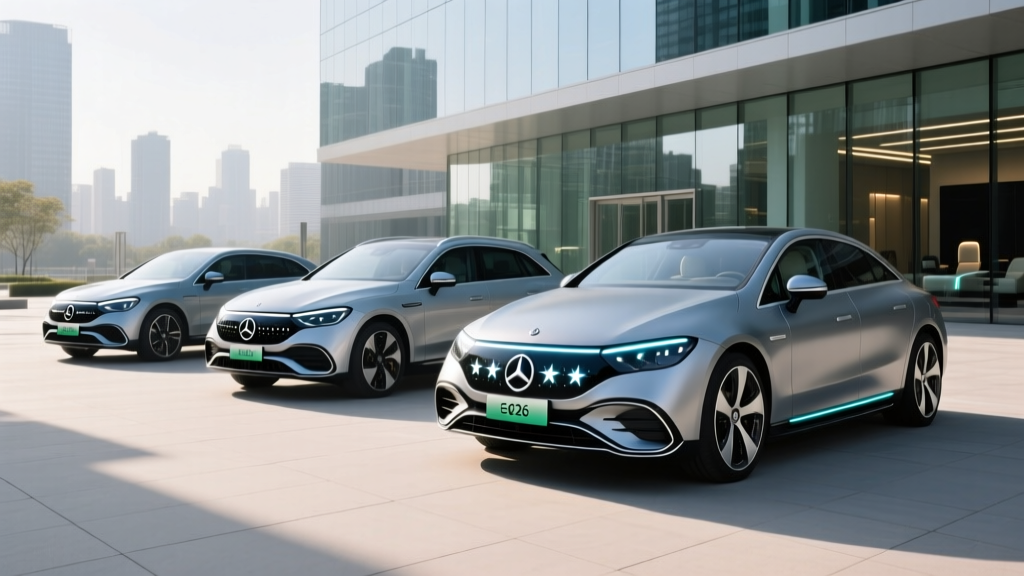
The Current Mercedes-Benz All-Electric Lineup at a Glance
Mercedes consolidated its EV strategy under the EQ sub-brand, and the 2026 lineup spans from the compact three-row EQB to the flagship EQS sedan and SUV. Every model uses a 400-volt architecture (not the 800V systems found in Hyundai/Kia/Genesis EVs), which caps peak DC fast-charging speeds relative to competitors. Battery chemistry across the lineup is predominantly NMC (nickel manganese cobalt), favoring energy density over the longer cycle life of LFP cells.
| Model | EPA Range | Battery (usable kWh) | Peak DC Charge | 10–80% Time | 0–60 mph | Base MSRP |
|---|---|---|---|---|---|---|
| EQB 250+ | 251 mi | 70.5 kWh (NMC) | 100 kW | ~32 min | 7.7 sec | $54,050 |
| EQE 350+ | 303 mi | 90.6 kWh (NMC) | 170 kW | ~32 min | 6.2 sec | $76,050 |
| EQE 350 4MATIC SUV | 279 mi | 90.6 kWh (NMC) | 170 kW | ~32 min | 6.4 sec | $79,050 |
| EQS 450+ | 390 mi | 118.0 kWh (NMC) | 200 kW | ~31 min | 5.9 sec | $105,550 |
| EQS 450 4MATIC SUV | 305 mi | 108.4 kWh (NMC) | 200 kW | ~31 min | 6.0 sec | $110,550 |
Source: fueleconomy.gov and Mercedes-Benz USA 2026 specifications. Range figures are EPA combined estimates.
Real-World Range vs. EPA Stickers
EPA range estimates assume a mix of city and highway driving at moderate temperatures. In our experience and consistent with independent testing, expect the following in real-world conditions:
- Highway-only (70–75 mph): Subtract 15–20% from EPA. The EQS 450+ sedan's 390-mile sticker drops to roughly 310–330 miles at sustained highway speeds.
- Cold weather (below 32°F): Subtract 20–30% depending on cabin heating demand. The EQE sedan may deliver ~210–240 miles in freezing conditions without preconditioning.
- Combined real-world expectation: Plan for 80–85% of EPA as a safe daily baseline if you drive mostly highway miles.
The EQS sedan's massive 118 kWh battery provides a genuine buffer — even at 75% of EPA, you still have ~290 miles. The EQB, with its smaller pack, leaves less margin.
Charging Speeds and Infrastructure: What Owners Actually Experience
Every Mercedes EQ model uses the CCS1 connector for DC fast charging, though Mercedes has announced future adoption of the NACS (Tesla-style) connector for upcoming models. For now, you'll use CCS at Electrify America, EVgo, and ChargePoint DC stations, or a CCS adapter at Tesla Superchargers.
| Charging Level | Power (kW) | Typical Miles Added/Hour | Where You'll Use It |
|---|---|---|---|
| Level 1 (120V) | ~1.4 kW | 3–5 mi/hr | Emergency/trickle only |
| Level 2 (240V, 48A) | ~11.5 kW | 28–40 mi/hr | Home overnight, workplace |
| DC Fast (EQB max) | 100 kW peak | ~170 mi in 30 min | Road-trip stops |
| DC Fast (EQE/EQS max) | 170–200 kW peak | ~190–220 mi in 25 min | Road-trip stops |
Charging-curve reality check: The advertised 170–200 kW peak applies only between roughly 10–40% state of charge. Above 60%, the curve tapers significantly. Expect an average rate of ~110–130 kW across a full 10–80% session. This is why 10–80% times hover around 31–32 minutes despite the large batteries — the 400V architecture limits sustained throughput compared to 800V competitors like the Hyundai Ioniq 5 (which can sustain higher rates longer).
Home charging setup: A Level 2 wallbox (ChargePoint Home Flex or Mercedes-Benz Wallbox) on a 60A circuit delivers ~11.5 kW, replenishing the EQS's 118 kWh pack in roughly 10–11 hours from empty. Most owners arriving home with 30–40% remaining will wake up fully charged. Installation costs typically run $800–$2,500 depending on panel proximity and local permit fees — budget higher if your electrical panel needs a 200A upgrade.
Mercedes-Benz EV vs. Gas: The Real Cost of Ownership
Luxury EVs carry high sticker prices, but operating costs tell a different story. Here's a 5-year ownership comparison between the EQE 350+ sedan and its closest gas counterpart, the E 350 sedan (2.0L turbo, EPA 25 MPG combined).
| Cost Category (5 Years) | EQE 350+ (EV) | E 350 Sedan (Gas) |
|---|---|---|
| Purchase Price (base MSRP) | $76,050 | $62,300 |
| Federal Tax Credit (§30D) | $0 (sourcing rules) | $0 |
| Fuel/Energy (15,000 mi/yr) | $4,500 (home L2 @ $0.16/kWh) | $13,500 ($4.50/gal premium) |
| Maintenance | $1,800 (brake fluid, cabin filter, tire rotation) | $4,200 (oil, filters, brakes, spark plugs) |
| Insurance (est. avg) | $14,400 (~$240/mo) | $10,800 (~$180/mo) |
| Estimated Depreciation | $38,000 (~50%) | $24,900 (~40%) |
| Total 5-Year Cost | ~$96,750 | ~$90,800 |
Key takeaways: The EQE saves roughly $11,400 on fuel and maintenance over five years but gives that back in higher depreciation, insurance premiums, and upfront cost. If you lease (a common path for luxury EVs), residual-value risk shifts to the lessor, and Mercedes often subsidizes lease rates to compensate. For buyers who hold vehicles 8–10 years, the fuel/maintenance savings compound more favorably.
Electricity cost variance: The $4,500 energy estimate assumes primarily home charging at the national average of ~$0.16/kWh. If you rely on public DC fast charging at $0.35–$0.50/kWh, annual energy costs roughly double to $8,000–$10,000. Home charging access is the single largest variable in EV ownership economics.
Federal Tax Credit and Incentive Reality
As of 2026, the Mercedes-Benz EQ lineup does not qualify for the federal §30D clean vehicle credit (up to $7,500). The reasons are twofold:
- MSRP cap: Sedans must be under $55,000; SUVs/vans/trucks under $80,000. The EQS sedan ($105,550) and EQS SUV ($110,550) exceed these caps.
- Battery sourcing requirements: Vehicles must meet critical-mineral and battery-component sourcing thresholds tied to US free-trade agreements. Mercedes sources cells from CATL (China) and other suppliers that do not meet 2026 phase-in percentages.
- Income caps: Even if a model qualified, buyers must have AGI below $150,000 (single) or $300,000 (joint) to claim the credit.
The EQB, priced from $54,050, technically falls under the $80,000 SUV cap, but battery-sourcing disqualification still applies. Always verify current eligibility on the IRS website or with your tax professional before purchasing — rules tighten annually through 2032.
State incentives may still apply. States like California, Colorado, and Massachusetts offer rebates of $1,000–$5,000 for EV purchases regardless of federal eligibility. Check your state energy office or the Alternative Fuels Data Center for current programs.
What First-Time EV Buyers Need to Know Before Choosing Mercedes
| Myth | Fact |
|---|---|
| "The EQS gets 390 miles — I'll never need to charge on road trips." | EPA 390 mi assumes mixed driving at moderate temps. Highway-only at 75 mph yields ~310–330 mi. Plan stops every 250–280 mi for comfort margin. |
| "Fast charging takes 15 minutes, like filling up with gas." | 10–80% takes ~31 minutes at a functioning 200 kW charger. Account for pull-in, authentication, and taper: budget 40–45 minutes per stop. |
| "I don't need home charging — public stations are everywhere." | Public DC charging costs 2–3× more than home L2, and reliability varies. Non-Tesla networks average ~80% uptime. Home charging is essential for cost-effective daily use. |
| "EV batteries need replacement after a few years." | Mercedes warranties the high-voltage battery for 10 years/155,000 miles against dropping below 70% capacity. NMC degradation averages 10–15% over 8 years based on current fleet data. |
| "Mercedes Drive Pilot makes it self-driving." | Drive Pilot is SAE Level 3 but only approved in Nevada and California, only below 40 mph on divided highways, and only in clear weather. You are still the driver in virtually all conditions. |
Understanding Mercedes Drive Pilot (SAE Level 3)
Drive Pilot is the most advanced driver-assistance system Mercedes offers, and it is conditionally SAE Level 3 — meaning the vehicle handles all driving tasks in approved conditions and the driver may disengage (eyes off, read a book) until the system requests takeover. This is distinct from Level 2 systems (Tesla Autopilot, GM Super Cruise) where you must remain engaged at all times. However, Level 3 operates only under strict constraints: below 40 mph, mapped divided highways, good weather, daytime. Outside those conditions, the EQS reverts to Level 2 assistance with full driver responsibility.
Decision Framework: Which Mercedes EQ Is Right for You?
Choose Based on Your Actual Driving Pattern
Choose the EQB if: You need a compact luxury SUV with occasional third-row seating, your daily commute is under 60 miles round-trip, you have home L2 charging, and you want the lowest entry price into the Mercedes EV lineup. Accept that the 251-mile EPA range means road trips require more frequent stops, and the 100 kW DC peak makes highway charging noticeably slower than the larger EQ models.
Choose the EQE sedan if: You want a midsize luxury daily driver with strong real-world range (~250 mi highway, ~230 mi cold-weather), a comfortable and quiet ride, and you value sedan dynamics over SUV utility. The 90.6 kWh battery and 170 kW charging strike a practical balance. This is the volume model in the lineup for good reason.
Choose the EQE SUV if: You need the EQE's powertrain in a higher-riding, more cargo-friendly package. Expect ~20 fewer miles of range vs. the sedan due to weight and aerodynamics, and a slightly higher base price. Ideal for families who want LATCH anchors, a power liftgate, and available air suspension.
Choose the EQS sedan if: Maximum range is your top priority and you can absorb the six-figure price. The 118 kWh battery is the largest in the lineup, giving the most buffer for highway and cold-weather driving. It's also the only model offering Drive Pilot (Level 3). Plan for premium insurance costs and steeper depreciation.
Choose the EQS SUV if: You need three rows of seating with electric powertrain and don't mind paying for it. The 305-mile EPA rating drops to ~245–260 miles on the highway. This is a niche product — compare carefully against the Tesla Model X and Rivian R1S before committing.
Consider a plug-in hybrid (PHEV) instead if: You lack reliable home charging, regularly drive over 300 miles between stops, live in extreme cold climates, or want to avoid range-management planning entirely. The Mercedes S 580e PHEV offers ~40 miles of electric-only range for daily commuting with a gas engine for longer trips — no charging infrastructure dependency.
Ownership Practicalities: The Details Dealers Don't Emphasize
Tire wear: EVs are heavier than gas equivalents (the EQS sedan weighs ~5,700 lbs), and instant torque accelerates tire wear. Budget $1,200–$1,800 for a set of premium all-season or EV-specific tires every 25,000–35,000 miles. Mercedes equips many EQ models with Michelin Pilot Sport EV or Hankook iON tires from the factory — these are optimized for low rolling resistance and noise reduction.
Brake longevity: Regenerative braking means you'll use the friction brakes far less. Expect brake pads to last 80,000+ miles in normal driving. However, Mercedes recommends periodic brake-fluid flushes (every 2 years) and occasional friction-brake application to prevent rotor corrosion.
Software updates: Mercedes delivers over-the-air (OTA) updates for the MBUX infotainment system, battery management, and Drive Pilot features. Unlike Tesla's frequent iterative updates, Mercedes typically pushes 2–4 major OTA updates per year. Some features (like rear-axle steering enhancement or additional MBUX themes) are available as paid OTA activations after purchase.
Warranty coverage: The basic vehicle warranty is 4 years/50,000 miles. The high-voltage battery is warranted for 10 years/155,000 miles against capacity dropping below 70%. This is competitive with BMW and Audi but trails Hyundai/Kia's 10-year/100,000-mile battery warranty (though Hyundai's 70% threshold is the same).
Charging network access: Mercedes partners with ChargePoint, EVgo, and Electrify America through the Mercedes me Charge app. You can activate sessions, monitor charging, and consolidate billing. However, NHTSA complaint data and owner surveys consistently show that non-Tesla DC fast-charging networks experience 15–20% session failure rates due to hardware or payment-system issues. Always have a backup charging plan on road trips.
Frequently Asked Questions
Does any Mercedes-Benz EV qualify for the $7,500 federal tax credit in 2026?
No. The entire Mercedes EQ lineup fails to meet the §30D battery-sourcing requirements, and several models exceed MSRP caps. You may still benefit from state-level rebates, utility charging incentives, or employer workplace-charging programs. Consult IRS Publication 5986 and a tax professional for your specific situation.
How does the Mercedes EQ lineup compare to Tesla in charging speed?
Tesla's Supercharger network (now accessible to CCS vehicles via adapter) offers up to 250 kW at V3 stalls, and Tesla's vehicles manage charge curves efficiently. Mercedes peaks at 170–200 kW on its 400V architecture, resulting in similar 10–80% times (~30 minutes) but less flexibility at older or lower-power stations. Tesla's network reliability advantage (~99% uptime) remains a significant ownership benefit for frequent road-trippers.
Is the Mercedes EQB a practical first EV for a family?
It depends on your range needs. The EQB's 251-mile EPA range is tight for families who road-trip regularly, and the 100 kW DC charging speed means longer stops. However, for daily school runs, commuting, and grocery trips under 60 miles, it's a refined, quiet, well-built option — especially if you can charge at home overnight. If you need more range, the EQE SUV is the next step up at a significant price increase.
What happens if the high-voltage battery degrades past 70% capacity?
Under warranty (10 years/155,000 miles), Mercedes will repair or replace modules to bring capacity back above 70%. Out of warranty, a full battery replacement for the EQS has been estimated at $22,000–$32,000 based on current parts pricing, though module-level repair is typically less expensive. Current fleet data suggests most NMC batteries retain 85–90% capacity at the 8-year mark with normal use (avoiding repeated 100% charges and frequent DC fast charging in extreme heat).
Can I charge a Mercedes EQ at a Tesla Supercharger?
Yes, with a CCS-to-NACS adapter. Tesla has opened select Supercharger stations to non-Tesla EVs via the built-in adapter program, and Mercedes dealers sell the official adapter (~$200–$250). Charging speed is limited by the vehicle's CCS inlet and the adapter's rating, typically capping around 150–175 kW in practice. Verify station compatibility in the Tesla app before relying on Superchargers for a road trip.