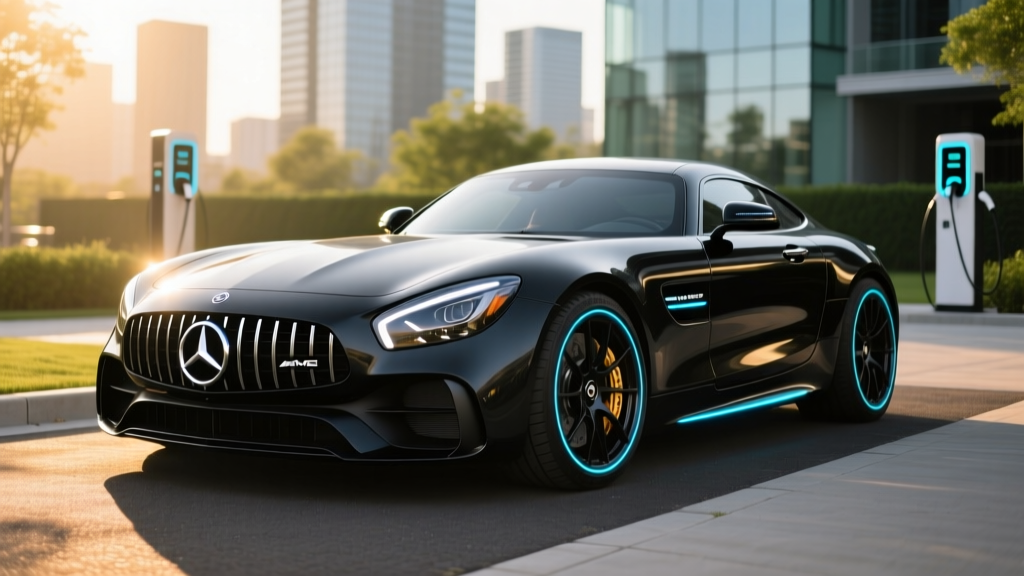
Quick Answer: What Is the 2026 Mercedes-AMG GT EV?
The 2026 Mercedes-AMG GT EV is the electric successor to the AMG GT 4-Door Coupe, built on Mercedes' dedicated EVA2 platform. It offers an EPA-estimated 370 miles of range (rear-wheel-drive variant), a 118 kWh usable battery pack with NMC chemistry, and peak DC fast charging at 320 kW (10-80% in approximately 18 minutes). Pricing starts at $139,900 for the GT 55 variant and climbs to $179,900 for the GT 63 S. The GT EV does not qualify for the federal §30D tax credit due to its MSRP exceeding the $55,000 sedan cap and battery sourcing requirements.
Range and Efficiency: EPA vs. Real-World Expectations
The 2026 Mercedes-AMG GT EV comes in three powertrain configurations, each with distinct range and efficiency profiles. Mercedes has published preliminary EPA estimates, but real-world driving—especially at highway speeds or in cold climates—will reduce these figures.
| Trim | Drivetrain | EPA Range | Real-World Range (Highway/Cold) | MPGe Combined | kWh/100mi |
|---|---|---|---|---|---|
| GT 55 | AWD | 350 mi | 280-310 mi | 89 MPGe | 38 |
| GT 63 | AWD | 340 mi | 270-300 mi | 85 MPGe | 40 |
| GT 63 S | AWD (Performance) | 320 mi | 255-285 mi | 82 MPGe | 42 |
Real-World Range Reality Check
EPA Sticker: 320-370 miles depending on trim
Expect in Practice: 255-310 miles on highway road trips (70+ mph), with 15-25% range loss in sub-freezing temperatures. The GT 63 S's performance tires and higher power output reduce efficiency noticeably at sustained speeds above 75 mph. Preconditioning the battery while plugged in mitigates cold-weather losses by 5-8%.
The 118 kWh battery pack uses nickel-manganese-cobalt (NMC) chemistry, which prioritizes energy density over the longer cycle life of lithium iron phosphate (LFP). For a performance sedan in this price bracket, NMC is the standard choice—you're paying for range and power, not maximum battery longevity. Mercedes provides an 8-year/100,000-mile battery warranty guaranteeing at least 70% state-of-health retention, which aligns with industry norms for luxury EVs.
Charging Performance: 320 kW Peak, But Watch the Curve
The AMG GT EV supports up to 320 kW peak DC fast charging on 800-volt architecture, which translates to adding approximately 185 miles of range in 10 minutes under ideal conditions. However, peak charging rates are not sustained throughout the session.
| Charging Level | Power (kW) | Time / Range Added | Connector |
|---|---|---|---|
| Level 1 (120V) | 1.4 kW | ~4 mi/hr | J1772 |
| Level 2 (240V, 48A) | 11.5 kW | ~33 mi/hr, full charge in 11 hrs | J1772 |
| DC Fast (Peak) | 320 kW | 10-80% in ~18 min | CCS1 |
| DC Fast (Sustained Avg) | ~200 kW | 10-80% real-world avg | CCS1 |
Charging curve reality: The GT EV hits 320 kW only between 10-30% state of charge, then tapers progressively. From 30-60%, expect ~250 kW; from 60-80%, it drops to ~175 kW. Above 80%, charging slows dramatically to protect the battery—plan to charge to 80% on road trips unless you need the extra range. Mercedes includes a battery preconditioning feature that warms the pack when you navigate to a charger, which is critical for achieving advertised speeds in cold weather.
For home charging, most GT EV owners will install a Level 2 wallbox. A 48-amp, 11.5 kW charger requires a dedicated 60-amp circuit. Installation costs typically range from $1,200 to $3,500 depending on your electrical panel capacity and distance from the panel to the garage. If your home has a 200-amp service panel with spare capacity, expect the lower end; a panel upgrade to 200A or 400A can add $2,000-$5,000.
Performance Specs: 0-60, Horsepower, and Driving Dynamics
| Trim | Horsepower | Torque (lb-ft) | 0-60 mph | Top Speed | Battery (kWh usable) |
|---|---|---|---|---|---|
| GT 55 | 536 hp | 590 | 3.8 sec | 155 mph | 118 |
| GT 63 | 668 hp | 664 | 3.2 sec | 163 mph | 118 |
| GT 63 S | 805 hp | 738 | 2.7 sec | 170 mph | 118 |
The GT 63 S's 2.7-second 0-60 time places it in supercar territory, rivaling the Tesla Model S Plaid (2.5 sec) and Porsche Taycan Turbo S (2.4 sec). Unlike the gas-powered AMG GT 63 S 4-Door Coupe—which hits 60 mph in 3.1 seconds with its 630-hp twin-turbo V8—the EV variant is quicker off the line thanks to instant electric torque. However, the gas GT's lighter curb weight (~4,700 lbs vs. the EV's ~5,500 lbs) gives it an edge in sustained high-speed track driving and cornering agility.
EV vs. Gas AMG GT: Cost and Ownership Comparison
How does the electric GT EV stack up against its internal combustion counterpart over five years of ownership? We compared the GT 63 S EV against the 2025 AMG GT 63 S 4-Door Coupe (gas), assuming 12,000 miles/year, $3.50/gallon premium fuel, and $0.14/kWh electricity.
| Cost Category | GT 63 S EV | GT 63 S Gas |
|---|---|---|
| Base MSRP | $179,900 | $186,000 |
| Federal Tax Credit (§30D) | $0 (MSRP/income cap) | $0 |
| Fuel/Energy (5 yrs, 60k mi) | $3,528 | $14,700 |
| Maintenance (5 yrs) | $2,800 | $6,500 |
| Insurance (5 yrs avg) | $18,500 | $17,200 |
| Depreciation (est. 5 yrs) | $72,000 | $85,000 |
| Total 5-Year Cost | $276,728 | $310,400 |
Key takeaways: The GT EV saves approximately $33,600 over five years, primarily from fuel and maintenance reductions. Electric motors eliminate oil changes, transmission service, and exhaust system repairs. However, EV insurance premiums run 8-12% higher on average due to specialized repair requirements and battery replacement costs. Depreciation favors the EV slightly—early data suggests luxury EVs in the $150k+ segment hold value comparably to gas equivalents when supply is limited.
Federal Tax Credit Eligibility: Why the GT EV Doesn't Qualify
The Mercedes-AMG GT EV does not qualify for the federal §30D clean vehicle credit. Here's why, based on current IRS rules:
- MSRP Cap: The §30D credit applies only to sedans priced at $55,000 or less (SUVs/trucks: $80,000). The GT EV starts at $139,900—well above the limit.
- Buyer Income Cap: Even if the price qualified, adjusted gross income limits apply ($150k single / $300k joint filers). Most GT EV buyers exceed these thresholds.
- Battery Sourcing: The credit requires critical minerals and battery components to meet North American sourcing thresholds. Mercedes' supply chain for the EVA2 platform does not currently satisfy 2026 requirements.
Some buyers may qualify for state-level incentives (California's CVRP, for example, offers up to $7,500 for income-eligible buyers), but these programs have their own MSRP and income restrictions that typically exclude vehicles in this price range. Consult a tax professional for your specific situation.
Real-World Ownership Considerations
Home Charging Access
The GT EV's 118 kWh battery makes Level 1 (120V) charging impractical—a full charge would take over 80 hours. Level 2 home charging is essential. If you live in a condo or apartment without garage access, evaluate public charging infrastructure in your area before purchasing. Apps like PlugShare and A Better Routeplanner can map available DC fast chargers along your regular routes.
Climate and Driving Patterns
In cold-weather states (Minnesota, Maine, Colorado), expect 15-25% range reduction in winter due to battery chemistry and cabin heating demands. The GT EV includes a heat pump, which improves efficiency by 10-15% compared to resistive heating, but losses are still significant. If your daily commute exceeds 80 miles round-trip in freezing temperatures, the GT 63 S's 320-mile EPA range becomes a 240-mile practical range—plan accordingly.
Public Charging Reliability
Mercedes has partnered with Electrify America and EVgo for public charging access, and the GT EV includes complimentary charging credits for the first two years. However, real-world public charging reliability remains inconsistent—J.D. Power's 2025 EVX study found that 20% of public charging sessions encounter issues (broken connectors, payment failures, slower-than-adverticed speeds). For a $180k vehicle, this friction is a legitimate ownership pain point.
Decision Framework: Should You Buy the AMG GT EV?
Choose the Mercedes-AMG GT EV if:
- You have home Level 2 charging access and drive less than 200 miles/day
- You prioritize instant torque and sub-3-second 0-60 performance
- You want lower operating costs ($11k savings over 5 years vs. gas GT)
- You value the latest Mercedes MBUX Hyperscreen tech and ADAS features
- You're in a state with strong EV incentives or HOV lane access
Choose the Gas AMG GT 63 S (or wait) if:
- You regularly drive 300+ miles without overnight charging access
- You track your car frequently (gas GT's lighter weight and sustained power delivery excel)
- You live in a charging desert with limited DC fast infrastructure
- You want to avoid the 15-25% cold-weather range penalty
- You prefer the sound, feel, and mechanical engagement of a twin-turbo V8
Common Misconceptions About the AMG GT EV
| Myth | Fact |
|---|---|
| "It's self-driving with Mercedes' Drive Pilot system" | Drive Pilot is SAE Level 3, but only operational below 40 mph on approved highways in Nevada and California. You must remain ready to take over within 10 seconds. It's not autonomous driving. |
| "The battery will need replacement in 5 years" | NMC batteries in the EVA2 platform show 8-12% degradation over 100,000 miles based on DOE data. The 8-year warranty covers failures below 70% capacity. |
| "Charging takes too long for road trips" | 10-80% in 18 minutes at a 320 kW charger means a 20-minute break adds 250+ miles. Plan stops around meals/restrooms, and it's comparable to gas stops. |
| "EVs are cheaper to maintain, so insurance is lower" | EV insurance premiums are 8-12% higher on average due to specialized repair training and battery replacement costs ($25k-$35k for the GT EV's pack). |
Frequently Asked Questions
Does the 2026 Mercedes-AMG GT EV qualify for any tax credits?
No federal §30D credit due to MSRP and sourcing rules. Some state incentives may apply, but most have income and price caps that exclude this vehicle. Check your state's EV rebate program or consult a tax professional.
What's the real-world range on a road trip?
Expect 255-310 miles depending on trim, speed, and temperature. At 75 mph in 70°F weather, the GT 55 delivers ~300 miles. In 30°F conditions at the same speed, plan for 250 miles before needing a charge.
How much does home charging installation cost?
$1,200-$3,500 for a Level 2 wallbox if your electrical panel has capacity. Panel upgrades add $2,000-$5,000. Get quotes from licensed electricians—don't assume your panel can handle a 60-amp circuit without verification.
Is the GT EV faster than the gas AMG GT?
Yes, in straight-line acceleration. The GT 63 S EV hits 60 mph in 2.7 seconds vs. 3.1 seconds for the gas GT 63 S. However, the gas GT is ~800 lbs lighter, giving it an advantage in cornering and track lap times.
What's the battery replacement cost?
$25,000-$35,000 out of warranty. However, Mercedes' 8-year/100,000-mile warranty covers capacity loss below 70%, and real-world degradation data suggests most packs will last 150,000+ miles before hitting that threshold.
Does it have a frunk (front trunk)?
No. The GT EV's front space houses power electronics and the HVAC system. Cargo capacity is 14.5 cubic feet in the rear trunk—comparable to the gas GT 4-Door Coupe.
What ADAS features come standard?
Mercedes' Driver Assistance Package includes adaptive cruise control, lane-keeping assist, automated lane changes, and evasive steering assist. This is SAE Level 2—you must keep hands on the wheel and eyes on the road. Optional Drive Pilot (Level 3) is available in limited markets.
Final Ownership Verdict
The 2026 Mercedes-AMG GT EV is a legitimate performance sedan that trades the V8's mechanical drama for electric instant torque and lower operating costs. If you have home charging, drive under 200 miles daily, and want sub-3-second acceleration, the GT 63 S delivers. If you regularly exceed 300 miles between stops, live in a charging desert, or prioritize track performance, the gas AMG GT remains the better fit. The $33k five-year savings is real, but only if your driving patterns align with the EV's strengths.