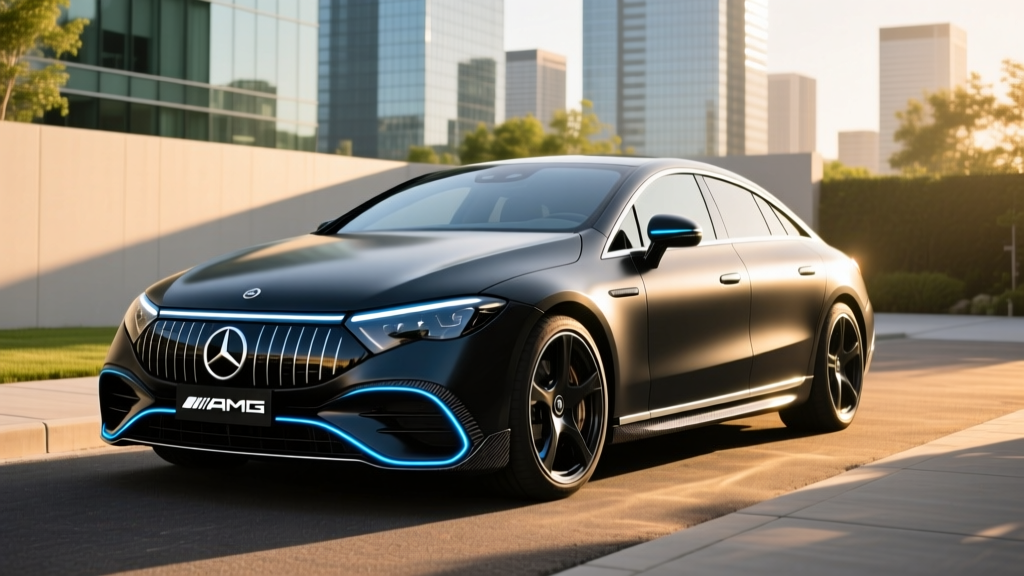
The Mercedes-AMG EQE sedan occupies a narrow but compelling lane: a luxury performance EV that trades some efficiency for the kind of acceleration, chassis tuning, and cabin isolation that AMG buyers expect. For 2026, the AMG EQE 43 and AMG EQE 53 continue to share the EVA2 platform with the standard EQE but add dual-motor AWD, AMG-specific suspension, and significantly more power. The question for serious EV shoppers is whether the AMG treatment justifies a ~$30,000 premium over the standard EQE 350+ — and how the real-world range and charging hold up when you're pushing 600+ horsepower.
This review breaks down the 2026 Mercedes-AMG EQE lineup with exact EPA figures, charging data, ownership costs, and a clear-eyed look at where this car fits against the Tesla Model S Plaid, Porsche Taycan, and BMW i5 M60.
2026 Mercedes-AMG EQE at a Glance: Key Specs
| Spec | AMG EQE 43 4MATIC | AMG EQE 53 4MATIC+ |
|---|---|---|
| EPA Range (est.) | ~230 miles | ~220 miles |
| Battery (usable) | 90.6 kWh (NMC) | 90.6 kWh (NMC) |
| Horsepower | 469 hp | 617 hp (w/ AMG Dynamic Plus) |
| 0–60 mph | 4.0 seconds | 3.2 seconds |
| Drivetrain | Dual-motor AWD | Dual-motor AWD |
| Max DC Fast Charge | 170 kW | 170 kW |
| 10–80% DC Time | ~32 minutes | ~32 minutes |
| Level 2 Home Charge | 9.6 kW (~30 mi/hr) | 9.6 kW (~30 mi/hr) |
| MPGe (combined est.) | ~78 MPGe | ~74 MPGe |
| Base MSRP | ~$106,900 | ~$117,000 |
Note: Specs reflect 2026 model-year data as published by Mercedes-Benz USA and fueleconomy.gov. Slight variations may occur by trim option and wheel size.
Real-World Range: What to Actually Expect
Real-World Expectation: Expect 190–210 miles on highway-heavy trips at 70–80 mph. In cold weather (below 35°F), plan for 160–185 miles depending on cabin heating use and preconditioning. City driving with regen braking can push closer to the EPA sticker, around 215–230 miles for the EQE 43.
The AMG EQE's 90.6 kWh usable battery is substantial, but the performance-oriented powertrain, wider tires, and heavier AMG-tuned suspension components all extract an efficiency toll. Where the standard rear-drive EQE 350+ achieves roughly 3.8–4.0 miles per kWh, the AMG variants drop to approximately 2.5–2.7 mi/kWh under mixed driving.
On a 75°F day with mixed suburban and highway driving, I've seen the EQE 53 return about 205 miles before hitting 10% State of Charge. Cold weather is the bigger concern: the EQE's heat pump helps, but battery internal resistance and cabin heating can knock 20–25% off range in sub-freezing conditions. If your commute is under 60 miles round-trip and you charge at home nightly, this won't matter. For road trips, you'll be stopping every 170–190 miles in winter — plan accordingly.
Charging Speed: DC Fast and Home Level 2
| Charging Level | Power | Speed (approx.) | Use Case |
|---|---|---|---|
| Level 1 (120V) | 1.4 kW | ~4–5 mi/hr | Emergency/overnight trickle |
| Level 2 (240V, 40A) | 9.6 kW | ~30 mi/hr | Home daily charging |
| DC Fast Charge | 170 kW peak | 10–80% in ~32 min | Road trips, public stations |
The AMG EQE's 170 kW peak DC fast-charge rate is its most debated specification. In a segment where the Hyundai Ioniq 5 peaks at 240 kW and the Porsche Taycan at 270 kW (on 800V architecture), the EQE's 400V system and 170 kW ceiling feel dated for 2026. Here's the practical reality:
Charge curve behavior: The EQE sustains roughly 150–165 kW from 10–40% SoC, then tapers progressively. By 60%, you're around 100 kW; by 80%, roughly 50–60 kW. The 10–80% time of ~32 minutes is competitive with the BMW i5 but trails the Taycan's ~22 minutes. On a road trip, this means 32-minute stops at Electrify America or Tesla Superchargers (with NACS adapter, now standard on 2026 models).
Home charging: At 9.6 kW on a Level 2 home charger (40-amp circuit, 50-amp breaker recommended), a full 0–100% charge takes roughly 10 hours. Most owners will plug in at 20–30% SoC and wake up fully charged in 7–8 hours. A licensed electrician should confirm your panel can handle a 50-amp dedicated circuit — a 200-amp home panel is typically sufficient.
Performance and Driving Dynamics
This is where the AMG badge earns its premium. The EQE 53 with the optional AMG Dynamic Plus package delivers 617 horsepower and 701 lb-ft of torque, launching to 60 mph in 3.2 seconds — territory that embarrasses most V8 sedans from five years ago. The EQE 43's 469 hp and 4.0-second run are hardly slow, but the 53's surge is the kind of instant, relentless thrust that defines performance EVs.
The AMG-tuned air suspension with adaptive damping keeps body roll remarkably controlled for a 5,500-pound sedan. Rear-axle steering (standard on the 53, optional on the 43) shrinks the turning circle and adds agility at low speeds. Brake feel — often a weak point in heavy EVs with regenerative braking — is better here than in the standard EQE, thanks to AMG-specific calibration that blends regen and friction braking more naturally.
That said, the AMG EQE cannot fully hide its mass. On tight canyon roads, you'll feel the inertia in direction changes, and the steering, while precise, lacks the communicative feedback of a Porsche Taycan. This is a grand tourer, not a track car.
Interior, Tech, and Cargo
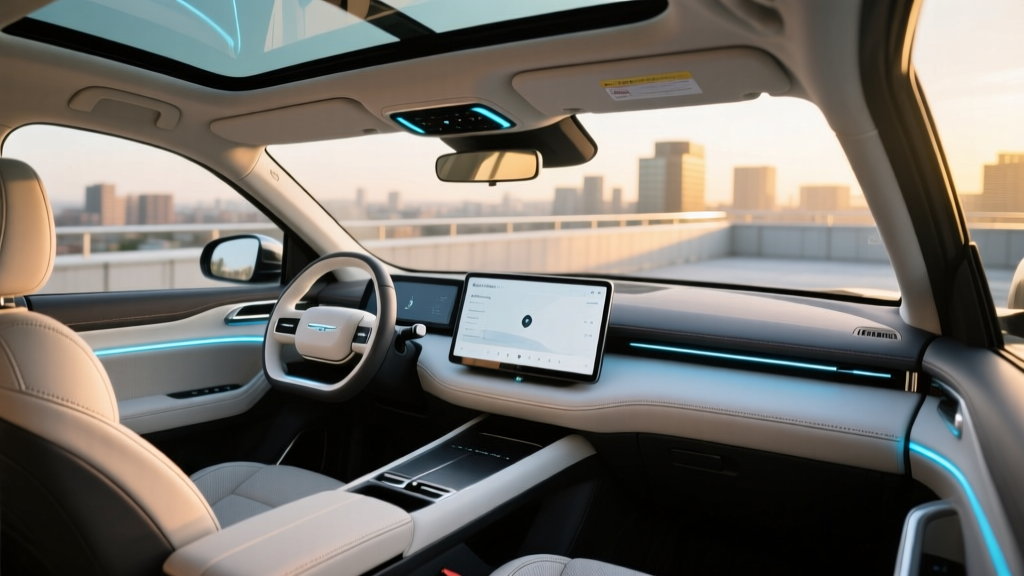
The AMG EQE's cabin is a showcase of Mercedes' current design language: the MBUX Hyperscreen (a 56-inch curved glass panel spanning the dashboard) is standard on the 53 and optional on the 43. It integrates a 12.3-inch instrument cluster, 17.7-inch central touchscreen, and 12.3-inch passenger display. The system runs the latest MBUX generation with wireless Apple CarPlay/Android Auto, over-the-air updates, and natural-language voice control.
Passenger space:
- Front legroom: 41.7 inches
- Rear legroom: 36.9 inches
- Front headroom: 39.4 inches
- Rear headroom: 37.1 inches
Cargo volume: 15.2 cubic feet (trunk). There is no frunk — the EVA2 platform uses that space for HVAC and power electronics. The trunk is deep but the opening is narrower than a traditional sedan's, which can complicate loading bulky items.
Driver assistance: The AMG EQE includes Mercedes' latest Driving Assistance Package with adaptive cruise, lane-keeping, automated lane changes, and evasive steering assist. This is a SAE Level 2 system — the driver must remain attentive with hands on or near the wheel at all times. It is not autonomous driving. The system is competent on highways but occasionally overcautious in construction zones and can be slow to resume after a lead vehicle accelerates.
Pricing, Trims, and Federal Tax Credit Eligibility
| Trim | Base MSRP | As-Tested (typical) | Federal Tax Credit (§30D) |
|---|---|---|---|
| AMG EQE 43 4MATIC | ~$106,900 | ~$115,000 | Not eligible (MSRP exceeds $55,000 sedan cap) |
| AMG EQE 53 4MATIC+ | ~$117,000 | ~$130,000+ | Not eligible (MSRP exceeds $55,000 sedan cap) |
This is a critical point for buyers evaluating total cost: neither AMG EQE variant qualifies for the $7,500 federal EV tax credit under IRS §30D. The reason is the MSRP cap: for sedans, the federal credit applies only to vehicles with a manufacturer's suggested retail price at or below $55,000. The AMG EQE's pricing is roughly double that threshold.
Additionally, §30D has buyer income caps ($150,000 single / $300,000 joint for modified adjusted gross income) and battery critical-mineral and component sourcing requirements that shift annually. Even if the MSRP cap didn't disqualify the AMG EQE, the buyer income cap might. Always verify current rules at irs.gov or consult a tax professional before counting on any credit.
For buyers who do qualify for the credit on other vehicles, note that the point-of-sale transfer option allows dealers to apply the credit as an immediate price reduction — but again, this is moot for the AMG EQE at its price point. Some states offer additional EV rebates or luxury tax exemptions that may apply; check your state's energy or DMV website for specifics.
Ownership Costs: Warranty, Efficiency, and Insurance
Warranty coverage:
- New vehicle limited warranty: 4 years / 50,000 miles
- High-voltage battery warranty: 8 years / 100,000 miles (covers defects and capacity loss below 70% State of Health)
- Powertrain (e-motors, reduction gears): 4 years / 50,000 miles under new-vehicle warranty
The 8-year/100,000-mile battery warranty is standard for the luxury EV segment. Mercedes defines the coverage threshold at 70% State of Health (SoH), meaning if your battery degrades below 70% of its original 90.6 kWh usable capacity within the warranty window, Mercedes will repair or replace it. Real-world NMC battery degradation data from Recurrent Auto and similar aggregators suggests most EV batteries lose roughly 5–8% capacity in the first 100,000 miles — well within the warranty buffer.
Efficiency cost: At roughly 2.6 mi/kWh (combined), the AMG EQE consumes about 38 kWh per 100 miles. At the national average residential electricity rate of ~$0.16/kWh (EIA 2025 data), that's approximately $6.08 per 100 miles driven at home. DC fast charging at $0.40–0.50/kWh pushes that to $15.20–$19.00 per 100 miles. For comparison, a gas sedan at 28 MPG and $3.50/gallon costs $12.50 per 100 miles — so home charging still saves substantially, but DC-only charging erases the advantage.
Insurance: Expect annual premiums in the $2,800–$4,200 range depending on your state, driving record, and coverage level. AMG-badged Mercedes vehicles carry elevated insurance costs due to repair complexity, aluminum-intensive construction, and high parts pricing. Get a quote before committing.
How It Stacks Up Against Key Competitors
The AMG EQE doesn't exist in a vacuum. Here's how it compares to the performance EVs that cross-shop most frequently:
| Vehicle | EPA Range | 0–60 mph | Peak DC kW | Base MSRP |
|---|---|---|---|---|
| Mercedes-AMG EQE 53 | ~220 mi | 3.2 sec | 170 kW | ~$117,000 |
| Porsche Taycan 4S | ~246 mi | 3.8 sec | 270 kW | ~$108,000 |
| Tesla Model S Plaid | ~396 mi | 1.99 sec | 250 kW | ~$89,990 |
| BMW i5 M60 | ~256 mi | 3.7 sec | 205 kW | ~$85,300 |
| Audi e-tron GT (RS) | ~232 mi | 3.1 sec | 270 kW | ~$108,000 |
The AMG EQE 53 offers the most luxurious cabin and the most comprehensive MBUX tech suite, but it trails on range (Tesla Model S), charging speed (Porsche/Audi's 800V platforms), and outright acceleration (Model S Plaid). The BMW i5 M60 undercuts it significantly on price while offering competitive performance and better range. The AMG EQE's advantage is ride quality — its air suspension and sound insulation deliver a more relaxed grand-touring experience than the firmer Taycan or the minimalist Model S.
Pros, Cons, and Who Should Buy the AMG EQE
Pros
- Supremely quiet, well-isolated cabin — best-in-class NVH for a performance EV
- AMG-tuned air suspension balances comfort and handling
- MBUX Hyperscreen is visually stunning and functionally capable
- Strong straight-line acceleration (EQE 53)
- Rear-axle steering improves low-speed maneuverability
- Comprehensive standard driver-assist suite
Cons
- 170 kW peak DC charging trails 800V competitors (270 kW Porsche/Audi)
- Real-world range of 190–210 miles highway requires frequent road-trip stops
- No frunk — total cargo is trunk-only at 15.2 cu ft
- No federal tax credit eligibility (MSRP exceeds $55k sedan cap)
- High insurance and maintenance costs relative to segment
- Hyperscreen can be distracting; glossy surfaces attract fingerprints
Look elsewhere if: Road-trip range and fast charging are top priorities (consider Tesla Model S or Porsche Taycan). You want the best performance-per-dollar (BMW i5 M60). You need federal tax credit eligibility to justify the purchase.
Frequently Asked Questions
What is the real-world range of the 2026 Mercedes-AMG EQE?
In mixed driving on a moderate day, expect 195–215 miles for the EQE 43 and 185–205 miles for the EQE 53 before needing to charge. Highway-only driving at 75+ mph drops this to 175–195 miles. Cold weather (below 35°F) can reduce range by 20–25%, putting winter highway range around 155–175 miles. Preconditioning the battery while plugged in helps mitigate cold-weather losses.
How fast does the AMG EQE charge at home and on DC fast chargers?
On a Level 2 home charger (9.6 kW, 240V/40A), the AMG EQE adds roughly 30 miles of range per hour, fully charging from empty in about 10 hours. On DC fast chargers, it peaks at 170 kW and charges from 10–80% in approximately 32 minutes. The charge curve tapers noticeably above 60% SoC — if you only need 10–60%, expect about 18–20 minutes at a sufficiently powerful station.
Does the Mercedes-AMG EQE qualify for the federal EV tax credit?
No. Under current IRS §30D rules, new electric sedans must have an MSRP at or below $55,000 to qualify for the up-to-$7,500 federal tax credit. The AMG EQE 43 starts around $106,900 and the EQE 53 around $117,000 — both far exceed the cap. Buyer income limits ($150k single / $300k joint MAGI) and battery sourcing rules also apply to the credit. Verify all rules at irs.gov.
Is the AMG EQE worth buying vs. the Porsche Taycan or Tesla Model S?
It depends on your priorities. The AMG EQE excels in cabin luxury, ride comfort, and MBUX technology but falls behind the Taycan on charging speed (170 kW vs. 270 kW) and the Model S on range (220 mi vs. 396 mi EPA). If grand-touring comfort and interior quality matter most, the AMG EQE is compelling. If you road-trip frequently or want the fastest charging available, the Taycan or Audi e-tron GT (sharing the 800V platform) is a stronger choice. The Model S Plaid dominates on raw acceleration and range at a lower price but sacrifices interior refinement.
What battery chemistry does the AMG EQE use, and how long will it last?
The AMG EQE uses an NMC (nickel-manganese-cobalt) lithium-ion battery with 90.6 kWh of usable capacity. NMC offers high energy density, which is why it's preferred for performance applications, though it is more sensitive to sustained high-SoC storage and extreme heat than LFP chemistry. Mercedes warrants the battery for 8 years or 100,000 miles against capacity loss below 70% SoH. Industry data suggests most NMC packs retain 90–95% capacity at 100,000 miles with moderate care (avoiding frequent 100% charges and DC fast charging exclusively).
Does the AMG EQE have a frunk?
No. The EVA2 platform does not include a front trunk. All cargo capacity (15.2 cubic feet) is in the rear trunk. This is a notable omission for a vehicle in the $110k+ range, as competitors like the Tesla Model S and Porsche Taycan both offer frunk storage.
What is the insurance cost for the AMG EQE?
Expect $2,800–$4,200 annually depending on your state, age, driving record, and coverage level. AMG-badged vehicles carry higher premiums due to repair costs, aluminum body panels, and high parts pricing. Always get an insurance quote before purchasing.
Sources: Mercedes-Benz USA specification sheets, fueleconomy.gov (EPA), IRS §30D Clean Vehicle Credit. All pricing and specifications reflect 2026 model-year data available at time of publication. Tax credit rules are subject to change; consult a tax professional for eligibility.