What Is MCU 2 in a Tesla? The Infotainment Hardware Behind the Screen
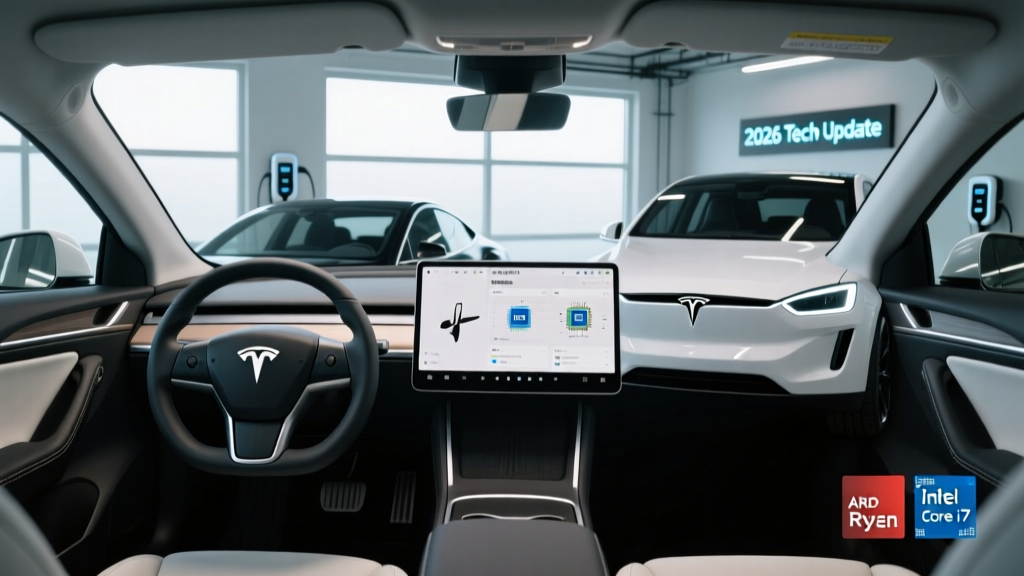
If you've seen the term MCU 2 Tesla floating through forums or used-car listings, it's not a new vehicle trim — it's a hardware generation of Tesla's Media Control Unit, the computer that powers the central touchscreen, navigation, media, and vehicle settings. Understanding which MCU version lives inside a given Tesla matters for UI responsiveness, app support (Netflix, YouTube, Arcade), and whether features like the newer FSD visualization stack render smoothly.
Tesla has cycled through three major MCU generations:
- MCU1 (Intel Atom E3950) — used in Model S/X built before March 2018. Sluggish by today's standards; lacks support for newer visualizations and some apps.
- MCU2 (Intel Atom E3950, upgraded) — installed in Model S/X from March 2018 through early 2021, and in Model 3/Y from launch through late 2021/early 2022. A meaningful step up in RAM and GPU capability over MCU1.
- MCU3 (AMD Ryzen Embedded) — the current hardware in all new Model 3, Model Y, Model S, and Model X as of 2026. Console-class performance, supports the full FSD visualization suite, AAA gaming, and fluid map rendering.
For 2026 buyers, the real question isn't "should I buy MCU 2?" — it's which current Teslas still carry Intel-based MCU2 hardware on the used market, and does it matter? Below, we walk through what MCU2 means for real-world ownership, how it compares to the AMD Ryzen MCU3 in today's lineup, and where it fits into Tesla's current pricing and tax-credit landscape.
MCU 2 vs MCU 3: What Tesla Owners Actually Notice
The jump from Intel Atom (MCU2) to AMD Ryzen (MCU3) is the most visible generational change Tesla has made to its cabin hardware. In side-by-side driving, the differences show up in specific, repeatable ways:
| Capability | MCU2 (Intel Atom) | MCU3 (AMD Ryzen) |
|---|---|---|
| Map panning & zoom | Occasional stutter at low zoom | Smooth, phone-like |
| FSD visualization (cars, lanes, curbs) | Simplified rendering | Full 3D scene with traffic lights, pedestrians |
| Netflix / YouTube / Twitch | 720p-capable, occasional buffering | Native 1080p+, stable playback |
| Tesla Arcade (Cyberpunk 2077, Stardew Valley) | Limited catalog, low frame rates | Full catalog, playable at 60 fps |
| Cold-boot time | ~25-35 seconds | ~10-15 seconds |
| Browser performance | Usable for basic sites | Near-desktop speed |
For daily driving — navigation, climate, media, phone calls — MCU2 remains perfectly capable in 2026. Where it falls short is the richer visualization layer Tesla has added since 2022, and the increasingly heavy web-based apps the infotainment system runs.
Which 2026 Teslas Use MCU 2, and Which Use AMD Ryzen?
As of the 2026 model year, every new Tesla sold in the U.S. ships with the AMD Ryzen-based MCU3. MCU2 only appears on the used and certified-pre-owned market. Here's the breakdown by model:
| Model | MCU2 Model Years | MCU3 (AMD) Model Years |
|---|---|---|
| Model S | 2018 – early 2021 (pre-refresh) | Mid-2021 refresh onward (Plaid, Long Range) |
| Model X | 2018 – early 2021 (pre-refresh) | Mid-2021 refresh onward |
| Model 3 | 2018 – late 2021 / early 2022 | Late 2021 onward; all Highland (2024+) builds |
| Model Y | 2020 – early 2022 | Mid-2022 onward; all Juniper (2025+) builds |
| Cybertruck | N/A | All builds (AMD) |
If you're shopping a 2026-new Tesla, you will get MCU3. If you're shopping a used 2019-2021 Model 3 or a 2020-2021 Model Y, you're looking at MCU2 — and that hardware difference should factor into your offer price.
2026 Tesla Lineup: Range, Charging, and Pricing With Current Hardware
Since MCU2 is now a used-market topic, the more useful reference for a 2026 buyer is the current Tesla lineup — all AMD-equipped — with real-world context layered on top of EPA stickers. Figures below reflect the latest fueleconomy.gov data and Tesla's published specs.
| Model (2026) | Trim | EPA Range | Battery (kWh / chem.) | Peak DC kW | 10-80% | 0-60 mph | Base MSRP |
|---|---|---|---|---|---|---|---|
| Model 3 | Long Range AWD | 341 mi | ~79 kWh, NMC | 250 kW | ~25 min | 4.2 s | $42,380 |
| Model 3 | RWD (LFP) | 272 mi | ~60 kWh, LFP | 170 kW | ~30 min | 5.8 s | $36,630 |
| Model Y | Long Range AWD | 320 mi | ~78 kWh, NMC | 250 kW | ~25 min | 4.8 s | $44,990 |
| Model S | Long Range | 402 mi | ~100 kWh, NMC | 250 kW | ~27 min | 3.1 s | $72,990 |
| Model X | Long Range | 335 mi | ~100 kWh, NMC | 250 kW | ~28 min | 3.8 s | $77,990 |
Does a 2026 Tesla Qualify for the Federal EV Tax Credit?
Under the current IRS §30D rules, eligibility is not automatic — it depends on MSRP caps, buyer income, and battery-critical-mineral sourcing. For 2026 purchases:
- MSRP cap: $55,000 for sedans (Model 3), $80,000 for SUVs/pickups (Model Y, Model X, Cybertruck).
- Buyner AGI cap: $150k single / $225k head-of-household / $300k joint.
- Battery sourcing: the credit splits into two $3,750 halves — one for critical-mineral sourcing, one for battery-component assembly. Foreign Entity of Concern (FEOC) restrictions on China-sourced components continue to tighten through 2026, which has trimmed eligibility for some trims mid-year.
- Point-of-sale transfer: qualified buyers can apply the credit as an immediate dealer discount rather than waiting for tax filing.
In practice, the Model 3 RWD and Long Range, plus most Model Y configurations, have fluctuated between the full $7,500 and a partial $3,750 depending on the build month's battery-sourcing compliance. Model S, Model X, and Cybertruck trims above the MSRP cap are ineligible regardless of income. Always verify the specific VIN's credit status on the DOE's credit lookup tool before signing.
Should You Buy a Used MCU 2 Tesla, or Pay Up for AMD?
MCU2 cars are now 4-8 years old, which means they sit in the sweet spot of Tesla depreciation — a 2020 Model 3 Long Range often trades between $22,000 and $28,000 in 2026, versus $42,380+ for a new equivalent. The trade-offs are concrete:
Pros of Buying MCU 2
- Significant depreciation discount ($15-25k less than new)
- Same Supercharger network access and NACS connector
- Core driving dynamics, regen, and Autopilot hardware (HW3) intact
- OTA updates still arriving, though feature-gated
Cons of Buying MCU 2
- Slower UI, limited Arcade and streaming quality
- Simplified FSD visualization vs AMD models
- Out-of-warranty battery risk (replacement ~$12-16k)
- Used EV credit capped at $4,000 under §25E, with its own income/price rules
If your use case is commuting and occasional road trips — and you don't care about in-car gaming or the latest FSD visual fidelity — an MCU2 Model 3 or Y is a rational, value-driven buy. If you plan to keep the car 5+ years and want the full visualization and infotainment experience, the AMD-equipped new or CPO cars are worth the premium.
Retrofitting MCU 3 Into an MCU 2 Tesla: Cost and Reality
Tesla has offered paid MCU upgrades in the past — most notably the $1,500-to-$2,500 MCU1-to-MCU2 program for older Model S/X owners. As of 2026, Tesla does not broadly offer an MCU2-to-MCU3 retrofit for Model 3 or Model Y. Some Model S/X owners with MCU2 have been offered the AMD upgrade through service centers, but availability is inconsistent and often bundled with other hardware changes (cameras, wiring harness).
Plan on the MCU you buy the car with being the MCU you keep. Budget accordingly — the ~$2,000 retrofit cost, where offered, is worth it for S/X owners who plan to hold the vehicle, less so for a Model 3 you'll trade in within three years.
Frequently Asked Questions About MCU 2 Teslas
Is MCU 2 still supported with software updates in 2026?
Yes. Tesla continues to push OTA updates to MCU2 vehicles, though some newer features — especially graphics-heavy FSD visualizations and certain Arcade titles — are AMD-only. Core driving, navigation, and media functions receive ongoing support.
Can I tell which MCU a used Tesla has before buying?
Yes. On the touchscreen, go to Software → Additional Vehicle Information. It will list the infotainment processor — "Intel Atom" indicates MCU2, "AMD Ryzen" indicates MCU3. Model year alone isn't a perfect proxy because of mid-year changeovers.
Does MCU 2 affect Autopilot or FSD capability?
Autopilot's core lane-keeping and adaptive cruise work identically on MCU2 and MCU3, because those functions run on the separate HW3/HW4 Autopilot computer. However, the visualization of what the car sees (rendered cars, traffic lights, curb rendering) is richer on MCU3. FSD (Supervised) still operates on MCU2 vehicles, just with a simpler on-screen representation. Remember that FSD is an SAE Level 2 driver-assist system — the driver must remain engaged at all times.
Is MCU 2 a deal-breaker for a 2026 used Tesla purchase?
Not for most buyers. If you primarily use the car for commuting, music, and navigation, MCU2 is fully adequate. If you want the best in-car entertainment, AAA gaming, or the most detailed FSD display, target an AMD-equipped vehicle.
How does MCU 2 affect resale value?
Used Teslas with MCU3 command a $2,000-$4,000 premium over equivalent MCU2 examples in 2026 private-party and dealer listings, reflecting both the hardware gap and the longer remaining software-support horizon.