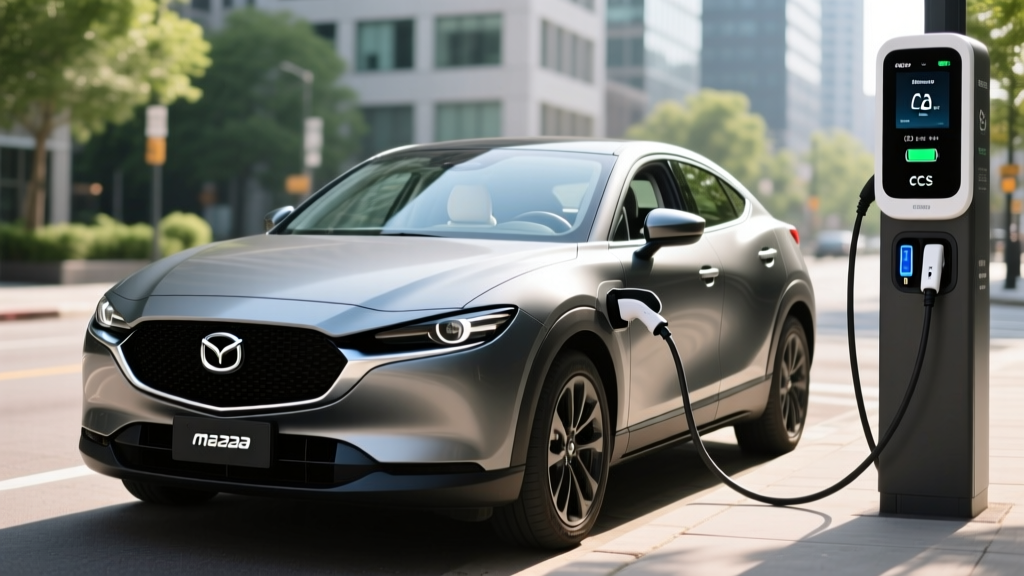
The Mazda MX-30 EV occupies a peculiar space in the electric vehicle market. While competitors push past 300 miles of EPA range, Mazda's sole battery-electric offering tops out at a modest 100 miles on a full charge. For the right buyer — a single or couple with predictable commutes and reliable home charging — the MX-30 delivers Mazda's signature driving dynamics in an affordable, stylish package. For everyone else, its limitations are hard to overlook.
This review covers the Mazda MX-30 EV's real-world range, charging speeds, pricing after federal tax credits, and whether it earns a spot on your shortlist against far more capable alternatives.
Mazda MX-30 EV Specifications at a Glance
| Spec | Value |
|---|---|
| EPA Range | 100 miles |
| Battery Capacity | 35.5 kWh (usable) |
| Battery Chemistry | NMC (Nickel Manganese Cobalt) |
| Motor / Drivetrain | 143 hp / 200 lb-ft, FWD single-motor |
| 0-60 mph | ~8.7 seconds |
| DC Fast Charge (peak) | 50 kW |
| 10-80% DC Charge Time | ~36 minutes |
| Level 2 Home Charge Rate | 6.6 kW (~22 mi/hr) |
| EPA Efficiency | 92 MPGe combined (100 MPGe city / 85 MPGe hwy) |
| Energy Consumption | 37 kWh/100 mi |
| Cargo Volume | 21.0 cu ft (rear seats up) |
| Rear Legroom | 30.4 inches |
| Base MSRP (Base) | $35,485 (incl. destination) |
| As-Tested MSRP (Premium Plus) | ~$39,000 |
| Battery Warranty | 8 years / 100,000 miles |
| Vehicle Warranty | 3 years / 36,000 miles |
Range and Efficiency: The MX-30's Defining Limitation
EPA Estimate: 100 miles
Real-World Highway (70 mph, 75°F): ~80-85 miles
Cold Weather (30°F, mixed driving): ~60-70 miles
Best-Case City (mild weather, regen-heavy): ~95-100 miles
The MX-30's small 35.5 kWh battery means range fluctuates significantly with conditions. Highway speeds and cold temperatures hit especially hard — expect a 30-40% reduction in winter if you're running cabin heat without preconditioning.
Mazda deliberately chose a smaller battery for the MX-30, citing lifecycle emissions and weight reduction. That engineering philosophy makes environmental sense but creates a practical ceiling. According to fueleconomy.gov, the MX-30 returns 92 MPGe combined — competitive with larger EVs — but its 37 kWh/100 mi consumption is unremarkable given the vehicle's compact size.
For context, a Chevrolet Bolt EV delivers 259 miles of EPA range from a 65 kWh battery, and the Hyundai Kona Electric manages 261 miles. The MX-30's 100-mile figure sits closer to a plug-in hybrid's electric-only range than a modern BEV.
If your daily round-trip commute stays under 50 miles and you charge at home every night, the range works. But a spontaneous 80-mile detour, a forgotten charging session, or a January cold snap can turn a non-issue into genuine range stress.
Charging Speed: Functional but Uninspiring
| Level | Power | Charge Time | Miles Added |
|---|---|---|---|
| Level 1 (120V household) | ~1.2 kW | ~30 hours (0-100%) | ~4 mi/hr |
| Level 2 (240V home/public) | 6.6 kW | ~5.5 hours (0-100%) | ~22 mi/hr |
| DC Fast Charge (CCS) | 50 kW peak | ~36 min (10-80%) | ~60 miles in 36 min |
The MX-30's charging story mirrors its range: adequate for routine use, frustrating for anything else. The 50 kW peak DC fast-charge rate is the vehicle's weakest competitive metric. Most 2025-2026 EVs accept 150-250+ kW on DC fast chargers, meaning the MX-30 charges at roughly one-quarter the speed of a Hyundai Ioniq 5 or Tesla Model 3.
Here's why that matters beyond the spec sheet: DC fast charging follows a charge curve. Peak kW is only sustained at low states of charge (typically 10-40%). As the battery fills, the rate tapers to protect cell health. With a 50 kW peak, the MX-30's taper starts early, and the 10-80% session takes roughly 36 minutes — time you'd spend at a Electrify America or EVgo station adding just 60 miles of range.
On a road trip, that means 36-minute stops every 60-70 miles (in ideal weather). Compare that to a Tesla Model 3 Long Range, which adds ~200 miles in 15 minutes at a Supercharger. The MX-30 is simply not a road-trip vehicle.
Home charging is where the MX-30 makes sense. A Level 2 home charger at 6.6 kW replenishes the full 35.5 kWh battery in about 5.5 hours. Plug in when you get home at 7 PM, and you're at 100% by midnight — well before your morning commute. This works beautifully if you have garage or driveway access with a 240V outlet or hardwired Level 2 unit.
Mazda includes a CCS1 connector as standard. With the industry's shift to NACS (Tesla's connector), adapters are available, and by 2026 most new public chargers support both or offer CCS-to-NACS adapter compatibility.
Performance and Driving Dynamics
The MX-30's 143-horsepower, front-wheel-drive powertrain won't win drag races. The 0-60 mph time of approximately 8.7 seconds is leisurely by EV standards — a Tesla Model 3 RWD does it in 5.8 seconds, and even a Nissan Leaf SV Plus manages 6.9 seconds.
Where the MX-30 earns points is chassis tuning. Mazda's engineers prioritized a natural, linear driving feel over one-pedal driving aggression. The regenerative braking is adjustable via paddle shifters behind the steering wheel, letting you dial in regen from mild coasting to strong deceleration — but it never quite reaches full one-pedal-driving territory where the car comes to a complete stop without the brake pedal.
Ride quality is firm but composed, and the steering carries the communicative weight Mazda is known for. If you value driving engagement over straight-line speed, the MX-30 feels more involving than its specs suggest. The low curb weight (~3,900 lbs, aided by the small battery) helps with agility around town.
Noise insulation is strong, and the cabin remains quiet even at highway speeds — a benefit of both the electric powertrain and Mazda's sound-deadening efforts.
Interior, Technology, and Practicality
Step inside the MX-30 and Mazda's design ambition becomes clear. The cabin uses sustainable materials — recycled plastic bottles for seat fabric, cork trim accents referencing Mazda's origins as a cork manufacturer in the 1920s. It's a distinctive, upscale interior that punches above the vehicle's price class.
Infotainment: An 8.8-inch display sits atop the dash, controlled by a rotary dial on the center console (no touchscreen). The interface is clean and responsive, with wireless Apple CarPlay and Android Auto on upper trims. A 7-inch digital instrument cluster faces the driver, and a 12-speaker Bose audio system is available on the Premium Plus trim.
Driver Assistance: Mazda's i-Activsense suite is standard, including:
- Adaptive cruise control with stop-and-go
- Lane-keeping assist and lane-departure warning
- Automatic emergency braking with pedestrian detection
- Blind-spot monitoring with rear cross-traffic alert
- Rear smart braking (reverse auto-braking)
This is a solid SAE Level 1-2 driver-assist suite — it supports the driver but does not replace active steering and braking responsibility. There is no hands-off or eyes-off capability.
Practicality is where the MX-30 stumbles. The most controversial design choice is the rear-hinged "freestyle" rear doors (similar to a BMW i3 or extended-cab pickup). There is no B-pillar, and the rear doors cannot open independently of the front doors. This makes rear-seat access awkward — you must open the front door first, then the rear door. It's manageable for occasional passengers but impractical for child-seat installation or regular rear-seat use.
Cargo space measures 21.0 cubic feet behind the rear seats — adequate for groceries and carry-on luggage but less than competitors (the Kona Electric offers 25.6 cu ft). Rear legroom is a tight 30.4 inches; tall adults will find it cramped for anything beyond short trips.
Pricing, Tax Credits, and Total Cost
| Trim | MSRP | Est. Federal Credit | Effective Price |
|---|---|---|---|
| Base | $35,485 | Up to $7,500* | ~$27,985 |
| Premium Plus | ~$39,000 | Up to $7,500* | ~$31,500 |
*Federal tax credit eligibility under IRS §30D depends on buyer income, vehicle MSRP caps, and battery component/critical mineral sourcing. The MX-30's MSRP falls under the $55,000 sedan cap, making it potentially eligible. However, battery sourcing rules may reduce or eliminate the credit. Consult a tax professional and verify current-year rules before purchasing.
The MX-30's pricing is its strongest competitive argument — if the full federal credit applies. At roughly $28,000 after the credit, it undercuts most new EVs on the market. Even without the credit, a $35,485 starting price is accessible for the EV segment.
Key IRS §30D requirements to verify:
- Buyer income caps: Modified AGI must not exceed $150,000 (single) / $300,000 (joint)
- MSRP caps: Vehicle MSRP must not exceed $55,000 for sedans (MX-30 qualifies)
- Battery sourcing: Increasingly strict critical-mineral and battery-component requirements may reduce the credit to $3,750 or eliminate it entirely depending on the model year and Mazda's supply chain
- Point-of-sale transfer: As of 2024, the credit can be transferred to the dealer as a down-payment reduction at purchase, rather than claimed on your tax return
Ownership costs beyond purchase are favorable. Electricity for the MX-30's 35.5 kWh battery costs roughly $4-6 for a full home charge (at $0.12-0.17/kWh national average), translating to about $0.04-0.06 per mile. That's a fraction of gasoline costs even for an efficient ICE vehicle. Mazda's 8-year/100,000-mile battery warranty provides long-term peace of mind, and the small battery means lower eventual replacement cost (estimated $5,000-7,000 out of warranty vs. $10,000-15,000+ for larger packs).
Mazda MX-30 EV vs. Key Competitors
| Vehicle | EPA Range | DC Fast Charge | 0-60 mph | Base MSRP |
|---|---|---|---|---|
| Mazda MX-30 EV | 100 mi | 50 kW (~36 min 10-80%) | 8.7 sec | $35,485 |
| Chevrolet Bolt EV | 259 mi | 55 kW (~30 min 10-80%) | 6.5 sec | ~$28,000 |
| Hyundai Kona Electric | 261 mi | 100+ kW (~18 min 10-80%) | 6.9 sec | ~$34,000 |
| Nissan Leaf SV Plus | 212 mi | 100 kW (~30 min 10-80%) | 6.9 sec | ~$36,000 |
The comparison is stark. Every major competitor offers at least double the MX-30's range, most charge faster, and several cost less before incentives. The Bolt EV, if still available in your market, offers 259 miles for thousands less. The Kona Electric matches the MX-30's price with 2.6x the range and dramatically faster charging.
The MX-30's advantages — interior material quality, driving dynamics, distinctive design — are real but subjective. They don't offset a 160-mile range deficit for most buyers.
Pros
- Distinctive, premium interior with sustainable materials
- Engaging driving dynamics for the class
- Low base price, especially after potential tax credit
- Strong standard safety suite (i-Activsense)
- Quiet, refined cabin
- 8-year/100,000-mile battery warranty
Cons
- 100-mile EPA range — lowest among current EVs
- 50 kW DC fast charging is painfully slow
- Rear-hinged doors make rear access impractical
- Cramped rear seat (30.4" legroom)
- No one-pedal driving to full stop
- Cargo space trails competitors
- Limited dealer availability (California-focused)
Who Should Buy the Mazda MX-30 EV?
- Single drivers or couples with no regular rear-seat passengers
- Predictable commutes under 50 miles round-trip
- Reliable home Level 2 charging access (garage or driveway)
- Buyers who prioritize interior quality and driving feel over range
- A second car for local errands, not primary transportation
- You regularly drive more than 60 miles per day
- You lack reliable home charging
- You need practical rear-seat access (children, car seats, adults)
- You take road trips longer than 80 miles one-way
- You live in a cold climate without a heated garage
The MX-30 is best understood as a premium urban commuter, not a do-everything vehicle. If it's your only car and you live in a sprawling metro or cold-weather region, the range limitation will frustrate you. If it's a second car for a two-car household, or your primary car in a compact city with home charging, its charm becomes more apparent.
Frequently Asked Questions
What is the real-world range of the Mazda MX-30 EV?
The EPA rates the MX-30 at 100 miles. In real-world mixed driving at moderate temperatures, expect 85-95 miles. Highway driving at 70+ mph drops that to roughly 80-85 miles. In cold weather (below 35°F), range can fall to 60-70 miles without preconditioning. Always plan trips assuming 75-80% of EPA range as your practical ceiling.
How fast does the MX-30 charge at home and on DC fast chargers?
At home on a Level 2 (240V) charger, the MX-30 accepts 6.6 kW, adding about 22 miles of range per hour and fully recharging in ~5.5 hours. On DC fast chargers, it peaks at 50 kW — achieving a 10-80% charge in roughly 36 minutes. This is significantly slower than most modern EVs, which accept 150-250+ kW.
Does the Mazda MX-30 qualify for the federal EV tax credit?
The MX-30's MSRP falls under the §30D sedan cap of $55,000, so it potentially qualifies. However, eligibility depends on your income (under $150K single / $300K joint), and critically, on battery component and critical-mineral sourcing rules that tighten annually. The credit may be reduced to $3,750 or eliminated entirely. Verify with the IRS clean vehicle credit page and a tax professional before relying on the full $7,500.
How much does the MX-30 cost after tax credits?
The Base trim starts at $35,485. If you qualify for the full $7,500 federal credit, the effective price drops to approximately $27,985. The Premium Plus trim at ~$39,000 would come to ~$31,500. State and local incentives (which vary by jurisdiction) may reduce the price further. Check your state's energy office or AFDC state incentive database for details.
Is the Mazda MX-30 worth buying over competitors?
For most buyers, no. The Chevrolet Bolt EV, Hyundai Kona Electric, and Nissan Leaf all offer 2-3x the range at similar or lower prices with faster charging. The MX-30 makes sense only if you value its specific strengths — interior quality, driving dynamics, distinctive design — and its range limitations align with your driving patterns. It's a niche vehicle, not a mainstream recommendation.
Is the MX-30 available nationwide?
Mazda has primarily sold the MX-30 EV in California and select ZEV-mandate states. Availability is limited compared to competitors. Check with your local Mazda dealer for current inventory, and be prepared to search across a wider region or consider ordering if the MX-30 isn't stocked nearby.
What is the battery warranty on the MX-30?
Mazda covers the MX-30's high-voltage battery for 8 years or 100,000 miles (whichever comes first), consistent with industry standards. This warranty covers defects and excessive capacity degradation — typically defined as falling below 70% of original capacity. The standard vehicle warranty is 3 years/36,000 miles.
Sources: EPA fueleconomy.gov, IRS §30D Clean Vehicle Credits, NHTSA, Mazda USA specifications.