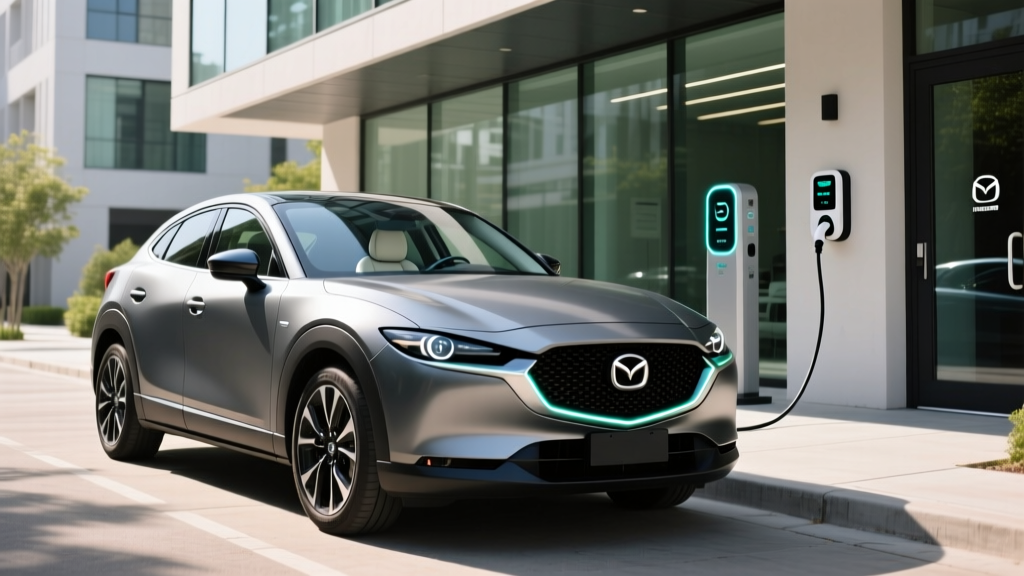
The Mazda MX-30 R-EV occupies a rare corner of the electrified market: a series plug-in hybrid that uses a rotary engine purely as a generator, never to drive the wheels. For 2026, Mazda continues to position it as a stylish urban commuter with the safety net of gasoline range extension — but its small battery, modest electric range, and limited availability demand a hard look at who it actually serves.
After spending time with the MX-30 R-EV's specs, ownership economics, and real-world efficiency data, we break down whether Mazda's rotary revival makes sense for your daily drive — or if a long-range BEV or a conventional PHEV is the smarter buy.
Range, Battery & Efficiency: The Numbers Behind the Rotary
The MX-30 R-EV pairs a 17.8 kWh (usable) lithium-ion battery with a single 830 cc rotary engine that acts exclusively as a range-extending generator. The electric motor — the only component that actually turns the wheels — produces 168 horsepower and 221 lb-ft of torque.
| Spec | Value |
|---|---|
| Battery (usable) | 17.8 kWh, NMC lithium-ion |
| Electric-only EPA range | 38 miles |
| Total range (EV + generator) | ~340 miles |
| Electric motor output | 168 hp / 221 lb-ft |
| Rotary generator | 830 cc single-rotor, 74 hp |
| Drivetrain | FWD (front-wheel drive, single motor) |
| 0-60 mph | ~7.9 seconds |
| EPA MPGe (electric mode) | ~92 MPGe combined |
| Fuel economy (generator mode) | ~32 mpg combined |
| Fuel tank | 13.2 gallons (regular unleaded) |
| Cargo volume | 21.0 cu ft (rear seats up) |
| Rear legroom | 33.1 inches |
| Curb weight | ~3,900 lbs |
The NMC (nickel manganese cobalt) chemistry is standard for Mazda's PHEV applications. It offers higher energy density than LFP but requires careful thermal management and should not be routinely held at 100% state of charge for long-term storage.
Charging Speed: DC Fast Charge & Home Level 2
Charging the MX-30 R-EV's 17.8 kWh battery is relatively quick given its size, but the peak DC rate is modest by 2026 PHEV standards.
| Level | Power | Time (0–100% or 10–80%) | Miles of EV Range Added |
|---|---|---|---|
| Level 1 (120V, 12A) | ~1.4 kW | ~12 hours (0–100%) | ~3 mi/hr |
| Level 2 (240V, 32A) | ~7.2 kW | ~2.5 hours (0–100%) | ~15 mi/hr |
| DC Fast Charge (CCS) | ~50 kW peak | ~25 min (10–80%) | ~23 mi in 25 min |
The 50 kW DC peak is the weakest link. While the battery is small enough that a full charge doesn't take long in absolute terms, the taper above 80% SoC means the last 20% adds disproportionately to your charging time. On a road trip, you'll rely on the rotary generator rather than hunting for DC chargers — which is the whole point of the EREV layout.
For daily use, Level 2 home charging is the sweet spot. A full overnight charge on a 240V/32A circuit restores the battery in roughly 2.5 hours, meaning even a short workday top-up can replenish your EV range. The onboard charger caps at 7.2 kW, so installing a 48A home charger won't speed things up — a 32A unit is sufficient and saves on installation cost.
Pricing, Trims & Federal Tax Credit Eligibility
The 2026 MX-30 R-EV is offered in three trims. Pricing has risen modestly year-over-year, but the entry point remains competitive within the compact PHEV crossover segment.
| Trim | Base MSRP | Est. Federal Credit (§30D) | Effective Price |
|---|---|---|---|
| Base | $35,795 | Up to $3,750* | ~$32,045 |
| Premium | $38,495 | Up to $3,750* | ~$34,745 |
| Premium Plus | $42,195 | Up to $3,750* | ~$38,445 |
*Destination charge (~$1,375) not included. Tax credit figures are estimates based on IRS §30D rules and battery-sourcing compliance. The MX-30 R-EV's credit is limited by the PHEV battery-capacity formula under §30D — the 17.8 kWh pack qualifies for a partial credit, not the full $7,500 available to larger-battery BEVs. Always verify current eligibility at IRS.gov and consult a tax professional. Income caps ($150K single / $300K joint) and the point-of-sale transfer option apply.
The Premium Plus trim adds a head-up display, 360-degree camera, Bose 12-speaker audio, heated rear seats, and a panoramic sunroof. For most buyers, the mid-level Premium — which includes a 10.25-inch infotainment display, adaptive cruise control, and wireless CarPlay/Android Auto — strikes the best value balance.
Driving Impressions & Powertrain Behavior
The series-hybrid architecture means the rotary engine never mechanically connects to the wheels. Under normal driving, the MX-30 R-EV feels like a pure EV: smooth, quiet, and torque-rich off the line. The 168 hp motor provides adequate acceleration for merging and city driving, though the 7.9-second 0-60 time won't thrill anyone accustomed to dual-motor EVs.
When the battery depletes, the 830 cc rotary generator spins up to maintain charge. Mazda has worked to isolate the generator's sound and vibration, and at cruising speeds the transition is subtle. Under hard acceleration with a depleted battery, however, the rotary drones audibly — a reminder that you're operating on borrowed electrons.
The FWD-only drivetrain limits the MX-30 R-EV's appeal in snow-belt states. Mazda does not offer an AWD variant. Traction control and winter tires mitigate this, but competitors like the Toyota RAV4 Prime and Hyundai Tucson PHEV provide standard or available AWD.
Tech, Interior & Practicality
Mazda's interior design remains a class highlight. The MX-30 R-EV features sustainable materials — door trim made from recycled fibers, a cork-lined center console (a nod to Mazda's founding as a cork manufacturer), and vegan leather upholstery on upper trims. Build quality and fit-and-finish punch above the price point.
The 10.25-inch infotainment screen runs Mazda Connect, controlled primarily by a rotary dial on the center console. Wireless Apple CarPlay and Android Auto are standard on Premium and above. The driver-assist suite — branded i-Activsense — includes adaptive cruise control with stop-and-go, lane-keeping assist, blind-spot monitoring, and rear cross-traffic braking.
Practicality is the MX-30 R-EV's weakest category. The rear-hinged "freestyle" doors look distinctive but make rear-seat access awkward in tight parking spaces. Rear legroom at 33.1 inches is tight for adults on longer trips. Cargo space at 21.0 cu ft trails the RAV4 Prime (37.6 cu ft) and Tucson PHEV (30.5 cu ft) significantly. This is strictly a two-adult-plus-groceries vehicle for daily use.
Pros, Cons & Who Should Buy
Pros
- Smooth, quiet EV driving for the first ~35 miles daily
- Rotary generator eliminates range anxiety on longer trips
- Premium interior materials and build quality
- Quick Level 2 home charging (~2.5 hrs)
- Competitive pricing after partial tax credit
- Unique, head-turning design with freestyle doors
Cons
- Short 38-mile EPA electric range vs. PHEV rivals
- FWD only — no AWD option
- Tight rear seat and cargo space
- Modest 50 kW DC fast-charge rate
- Partial federal tax credit (~$3,750), not the full $7,500
- Limited dealer availability in most US markets
- Rotary generator audible under heavy load when depleted
Who Is the MX-30 R-EV For?
Buy it if: You commute under 35 miles round-trip, have reliable home Level 2 charging, rarely carry rear passengers, and want a stylish PHEV that drives like an EV daily but can handle occasional 300-mile road trips without charging-infrastructure anxiety.
Skip it if: You need AWD, regularly haul adults in the back seat, want 45+ miles of electric range (look at the RAV4 Prime), or live in a cold climate where the short EV range will shrink further.
How It Compares to Key PHEV Competitors
| Spec | Mazda MX-30 R-EV | Toyota RAV4 Prime | Hyundai Tucson PHEV |
|---|---|---|---|
| EPA EV Range | 38 mi | 42 mi | 33 mi |
| Battery | 17.8 kWh NMC | 18.1 kWh NMC | 13.8 kWh NMC |
| Total Range | ~340 mi | ~600 mi | ~400 mi |
| Drivetrain | FWD | AWD | AWD |
| Horsepower | 168 hp | 302 hp | 261 hp |
| Cargo (rear up) | 21.0 cu ft | 37.6 cu ft | 30.5 cu ft |
| Base MSRP | $35,795 | $44,515 | $38,725 |
| Federal Credit (est.) | ~$3,750 | ~$7,500 | ~$3,750 |
The RAV4 Prime dominates on total range, power, AWD, and cargo — but costs nearly $9,000 more before credits and has long been subject to dealer markups. The Tucson PHEV offers AWD and more space at a similar price. The MX-30 R-EV's advantage is its lower entry price and its pure EV-like driving feel on short commutes, but it concedes practicality across the board.
Warranty & Battery Longevity
Mazda covers the MX-30 R-EV with a competitive warranty package:
- New vehicle: 3 years / 36,000 miles
- Powertrain: 5 years / 60,000 miles
- Hybrid/EV battery components: 8 years / 100,000 miles (10 years / 150,000 miles in CARB states including California, New York, and Massachusetts)
- Battery capacity retention: Mazda warrants against dropping below 70% state of health during the coverage period
The 17.8 kWh NMC pack is liquid-cooled, which aids longevity. Series-hybrid operation also helps: because the rotary generator maintains the battery in an optimal state-of-charge window (roughly 20–80% SoC) rather than letting it cycle from full to empty, degradation should be modest. Based on industry data for similarly sized NMC packs in PHEV applications, expect 5–8% capacity loss over 5 years / 75,000 miles of typical use.
Replacement cost for the high-voltage battery, should it fail out of warranty, is estimated at $5,500–$7,500 including labor — lower than most BEV packs but still a meaningful expense.
Frequently Asked Questions
What is the real-world range of the Mazda MX-30 R-EV?
The EPA rates it at 38 miles electric-only and approximately 340 miles total. In real-world driving, expect 26–38 electric miles depending on speed and temperature. Highway driving and cold weather push you toward the lower end. The rotary generator extends total range reliably, though fuel economy in generator mode averages around 32 mpg.
How fast does it charge at home and on DC fast chargers?
On a 240V Level 2 home charger (32A), the 17.8 kWh battery fills in about 2.5 hours at 7.2 kW. DC fast charging peaks at roughly 50 kW, reaching 10–80% in approximately 25 minutes. The modest DC rate is acceptable given the small battery — you'll rarely need public charging on daily routes.
How much does the MX-30 R-EV cost after tax credits?
The base trim starts at $35,795. With the estimated $3,750 federal credit (applied at point of sale), the effective price drops to roughly $32,045 before destination and state incentives. The Premium Plus trim lands around $38,445 after credit. Verify your eligibility — income caps and battery-sourcing rules under IRS §30D apply. See IRS.gov for current rules.
Is the MX-30 R-EV worth buying over the RAV4 Prime or Tucson PHEV?
If your commute is short, you don't need rear-seat or cargo space, and you value design and driving refinement over raw capability, the MX-30 R-EV makes a compelling case at its lower price point. If you need AWD, more than 40 miles of electric range, or family-hauling practicality, the RAV4 Prime or Tucson PHEV are stronger choices — though they cost more.
Does the MX-30 R-EV qualify for the full $7,500 federal tax credit?
No. The MX-30 R-EV qualifies for a partial credit of approximately $3,750 under IRS §30D. PHEVs with smaller batteries receive a reduced credit calculated on a per-kWh basis. The full $7,500 requires a larger battery and compliance with critical-mineral and battery-component sourcing requirements. Your personal eligibility also depends on income caps ($150K single / $300K joint modified AGI) and MSRP limits ($80K for SUVs, which the MX-30 clears easily).
Can the rotary engine drive the wheels directly?
No. The MX-30 R-EV is a series hybrid (EREV). The 830 cc rotary engine only generates electricity to feed the motor or recharge the battery. The wheels are always driven by the electric motor. This is fundamentally different from parallel hybrids like the RAV4 Prime, where the gas engine can mechanically drive the wheels.
Is the MX-30 R-EV available nationwide?
As of the 2026 model year, Mazda has expanded MX-30 R-EV availability beyond its initial California-focused launch, but it remains limited to select markets. Check with your local Mazda dealer for inventory. National roll-out has been slower than anticipated due to supply constraints.
Final Verdict
The 2026 Mazda MX-30 R-EV is a niche vehicle done well. Its series-hybrid rotary architecture delivers genuine EV driving quality for short commutes while eliminating the charging-anxiety barrier that keeps many buyers from going fully electric. The interior quality, design, and base pricing are strong points.
But niche means trade-offs. The 38-mile electric range trails key PHEV rivals, FWD limits its all-weather utility, and the rear seat and cargo area are cramped. The partial tax credit (~$3,750) narrows the price advantage against better-equipped competitors like the Tucson PHEV.
If your daily drive fits within the MX-30 R-EV's electric envelope and you value Mazda's design and driving dynamics, it's a genuinely satisfying commuter car that can handle the occasional road trip. If you need more versatility, the PHEV segment offers stronger all-around options — just expect to pay more for them.