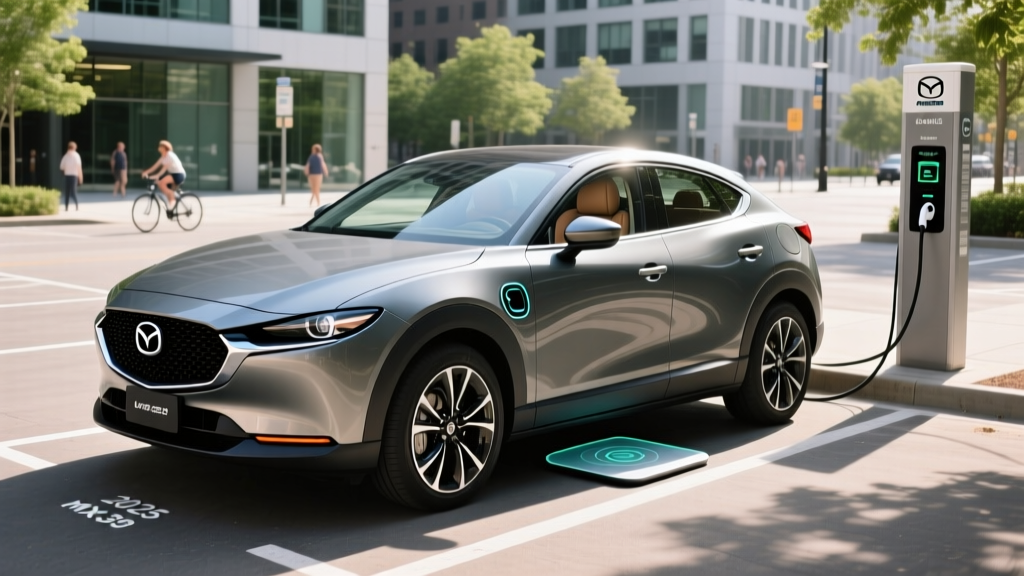
The Mazda MX-30 EV occupies a peculiar space in the American electric-vehicle market. While competitors push past 300 miles of EPA-rated range and 200 kW fast-charging speeds, Mazda has deliberately positioned the MX-30 as an urban-focused commuter with a design-first philosophy and an intentionally small battery. For 2026, the MX-30 returns largely unchanged, still offering its cork-trimmed interior, rear-hinged freestyle doors, and a 35.5 kWh battery pack that yields just 100 miles of EPA-estimated range. That number alone will disqualify it from many buyers' shortlists — but for a specific type of driver, the MX-30's refinement, build quality, and city-friendly footprint make a surprisingly compelling case.
In this review, we break down the exact numbers behind the 2026 Mazda MX-30 EV: what range you'll actually see on the road, how fast it charges at home and on DC fast chargers, whether it qualifies for the federal tax credit, and how it stacks up against rivals like the Chevrolet Bolt EV, Nissan Leaf, and Mini Cooper SE.
2026 Mazda MX-30 EV at a Glance: Full Spec Sheet
| Specification | Value |
|---|---|
| EPA Range | 100 miles |
| Battery Capacity (Usable) | 35.5 kWh (NMC lithium-ion) |
| Motor Output | 143 hp / 200 lb-ft torque |
| Drivetrain | Front-wheel drive (FWD) |
| 0–60 mph | ~9.0 seconds |
| Top Speed | 87 mph (electronically limited) |
| EPA Efficiency | 92 MPGe combined (25 kWh/100 mi) |
| Max DC Fast Charge Rate | 50 kW |
| 10–80% DC Charge Time | ~36 minutes |
| Level 2 Home Charging Rate | 7.2 kW (~22 mi/hr) |
| Level 2 Full Charge Time | ~5 hours |
| Charging Port | CCS1 (J1772 for AC) |
| Cargo Volume (behind rear seats) | 21.0 cu ft |
| Front Legroom | 41.1 in |
| Rear Legroom | 30.2 in |
| Battery Warranty | 8 years / 100,000 miles |
| Bumper-to-Bumper Warranty | 3 years / 36,000 miles |
| Base MSRP (MX-30 EV) | $35,050 |
| Premium Plus Package MSRP | $38,550 |
| Federal Tax Credit (§30D) | Up to $7,500 (eligibility varies) |
Range and Efficiency: The 100-Mile Reality
EPA Estimate: 100 miles
Real-World City/Commuting: ~90–105 miles (regen braking helps in stop-and-go)
Real-World Highway (70 mph): ~75–85 miles
Cold Weather (below 32°F): ~60–75 miles (30–40% loss typical for NMC packs without dedicated heat pump in extreme cold)
The 2026 MX-30's 100-mile EPA rating places it at the bottom of the new-EV range ladder, alongside the Mini Cooper SE (114 miles) and well behind the Chevrolet Bolt EV (259 miles). Mazda has been transparent about this design choice: the smaller 35.5 kWh battery keeps weight down (curb weight is roughly 3,700 lbs), reduces manufacturing footprint, and lowers the entry price. The NMC (nickel manganese cobalt) chemistry offers good energy density for its size but doesn't match the cycle-life longevity of LFP packs found in some competitors.
In practice, the MX-30 excels in urban environments where regenerative braking recaptures energy at every stoplight. Drivers with short, predictable commutes of 30–40 miles round-trip will find the range entirely sufficient, often going two or three days between charges. Highway driving is a different story — at sustained 70+ mph speeds, efficiency drops noticeably, and the electronically limited 87 mph top speed underscores that this is not a road-trip vehicle.
The MX-30's 92 MPGe combined rating (25 kWh per 100 miles) is respectable for its class. For comparison, the Bolt EV achieves 120 MPGe combined, while the Mini Cooper SE rates at 110 MPGe. According to fueleconomy.gov, the MX-30's efficiency is adequate but not class-leading, partly due to its heavier curb weight relative to its battery size.
Charging Speed: DC Fast Charging and Home Level 2
| Charging Level | Power | Speed / Time | Connector |
|---|---|---|---|
| Level 1 (120V outlet) | ~1.4 kW | ~3 mi/hr — full charge in ~25 hrs | J1772 |
| Level 2 (240V home/public) | 7.2 kW | ~22 mi/hr — full charge in ~5 hrs | J1772 |
| DC Fast Charge | 50 kW (peak) | 10–80% in ~36 min | CCS1 |
The MX-30's 50 kW peak DC fast-charging rate is the most significant practical limitation for any owner considering road trips or mid-day top-ups. While competitors like the Hyundai Ioniq 5 (peak 240 kW) or even the Bolt EV (peak 55 kW) can add range much faster, the MX-30's small battery means the absolute charging time isn't catastrophic — you're adding roughly 55 miles of range in 30 minutes at a 50 kW station.
The charge curve is relatively flat, which is typical for smaller packs: the MX-30 sustains close to its peak rate through about 60% state of charge before tapering. The 10–80% time of approximately 36 minutes is usable for planned stops but means spontaneous highway detours require patience. On networks like Electrify America or EVgo, you'll often find chargers capable of 150–350 kW — the MX-30 simply won't use that capacity.
For home charging, the 7.2 kW onboard charger is adequate. Plugging into a Level 2 wallbox (like a ChargePoint Home Flex or Emporia Level 2) will replenish the battery from empty in about five hours, meaning an overnight charge easily tops up any daily driving. Level 1 charging from a standard 120V outlet adds roughly 3 miles per hour — sufficient only for emergency trickle charging or very low-mileage drivers.
Performance and Driving Dynamics
The MX-30's single front-mounted electric motor produces 143 horsepower and 200 lb-ft of torque, routing power exclusively to the front wheels. The 0–60 mph time of approximately 9.0 seconds is leisurely by EV standards — the Bolt EV hits 60 in about 6.5 seconds, and the Tesla Model 3 does it in under 5. This isn't a performance EV, and Mazda doesn't pretend otherwise.
Where the MX-30 shines is ride refinement. Mazda tuned the suspension for comfort over sportiness, and the result is a quiet, composed ride that absorbs city potholes and speed bumps with an almost luxury-car composure. The steering is light and precise, the turning radius is tight, and the overall driving feel is more premium than the price suggests. Mazda's e-Skyactiv electric powertrain integrates smoothly, with linear throttle response and well-calibrated regenerative braking that can be modulated via steering-wheel paddles.
The MX-30 does not offer all-wheel drive or a dual-motor variant for 2026, which limits its appeal in snow-belt states. However, the low center of gravity (battery pack mounted under the floor) provides stable handling in wet conditions.
Interior, Tech, and Practicality
The MX-30's interior is where Mazda differentiates itself from every competitor in this price range. The cabin features sustainably sourced materials, including recycled PET bottle fabrics, door trim made from recycled cork (a nod to Mazda's origins as the Toyo Cork Kogyo company), and a vegan leatherette option. The floating center console and freestyle rear-hinged doors (similar to the BMW i3 or Mazda RX-8) give the cabin an airy, architectural quality.
However, the freestyle doors create a real practicality trade-off: rear-seat passengers can only exit when the front doors are open, which is awkward in tight parking spaces and problematic in rain. Rear legroom at 30.2 inches is tight for adults on longer trips, though adequate for children or short commutes.
Infotainment & Tech:
- 8.8-inch center display (non-touch; controlled via rotary dial)
- Wireless Apple CarPlay and Android Auto
- 12-speaker Bose premium audio (Premium Plus trim)
- 7.0-inch digital instrument cluster
- Head-up display with EV-specific range/charge info
- Wireless phone charging pad
Driver Assistance (Mazda i-Activsense — SAE Level 1-2):
- Adaptive cruise control with stop-and-go
- Lane-keeping assist and lane-departure warning
- Blind-spot monitoring with rear cross-traffic alert
- Automatic emergency braking (front and rear)
- 360-degree camera (Premium Plus trim)
The non-touchscreen infotainment system is polarizing — some drivers appreciate the tactile rotary controller, while others find it dated compared to competitors' large touchscreen interfaces. Apple CarPlay integration works well wirelessly, mitigating the native software's limitations.
The MX-30's i-Activsense suite is an SAE Level 1–2 driver-assistance system. It provides adaptive cruise and lane-centering support but requires full driver engagement at all times. This is not an autonomous or "self-driving" system — your hands must remain on the wheel and eyes on the road.
Pricing, Trims, and Federal Tax Credit Eligibility
| Trim / Package | MSRP | Est. Price After §30D Credit* |
|---|---|---|
| MX-30 EV (base) | $35,050 | ~$27,550 |
| MX-30 EV Premium Plus | $38,550 | ~$31,050 |
*Federal tax credit estimates assume buyer eligibility under IRS §30D rules. Actual credit varies. See eligibility checklist below.
The 2026 MX-30 starts at $35,050 (including destination), with the Premium Plus package adding roughly $3,500 for the Bose audio system, 360-degree camera, heated steering wheel, and additional interior trim upgrades. Mazda has kept the trim strategy simple — there are essentially two configurations rather than a complex ladder.
Federal Tax Credit (§30D) Eligibility Checklist:
- ✅ MSRP Cap: The MX-30 qualifies — it's a passenger car under the $55,000 MSRP cap for sedans/hatchbacks
- ⚠️ Income Cap: Buyer AGI must not exceed $150,000 (single), $225,000 (head of household), or $300,000 (joint filing)
- ⚠️ Battery Sourcing: Critical minerals and battery component requirements apply under the Inflation Reduction Act — Mazda's supply chain compliance may affect credit amount ($3,750 for minerals, $3,750 for components, up to $7,500 total). Verify current-year status at irs.gov
- ✅ Point-of-Sale Transfer: Eligible buyers can transfer the credit to the dealer at purchase, reducing the out-of-pocket price immediately rather than waiting for tax filing
- ⚠️ Final Assembly: Must be assembled in North America — the MX-30 sold in the U.S. is imported from Japan, which may disqualify it from the §30D new-vehicle credit under current rules
The Mazda MX-30 for the U.S. market is manufactured in Japan. Under current IRS §30D rules, new clean vehicles must undergo final assembly in North America to qualify for the federal tax credit. This likely makes the MX-30 ineligible for the $7,500 new-vehicle credit. Always verify your specific vehicle's VIN at fueleconomy.gov before purchasing. The MX-30 may qualify for certain state-level incentives — check your local energy office.
Ownership Costs and Warranty Coverage
Mazda provides an 8-year/100,000-mile warranty on the MX-30's high-voltage battery pack and electric powertrain components, matching the industry standard set by federal mandate for emissions-related components. The battery is warrantied to retain at least 70% of its original capacity during that period. The bumper-to-bumper warranty is 3 years/36,000 miles, with complimentary roadside assistance for 3 years.
Operating costs are where the MX-30 delivers tangible savings over a gas-powered subcompact. At the national average electricity rate of approximately $0.17/kWh (per EIA data), a full charge costs roughly $6.04 — equivalent to about 2.5 gallons of gasoline. Over a year of 10,000 miles, charging costs would be approximately $425 versus roughly $1,100 in fuel for a comparable 30 MPG gas car at $3.30/gallon. Insurance premiums for the MX-30 tend to be moderate, typically in line with gas-powered Mazda CX-30 rates, though EV insurance can vary significantly by state and carrier.
How the MX-30 Compares to Key Rivals
| Spec | Mazda MX-30 | Chevrolet Bolt EV | Mini Cooper SE | Nissan Leaf S |
|---|---|---|---|---|
| EPA Range | 100 mi | 259 mi | 114 mi | 212 mi |
| Battery (kWh) | 35.5 | 65 | 32.6 | 60 |
| Peak DC Charge | 50 kW | 55 kW | 50 kW | 100 kW |
| 0–60 mph | 9.0 sec | 6.5 sec | 6.9 sec | 7.4 sec |
| Base MSRP | $35,050 | $27,800 | $32,000 | $29,230 |
| Cargo (cu ft) | 21.0 | 16.3 | 8.7 | 23.6 |
| NA Assembly (§30D) | No (Japan) | Yes (MI) | No (UK/Germany) | Yes (TN) |
The comparison table reveals the MX-30's core challenge: it offers the least range and slowest charging in its price bracket, while competitors like the Bolt EV deliver 2.5× the range for $7,000 less — and the Bolt qualifies for the federal credit due to U.S. assembly. The MX-30 wins on interior material quality, ride refinement, and cargo volume (surprisingly competitive at 21 cu ft), but these are subjective advantages against hard numbers like range and price.
- Premium, sustainable interior materials
- Quiet, composed ride quality
- Tight turning radius, easy city parking
- Unique design stands out in a sea of crossovers
- Adequate cargo space (21 cu ft)
- Standard wireless CarPlay/Android Auto
- 100-mile EPA range is severely limiting
- 50 kW DC fast charging is slow for 2026
- Non-touch infotainment feels dated
- Rear-hinged doors impractical in tight spaces
- Tight rear-seat legroom (30.2 in)
- Likely ineligible for federal §30D tax credit (Japan assembly)
- Higher price than longer-range competitors
Who Should Buy the Mazda MX-30 EV?
- Have a predictable daily commute under 50 miles round-trip
- Have reliable home Level 2 charging access
- Value interior quality and design over maximum range
- Want a second car for errands and city driving, not road trips
- Live in a mild climate (less cold-weather range loss)
- Appreciate Mazda's brand heritage and driving refinement
- Need 200+ miles of range for highway commuting or road trips
- Want DC fast charging above 100 kW for quick public top-ups
- Need adult-friendly rear seating regularly
- Want to maximize federal tax credit savings
- Live in extreme cold-weather regions (significant range loss)
Frequently Asked Questions
What is the real-world range of the 2026 Mazda MX-30 EV?
The EPA rates the MX-30 at 100 miles. In real-world city driving with regenerative braking, expect 90–105 miles. Highway driving at 70 mph drops that to 75–85 miles, and cold weather (below freezing) can reduce range to 60–75 miles. This makes it strictly a commuter and city vehicle for most owners.
How fast does the MX-30 charge at home and on DC fast chargers?
On a Level 2 home charger (7.2 kW), the MX-30 charges from empty in about 5 hours, adding roughly 22 miles of range per hour. On a DC fast charger, it peaks at 50 kW and reaches 10–80% in approximately 36 minutes. The 50 kW peak rate is slow compared to 2026 standards but partially offset by the small battery.
Does the Mazda MX-30 qualify for the $7,500 federal EV tax credit?
Most likely not. Under current IRS §30D rules, the vehicle must undergo final assembly in North America to qualify for the new clean vehicle credit. The U.S.-spec MX-30 is manufactured in Japan, which likely disqualifies it. Always verify by entering the VIN at fueleconomy.gov before purchase. Some state-level incentives may still apply.
Is the MX-30 worth buying versus the Chevrolet Bolt EV or Nissan Leaf?
On pure specs, no — the Bolt EV offers 259 miles of range for $7,000 less and qualifies for the federal credit. The Leaf offers 212 miles with faster DC charging and North American assembly. The MX-30's case rests on interior quality, ride refinement, and design appeal. If those subjective qualities matter more to you than range and value, it can be justified. For most buyers prioritizing practicality and cost, the Bolt or Leaf is the stronger choice.
What is the MX-30's battery warranty?
Mazda covers the high-voltage battery pack for 8 years or 100,000 miles, whichever comes first. The warranty guarantees the battery will retain at least 70% of its original capacity during that period. This matches the federal minimum standard for EV battery warranties.
Can the MX-30 handle road trips?
Technically yes, but not comfortably. With 100 miles of range and 50 kW DC charging, you'd need to stop every 60–80 miles for roughly 35 minutes on a road trip. This is viable only with meticulous route planning along well-served charging corridors. For regular road trippers, a longer-range EV (250+ miles) is strongly recommended.