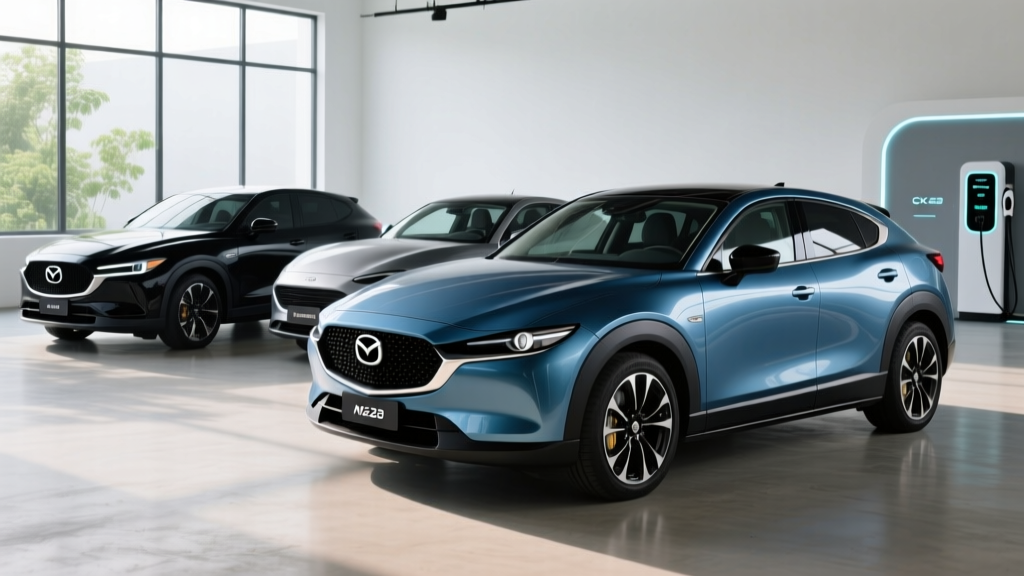
The short answer: Mazda's full electric offerings in 2026 remain limited. The Mazda MX-30 EV (where still available) delivers just 100 miles EPA range from a 35.5 kWh battery, making it one of the shortest-range new EVs on the market. Mazda's stronger electrification play is its plug-in hybrid lineup (CX-70 PHEV, CX-90 PHEV) offering 25–26 miles electric-only before the gas engine engages. If you need a true long-range Mazda full electric vehicle, you'll likely need to wait for the announced 2027+ Mazda EV platform or look to competitors today.
Where Mazda's Full Electric Strategy Stands in 2026
Mazda has been more cautious with full battery-electric vehicles (BEVs) than rivals like Hyundai, Kia, and Tesla. While those brands field multiple models with 250–320+ miles of EPA range, Mazda's dedicated EV — the MX-30 — launched with a 100-mile range that reflects its original design philosophy as a city commuter, not a road-trip vehicle.
For 2026, the MX-30's availability varies by market. It was initially sold only in California and select states. Buyers outside those regions may find no Mazda full electric option on dealer lots. Mazda has announced a partnership with Panasonic and a new dedicated EV architecture expected around 2027–2028, but those vehicles are not yet available for purchase and specs remain preliminary.
What Mazda does offer broadly are plug-in hybrids: the CX-70 PHEV and CX-90 PHEV pair a 2.5-liter four-cylinder with a 17.8 kWh battery pack for short electric-only commutes and unlimited gas range beyond that.
Specs at a Glance: Mazda MX-30 EV vs. Mazda PHEVs
| Spec | MX-30 EV (where available) | CX-70 PHEV | CX-90 PHEV |
|---|---|---|---|
| Powertrain | BEV (full electric) | Plug-in hybrid | Plug-in hybrid |
| Battery (usable) | 35.5 kWh (LFP/NMC — region-dependent) | 17.8 kWh (NMC) | 17.8 kWh (NMC) |
| EPA Electric Range | 100 mi | 26 mi (EV-only) | 26 mi (EV-only) |
| Total Range (PHEV) | N/A | ~430 mi (gas + EV) | ~430 mi (gas + EV) |
| Horsepower | 143 hp / 200 lb-ft | 323 hp combined | 323 hp combined |
| 0–60 mph | ~9.1 sec | ~6.0 sec | ~6.3 sec |
| DC Fast Charge (peak) | 50 kW (CCS) | N/A (no DC fast charge) | N/A (no DC fast charge) |
| 10–80% DC Charge | ~36 min (at 50 kW peak) | N/A | N/A |
| Level 2 Charge Rate | 6.6 kW | ~3.3 kW (est.) | ~3.3 kW (est.) |
| Base MSRP | ~$34,000 (when available) | ~$54,400 | ~$52,500 |
| Battery Warranty | 8 yr / 100,000 mi | 8 yr / 100,000 mi | 8 yr / 100,000 mi |
Sources: fueleconomy.gov, Mazda USA press materials.
Real-World Range: What the EPA Sticker Doesn't Tell You
The MX-30's 100-mile EPA range is the headline problem. In real-world conditions, expect:
- Mild weather, city driving: ~95–105 miles — regenerative braking helps in stop-and-go traffic.
- Highway driving (70 mph): ~75–85 miles — EVs lose efficiency at sustained high speeds due to aerodynamic drag.
- Cold weather (below 32°F): ~60–75 miles — battery chemistry slows, cabin heating draws significant energy, and Mazda does not equip the MX-30 with a heat pump in all markets.
For the PHEV models, the 26-mile electric-only range is realistic for short commutes in moderate weather. Expect roughly 20–22 miles in cold conditions or heavy highway use. Once the battery depletes, the gas engine delivers approximately 25 MPG combined — respectable for a three-row SUV but not class-leading.
Range reality check: If your daily round-trip commute exceeds 60 miles, or you live in a cold-weather state, the MX-30's 100-mile EPA range becomes a genuine constraint — not a quirk. Most competing EVs (Chevy Equinox EV, Hyundai Ioniq 5, Tesla Model Y) deliver 250–320 miles EPA, making the MX-30 an outlier in 2026.
Charging: The 50 kW Bottleneck
The MX-30's DC fast charging tops out at 50 kW — a rate that was modest at launch and is now severely outdated. To put that in perspective:
| Charging Level | Power | Miles Added per Hour | Notes |
|---|---|---|---|
| Level 1 (120V outlet) | ~1.4 kW | ~4–5 mi/hr | Full charge: ~25+ hours |
| Level 2 (240V home) | 6.6 kW | ~20–22 mi/hr | Full charge: ~5 hours |
| DC Fast Charge | 50 kW (peak) | ~120–140 mi/hr (theoretical) | 10–80% in ~36 min; sustained rate lower |
At a public DC fast charger, the MX-30 adds roughly 50–60 miles of range in a 30-minute session. That's fine for topping up during errands, but it makes road trips impractical. Compare this to a Hyundai Ioniq 5 peaking at 240 kW (10–80% in ~18 minutes) or a Tesla Model Y at 250 kW (10–80% in ~15 minutes).
The CX-70 and CX-90 PHEVs lack DC fast charging entirely. You're limited to Level 2 at home or public Level 2 stations, which fully replenishes the small battery in about 5–6 hours.
Cost Breakdown: Mazda EV vs. Gas vs. Hybrid
| Cost Factor | MX-30 EV | CX-90 PHEV | CX-90 Gas (Turbo) |
|---|---|---|---|
| Base MSRP | ~$34,000 | ~$52,500 | ~$43,500 |
| Federal Tax Credit (§30D) | Up to $7,500 (if eligible*) | Up to $7,500 (if eligible*) | $0 |
| Effective Price (after credit) | ~$26,500 | ~$45,000 | $43,500 |
| Fuel/Energy Cost (15,000 mi/yr) | ~$500–$650 (home charging)** | ~$900–$1,200 (mix) | ~$2,100–$2,400 |
| Annual Maintenance | ~$150–$250 | ~$400–$600 | ~$500–$700 |
| 5-Year Fuel + Maintenance | ~$3,250–$4,500 | ~$6,500–$9,000 | ~$13,000–$15,500 |
* Federal §30D credit eligibility depends on MSRP caps, buyer income limits, and battery critical-mineral sourcing. Check current rules at irs.gov. The MX-30 may not qualify in all configurations or model years due to sourcing requirements.
** Based on $0.14/kWh average home electricity; public DC charging costs significantly more ($0.30–$0.50/kWh).
The MX-30 is the cheapest to operate by a wide margin — but only if you can charge at home. Public-only charging erases much of the cost advantage. The PHEVs split the difference: cheap electric-only commuting with gas flexibility for longer trips.
Tax Credit Reality for Mazda Electrified Vehicles
Under current IRS §30D rules, qualifying for the full $7,500 federal credit requires meeting all of the following:
- MSRP cap: SUVs/vans/pickups ≤ $80,000; sedans ≤ $55,000
- Buyer income cap: MAGI ≤ $150,000 (single), $225,000 (head of household), $300,000 (joint)
- Battery sourcing: Increasing percentages of critical minerals and battery components must be sourced from the US or free-trade-agreement partners (thresholds tighten annually)
- Final assembly: Must occur in North America
- Point-of-sale transfer: You can apply the credit as a down-payment reduction at the dealer
The MX-30's assembly location and battery sourcing have been inconsistent with §30D requirements across model years. Always verify current eligibility on fueleconomy.gov before purchase — never rely solely on dealer assurances.
Common Misconceptions About Mazda's EVs
| Myth | Fact |
|---|---|
| "Mazda doesn't make electric cars." | The MX-30 is a full EV, but availability is limited to select markets and its 100-mile range makes it niche. |
| "The PHEVs are basically EVs." | CX-70/CX-90 PHEVs offer only 26 miles electric-only. Beyond that, they run on gasoline at ~25 MPG combined. |
| "The MX-30 will get a range update." | As of 2026, no range-extended MX-30 variant has been confirmed for the US market. Mazda's next-gen EV platform is expected around 2027–2028. |
| "I can road-trip in an MX-30." | Technically yes, but 50 kW DC charging and 100-mile range mean stopping every 60–80 miles for 30+ minutes. Not practical for most road trips. |
| "All Mazdas qualify for the $7,500 tax credit." | Eligibility depends on MSRP, income, battery sourcing, and assembly location. Always verify on fueleconomy.gov. |
Who Should (and Shouldn't) Buy a Mazda Full Electric or PHEV
Buy the MX-30 EV if:
- You live in a mild climate (rarely below 40°F)
- Your daily driving is under 50 miles round-trip
- You have reliable home Level 2 charging
- You want the lowest possible operating cost and the car is available in your state
- You value Mazda's interior quality and driving dynamics over range
Buy the CX-70/CX-90 PHEV if:
- Your commute is under 25 miles and you can charge at home nightly
- You regularly take road trips or drive in areas with limited charging infrastructure
- You need three rows (CX-90) or a sportier two-row SUV (CX-70)
- You want electric commuting without range anxiety
Look elsewhere (Hyundai, Kia, Tesla, Chevy) if:
- You need 250+ miles of range for road trips or long commutes
- You live in a cold-weather state where the MX-30's range drops to 60–75 miles
- You rely solely on public charging (50 kW peak makes this painful)
- You want a dedicated BEV SUV or sedan with fast DC charging
Frequently Asked Questions
Does Mazda have a long-range full electric vehicle for 2026?
No. The MX-30 remains Mazda's only full EV in the US market, with just 100 miles EPA range. Mazda has announced a new dedicated EV platform in partnership with Panasonic, but vehicles built on it are not expected before 2027–2028. Specs for those models are preliminary and unconfirmed.
How does the MX-30 compare to a gas Mazda3 on cost?
The MX-30 (if eligible for the full §30D credit) can be purchased for roughly $26,500 — comparable to a mid-trim Mazda3. Over five years, the MX-30 saves approximately $8,000–$11,000 in fuel and maintenance, assuming home charging. However, the Mazda3 offers unlimited range and no charging dependency.
Can I charge the CX-90 PHEV at a DC fast charger?
No. The CX-90 and CX-70 PHEVs do not support DC fast charging. They charge via Level 1 (120V) or Level 2 (240V) only. A full Level 2 charge takes approximately 5–6 hours.
What happens to the MX-30's battery in winter?
Expect 25–40% range loss in freezing temperatures. A 100-mile EPA rating can drop to 60–75 real-world miles in cold weather, especially with cabin heating. Preconditioning the battery while plugged in helps mitigate this, but the small battery offers little buffer.
Is the MX-30 available nationwide?
No. Mazda initially limited the MX-30 to California and a handful of ZEV-mandate states. Availability in other regions is extremely limited. Contact your local dealer to confirm inventory.
Should I wait for Mazda's next-generation EV?
If you want a Mazda-branded full electric vehicle with competitive range (250+ miles), waiting is reasonable — but the timeline is 2027–2028 at earliest, with no confirmed specs. If you need an EV now, competitors like the Hyundai Ioniq 5, Chevy Equinox EV, or Tesla Model Y offer substantially more range and faster charging today.