The Bottom Line on Mazda EVs
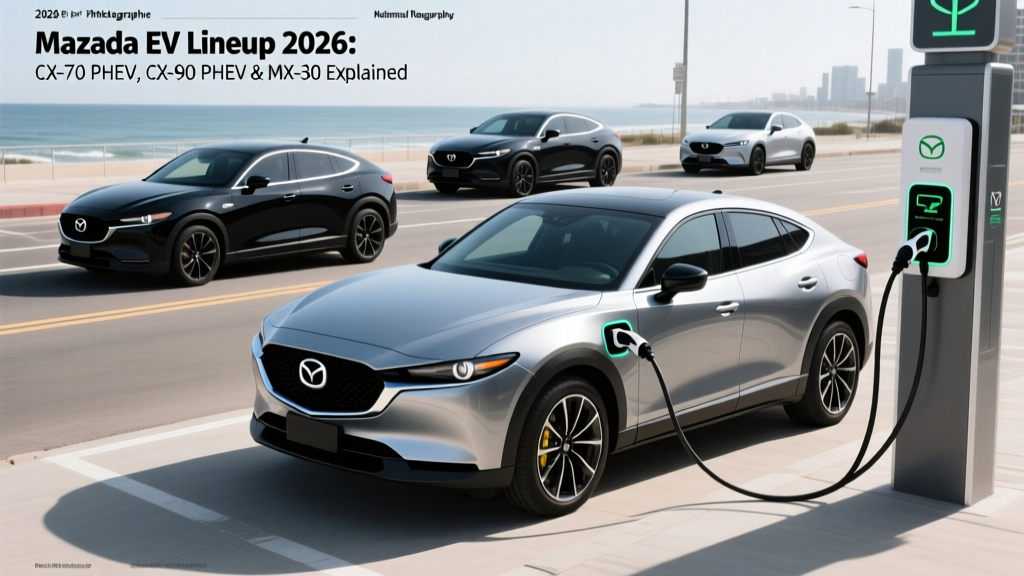
Mazda's electrified lineup in 2026 consists of two plug-in hybrids — the CX-70 PHEV (26 miles electric-only, starts ~$52,970) and the CX-90 PHEV (26 miles electric-only, starts ~$51,775) — plus the limited-availability MX-30 EV (100-mile range, California-only). If you want a Mazda with meaningful electric-only commuting capability, the CX-70 PHEV or CX-90 PHEV are your best options. If you need a full battery-electric vehicle with 250+ miles of range, Mazda does not currently offer one — and you should look at competitors like the Hyundai Ioniq 5 or Tesla Model Y.
Understanding Mazda's Electrified Strategy
Mazda has taken a cautious, incremental approach to electrification compared to rivals. Rather than going all-in on battery-electric vehicles (BEVs), Mazda has prioritized plug-in hybrid (PHEV) powertrains for its larger SUVs while limiting its sole full EV — the MX-30 — to a niche compliance role. This strategy reflects Mazda's engineering philosophy: optimize what they know (inline-six engines, premium interiors) while adding electric capability where it makes practical sense.
For 2026, here is how Mazda's electrified lineup breaks down:
| Model | Type | EPA Electric Range | Battery (kWh) | Combined MPG / MPGe | Base MSRP |
|---|---|---|---|---|---|
| Mazda CX-70 PHEV | Plug-in Hybrid | 26 mi | 17.8 kWh | 25 MPG / 56 MPGe | ~$52,970 |
| Mazda CX-90 PHEV | Plug-in Hybrid | 26 mi | 17.8 kWh | 25 MPG / 56 MPGe | ~$51,775 |
| Mazda MX-30 EV | Battery Electric | 100 mi | 35.5 kWh | 92 MPGe | ~$35,650 (CA only) |
Data sourced from fueleconomy.gov and Mazda USA. Prices reflect approximate 2026 model-year MSRP before destination charges.
Mazda CX-70 PHEV: The Two-Row Electrified SUV
The CX-70 PHEV pairs a 2.5-liter inline-four with an electric motor integrated into an 8-speed automatic transmission, producing a combined 323 horsepower and 369 lb-ft of torque. The 17.8 kWh lithium-ion battery delivers an EPA-rated 26 miles of electric-only driving — enough for many commuters' daily round trips.
Real-world range reality: Expect 20-23 miles of electric-only range in mixed highway driving, and as low as 15-18 miles in cold weather (below 35°F). The EPA 26-mile figure assumes moderate temperatures and suburban-speed driving.
Charging the CX-70 PHEV
The CX-70 PHEV supports Level 2 AC charging at approximately 7.2 kW, which replenishes the 17.8 kWh battery from empty to full in roughly 2.5 hours. There is no DC fast-charging capability — this is standard for PHEVs in this class.
| Charging Level | Power | Time (0-100%) | Where |
|---|---|---|---|
| Level 1 (120V) | ~1.4 kW | ~12-13 hours | Standard household outlet |
| Level 2 (240V) | ~7.2 kW | ~2.5 hours | Home wallbox or public L2 |
| DC Fast Charge | Not supported | N/A | N/A |
For daily use, Level 1 charging overnight (plugged into a standard 120V outlet) can recover 15-20 miles of electric range in 10-12 hours — sufficient for most PHEV owners who drive 25-35 miles daily. A Level 2 home charger is a worthwhile upgrade if your commute regularly exceeds 20 miles.
Mazda CX-90 PHEV: The Three-Row Family Option
The CX-90 PHEV uses the same 2.5L PHEV powertrain as the CX-70 but in a longer, three-row body. Output is identical at 323 hp and 369 lb-ft. The 26-mile electric-only range is also the same, as both vehicles share the 17.8 kWh battery pack.
Where the CX-90 PHEV differs is in total fuel economy once the battery depletes. With a heavier curb weight (~5,100 lbs vs ~4,900 lbs for the CX-70), the CX-90 PHEV returns slightly lower gas-only MPG in real-world highway driving. Expect 23-24 MPG combined on gas alone in the CX-90 vs 24-25 MPG combined in the CX-70.
Battery warranty: Mazda covers the high-voltage battery for 8 years / 100,000 miles (or 10 years / 150,000 miles in CARB states like California), which is competitive with the segment. Coverage includes defects and capacity loss below a specified threshold — check your state's specific warranty terms.
Mazda MX-30 EV: The 100-Mile City Car
The MX-30 is Mazda's only fully electric vehicle, and it comes with significant caveats. Its 35.5 kWh battery delivers just 100 miles of EPA range — the lowest of any EV currently sold in the US market. Mazda has limited sales to California dealerships, making it essentially a compliance vehicle.
MX-30 Charging Specs
- Peak DC fast charge: ~50 kW (10-80% in approximately 36 minutes)
- Level 2 AC charge: ~6.6 kW (full charge in ~5 hours)
- Connector: CCS1
- 0-60 mph: ~9.0 seconds
- Horsepower: 143 hp
Real-World Range Warning: MX-30
EPA sticker: 100 miles. Real-world highway driving at 70 mph: expect 75-85 miles. In cold weather (below 30°F): expect 60-70 miles. This vehicle is viable only as a dedicated city commuter with reliable home charging and no regular highway or long-distance needs.
The MX-30's small battery was a deliberate engineering choice by Mazda to reduce weight and cost, but it renders the vehicle impractical for most American buyers. Unless your daily driving is strictly under 50 miles round-trip and you have Level 2 charging at home, the MX-30 is not recommended.
Mazda PHEV vs Gas vs Competitor EVs: Cost Comparison
How does a Mazda PHEV stack up financially against a gas-only midsize SUV and a comparable full EV? Here is a 5-year ownership comparison assuming 15,000 miles/year, $3.50/gallon gas, and $0.14/kWh electricity:
| Category | CX-70 PHEV | CX-70 Gas (Turbo) | Hyundai Ioniq 5 (EV) |
|---|---|---|---|
| Base MSRP | ~$52,970 | ~$41,520 | ~$42,600 |
| Fed. Tax Credit (§30D) | Not eligible* | None | Up to $7,500** |
| Annual Fuel/Energy Cost | ~$1,050 | ~$2,100 | ~$630 |
| 5-Year Fuel/Energy Total | ~$5,250 | ~$10,500 | ~$3,150 |
| Maintenance (5-yr est.) | ~$2,800 | ~$3,500 | ~$1,800 |
| 5-Year Total (purchase + energy + maint.) | ~$61,020 | ~$55,520 | ~$40,050*** |
*Mazda PHEVs do not currently qualify for the §30D federal tax credit due to battery sourcing and critical-mineral requirements. Verify current eligibility at irs.gov.
**Ioniq 5 eligibility depends on buyer income, MSRP caps, and battery-component sourcing. Rules change — confirm before purchase.
***After $7,500 federal credit applied at point of sale, Ioniq 5 effective price ~$35,100.
The CX-70 PHEV carries a substantial price premium over the gas CX-70. The fuel savings are meaningful (~$1,050/year less than gas), but they do not close the $11,450 MSRP gap within 5 years. The PHEV makes financial sense primarily if you value the electric-only commuting experience, qualify for state-level PHEV incentives, or plan to keep the vehicle 8+ years.
Federal Tax Credit: What Mazda Buyers Need to Know
The §30D federal clean vehicle credit offers up to $7,500 for qualifying new EVs and PHEVs. However, Mazda's electrified vehicles face challenges under current rules:
- Battery sourcing: The critical-minerals and battery-component requirements disqualify many Mazda PHEVs as of 2026. Mazda sources battery cells from suppliers that may not meet US-content thresholds.
- MSRP cap: SUVs must be under $80,000 MSRP. Both CX-70 and CX-90 PHEVs fall within this cap on lower trims.
- Income cap: Buyer AGI must not exceed $150,000 (single) / $300,000 (joint). This applies to all qualifying vehicles.
- Point-of-sale transfer: If a vehicle qualifies, the credit can be applied at purchase to reduce the sale price — no need to wait for tax filing.
Always verify eligibility at fueleconomy.gov and consult a tax professional before relying on the credit in your purchase decision.
Real-World Ownership Considerations
Home Charging Access
PHEV ownership is most rewarding with Level 2 home charging. A 240V home charger installation typically costs $500-$2,000 (equipment + electrician + permit) depending on panel capacity and wiring distance. Without home charging, a PHEV still functions as a conventional hybrid — you just miss the electric-only commute benefit.
Climate Impact
Cold weather reduces electric-only range by 20-35% in PHEVs. The CX-70 PHEV's 26-mile EPA range may drop to 17-20 miles in sub-freezing temperatures. Mazda's PHEVs use a heat pump for cabin heating in EV mode, which partially mitigates this loss — but plan conservatively if you live in northern climates.
Driving Patterns
The Mazda PHEV powertrain is ideal for drivers who commute 15-25 miles one-way and can charge at home overnight. If your daily driving exceeds 50 miles regularly, you will operate on gasoline most of the time, and the fuel-economy advantage over the gas CX-70 narrows to just 1-2 MPG.
Common Misconceptions About Mazda EVs
| Myth | Fact |
|---|---|
| "Mazda has a full-electric SUV." | Mazda does not currently sell a full-electric SUV. The MX-30 is a small crossover with 100 miles of range, sold only in California. |
| "The CX-90 PHEV qualifies for the $7,500 tax credit." | As of 2026, Mazda PHEVs generally do not qualify for §30D due to battery-sourcing requirements. Rules change — always verify at irs.gov. |
| "PHEVs are just as efficient as full EVs." | Once the battery depletes, a PHEV operates as a heavy hybrid. The CX-70 PHEV gets ~25 MPG on gas alone — good, but not the 100+ MPGe of a BEV. |
| "I don't need to charge a PHEV at home." | Without regular charging, you carry 800+ lbs of battery and electric motor you never use. The fuel savings come from actually plugging in daily. |
| "The MX-30 can be a primary vehicle." | At 100 miles EPA (75-85 real-world highway), the MX-30 works only as a secondary city car for short commutes with reliable home charging. |
Decision Framework: Which Mazda (or Alternative) Is Right for You?
Choose the CX-70 PHEV if:
- You want a premium two-row SUV with 20-26 miles of electric commuting
- You have Level 2 home charging and a commute under 25 miles one-way
- You value Mazda's inline-six driving dynamics and interior quality
- You occasionally take longer road trips and want gas-engine flexibility
Choose the CX-90 PHEV if:
- You need three rows and want electric-only school-run capability
- Your daily driving is under 25 miles and you can charge at home
- You prefer Mazda's design and interior over the Toyota Grand Highlander Hybrid
Look beyond Mazda (to a full EV) if:
- You want 250+ miles of electric range and no gas engine
- You want to qualify for the §30D federal tax credit
- Your daily commute exceeds 30 miles and you want zero tailpipe emissions
- Consider: Hyundai Ioniq 5, Tesla Model Y, Ford Mustang Mach-E, or Kia EV6
Skip electrification (for now) if:
- You lack home charging access and your area has limited public charging
- You regularly drive 500+ miles between fuel stops in rural areas
- The CX-70 gas turbo ($41,520) offers strong performance at a much lower entry price
Frequently Asked Questions
Does Mazda make a fully electric car?
Yes — the MX-30 EV, but it has only 100 miles of EPA range and is sold exclusively through California dealerships. Mazda has announced plans for additional EVs in the coming years, but as of 2026, no long-range Mazda BEV is available for purchase.
How long does it take to charge the CX-70 PHEV at home?
On a Level 2 (240V) home charger at 7.2 kW, the CX-70 PHEV's 17.8 kWh battery charges from empty to full in approximately 2.5 hours. On a standard 120V outlet (Level 1), expect 12-13 hours for a full charge.
Do Mazda PHEVs qualify for the federal tax credit?
Generally, no. As of 2026, Mazda PHEVs do not meet the §30D battery-component and critical-mineral sourcing requirements. State-level incentives may still apply — check your state's clean-vehicle rebate program. Always verify current rules at irs.gov.
What happens if I never charge my Mazda PHEV?
The vehicle will operate as a conventional hybrid, using the gas engine and regenerative braking to manage a small battery charge. You will get approximately 24-25 MPG combined — slightly better than the gas-only CX-70 but far below the efficiency you would achieve by charging regularly. You also carry unnecessary battery weight.
Is the Mazda CX-70 PHEV worth the premium over the gas model?
Financially, the ~$11,000 price premium is difficult to justify through fuel savings alone (~$1,050/year). It makes sense if you prioritize the silent electric commute, want to reduce fossil fuel use, qualify for state incentives, or plan to keep the vehicle 8+ years to accumulate savings. For pure economics, the gas CX-70 wins in the short term.
Will Mazda release a long-range EV?
Mazda has announced a roadmap for multiple battery-electric vehicles by the late 2020s, including partnerships for dedicated EV platforms. However, no specific model with confirmed specs, pricing, or release date has been announced as of early 2026. Treat any projected specs as preliminary until Mazda confirms production details.