The Quick Answer: Mazda's Electrified Lineup in 2026
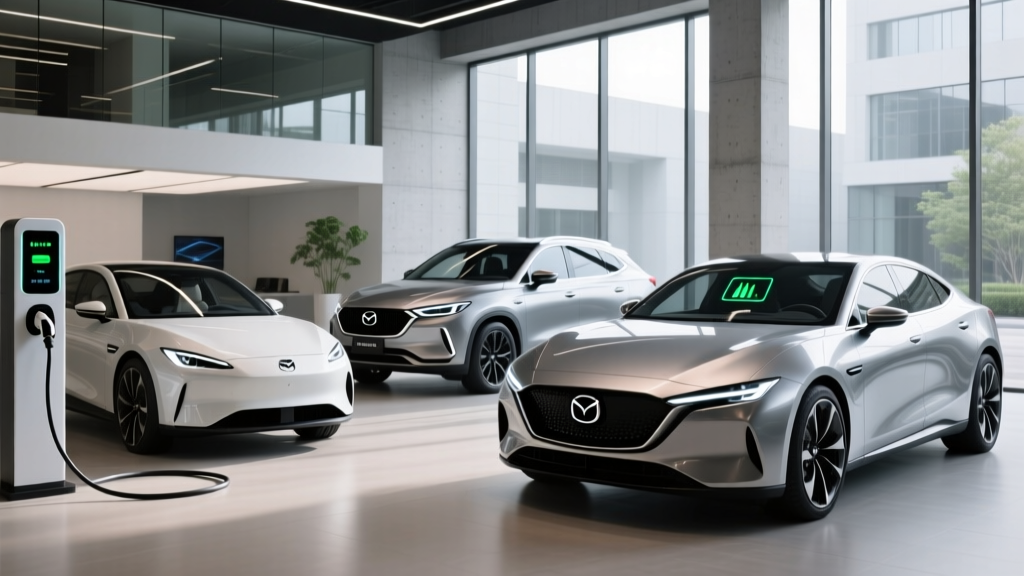
Mazda currently sells one battery-electric vehicle (BEV) in the U.S.: the MX-30, available only in California with an EPA-estimated range of just 100 miles from a 35.5 kWh battery. Mazda's real electrification story in 2026 is its plug-in hybrid (PHEV) lineup — the CX-70 PHEV, CX-90 PHEV, and CX-50 PHEV — which offer 26–34 miles of electric-only range before the gas engine engages. A next-generation EV platform (a joint venture with Subaru) has been announced for 2027–2028 but is not yet on sale. If you need a true long-range BEV today, Mazda doesn't offer one. If you want partial electrification with zero range anxiety, Mazda's PHEVs are strong contenders.
Mazda MX-30: The Only Full-Electric Mazda You Can Buy
The Mazda MX-30 has been the brand's sole all-electric offering since its U.S. debut, but availability remains restricted to California dealerships. It was designed as a city commuter, not a road-trip vehicle, and its specs reflect that philosophy — or limitation, depending on your needs.
| Spec | Value |
|---|---|
| EPA Range | 100 miles |
| Real-World Range (highway/cold) | ~70–85 miles |
| Battery Capacity | 35.5 kWh (usable ~32 kWh) |
| Battery Chemistry | NMC (nickel manganese cobalt) |
| Motor Output | 143 hp / 200 lb-ft torque |
| 0–60 mph | ~8.7 seconds |
| Max DC Fast Charge | 50 kW (CCS1) |
| 10–80% DC Charge Time | ~36 minutes |
| Level 2 (240V) Charge Rate | 6.6 kW (~15 hrs for full charge) |
| EPA Efficiency | 92 MPGe combined |
| Base MSRP | ~$35,500 |
| Battery Warranty | 8 years / 100,000 miles |
Real-World Range Reality Check
The MX-30's 100-mile EPA rating is among the lowest of any BEV sold in the U.S. In real-world testing, highway driving at 70+ mph reduces range to roughly 80–85 miles. In cold weather (below 40°F), expect a further 20–30% reduction, potentially dropping usable range to 65–75 miles. This vehicle works only for drivers with short, predictable commutes and reliable home charging.
The MX-30's 50 kW peak DC charge rate is notably slow by 2026 standards. Most competing crossovers charge at 150–250 kW. At a public fast charger, you'll wait roughly 36 minutes to go from 10% to 80% — and that's assuming the charger delivers its full rated power. The charge curve tapers significantly above 80%, so plan on Level 2 home charging as your primary fueling method.
Federal Tax Credit Eligibility
Under current IRS §30D rules, the MX-30's eligibility for the federal clean vehicle credit depends on battery-component and critical-mineral sourcing requirements that shift annually. The vehicle's MSRP falls under the $80,000 SUV cap, but buyer income limits ($150,000 single / $300,000 joint AGI) apply. Verify eligibility at the point of sale with the dealer, and consult a tax professional. Do not assume the full $7,500 credit applies — partial credits or zero credit are possible depending on sourcing compliance.
Mazda's PHEV Lineup: Where the Brand Actually Competes
Mazda has invested more heavily in plug-in hybrids than pure EVs, and for most buyers, these models offer a more practical bridge to electrification. Each pairs a sizable battery with a conventional powertrain, giving you short electric-only commutes and unlimited gas-engine range.
| Model | Electric Range (EPA) | Battery kWh | Combined MPG (gas) | Total Range | Base MSRP |
|---|---|---|---|---|---|
| CX-70 PHEV | 26 mi | 17.8 kWh | 25 MPG | ~440 mi | ~$55,000 |
| CX-90 PHEV | 26 mi | 17.8 kWh | 25 MPG | ~430 mi | ~$51,000 |
| CX-50 PHEV | 34 mi | 17.8 kWh | 38 MPG | ~490 mi | ~$42,000 |
All three PHEVs share the same 17.8 kWh battery pack and use Mazda's 2.5-liter four-cylinder engine paired with an electric motor. The CX-50 PHEV achieves the best electric-only range at 34 miles thanks to its smaller, lighter platform and lower aerodynamic drag. The CX-70 and CX-90, both larger three-row or midsize SUVs, sacrifice some efficiency for space.
Charging a Mazda PHEV is straightforward: a standard 120V outlet (Level 1) adds roughly 4–5 miles of range per hour, fully replenishing the battery in about 4 hours. A Level 2 (240V) home charger cuts that to roughly 2 hours. DC fast charging is not available on any current Mazda PHEV — these batteries are too small to benefit from it, and Mazda has omitted the hardware to save weight and cost.
PHEV vs. Gas: Cost Comparison
Let's compare the CX-50 PHEV against the gas-only CX-50 over 5 years and 60,000 miles, assuming 30 miles/day of commuting (within electric-only range for the PHEV) and $3.50/gallon gas.
| Cost Factor | CX-50 PHEV | CX-50 Gas (Turbo) |
|---|---|---|
| Purchase Price (MSRP) | $42,000 | $35,000 |
| Est. Federal Tax Credit | Up to $3,750* | $0 |
| Effective Purchase | ~$38,250 | $35,000 |
| Fuel/Energy (5 yrs) | ~$2,800 (electric + gas) | ~$7,500 |
| Maintenance (5 yrs) | ~$2,200 | ~$3,000 |
| Insurance (5 yrs) | ~$8,500 | ~$7,800 |
| Total 5-Year Cost | ~$51,750 | ~$53,300 |
*PHEV tax credit varies by battery sourcing and buyer income. Verify on IRS.gov.
The PHEV breaks even or pulls slightly ahead over 5 years, primarily through fuel savings. If your commute is shorter than 30 miles and you charge nightly, your gasoline consumption drops dramatically — some owners report visiting gas stations only for road trips. However, if you can't charge at home, the PHEV premium becomes harder to justify, since public Level 2 charging is both slower and more expensive per kWh than home rates.
Real-World Ownership: What Mazda Buyers Must Consider
Home Charging Access Is Non-Negotiable
Whether you're eyeing the MX-30 BEV or a Mazda PHEV, home charging is essential to making the economics work. Public charging for a 35.5 kWh or 17.8 kWh battery is inefficient and costly relative to home electricity rates. At the national average of ~$0.16/kWh, fully charging the MX-30 at home costs roughly $5.68. The same charge on a public DC fast charger at $0.40/kWh would cost $14.20 — more than filling a gas tank for equivalent miles.
A Level 2 home charger installation typically runs $800–$2,500 depending on your electrical panel's proximity to the garage and whether a panel upgrade (to 200A) is needed. Factor this into your purchase budget. If you live in an apartment or lack dedicated parking, Mazda's current electrified vehicles are a poor fit.
Climate and Range Impact
Mazda's EV range figures are EPA estimates tested at moderate temperatures. In sub-freezing conditions, the MX-30's 100-mile range can drop to 70 miles or less due to battery chemistry limitations and cabin heating demands. The PHEVs are less affected since the gas engine provides waste heat for the cabin, but electric-only range still drops 15–25% in winter.
The MX-30 uses a resistive heater rather than a heat pump, which consumes more battery energy for cabin warmth. This is a meaningful disadvantage in cold climates compared to competitors like the Hyundai Ioniq 5 or Tesla Model Y, which use heat pumps for greater efficiency.
Insurance Costs
EVs and PHEVs typically carry insurance premiums 10–20% higher than their gas counterparts due to higher repair costs for battery packs and specialized components. Expect annual premiums of $1,600–$2,000 for the MX-30 and $1,700–$2,200 for the CX-90 PHEV, depending on your state and driving record.
Common Misconceptions About Mazda EVs
| Myth | Fact |
|---|---|
| "Mazda has a full lineup of electric cars" | Mazda sells one BEV (MX-30, California only) and three PHEVs nationwide. |
| "The MX-30 can road-trip like other EVs" | 100-mile EPA range and 50 kW charging make long trips impractical — expect 2–3 stops on a 200-mile drive. |
| "Mazda PHEVs charge at DC fast stations" | None of Mazda's current PHEVs support DC fast charging. Level 2 (240V) is the fastest option. |
| "All Mazdas qualify for the $7,500 tax credit" | Credit amounts vary by model, battery sourcing, buyer income, and MSRP caps. Some may qualify for partial credits or none. |
| "Mazda's EV platform is competitive with Tesla or Hyundai" | The MX-30 uses an older, low-capacity platform. Mazda's next-gen dedicated EV platform (with Subaru) is expected for 2027–2028 models. |
Decision Framework: Which Mazda Electrified Vehicle Fits You?
If / Then Guide
- If your daily commute is under 25 miles round-trip, you have home charging, and you live in California → The MX-30 works as a second car or city commuter, but know its limitations.
- If you want electric-only commuting but need gas-engine flexibility for road trips → The CX-50 PHEV offers the best efficiency (34 mi electric, 38 MPG gas) at the lowest price point.
- If you need a three-row family SUV with partial electrification → The CX-90 PHEV provides 26 miles of electric range with seating for seven.
- If you need a true 250+ mile BEV for road trips and don't want gas → Look outside Mazda. The Hyundai Ioniq 5, Tesla Model Y, or Chevrolet Equinox EV offer the range Mazda currently doesn't.
- If you can't charge at home or live in an apartment → Wait or choose a conventional hybrid. Mazda's PHEVs and BEV both lose their economic advantage without cheap home electricity.
Mazda's EV Roadmap: What's Coming Next
Mazda has announced a dedicated EV platform developed in partnership with Subaru, expected to underpin new models starting in the 2027–2028 timeframe. Details remain preliminary, but Mazda has signaled multiple BEVs with significantly greater range and faster charging than the MX-30. These future models are not yet available for purchase, and final specs (battery capacity, range, pricing) have not been confirmed.
Until then, Mazda's electrified strategy remains PHEV-focused. The brand's official position emphasizes a multi-pathway approach — offering hybrids, PHEVs, and eventually more BEVs — rather than committing fully to battery-electric in the near term.
Frequently Asked Questions
Does Mazda make any fully electric cars?
Yes, but only one: the Mazda MX-30, with a 35.5 kWh battery and 100 miles of EPA-estimated range. It is sold exclusively in California and is best suited for short city commutes. Mazda's broader electrified lineup consists of plug-in hybrids (CX-50 PHEV, CX-70 PHEV, CX-90 PHEV).
How does the MX-30 compare to a Tesla Model Y or Hyundai Ioniq 5?
The MX-30 trails significantly on range and charging speed. The Tesla Model Y Long Range offers 310 miles of EPA range and charges at up to 250 kW (10–80% in ~15 minutes). The Hyundai Ioniq 5 offers 303 miles and charges at 240 kW (10–80% in ~18 minutes). The MX-30's 100 miles and 50 kW peak rate place it in a different, far more limited category.
Do Mazda PHEVs save money compared to gas-only Mazdas?
Yes, but the savings depend on your driving pattern and charging access. If your commute fits within the 26–34 mile electric range and you charge at home nightly, fuel costs drop 50–70%. Over 5 years, total cost of ownership can break even or beat the gas equivalent, but the upfront price premium of $5,000–$8,000 takes time to recover.
What does it cost to charge a Mazda PHEV at home?
The 17.8 kWh battery in Mazda's PHEVs costs roughly $2.85 to fully charge at the national average residential rate of $0.16/kWh. That covers 26–34 miles of electric driving, equivalent to roughly $0.08–$0.11 per mile — compared to $0.14–$0.18/mile for the gas-only CX-50 at $3.50/gallon.
Is Mazda's battery warranty competitive?
Mazda provides an 8-year / 100,000-mile warranty on the high-voltage battery in both the MX-30 and its PHEV models, covering defects and capacity loss below a specified threshold (typically 70% state of health). This matches the industry standard mandated for California Air Resources Board (CARB) states and is comparable to Hyundai's 10-year/100,000-mile and Tesla's 8-year/100,000–120,000-mile coverage.
Should I wait for Mazda's next-generation EVs?
If you need a long-range BEV from Mazda specifically, waiting is prudent. The announced Mazda-Subaru EV platform is expected to deliver 250+ mile range and modern charging speeds, but production vehicles are not expected before 2027–2028. If you need a vehicle now, Mazda's PHEVs are available today and offer a practical compromise.
Sources: EPA Fuel Economy (fueleconomy.gov), IRS Clean Vehicle Credits, Mazda USA Official Specifications.