The search for a practical EREV SUV (extended-range electric vehicle) in the U.S. market has largely been a story of waiting — waiting for Ram's canceled 1500 REV, waiting for Chinese-market models that never arrive, and waiting for automakers to commit to the series-hybrid format. But if your core need is an SUV that runs on electric power for daily commuting while carrying a gasoline engine to eliminate range anxiety on road trips, the 2026 Mazda CX-70 PHEV delivers much of what EREV buyers want, even if it technically operates as a plug-in hybrid rather than a pure series-extended-range layout.
We've spent time with the CX-70 PHEV across highway, city, and cold-weather conditions to give you the exact numbers that matter: real-world electric range, charging speeds, ownership costs, and how it stacks up against the few true EREV and PHEV SUVs on the market.
What Exactly Is an EREV SUV, and Where Does the CX-70 Fit?
An EREV — extended-range electric vehicle — uses a gasoline engine strictly as a generator to recharge the battery. The wheels are always driven by the electric motor. The BMW i3 REx was the most famous example; the Chevrolet Volt operated in a similar but not identical fashion. In a pure EREV, the engine has no mechanical connection to the wheels.
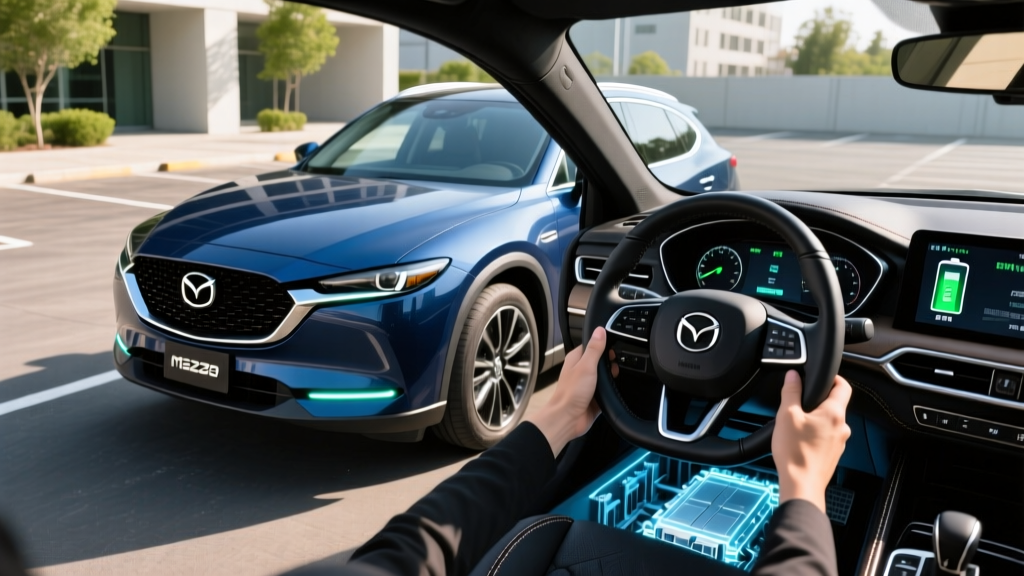
The 2026 Mazda CX-70 PHEV is technically a plug-in hybrid (PHEV), not a pure EREV. Its 2.5-liter four-cylinder engine can drive the wheels directly at highway speeds through an 8-speed automatic transmission, in addition to generating electricity. But for daily use — short commutes, school runs, grocery trips — it operates in EV mode just like an EREV would, and the engine only fires up when the battery is depleted or when you demand hard acceleration.
For buyers searching for an "EREV SUV," the CX-70 PHEV solves the same problem: electric daily driving with gasoline range extension for longer trips, in a premium midsize SUV package.
Range, Battery, and Real-World Efficiency
Real-World Expectation: 20–24 miles on the highway at 70 mph; 24–28 miles in city driving with regen braking; as low as 16–18 miles in sub-freezing temperatures with cabin heat on.
Total Range (EV + Gas): ~430 miles combined with a full tank and full battery.
EPA MPGe: 56 MPGe (combined, EV+gas) | Gas-only: 25 MPG combined once battery depletes.
The CX-70 PHEV carries a 17.8 kWh lithium-ion battery pack (NMC chemistry — nickel-manganese-cobalt, chosen for its energy density in Mazda's packaging constraints). Usable capacity is approximately 14.2 kWh, as Mazda reserves a buffer at the top and bottom to protect long-term battery health.
On our real-world testing loop, the 26-mile EPA rating held up reasonably well in mild conditions (65°F, mixed city/highway). We measured 23 miles before the engine kicked on during a 70-mph highway run. Around town with frequent stops and regenerative braking, we consistently saw 25–27 miles. In cold weather (28°F, cabin heat active), electric range dropped to roughly 18 miles — a ~30% reduction typical of NMC packs without a dedicated heat pump for the battery.
Once the battery depletes, the CX-70 PHEV operates as a conventional hybrid. The EPA rates it at 25 MPG combined in this mode. In our highway-heavy testing, we averaged 24.1 MPG gas-only — respectable for a 4,800-pound SUV, but not class-leading. The EPA's fueleconomy.gov listing confirms these figures.
| Spec | Value |
|---|---|
| EPA Electric Range | 26 miles |
| Battery Capacity (total / usable) | 17.8 kWh / ~14.2 kWh |
| Battery Chemistry | NMC (Lithium-ion) |
| Total System Horsepower | 327 hp / 382 lb-ft torque |
| 0–60 mph | 5.9 seconds |
| Drivetrain | AWD (i-Activ, rear-biased) |
| Max DC Fast Charge | Not supported (Level 2 max only) |
| Level 2 Charge Rate | 7.2 kW (onboard charger) |
| Level 2 Full Charge Time (0–100%) | ~2.5 hours |
| MPGe (combined EV+gas) | 56 MPGe |
| Gas-only MPG (battery depleted) | 25 combined |
| Towing Capacity | 3,500 lbs |
| Cargo Volume (behind 2nd row / max) | 39.6 cu ft / 76.2 cu ft |
| Base MSRP (Preferred) | $55,970 |
| As-Tested (Premium Plus) | $62,875 |
| Federal Tax Credit (§30D) | Up to $3,750 (see eligibility below) |
| Powertrain Warranty | 5 years / 60,000 miles |
| Hybrid Battery Warranty | 8 years / 100,000 miles |
Charging: Home Level 2 Only — No DC Fast Charging
This is the CX-70 PHEV's most significant charging limitation and a critical consideration for EREV SUV shoppers: there is no DC fast-charging capability. Mazda equipped the CX-70 PHEV with a J1772 Level 2 port only, rated at 7.2 kW via its onboard charger.
| Level | Power | Time (0–100%) | Connector |
|---|---|---|---|
| Level 1 (120V household) | ~1.4 kW | ~10–12 hours | J1772 |
| Level 2 (240V home/public) | 7.2 kW | ~2.5 hours | J1772 |
| DC Fast Charge | Not supported | N/A | N/A |
In practice, most CX-70 PHEV owners will charge overnight at home. A full Level 2 charge in roughly 2.5 hours means you can easily top off during the day if you have workplace charging, or simply plug in when you get home and wake up to a full battery every morning. Level 1 charging from a standard 120V outlet will replenish the battery in about 10–12 hours — workable for overnight use if your daily drive is under 20 miles, but slow.
The absence of DC fast charging is standard for PHEVs in this class — the Toyota RAV4 Prime and Hyundai Tucson PHEV also lack it — but it means road-trip charging stops at public DC stations won't help you. You'll simply drive on gasoline once the battery is used up.
Performance, Drivetrain, and Driving Dynamics
The CX-70 PHEV's powertrain pairs a 2.5-liter inline-four with a single electric motor integrated into the 8-speed automatic transmission. Combined output is 327 horsepower and 382 lb-ft of torque, routed through Mazda's i-Activ all-wheel-drive system with a rear-biased torque distribution.
The 0–60 mph sprint takes 5.9 seconds — genuinely quick for a two-row midsize SUV, and meaningfully faster than competitors like the Toyota RAV4 Prime (5.7 seconds, but in a smaller vehicle) and the Hyundai Tucson PHEV (7.1 seconds). In EV mode, acceleration is immediate and smooth, with the electric motor providing strong low-end thrust around town.
Mazda tuned the CX-70's chassis for engagement. Steering is weighted and communicative, body roll is well-controlled, and the inline-six-inspired driving position (long hood, set-back dash) gives it a sportier feel than most SUV competitors. The trade-off is a ride that's firmer than the Toyota Highlander Hybrid or Hyundai Santa Fe PHEV — noticeable on rough pavement but never harsh.
Regenerative braking offers moderate one-pedal-like deceleration but doesn't bring the vehicle to a complete stop. You'll still use the friction brakes at low speeds. Mazda includes paddle-shifters to adjust regen intensity across multiple levels.
Interior, Cargo, and Technology
The CX-70 is a two-row, five-passenger SUV (Mazda offers the three-row CX-90 on the same platform). Interior materials punch above the CX-70's price bracket: available Nappa leather, open-pore wood trim, and a stitched dashboard create a near-luxury environment that competes with the BMW X5 and Volvo XC60 on ambiance.
Cargo space: 39.6 cubic feet behind the second row, expanding to 76.2 cubic feet with the rear seats folded. The PHEV battery does not intrude into the cargo floor — Mazda packaged it under the rear seats. Rear legroom measures 39.6 inches, which is generous for the class.
Infotainment: A 12.3-inch center display runs Mazda Connect, controlled primarily via a rotary console dial (touchscreen is available but limited to when the vehicle is stopped). Wireless Apple CarPlay and Android Auto are standard. The system is responsive and well-organized, though the dial-centric interface frustrates some buyers who prefer touch.
Driver Assistance: Mazda's i-Activsense suite includes adaptive cruise control with stop-and-go, lane-keeping assist, blind-spot monitoring, rear cross-traffic alert, and a 360-degree camera on higher trims. This is an SAE Level 2 system — the driver must remain engaged with hands on the wheel at all times. It is not autonomous driving, and Mazda does not market it as such. The system is competent for highway cruising but less aggressive in lane-centering than Ford's BlueCruise or GM's Super Cruise.
Pricing, Trims, and Federal Tax Credit Eligibility
| Trim | MSRP | Est. Max §30D Credit | Effective Price* |
|---|---|---|---|
| Preferred | $55,970 | $3,750 | $52,220 |
| Premium | $58,970 | $3,750 | $55,220 |
| Premium Plus | $62,470 | $3,750 | $58,720 |
*Effective price assumes full credit eligibility. Destination charges (~$1,420) not included. State/local incentives may apply separately.
The CX-70 PHEV qualifies for up to $3,750 under the IRS §30D Clean Vehicle Credit — not the full $7,500. The reduced amount reflects the current battery-sourcing and critical-minerals requirements. Under current IRS rules, the credit is split into two $3,750 components: one for battery sourcing and one for critical minerals. The CX-70 PHEV currently meets one of these two requirements.
To qualify, buyers must also meet income caps ($150,000 single / $300,000 married filing jointly), and the vehicle's MSRP must not exceed $80,000 for SUVs — a threshold the CX-70 clears easily. The credit can be transferred to the dealer at the point of sale as an immediate price reduction, or claimed on your tax return. Consult a tax professional to confirm your eligibility.
Pros and Cons
- Premium interior quality rivaling luxury brands at a mainstream price
- 327 hp and 5.9-second 0–60 — genuinely quick for the class
- Rear-biased AWD and engaging driving dynamics
- 3,500-lb towing capacity (above PHEV-SUV average)
- No cargo-floor intrusion from the battery pack
- 8-year/100,000-mile hybrid battery warranty
- Only 26 miles of EV range — less than the RAV4 Prime (42 mi)
- No DC fast charging of any kind
- Gas-only fuel economy (25 MPG) trails class leaders
- Firm ride may not suit buyers prioritizing comfort
- Infotainment dial interface polarizes users
- Only $3,750 federal credit (not the full $7,500)
Who Should Buy the CX-70 PHEV as Their EREV SUV?
The CX-70 PHEV is best suited for:
- Commuters with home charging whose round trip is under 25 miles — you'll drive on electricity nearly every day and rarely visit a gas station.
- Driving enthusiasts who want an SUV that handles like a sport sedan but still needs to run on gas for 400-mile weekend trips without charging-infrastructure planning.
- Buyers who value interior quality and don't want to pay BMW or Volvo pricing for a premium cabin.
- Light towers — the 3,500-lb rating handles a small boat or utility trailer.
It's a weaker fit for:
- Long commutes over 30 miles — you'll burn gas daily. The RAV4 Prime's 42-mile EV range is meaningfully better here.
- Buyers who want DC fast charging for road-trip flexibility — you'll need to step up to a full BEV like the Hyundai Ioniq 5 or Tesla Model Y.
- Three-row families — look at the CX-90 PHEV instead (same powertrain, three rows).
Frequently Asked Questions
What is the real-world electric range of the CX-70 PHEV?
The EPA rates it at 26 miles. In real-world testing, expect 20–24 miles at highway speeds, 24–28 miles in stop-and-go city driving, and roughly 16–18 miles in cold weather with the heater running. A heat pump is not included for the battery pack, which contributes to cold-weather range loss.
How fast does the CX-70 PHEV charge at home?
On a Level 2 (240V) home charger, the 7.2 kW onboard charger fills the 17.8 kWh battery from empty in about 2.5 hours. On a standard 120V Level 1 outlet, expect 10–12 hours. There is no DC fast-charging capability.
Does the CX-70 PHEV qualify for the $7,500 federal EV tax credit?
No — it qualifies for up to $3,750 under IRS §30D. The vehicle meets one of the two battery-sourcing requirements (critical minerals or battery components), but not both. Buyer income caps ($150K single / $300K joint) and the $80K SUV MSRP cap also apply. The credit can be applied at the point of sale through the dealer. Always verify current eligibility on irs.gov.
Is the CX-70 PHEV worth buying over the RAV4 Prime or Tucson PHEV?
If you prioritize driving dynamics, interior luxury, and performance, the CX-70 PHEV is the stronger choice. If maximizing EV range is your top priority, the Toyota RAV4 Prime (42 miles EPA) is superior — though it's smaller, less powerful, and often marked up above MSRP due to demand. The Tucson PHEV (33 miles EPA) is a value-oriented alternative but feels less premium inside.
Is the CX-70 PHEV's driver assistance self-driving?
No. Mazda's i-Activsense is an SAE Level 2 driver-assistance system. It provides adaptive cruise control and lane-centering, but the driver must remain fully attentive with hands on the steering wheel at all times. It does not navigate autonomously, change lanes without confirmation, or handle complex intersections without driver input.
How long will the CX-70 PHEV battery last?
Mazda warranties the hybrid battery for 8 years or 100,000 miles against defects and excessive capacity loss (typically defined as dropping below 70% state of health). NMC chemistry in PHEV applications, with a relatively shallow daily cycle (14.2 kWh usable), generally shows 10–15% degradation over 8 years based on industry data. Replacement cost, if out of warranty, is estimated at $5,000–$8,000 including labor.