The Matte Black Tesla Model 3: What Buyers Need to Know in 2026
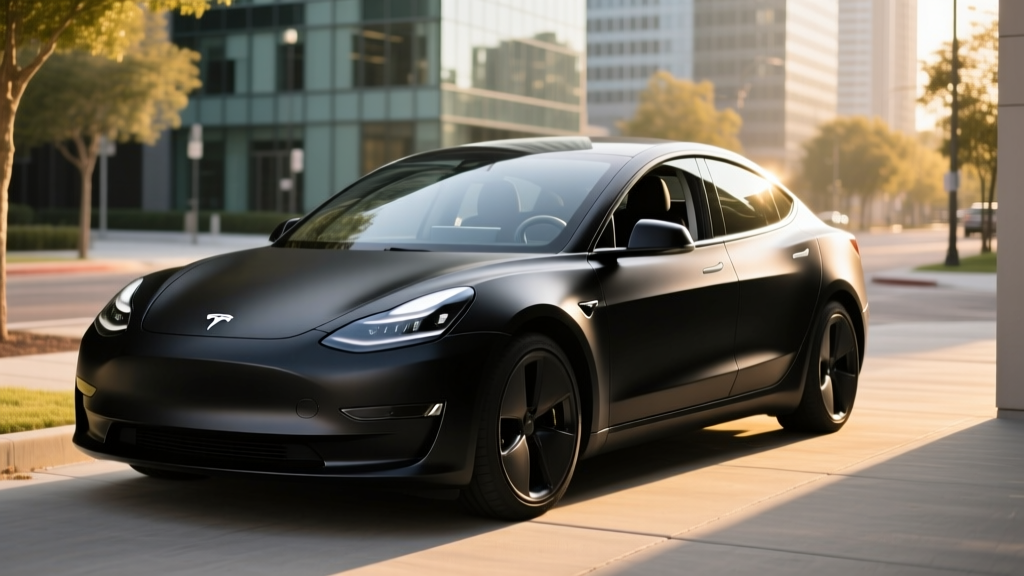
The matte black Tesla Model 3 isn't a factory paint option — it's a statement. Tesla offers five standard colors for the refreshed "Highland" Model 3 lineup, and none of them are matte. Achieving the flat, light-absorbing stealth aesthetic requires either a premium vinyl wrap or a third-party paint-protection-film (PPF) conversion applied after delivery. But beneath that sinister exterior sits one of the most efficient, best-charging electric sedans on the market. This review breaks down the 2026 Model 3's real-world range, charging behavior, ownership costs, and whether wrapping one in matte black is worth the investment.
We'll cover both the Long Range RWD and the Performance AWD variants — the two trims most commonly wrapped — with exact EPA figures, sustained charging data, and a clear-eyed look at what the §30D federal tax credit actually covers in 2026.
| Spec | Long Range RWD | Performance AWD |
|---|---|---|
| EPA Range | 363 miles | 315 miles |
| Battery (usable) | ~79 kWh (NMC) | ~79 kWh (NMC) |
| Drivetrain | Rear-Wheel Drive | Dual-Motor AWD |
| Horsepower | 346 hp | 510 hp |
| 0–60 mph | 4.9 sec | 2.9 sec |
| Peak DC Fast Charge | 250 kW | 250 kW |
| 10–80% DCFC Time | ~25 min | ~25 min |
| Level 2 Rate | 11.5 kW (~44 mi/hr) | 11.5 kW (~44 mi/hr) |
| MPGe (combined) | 132 MPGe | 116 MPGe |
| kWh / 100 mi | 25 | 29 |
| Cargo Volume | 23 cu ft (trunk + frunk) | 23 cu ft (trunk + frunk) |
| Base MSRP | $44,130 | $54,130 |
| Battery Warranty | 8 yr / 120,000 mi | 8 yr / 120,000 mi |
Real-World Range: Beyond the EPA Sticker
The EPA rates the Model 3 Long Range RWD at 363 miles — one of the highest figures in its class. The Performance AWD drops to 315 miles due to its dual-motor drag and stickier tires. But EPA numbers are generated under controlled conditions, and real-world results depend heavily on speed, temperature, and terrain.
EPA Sticker: 363 mi (Long Range RWD) / 315 mi (Performance AWD)
Real-World Highway (70–75 mph, moderate climate): ~290–310 mi / ~250–270 mi
Cold Weather (below 30°F, highway): ~230–260 mi / ~200–225 mi
City / Commuter Driving (with regen): Often exceeds EPA — 360–380 mi achievable
The Model 3 Highland benefits from improved aerodynamics (a 0.219 Cd) and a heat pump that reduces cabin-heating energy draw in winter. Still, at sustained 80 mph on the interstate, expect to consume roughly 28–30 kWh/100 mi in the Long Range — translating to about 270 miles before you'll want to stop. In sub-freezing conditions, battery resistance increases and the thermal management system draws additional energy, trimming another 10–15% off highway range.
For commuters with access to home charging and mostly stop-and-go driving, the Model 3's regenerative braking recovers meaningful energy, and hitting or even exceeding the EPA figure is realistic. Road trippers should plan conservatively: assume 250–280 miles between Supercharger stops in the Long Range, and 220–240 in the Performance.
Charging Speed: DC Fast Charging and Home Setup
Charging speed is where the Model 3 Highland earns its reputation. Both trims peak at 250 kW on a V3 or V4 Tesla Supercharger, which is among the fastest sustained rates in the mid-size sedan segment. However, peak kW is not sustained kW — understanding the charge curve matters for realistic trip planning.
| Charging Level | Power (kW) | Rate | Typical Use Case |
|---|---|---|---|
| Level 1 (120V household) | ~1.4 kW | ~5 mi/hr | Emergency / trickle top-up |
| Level 2 (240V home Wall Connector) | 11.5 kW | ~44 mi/hr | Daily overnight charging |
| Level 2 (public AC) | 7.2–19.2 kW | 28–74 mi/hr | Destination / workplace |
| DC Fast Charge (Supercharger V3/V4) | Peak 250 kW | ~175 mi in 15 min | Road trips |
| DC Fast Charge (CCS adapter, 3rd-party) | Up to 250 kW | Varies by station | Non-Tesla networks |
The charge curve reality: The Model 3 hits its 250 kW peak between roughly 10–30% state of charge (SoC), then progressively tapers. From 10–80%, expect about 25 minutes at a V3 Supercharger. The 80–100% stretch adds another 20–25 minutes due to cell-balancing and thermal limits — this is why Tesla's navigation system typically routes you to arrive at chargers at 10–15% and depart at 70–80%.
One practical advantage: the Model 3 includes a native NACS (North American Charging Standard) port, meaning it accesses the full Tesla Supercharger network without adapters. For Electrify America, EVgo, or other CCS-based networks, Tesla sells a CCS adapter (~$175) that enables compatibility. As of 2026, most major networks have begun adding NACS connectors, but the adapter remains useful for older stations.
Preconditioning matters. When you navigate to a Supercharger using the car's built-in routing, the battery automatically preheats to optimal temperature before arrival. This can shave 5–8 minutes off your 10–80% time in cold weather. Skipping preconditioning (e.g., pulling into a charger without nav routing) means slower initial charge rates.
For home charging, the Tesla Wall Connector on a 60-amp circuit delivers the full 11.5 kW (48 amps continuous), adding roughly 44 miles of range per hour. A full 10–80% top-up at home takes about 6–7 hours — ideal for overnight. Installation typically runs $800–$2,000 depending on panel capacity and conduit distance. Homes with older 100-amp electrical panels may need a $1,500–$3,000 panel upgrade to support a dedicated 60-amp EV circuit.
Performance and Driving Dynamics
The Model 3 Performance AWD's 2.9-second 0–60 mph time places it in supercar territory, and the instant torque delivery makes it feel even quicker in real-world passing situations. The Long Range RWD's 4.9-second sprint is no slouch either — it out-accelerates most gas-powered sport sedans in its price range.
The Highland refresh brought meaningful chassis improvements: revised suspension tuning, frequency-selective dampers, and improved sound insulation. The result is a ride that's noticeably more compliant over rough pavement than the pre-2024 Model 3, while retaining sharp turn-in and minimal body roll. The Performance trim adds adaptive dampers, larger brakes, and a track mode with adjustable torque distribution.
Both trims come standard with Tesla's basic Autopilot — a Level 2 driver-assistance system that includes adaptive cruise control and lane-centering on highways. Full Self-Driving (Supervised) remains an optional $8,000 add-on or $99/month subscription. To be clear: FSD is still SAE Level 2, meaning the driver must remain fully engaged and ready to take over at any moment. It is not autonomous driving.
The Matte Black Wrap: Cost, Quality, and Considerations
Tesla does not offer matte black as a factory color for the 2026 Model 3. The available colors are Pearl White, Solid Black (gloss), Deep Blue, Ultra Red, and Quicksilver (stealth grey). Achieving a true matte black finish requires an aftermarket wrap or PPF conversion.
Vinyl wrap: A full-vehicle matte black vinyl wrap from a reputable installer typically costs $3,000–$5,000 using premium films like 3M Matte Black or Avery Dennison Supreme Wrapping Film. Quality wraps last 5–7 years with proper care, are removable without damaging the factory paint, and can actually protect the underlying finish from minor rock chips and UV fading.
Matte PPF (paint protection film): A more expensive option at $5,000–$8,000, matte PPF provides the flat-black aesthetic while offering superior stone-chip and scratch protection. Brands like XPEL Stealth and Suntek Matte are popular choices. PPF typically lasts 7–10 years and includes self-healing properties for minor swirl marks.
Ownership considerations: Matte finishes require specific care — no automatic car washes with abrasive brushes, no wax or sealant (which create glossy patches), and hand-washing with pH-neutral soap. Touchless car washes are generally safe. Some wrap manufacturers offer warranties against peeling, cracking, and excessive fading, but coverage varies. Additionally, notify your insurance provider: wraps are aftermarket modifications and may need a rider for full replacement coverage.
Pricing, Tax Credits, and Total Cost
The 2026 Tesla Model 3 Long Range RWD starts at $44,130 (including destination). The Performance AWD begins at $54,130. Adding FSD, premium interior upgrades, or larger wheels pushes the as-tested price higher — a fully optioned Performance can reach $63,000+.
| Trim | Base MSRP | Typical As-Tested | §30D Credit Eligibility |
|---|---|---|---|
| Long Range RWD | $44,130 | $46,000–$52,000 | Up to $7,500 (if sourcing rules met) |
| Performance AWD | $54,130 | $56,000–$63,000 | Up to $7,500 (if sourcing rules met) |
Federal tax credit (§30D) details for 2026: The Model 3 may qualify for up to $7,500 under the Inflation Reduction Act's clean vehicle credit, but eligibility depends on three overlapping requirements:
- MSRP cap: Sedans must have an MSRP at or below $55,000. The Long Range RWD qualifies at base price; the Performance AWD at $54,130 also qualifies, but adding options that push the MSRP above $55,000 disqualifies it.
- Buyer income cap: Modified adjusted gross income must not exceed $150,000 (single), $225,000 (head of household), or $300,000 (married filing jointly).
- Battery sourcing: A percentage of critical minerals and battery components must be sourced from the US or free-trade-agreement countries. These thresholds increase annually. As of 2026, vehicles must meet both the critical-minerals and battery-component requirements to receive the full $7,500; meeting only one yields $3,750. Check the latest eligibility list on fueleconomy.gov before purchasing, as sourcing compliance can change mid-year.
The credit can now be transferred to the dealer at point of sale, effectively reducing your purchase price upfront rather than waiting for a tax refund. Consult a tax professional to confirm your personal eligibility — rules are subject to change and individual circumstances vary.
According to IRS.gov, the point-of-sale transfer requires the dealer to be registered with the IRS Energy Credits Online portal. Tesla participates in this program, but you should confirm the credit transfer process at the time of order.
Interior, Cargo, and Daily Practicality
The Model 3's cabin follows Tesla's minimalist philosophy: a single 15.4-inch center touchscreen handles all infotainment, climate, and vehicle controls. There are no physical buttons, no instrument cluster, and no traditional stalks — turn signals are on the steering wheel rim, and gear selection is via the touchscreen (with a backup console button). This takes acclimation but becomes intuitive within a week of driving.
The Highland refresh improved interior materials with ventilated front seats, ambient lighting, acoustic glass, and a rear-seat 8-inch touchscreen for climate and media control. Build quality has noticeably improved over earlier Model 3 generations, with tighter panel gaps and softer-touch materials.
Dimensions:
- Cargo (trunk): 21 cu ft
- Frunk (front trunk): 2 cu ft
- Total cargo: 23 cu ft
- Rear legroom: 35.2 inches
- Front headroom: 40.3 inches
- Rear headroom: 37.8 inches
The 23 cu ft total is competitive with compact luxury sedans, and the trunk's wide opening and flat load floor make it practical for groceries, luggage, or a stroller. However, the frunk is small — useful for charging cables but not much else. Rear-seat passengers taller than 6 feet will find headroom tight due to the sloping roofline, and the fixed glass roof offers no shade option beyond the factory tint.
Who the Matte Black Model 3 Suits Best
Pros
- Class-leading 363-mile EPA range (Long Range RWD)
- 250 kW peak DC fast charging with Supercharger network access
- 2.9-sec 0–60 mph (Performance) at a sub-$55K price
- Low running costs: ~$0.04–$0.06/mile on home electricity
- Over-the-air updates continuously add features
- Matte wrap protects factory paint and adds resale uniqueness
Cons
- No factory matte color — wrap adds $3,000–$8,000
- Buttonless interior requires learning curve
- Rear headroom limited for tall passengers
- FSD is Level 2 only, not autonomous — $8K option is debatable value
- Insurance premiums run 15–25% higher than comparable gas sedans
- Matte wrap requires careful hand-wash maintenance
Best for: Tech-forward commuters and road-trippers who want standout aesthetics and are willing to invest in a wrap. The Long Range RWD is the value pick — 363 miles of range, RWD simplicity, and a price that stays under the $55,000 MSRP cap for the full tax credit. The Performance AWD suits enthusiasts who prioritize acceleration and all-weather traction, but buyers must watch option creep to stay under the credit cap.
Not ideal for: Large families (the Model Y or Model S offer more rear space and cargo), buyers in areas with limited Supercharger access who need CCS-standard charging, or anyone who prefers physical buttons and a traditional instrument cluster.
Frequently Asked Questions
Does Tesla offer a matte black Model 3 from the factory?
No. Tesla's 2026 Model 3 color palette includes Pearl White, Solid Black (gloss), Deep Blue, Ultra Red, and Quicksilver. A matte black finish requires an aftermarket vinyl wrap ($3,000–$5,000) or matte PPF ($5,000–$8,000) applied by a professional installer after delivery.
What is the real-world range of the matte black Tesla Model 3?
The wrap adds negligible weight and has no meaningful effect on range. The underlying vehicle determines efficiency: the Long Range RWD delivers roughly 290–310 miles at highway speeds in moderate weather, and the Performance AWD achieves 250–270 miles. Cold weather (below 30°F) can reduce these figures by 15–25%. City driving with regenerative braking can meet or exceed the EPA estimates.
How fast does the Model 3 charge on DC fast chargers and at home?
On a Tesla V3/V4 Supercharger, the Model 3 peaks at 250 kW and charges from 10–80% in approximately 25 minutes. At home on a Level 2 Tesla Wall Connector (240V, 60-amp circuit), it charges at 11.5 kW, adding about 44 miles of range per hour — a full overnight session easily covers daily driving needs.
Does the 2026 Tesla Model 3 qualify for the $7,500 federal EV tax credit?
It can, but eligibility depends on three factors: (1) the vehicle MSRP must be at or below $55,000 for sedans — the Long Range RWD qualifies at base, and the Performance qualifies at its $54,130 base, but options pushing MSRP above $55K disqualify it; (2) the buyer's modified AGI must fall under IRS income caps; and (3) the battery must meet 2026 critical-minerals and component-sourcing thresholds. Always verify current eligibility on fueleconomy.gov and consult a tax professional.
Will wrapping my Model 3 in matte black void the warranty?
A professionally installed vinyl wrap or PPF does not void Tesla's vehicle or battery warranty. However, if the wrap causes damage during installation or removal (e.g., paint adhesion issues on a repainted panel), that specific damage would not be covered. Tesla's battery and drive unit warranty remains unaffected: 8 years / 120,000 miles for Long Range and Performance trims, with a guaranteed minimum 70% capacity retention over that period.
Is the matte black Model 3 worth buying over the Hyundai Ioniq 6 or BMW i4?
The Model 3 Long Range's 363-mile range and Supercharger network access give it a road-trip advantage over the Ioniq 6 (361 miles EPA, but limited DCFC network via CCS) and the BMW i4 eDrive40 (307 miles, higher starting price). The Ioniq 6 charges faster on paper (peak 350 kW on 800V architecture) but real-world 10–80% times are comparable. The i4 offers a more traditional luxury interior with physical controls. If Supercharger reliability and range matter most, the Model 3 wins. If interior luxury or 800V charging speed is the priority, consider the alternatives.
How do I maintain a matte black wrap?
Hand-wash only with pH-neutral automotive soap and a microfiber mitt. Avoid automatic brush washes, abrasive sponges, wax, ceramic coatings (unless specifically formulated for matte finishes), and polishing compounds. Touchless car washes are generally acceptable. Park in shade or use a car cover when possible to reduce UV exposure. Most premium wraps last 5–7 years; PPF lasts 7–10 years with proper care.
Sources: fueleconomy.gov (EPA range and efficiency data), IRS.gov (§30D clean vehicle credit rules), Tesla.com (manufacturer specifications and pricing).