The Cybertruck in Matte Black: Does the Wrap Change the EV?
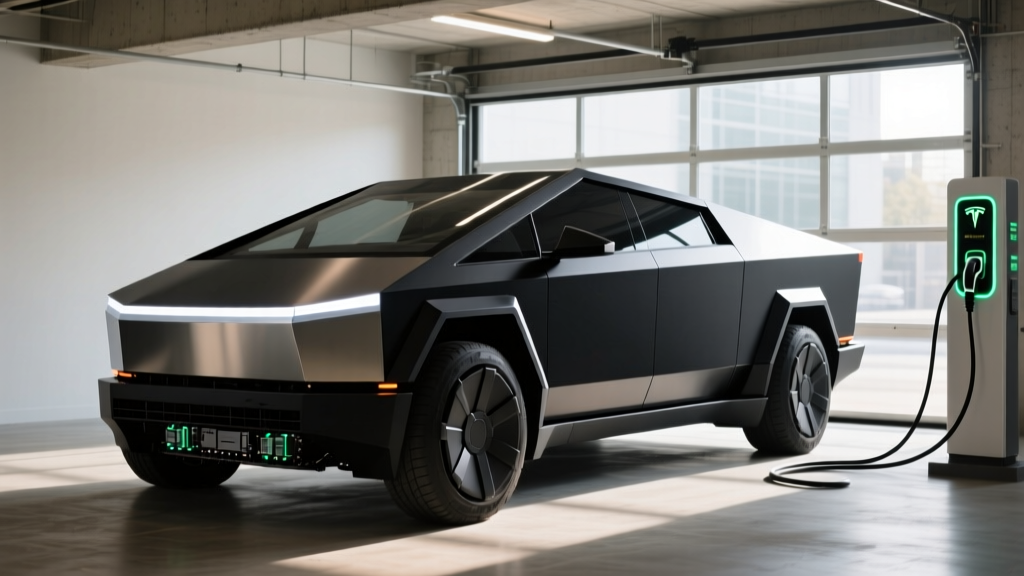
The Tesla Cybertruck's angular stainless-steel exoskeleton is already one of the most recognizable vehicle designs on the road. But for owners who want to move beyond the bare-metal look, a matte black wrap has become the single most popular customization — transforming the truck from polarizing concept-art-on-wheels into something stealthier and more aggressive. If you're searching for a matte black Cybertruck wrap, you're likely weighing aesthetics against practical concerns: Does vinyl affect range? Does it interfere with Tesla's cameras and sensors? What does a quality install actually cost in 2026?
This review covers the full Cybertruck ownership picture — EPA range, charging speed, battery specs, pricing, and federal tax credit eligibility — alongside a dedicated deep-dive into matte black wrapping: costs, installer considerations, range impact, and maintenance realities. Whether you're spec'ing a new order or wrapping a truck already in your garage, here's everything you need to decide.
2026 Cybertruck Specs: Range, Battery, and Efficiency
| Specification | AWD (Dual Motor) | Cyberbeast (Tri-Motor) |
|---|---|---|
| EPA Estimated Range | 340 miles | 320 miles |
| Battery Capacity (usable) | ~123 kWh (estimated, NMC) | ~123 kWh (estimated, NMC) |
| Efficiency | ~56 MPGe / ~58 kWh/100mi | ~52 MPGe / ~62 kWh/100mi |
| 0-60 mph | 3.9 seconds | 2.6 seconds |
| Horsepower | 600 hp | 845 hp |
| Drivetrain | Dual-Motor AWD | Tri-Motor AWD |
| Towing Capacity | 11,000 lbs | 11,000 lbs |
| Payload Capacity | 2,500 lbs | 2,500 lbs |
Tesla does not officially publish the Cybertruck's battery capacity in kWh, but teardown analyses and charging data point to a usable pack size in the 120–125 kWh range using NMC (nickel manganese cobalt) chemistry. NMC offers higher energy density than LFP, which matters in a vehicle this heavy — the Cybertruck's curb weight exceeds 6,600 lbs in AWD trim.
The EPA rates the AWD Cybertruck at 340 miles and the Cyberbeast at 320 miles. In real-world highway driving at 70–75 mph, expect approximately 260–290 miles from the AWD and 240–270 miles from the Cyberbeast. The truck's slab-sided aerodynamics and 6,600+ lb weight punish efficiency at speed. In cold weather (below 32°F), range can drop an additional 20–30%, putting real-world winter highway range closer to 200–230 miles. City driving with regenerative braking recovers more energy, often matching or slightly exceeding the EPA sticker.
Source: EPA Fuel Economy — Tesla Cybertruck
Charging Speed: DC Fast Charge and Home Level 2
| Charging Level | Power / Rate | Speed (Miles Added) | Notes |
|---|---|---|---|
| Level 1 (120V household) | ~1.4 kW | ~3–4 miles/hour | Emergency/trickle only; 85+ hours for full charge |
| Level 2 (240V home/work) | 11.5 kW (48A) | ~30–34 miles/hour | Full charge overnight (~10–11 hours); requires NACS connector or J1772 adapter |
| DC Fast Charge (V4 Supercharger) | Peak ~250 kW | ~130+ miles in 15 min | 10–80% in approximately 28–32 minutes; taper above 80% is significant |
| DC Fast Charge (CCS via adapter) | Peak ~150–200 kW | Varies by station | Requires Tesla CCS adapter; speeds depend on network (Electrify America, EVgo) |
The Cybertruck uses Tesla's NACS (North American Charging Standard) connector natively, giving it seamless access to the Supercharger network — over 6,000 stations and 60,000+ connectors in North America as of early 2026. On a V4 Supercharger cabinet, the truck peaks around 250 kW, though sustained rates average closer to 150–180 kW across the 10–80% window due to the large battery's charge curve taper. Expect a 10–80% session to take roughly 28–32 minutes under optimal conditions (battery preconditioned via navigation routing to the charger).
For home charging, the Cybertruck's onboard charger accepts up to 11.5 kW (48 amps) on a 240V Level 2 circuit. A typical 60-amp dedicated circuit with a Tesla Wall Connector or equivalent NACS station will add about 30–34 miles of range per hour — enough to fully replenish the pack overnight. Installation costs for a Level 2 home setup typically range from $500 to $2,500 depending on panel capacity and conduit run, though homes needing a 200-amp panel upgrade can see costs exceed $4,000.
Matte Black Cybertruck Wrap: Cost, Process, and Range Impact
Here's the core question for anyone researching a matte black Cybertruck wrap: what does it actually involve, and what does it cost?
Wrap Cost Breakdown (2026 Estimates)
| Component | Cost Range | Notes |
|---|---|---|
| Full-body matte black vinyl (material) | $1,500 – $3,000 | Premium films: 3M Scotchcal, Avery Dennison, XPEL Stealth |
| Professional installation (full truck) | $3,500 – $6,000 | Cybertruck's angular panels are easier to wrap than curved bodies, but edges and the vault bed require precision |
| Chrome/brightwork delete (if applicable) | $300 – $800 | Blacking out badges, trim, window surrounds |
| PPF (paint protection film) under wrap | $2,000 – $4,000 | Optional; protects stainless steel underneath if you plan to remove the wrap later |
| Total (quality full wrap) | $5,000 – $9,000 | Budget shops may quote lower; expect corner-cutting on seams and edges |
Does a Matte Black Wrap Affect Range?
The short answer: negligibly. A full vinyl wrap adds approximately 15–25 lbs to the vehicle — a rounding error on a 6,600-lb truck. You will not measure a meaningful range difference. However, there are two indirect factors worth considering:
- Thermal absorption: Matte black surfaces absorb more solar radiation than bare stainless steel. In hot climates, cabin temperatures after sun exposure will be higher, increasing HVAC energy draw during initial cool-down. In practice, this might cost 2–5 miles of range on a hot summer day — not significant, but real.
- Sensor and camera clearance: The Cybertruck relies on eight external cameras for Autopilot and FSD (Supervised). A reputable installer will precision-cut around every camera lens, radar-transparent zone, and ultrasonic sensor area. Poorly cut wraps that overlap camera housings will degrade driver-assist performance. Inspect every camera aperture before leaving the shop.
Maintaining a Matte Black Wrap
Matte vinyl requires different care than paint or bare steel. Avoid automatic car washes with rotating brushes — they will scuff the matte finish and create glossy streaks. Hand-wash with a pH-neutral automotive soap and microfiber mitt. Matte-specific detail sprays (such as Chemical Guys Matte Detailer or XPEL's own maintenance line) help resist water spotting and UV fading. A quality matte wrap from a premium film manufacturer should last 5–7 years with proper care before showing significant UV degradation or edge lifting.
Pricing, Trim Levels, and Federal Tax Credit Eligibility
| Trim | Base MSRP (2026) | Est. As-Tested (with common options) | Federal §30D Credit Eligible? |
|---|---|---|---|
| AWD (Dual Motor) | $79,990 | $82,000 – $88,000 | Eligible up to $7,500 (see caveats below) |
| Cyberbeast (Tri-Motor) | $99,990 | $102,000 – $110,000 | Eligible up to $7,500 (see caveats below) |
The Cybertruck qualifies as a light truck under IRS §30D rules, meaning the MSRP cap for eligibility is $80,000 for trucks, vans, and SUVs (higher than the $55,000 sedan cap). The base AWD at $79,990 squeaks under this threshold. The Cyberbeast at $99,990 exceeds it — however, as of current IRS guidance, the MSRP cap applies to the base model before destination and options, and Tesla's pricing structure has shifted across model years. Always verify current eligibility on the IRS Clean Vehicle Provisions page before purchasing.
- Buyer income cap: Modified AGI must not exceed $150,000 (single), $225,000 (head of household), or $300,000 (joint filers)
- MSRP cap: $80,000 for trucks/SUVs/vans (base model, before options/destination)
- Battery sourcing: Critical minerals and battery components must meet phased percentage thresholds from US or FTA-partner countries (increases annually through 2029)
- Point-of-sale transfer: Buyers can elect to transfer the credit to the dealer at purchase, reducing the out-of-pocket price immediately (requires dealer registration with IRS)
- Final assembly: Vehicle must undergo final assembly in North America (Cybertruck is built in Austin, TX — qualifies)
For the AWD trim at $79,990, a buyer meeting all income and sourcing requirements could reduce the effective purchase price to approximately $72,490 via the point-of-sale credit transfer. The Cyberbeast's price puts it above the MSRP cap under most interpretations — consult a tax professional for your specific situation, as IRS guidance on trim-level pricing continues to evolve.
Interior, Tech, Cargo, and Daily Usability
The Cybertruck's interior is minimalist in the extreme — a single 18.5-inch front touchscreen handles virtually all vehicle functions, with a secondary 9.4-inch rear screen for passengers. There are no physical buttons for climate, wipers, or mirror adjustment. Everything routes through the UI. This is either refreshingly clean or maddeningly impractical, depending on your tolerance for screen-based controls while driving.
Cargo and Passenger Dimensions
| Dimension | Measurement |
|---|---|
| Front headroom | 41.0 in |
| Front legroom | 42.2 in |
| Rear headroom | 38.4 in |
| Rear legroom | 38.2 in |
| Vault (bed) length | 72.0 in (6 ft) |
| Vault cargo volume | 67 cu ft (bed only); up to 120+ cu ft with tonneau-covered sub-storage |
| Frunk volume | ~7 cu ft (lockable, weatherproof) |
| Towing capacity | 11,000 lbs |
The power-operated tonneau cover on the vault is a standout feature — it's lockable, supports up to 300 lbs of distributed weight on top, and integrates with the truck's air suspension for load-leveling. The 120V and 240V bed outlets (up to 9.6 kW continuous output via Powershare) make the Cybertruck a legitimate mobile power source for job sites, camping, or emergency home backup (with the appropriate V2H transfer switch).
Driver Assistance: Autopilot and FSD (Supervised)
Tesla's Autopilot and Full Self-Driving (Supervised) are SAE Level 2 driver-assistance systems. The driver must remain fully engaged, hands on the wheel (or torque-confirmed via steering input), and eyes on the road at all times. This is not autonomous driving. Tesla's camera-only vision system handles highway lane-keeping, adaptive cruise, and city-street navigation, but it requires constant human supervision. Only Level 4 services (Waymo, Zoox) operate without a human driver in defined areas.
FSD (Supervised) costs $8,000 as a one-time purchase or $99/month as a subscription in 2026. Its capability has improved substantially, but it still makes errors at complex intersections, construction zones, and unmapped roads. Treat it as an advanced cruise control, not a chauffeur.
Warranty Coverage and Long-Term Ownership
| Coverage | Term |
|---|---|
| Basic Vehicle Limited Warranty | 4 years / 50,000 miles |
| Battery & Drive Unit Warranty | 8 years / 120,000 miles (minimum 70% capacity retention) |
| Restraint System | 5 years / 60,000 miles |
| Corrosion (body) | Not applicable (stainless steel exoskeleton does not rust; however, fasteners, undercarriage, and non-steel components are covered for 4 years) |
Tesla's 8-year/120,000-mile battery warranty guarantees at least 70% capacity retention. If the pack degrades below that threshold within the warranty period, Tesla will repair or replace it. NMC chemistry in a large pack like the Cybertruck's typically shows 8–12% degradation over the first 100,000 miles based on fleet data from Model S/X owners — well within the warranty floor. Replacement cost for an out-of-warranty Cybertruck battery pack is estimated at $15,000–$22,000 based on current Tesla service pricing for comparable pack sizes.
Pros, Cons, and the Verdict
- Class-leading towing (11,000 lbs) with integrated trailer brake controller
- 9.6 kW Powershare — 120V/240V outlets in bed and frunk
- Stainless exoskeleton: no paint to chip, no rust on body panels
- Access to Tesla Supercharger network (60,000+ connectors)
- 2.6-second 0-60 in Cyberbeast trim (supercar acceleration in a truck)
- Air suspension with 16+ inches of ground clearance adjustment
- Matte black wrap applies cleanly to flat stainless panels — lower install risk vs. curved vehicles
- Real-world highway range significantly below EPA (260–290 mi vs. 340 mi sticker)
- Cold-weather range loss of 20–30% is severe in northern climates
- Everything is screen-controlled — no physical buttons for climate or wipers
- Cyberbeast exceeds $80K MSRP cap, likely disqualifying it from §30D credit
- Rear visibility is poor; relies heavily on camera feed
- Build quality inconsistencies reported in early production units
- Matte black wrap requires hand-washing — no automatic car washes
- Insurance premiums run 20–40% above comparable F-150 Lightning or Rivian R1T
Who Is the Cybertruck For?
The Cybertruck fits a narrow but passionate buyer profile. It's ideal for tech-forward truck owners who need genuine towing and payload capability but want EV running costs and the Powershare mobile power feature. It works for job-site professionals who can leverage the 9.6 kW bed outlets. It's a strong adventure/camping platform thanks to air suspension, range, and the sealed vault. It is not ideal for buyers prioritizing maximum real-world range (the Rivian R1T Dual-Motor Max offers ~410 miles EPA), traditional truck ergonomics (the F-150 Lightning has physical buttons and a more familiar cab layout), or budget-conscious shoppers (the base AWD starts at nearly $80K before wrap costs).
Is the Cybertruck Worth It vs. Competitors?
Against the Ford F-150 Lightning (Extended Range, EPA 320 mi, ~$69,995 base), the Cybertruck offers more power, better towing, and Powershare versatility — but the Lightning wins on interior practicality, physical controls, and price. Against the Rivian R1T (Dual-Motor Max, EPA 410 mi, ~$87,000), the R1T delivers superior real-world range, a more refined interior, and the Gear Tunnel storage system, though the Cybertruck counters with faster DC charging and Supercharger access. The Cybertruck's strongest competitive moat remains the Supercharger network and Powershare capability.
Frequently Asked Questions
What is the real-world range of the Cybertruck?
The EPA rates the AWD at 340 miles and the Cyberbeast at 320 miles. Real-world highway driving at 70+ mph yields approximately 260–290 miles (AWD) or 240–270 miles (Cyberbeast). In cold weather below freezing, expect an additional 20–30% reduction, bringing winter highway range to roughly 200–230 miles.
How fast does the Cybertruck charge?
On a V4 Supercharger, the Cybertruck peaks at ~250 kW and charges from 10–80% in approximately 28–32 minutes with battery preconditioning. At home on a 240V Level 2 circuit (48A/11.5 kW), it adds about 30–34 miles per hour, fully charging overnight in 10–11 hours.
How much does a matte black Cybertruck wrap cost?
A quality full-body matte black wrap using premium film (3M, Avery, XPEL) and professional installation typically costs $5,000–$9,000 in 2026. Budget shops may quote $3,500–$4,500, but expect compromises on edge finishing, camera cutouts, and film longevity.
Does the Cybertruck qualify for the $7,500 federal EV tax credit?
The base AWD at $79,990 MSRP falls under the $80,000 truck MSRP cap and is eligible for up to $7,500 via IRS §30D, provided the buyer meets income limits ($150K single / $300K joint), battery sourcing requirements are satisfied, and final assembly is in North America (it is — Austin, TX). The Cyberbeast at $99,990 likely exceeds the MSRP cap. Always verify current rules at IRS.gov and consult a tax professional.
Does a matte black wrap void the Tesla warranty?
A professionally installed vinyl wrap does not void the vehicle warranty under the Magnuson-Moss Warranty Act. However, if wrap removal damages the stainless surface or if poorly cut film obstructs a camera and causes a collision, those specific damages would not be covered. Use an experienced installer who understands Tesla sensor layouts.
How long does a matte black wrap last on a Cybertruck?
Premium matte vinyl films (3M, Avery Dennison, XPEL) typically last 5–7 years with proper hand-wash maintenance and UV protection. The Cybertruck's flat panels actually help — there are fewer complex curves where film stress and edge-lifting occur. Avoid automatic car washes, which will degrade the matte finish prematurely.
Is the Cybertruck good for towing?
Yes. With an 11,000-lb rating and integrated trailer brake controller, the Cybertruck tows competitively with full-size gas trucks. However, towing cuts EV range roughly in half — expect 150–180 miles of real-world range when towing a 7,000–8,000 lb trailer at highway speeds. Plan charging stops accordingly.