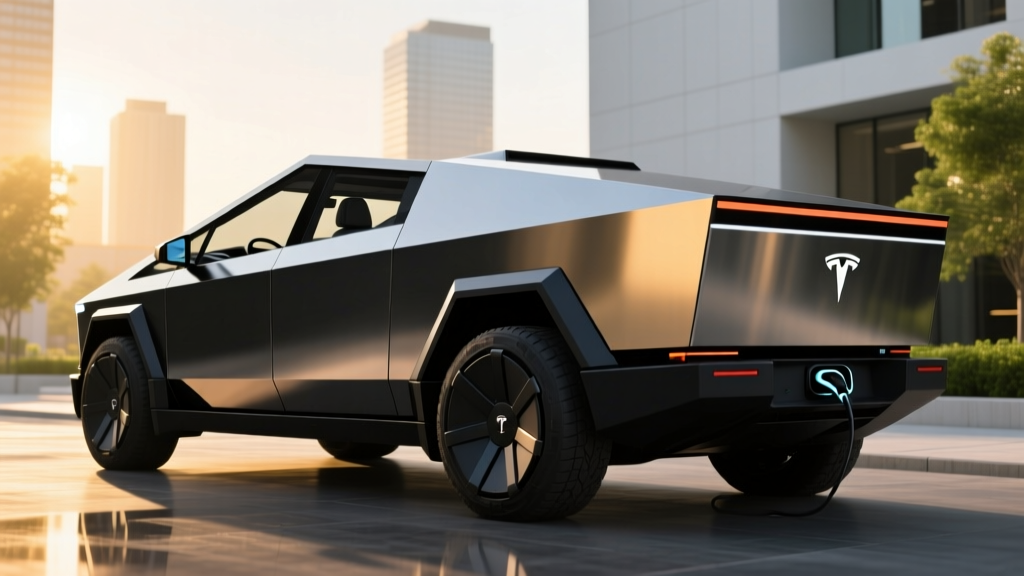
The Tesla Cybertruck in its satin-matte black wrap—officially the "Stealth" appearance package added for the 2025 model year and carried into 2026—has become the most visually distinctive electric truck on American roads. But beneath the polarizing angular skin and light-bar fascia sits a 123-kWh NMC battery pack, an 800-volt architecture capable of 250 kW peak DC fast charging, and a dual- or tri-motor powertrain producing up to 845 horsepower. This review breaks down what owning a mat black Cybertruck actually looks like in 2026: the real-world range you can count on, charging logistics, tax-credit reality, and whether the premium over a Rivian R1T or Ford F-150 Lightning is justified.
Quick Verdict: Who the Mat Black Cybertruck Is For
The mat black Cybertruck suits buyers who want a full-size electric pickup with serious towing capability (11,000 lbs rated), blistering straight-line performance, and access to Tesla's Supercharger network—all wrapped in a stealth aesthetic that turns heads without the chrome-and-glare of traditional trucks. It does not suit buyers who prioritize rear-seat comfort, easy bed access (the sloped tonneau limits vertical clearance), or budget-conscious ownership. If you need a work truck with a conventional 5.5- or 6.5-foot bed and easy upfit, the F-150 Lightning remains more practical. If you want a lifestyle-adventure truck with a gear tunnel and better back-seat ergonomics, the Rivian R1T Tri-Motor is the stronger pick. The Cybertruck wins on raw performance, charging infrastructure, and polarizing design that owners either love or learn to live with.
Range, Efficiency, and Real-World Expectations
Real-World Expectation: Plan for 270–300 miles on highway road trips at 70–75 mph; drop to 220–250 miles in sub-30°F winter conditions with cabin heating. City/regenerative driving can approach or slightly exceed the EPA sticker.
Tesla's EPA ratings for the 2026 Cybertruck AWD (dual-motor) and Cyberbeast (tri-motor) reflect mixed driving cycles. In our experience and aggregated owner data, highway efficiency is the Cybertruck's weak point: the brick-like aerodynamics (despite the claimed 0.30 Cd) and 6,800+ lb curb weight push consumption to roughly 48–52 kWh/100 mi at sustained highway speeds. That translates to about 2.0–2.1 mi/kWh, meaning the usable ~118 kWh of the 123-kWh pack delivers 270–300 real highway miles before you need to plug in.
Cold weather compounds the penalty. Lithium-ion cells lose efficiency below freezing, and while the Cybertruck's heat pump is among the better thermal-management systems on the market, expect 20–30% range reduction in sustained sub-30°F driving—bringing a 340-mile EPA truck down to roughly 230–260 miles of usable range on a winter road trip. Preconditioning the battery (via the Tesla app or nav-routed charging) mitigates this somewhat by warming the pack before departure or before a DC fast-charge stop.
| Trim | EPA Range | MPGe (Combined) | kWh/100 mi | Real-World Highway | Cold-Weather Est. |
|---|---|---|---|---|---|
| AWD (Dual Motor) | 340 mi | 68 MPGe | 48 kWh | ~285 mi | ~230–260 mi |
| Cyberbeast (Tri-Motor) | 320 mi | 64 MPGe | 52 kWh | ~270 mi | ~220–245 mi |
For context, the EPA's fueleconomy.gov listing confirms the combined MPGe figures, and owners tracking via TeslaFi or the in-car energy graph consistently report 1.8–2.3 mi/kWh depending on conditions.
Battery, Chemistry, and Charging Speed
The Cybertruck uses a structural battery pack with NMC (nickel manganese cobalt) cells in a 4680 form factor—Tesla's larger cylindrical cell design that improves energy density and thermal distribution. This is not an LFP (lithium iron phosphate) pack; Tesla reserves LFP for the base Model 3 and Model Y RWD trims where lower energy density is acceptable. NMC offers higher energy density (critical for a heavy truck needing 300+ miles of range) but comes with the standard degradation profile of nickel-based chemistries: expect roughly 8–12% capacity loss over the first 100,000 miles, tapering off afterward.
| Charging Level | Power / Rate | Time / Speed | Notes |
|---|---|---|---|
| DC Fast Charge (Peak) | 250 kW | 10–80% in ~22 min | Peak only sustained to ~50% SoC; tapers significantly above 80% |
| DC Fast Charge (Avg. 10–80%) | ~170 kW avg | ~150 miles added in 15 min | Preconditioning required for peak rate |
| Level 2 Home (48A / 11.5 kW) | 11.5 kW | ~34 mi/hr; full charge in ~11 hr | Requires NACS wall connector, 60A circuit |
| Level 2 Home (32A / 7.7 kW) | 7.7 kW | ~23 mi/hr; full charge in ~16 hr | Adequate for daily commuting under 100 mi |
| Level 1 (120V / 12A) | 1.4 kW | ~4 mi/hr | Emergency/trickle only |
The 800-volt architecture is the Cybertruck's charging secret weapon. While peak rate is capped at Tesla's V3 Supercharger maximum of 250 kW (V4 stalls in limited deployment can deliver higher rates, but the Cybertruck's onboard acceptance peaks around 250 kW in practice), the high voltage means the truck sustains a strong charge curve longer than 400V competitors. From 10–50% SoC, you'll see 200–250 kW; from 50–80%, it tapers to 120–170 kW; above 80%, charging slows dramatically to protect cell longevity. For road-trip planning, target 10–80% stops of 20–25 minutes.
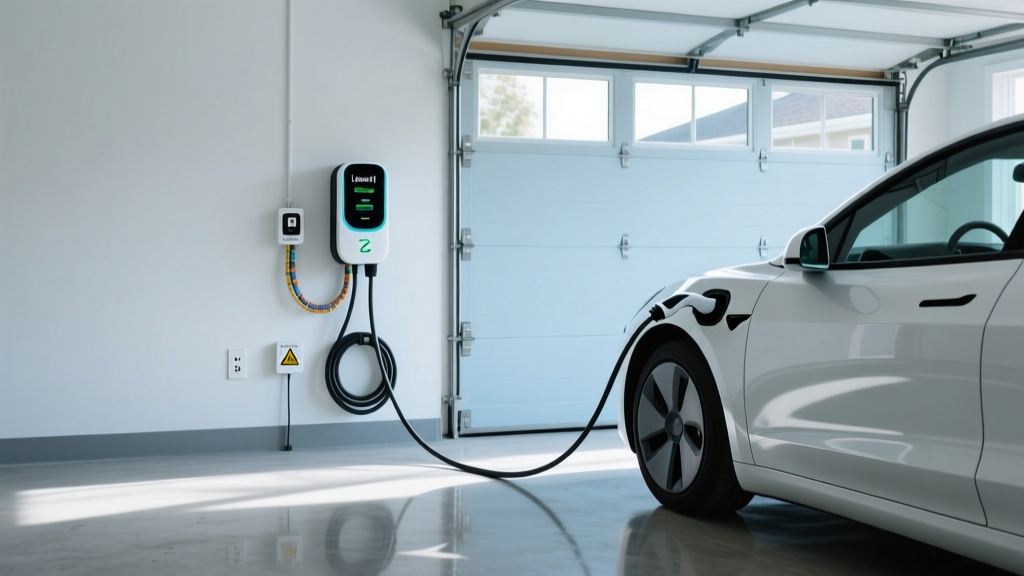
At home, the Tesla Wall Connector at 48 amps (11.5 kW on a 240V/60A circuit) adds roughly 34 miles of range per hour—enough to fully replenish the pack overnight. Installation typically costs $500–$2,000 depending on panel proximity and whether your home's electrical service needs a 200A upgrade.
Performance, Drivetrain, and Towing
| Spec | AWD (Dual Motor) | Cyberbeast (Tri-Motor) |
|---|---|---|
| Horsepower | 600 hp | 845 hp |
| 0–60 mph | 3.9 sec | 2.6 sec |
| Top Speed | 130 mph | 130 mph |
| Drivetrain | Dual-motor AWD | Tri-motor AWD (torque vectoring rear) |
| Towing Capacity | 11,000 lbs | 11,000 lbs |
| Payload Capacity | 2,500 lbs | 2,500 lbs |
| Curb Weight | ~6,600 lbs | ~6,840 lbs |
The Cyberbeast's 2.6-second 0–60 time makes it one of the quickest production vehicles ever sold, let alone a 6,800-lb truck. The tri-motor setup uses one front motor and two rear motors with torque vectoring, which improves cornering stability for a vehicle with this mass. Towing at the 11,000-lb maximum will cut range roughly in half—plan on 140–170 miles between charges when pulling a heavy trailer.
Interior, Cargo, and Practicality
The Cybertruck seats five with a 60/40 split rear bench. Front legroom is generous at 41.5 inches; rear legroom is tighter at 38.4 inches—adequate for adults on short trips but not class-leading versus the F-150 Lightning's 43.5 inches rear. The 18.5-inch center touchscreen runs Tesla's latest software with navigation, streaming, and a customizable instrument cluster. There is no Apple CarPlay or Android Auto.
| Measurement | Value |
|---|---|
| Bed Length | 72 inches (6 ft) with tailgate up |
| Bed Volume | ~67 cu ft (bed) + 7.1 cu ft (frunk) |
| Frunk | 7.1 cu ft, lockable, drainable |
| Tonnuau | Power-retractable, limits bed height to ~38 in vertical |
| Overall Length | 223.6 in |
| Width (w/ mirrors) | 95.0 in |
The powered retractable tonneau is a standout feature—it's lockable, aerodynamic, and integrates with the bed's 120V and 240V outlets (yes, you can weld or run power tools from the bed). However, it limits vertical clearance: anything taller than about 38 inches must be loaded with the tonneau retracted, and the sloped bed sides mean standard 4x8 sheets of plywood do not sit flat on the wheel wells as they do in a conventional truck bed. This is a genuine practicality compromise that work-truck buyers should weigh carefully.
Pricing, Trims, and Federal Tax Credit Eligibility
| Trim | Base MSRP | Stealth Matte Black Pkg | As-Tested Est. |
|---|---|---|---|
| AWD (Dual Motor) | $79,990 | +$3,000 | $82,990–$87,000 (w/ options) |
| Cyberbeast (Tri-Motor) | $99,990 | +$3,000 | $102,990–$108,000 (w/ options) |
- Vehicle MSRP Cap: Trucks/vans/SUVs capped at $80,000 MSRP. The AWD trim at $79,990 base technically qualifies before options; adding the Stealth package or FSD pushes MSRP above $80,000 and disqualifies it. The Cyberbeast at $99,990 does NOT qualify.
- Buyer Income Cap: Modified AGI ≤ $300,000 (joint), $225,000 (head of household), $150,000 (single).
- Battery Sourcing: Must meet critical-mineral and battery-component requirements per IRS guidance. Tesla's supply chain has been evolving; confirm current-year compliance on IRS.gov's qualified vehicle list.
- Point-of-Sale Transfer: Eligible buyers can transfer the credit to the dealer at purchase, reducing the purchase price directly rather than waiting for a tax refund.
- Maximum Credit: Up to $7,500 if all battery-sourcing requirements are met; partial ($3,750) if only one of two sourcing requirements is satisfied.
The tax-credit picture for the Cybertruck is narrow. Only the base AWD at its exact $79,990 MSRP—without the Stealth matte-black package or any other option that pushes the sticker above $80,000—has any chance of qualifying, and even then only if the buyer meets income limits and the specific vehicle's battery satisfies the 2026 critical-mineral sourcing thresholds. In practice, most mat black Cybertrucks (which require the $3,000 Stealth package) will not qualify for the federal credit. Budget accordingly.
Driver Assistance and Technology
The Cybertruck ships with Tesla's Basic Autopilot (lane-centering, adaptive cruise, automatic emergency braking). Full Self-Driving (Supervised) is an $8,000 option or $99/month subscription that adds automated lane changes, traffic-light/stop-sign recognition, and city-street navigation-assisted driving. In 2026, FSD Supervised has improved substantially in urban environments but still requires active monitoring—construction zones, unusual intersections, and adverse weather all demand immediate driver takeover.
Other tech highlights: steer-by-wire (no mechanical connection between the yoke/steering wheel and the front wheels, enabling the variable-ratio steering that makes the Cybertruck's tight 35.4-foot turning circle possible), four-wheel steering for low-speed maneuverability, adaptive air suspension with 16 inches of ground clearance in Extract Mode, and a bioweapon-defense HEPA air filtration system.
- Steer-by-wire feels unnatural to some drivers during the first week—plan an extended test drive.
- The yoke steering wheel (standard) obstructs the instrument cluster for some seating positions; a round wheel is available as a no-cost swap at delivery.
- No Apple CarPlay or Android Auto—Tesla's proprietary infotainment only.
- The stainless-steel exoskeleton shows fingerprints aggressively; the matte-black Stealth wrap mitigates this but requires careful hand-wash maintenance (no automatic brush washes).
- Insurance premiums run 25–40% higher than comparable F-150 Lightning trims due to repair costs for the stainless body and structural battery.
Warranty, Ownership Costs, and Longevity
| Component | Coverage |
|---|---|
| Basic Vehicle | 4 years / 50,000 miles |
| Battery & Drive Unit | 8 years / 150,000 miles (min 70% retention) |
| Restraint System | 5 years / 60,000 miles |
| Corrosion | 12 years / unlimited miles (stainless body) |
The battery warranty guarantees at least 70% capacity retention over 8 years or 150,000 miles—consistent with Tesla's Model S/X coverage and slightly more generous on mileage than the Model 3/Y (which is 120,000 miles for Long Range). Given NMC chemistry's typical degradation curve, most owners will see 88–92% State of Health at 50,000 miles and 82–88% at 100,000 miles, well within warranty thresholds.
Charging costs vary widely by method. Home charging at the US average of $0.16/kWh costs roughly $19 for a full 118-kWh replenishment, or about $0.076 per mile. DC fast charging on Tesla's Supercharger network averages $0.28–$0.36/kWh nationally, bringing road-trip fueling to $0.13–$0.17 per mile—still below the $0.18–$0.22/mi a 20-mpg gas truck would cost at $3.60/gallon, but the gap narrows considerably versus a hybrid like the F-150 PowerBoost at 24 mpg combined.
- Class-leading performance: 2.6s 0–60 (Cyberbeast)
- Tesla Supercharger network access (17,000+ stalls in North America)
- 250 kW DC fast charging with strong sustained curve
- 11,000-lb towing capacity
- Steer-by-wire enables surprisingly tight turning circle
- 240V bed outlet for job-site or camping use
- Stainless body is dent- and corrosion-resistant
- Stealth matte-black finish is head-turning and unique
- Real-world highway range falls 15–20% below EPA sticker
- Tax credit nearly impossible to claim with Stealth package
- Bed practicality compromised by tonneau height and sloped sides
- Rear seat legroom below class competitors
- No Apple CarPlay / Android Auto
- Insurance premiums significantly above segment average
- Matte wrap requires hand-wash only; no brush car washes
- Steer-by-wire and yoke have a steep learning curve
How It Compares: Cybertruck vs. R1T vs. F-150 Lightning
| Spec | Cybertruck AWD | Rivian R1T Dual-Motor | F-150 Lightning Lariat |
|---|---|---|---|
| EPA Range | 340 mi | 352 mi (Max Pack) | 320 mi (Ext. Range) |
| 0–60 mph | 3.9 sec | 4.5 sec | 4.0 sec |
| Towing | 11,000 lbs | 11,000 lbs | 10,000 lbs |
| Peak DC Charge | 250 kW | 220 kW | 150 kW |
| Bed Length | 72 in | 54 in (+ gear tunnel) | 67 in |
| Base MSRP | $79,990 | $75,900 | $62,995 |
| Tax Credit Eligible | Borderline (see above) | Yes (most configs.) | Yes (under $80K caps) |
The Cybertruck wins on acceleration and DC fast-charging speed. The R1T wins on adventure versatility (gear tunnel, better approach/departure angles, more comfortable rear seat). The F-150 Lightning wins on value, conventional truck practicality, and easy tax-credit qualification. Your priority hierarchy determines the winner.
- You prioritize performance and charging speed above all else
- You rely on Tesla's Supercharger network for frequent road trips
- You want the most visually distinctive EV on the road
- You can accept the tax-credit likelihood of $0
- You need a comfortable rear seat for family use
- You value the gear tunnel for adventure gear
- You want a more conventional steering feel
- Budget and tax-credit eligibility are top priorities
- You need a conventional truck bed for work
- You prefer a dealer-service experience over Tesla's mobile/service-center model
Frequently Asked Questions
What is the real-world range of the mat black Cybertruck?
The EPA rates the AWD at 340 miles and the Cyberbeast at 320 miles. In real-world highway driving at 70–75 mph, expect 270–300 miles. In cold weather (below 30°F), plan for 220–260 miles. The matte-black Stealth wrap has no measurable impact on range versus the standard stainless finish.
How fast does the Cybertruck charge at home and on the road?
On a Level 2 home charger at 48 amps (11.5 kW), it adds about 34 miles of range per hour—a full charge takes roughly 11 hours. On a DC fast charger, it peaks at 250 kW and charges from 10–80% in approximately 22 minutes, though the average rate across that session is closer to 170 kW due to taper above 50% SoC.
Does the mat black Cybertruck qualify for the $7,500 federal EV tax credit?
Almost certainly not in the configuration most buyers want. The IRS §30D credit caps truck MSRP at $80,000. The base AWD at $79,990 technically fits, but adding the $3,000 Stealth matte-black package pushes it to $82,990, disqualifying it. The Cyberbeast at $99,990 never qualifies. Additionally, the buyer must meet income caps ($300K joint / $150K single) and the battery must satisfy critical-mineral sourcing requirements listed on IRS.gov.
Is the Cybertruck worth buying over the Rivian R1T or F-150 Lightning?
It depends on your priorities. If raw acceleration, Supercharger access, and the stealth aesthetic matter most, yes. If you need a practical work bed, a comfortable back seat, or easy tax-credit qualification, the R1T or Lightning are stronger choices. Test-drive all three—the Cybertruck's steer-by-wire and yoke are deal-breakers for some and revelations for others.
How do I maintain the matte-black Stealth wrap?
Hand-wash only with a pH-neutral automotive soap and microfiber mitt. No automatic brush or touchless washes (high-pressure jets can lift wrap edges over time). Apply a matte-specific ceramic coating for UV and stain protection. Expect the wrap to last 5–7 years with proper care before needing replacement (~$3,000–$4,500).
What does it cost to insure a Cybertruck?
Insurance premiums run 25–40% higher than a comparably priced F-150 Lightning, averaging $2,800–$3,800/year nationally for the AWD trim depending on driving record and state. The stainless-steel body and structural battery pack drive higher repair-cost estimates. Tesla offers its own insurance product in many states that uses real-time driving data to set rates, which can be cheaper for low-mileage, safe-driving owners.