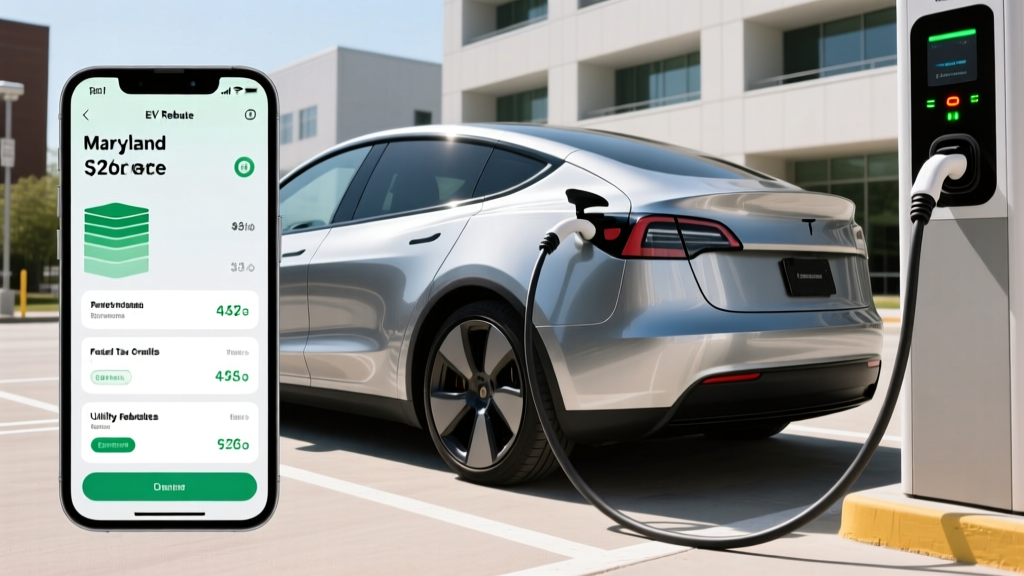
Maryland has quietly become one of the most incentive-rich states for electric vehicle buyers in the U.S. Between the Maryland electric vehicle rebate (officially the Clean Energy Vehicle Tax Credit), the federal §30D credit, and local utility programs from BGE, Pepco, and Potomac Edison, a qualifying EV purchase in 2026 can stack thousands of dollars in savings. But the incentive landscape is layered — and eligibility depends on your income, the vehicle's MSRP, battery sourcing, and even your utility provider.
This guide breaks down every dollar you can realistically claim, then puts EV ownership to the test with a full 5-year total cost of ownership (TCO) analysis — including the higher insurance premiums and depreciation curves that most savings calculators conveniently leave out.
Maryland's Clean Energy Vehicle Tax Credit: What You Actually Get
Maryland's state incentive is a tax credit — not a rebate check — worth up to $3,000 for qualifying plug-in electric vehicles. Here are the critical parameters:
- Credit amount: Up to $3,000 for battery electric vehicles (BEVs); up to $2,500 for qualifying plug-in hybrids (PHEVs)
- Battery capacity requirement: Minimum 5 kWh battery
- Vehicle condition: New vehicles only; must be purchased or leased from a licensed Maryland dealer
- Application: Claimed on your Maryland state income tax return (Form 500CR) for the year of purchase
- Credit cap: Non-refundable — it reduces your state tax liability to zero but won't generate a refund beyond that
- Funding: Subject to annual state budget appropriation; confirm availability with the Maryland Energy Administration before purchasing
Beyond the state tax credit, Maryland utilities offer their own EV incentives that can be combined:
- BGE (Baltimore Gas & Electric): EVsmart program — up to $300 rebate for Level 2 home charger installation, plus time-of-use (TOU) charging rates as low as ~$0.07/kWh off-peak
- Pepco: EV Charger Rewards — up to $500 toward Level 2 charger purchase and installation for residential customers
- Potomac Edison: Residential EV rebate programs vary by year; check current offerings at potomacedison.com
- Delmarva Power: Similar EV charger rebates available in the Delmarva service territory
Federal §30D Tax Credit: Up to $7,500 — With Strings Attached
The federal EV tax credit under IRS §30D remains the single largest incentive available, but qualifying in 2026 requires navigating a gauntlet of rules. The credit is split into two halves — $3,750 for critical minerals sourcing and $3,750 for battery component manufacturing — and your vehicle must meet both to receive the full $7,500.
- Income caps (modified AGI): $150,000 single / $225,000 head of household / $300,000 joint filers
- MSRP caps: ≤$80,000 for vans, SUVs, and pickups; ≤$55,000 for sedans and other body styles
- Battery sourcing: Critical minerals must be sourced from the U.S. or a free-trade-agreement partner (percentage thresholds increase annually — check IRS.gov §30D guidance for current-year requirements)
- Battery components: Must be manufactured or assembled in North America (percentage thresholds increase annually)
- FEOC exclusion: Vehicles with battery components or critical minerals from a "foreign entity of concern" (primarily China, Russia, North Korea, Iran) are disqualified entirely
- Point-of-sale transfer: You can transfer the credit to the dealer at purchase, reducing your out-of-pocket cost immediately — even if your tax liability is lower than the credit amount
- Vehicle assembly: Final assembly must occur in North America
5-Year Total Cost of Ownership: The Real Math
To make the savings concrete, let's model a realistic 5-year ownership scenario. We'll compare a popular 2026 BEV — the Hyundai Ioniq 5 SEL (EPA 303 miles, 77.4 kWh NMC battery, 225 HP) — against a comparably equipped gas compact SUV, the Toyota RAV4 XLE AWD (EPA 30 MPG combined).
Assumptions: 12,000 miles/year, $0.14/kWh average electricity (Maryland residential blended rate), $3.60/gallon regular unleaded, Maryland insurance averages, manufacturer-recommended maintenance schedules.
| Cost Category | 2026 Hyundai Ioniq 5 SEL (BEV) | 2026 Toyota RAV4 XLE AWD (Gas) |
|---|---|---|
| MSRP (base) | $48,395 | $33,845 |
| Federal §30D credit (if qualifying) | −$7,500 | $0 |
| Maryland state credit | −$3,000 | $0 |
| Effective purchase price | $37,895 | $33,845 |
| Energy/fuel (5 yrs, 60K mi) | $2,856 (33 kWh/100mi × $0.14/kWh) |
$7,200 (30 MPG × $3.60/gal) |
| Maintenance (5 yrs) | $1,200 (cabin filter, tire rotation, wipers) |
$3,800 (oil, filters, brakes, transmission) |
| Insurance (5 yrs) | $11,500 (~$2,300/yr avg) |
$9,000 (~$1,800/yr avg) |
| Depreciation (5 yrs) | $18,500 (~49% of effective price) |
$13,200 (~39% of MSRP) |
| 5-Year Total Cost | $71,951 | $67,045 |
The verdict: Even with $10,500 in combined federal and Maryland incentives, the Ioniq 5 costs roughly $4,900 more over 5 years in this scenario — primarily due to higher insurance premiums and steeper depreciation. However, if you qualify for the full incentives, charge primarily at home on off-peak utility rates (~$0.07/kWh), and hold the vehicle for 8+ years (amortizing depreciation), the math can flip. Your mileage — literally — will vary.
Charging vs. Gas: Cost Per Mile in Maryland
The fuel-cost advantage is where EVs consistently win, and the gap widens if you have access to off-peak utility rates or free workplace charging.
| Scenario | Cost/Mile | Annual (12K mi) | 5-Year Total |
|---|---|---|---|
| Ioniq 5 — Home charging (MD avg $0.14/kWh) | $0.047 | $566 | $2,830 |
| Ioniq 5 — Off-peak TOU rate ($0.07/kWh) | $0.024 | $283 | $1,416 |
| Ioniq 5 — DC fast charging ($0.40/kWh avg) | $0.133 | $1,596 | $7,980 |
| RAV4 AWD — Gas ($3.60/gal, 30 MPG) | $0.120 | $1,440 | $7,200 |
Key insight: Home charging is essential to the cost advantage. At Maryland's average residential rate of ~$0.14/kWh, you save roughly $0.073/mile versus gas. But if you rely exclusively on DC fast charging at $0.40/kWh (common at Electrify America and EVgo stations), your per-mile cost actually exceeds gasoline. For Maryland residents, enrolling in BGE or Pepco's time-of-use rate plan and charging overnight is the single highest-impact financial decision you can make.
Maintenance Savings: Where EVs Quietly Win
EV powertrains have roughly 20 moving parts versus 2,000+ in an internal combustion engine. That mechanical simplicity translates directly to maintenance savings:
| Maintenance Item | EV (Ioniq 5) | Gas (RAV4) |
|---|---|---|
| Oil changes ($50-80 each) | Not required | $500-$800 / 5 yrs |
| Transmission fluid | Not required (single-speed) | $150-$300 / 5 yrs |
| Brake pads & rotors | $200-$400 / 5 yrs (regen braking = 60-80% less wear) |
$600-$1,200 / 5 yrs |
| Engine air filter | Not required | $100-$200 / 5 yrs |
| Spark plugs | Not required | $200-$400 / 5 yrs |
| Cabin air filter | $100-$200 / 5 yrs | $100-$200 / 5 yrs |
| Tire rotation & replacement | $800-$1,200 / 5 yrs (heavier vehicle = faster tire wear) |
$600-$900 / 5 yrs |
| 5-Year Total | ~$1,100-$1,800 | ~$2,250-$4,000 |
The Ioniq 5's 8-year/100,000-mile battery warranty and 5-year/60,000-mile basic warranty also cover more powertrain components for longer than the RAV4's 3-year/36,000-mile basic and 5-year/60,000-mile powertrain coverage. One offset: EV tires wear faster due to higher curb weight (the Ioniq 5 is ~4,400 lbs vs. the RAV4's ~3,600 lbs) and instant torque. Budget for at least one set of replacement tires over 5 years.
Insurance Reality: The Cost Nobody Talks About
EV insurance premiums in Maryland run 15-30% higher than equivalent gas vehicles. For our Ioniq 5 vs. RAV4 comparison, expect roughly $2,200-$2,500/year for the EV versus $1,700-$2,000/year for the gas SUV (assuming clean driving records, $100K/$300K liability, comprehensive and collision coverage).
Why the premium gap?
- Higher repair costs: EV battery packs and specialized electronics are expensive to replace after collision damage. A minor rear-end impact that damages a battery enclosure can total an EV that a gas car would walk away from.
- Specialized labor: Fewer body shops have high-voltage-certified technicians, pushing repair costs upward.
- Higher vehicle values: The Ioniq 5's MSRP is ~$14,500 more than the RAV4's, and collision/comprehensive premiums scale with vehicle value.
- Parts availability: EV-specific parts (battery modules, power electronics, heat pump assemblies) have longer lead times, increasing rental-car and labor costs for insurers.
Cost-offset tip: Shop at least 4-5 insurers. Tesla Insurance, Progressive, and GEICO have become more competitive on EV premiums. Some Maryland insurers offer EV-specific discounts of 5-10% for completing a manufacturer's EV safety course.
Depreciation: The Wild Card in EV Economics
EV depreciation has been volatile. From 2022-2024, used EV values dropped sharply as Tesla's aggressive new-vehicle price cuts cascaded through the resale market, new models flooded the segment, and early-adopter trade-ins increased supply. By 2025-2026, depreciation rates have begun stabilizing, but EVs still generally lose value faster than comparable gas vehicles:
- Average 5-year BEV depreciation: 45-55% of purchase price (vs. 35-42% for mainstream gas vehicles)
- Worst depreciators: Luxury EVs and discontinued models (early luxury EVs from Mercedes and Audi have seen 60%+ depreciation)
- Best holders: High-demand models with limited supply — the Rivian R1T, certain Porsche Taycan trims, and well-equipped Hyundai/Kia EV6 variants have retained 55-60% of value at 5 years
- Battery health impact: Buyers increasingly demand battery State of Health (SoH) reports. An EV with 90%+ SoH commands a meaningful premium over one at 80%
For the Maryland buyer, the silver lining is that depreciation applies to your effective purchase price after incentives. If you paid $37,895 for the Ioniq 5 after credits (vs. $48,395 MSRP), a 49% depreciation rate means ~$18,500 in lost value — closer to what a gas vehicle loses on a higher percentage of a lower starting price.
Stacking Every Incentive: A Maryland Buyer's Action Plan
Here's the optimal sequence for a 2026 Maryland EV purchase:
- Verify federal §30D eligibility: Check your AGI against income caps, confirm the vehicle's MSRP is under the cap, and use fueleconomy.gov to confirm the specific trim qualifies based on current battery-sourcing rules.
- Confirm Maryland state credit availability: Contact the Maryland Energy Administration to verify the Clean Energy Vehicle Tax Credit has funding available for the current tax year.
- Apply for utility charger rebates BEFORE installation: BGE, Pepco, and Potomac Edison typically require pre-approval before you install a Level 2 home charger. Apply early — some programs have waitlists.
- Choose point-of-sale transfer for the federal credit: If buying from a registered dealer, transferring the §30D credit at the point of sale reduces your financed amount immediately. You'll still need to file IRS Form 8936 with your tax return to confirm eligibility.
- Enroll in a TOU rate plan: Contact your utility to switch to a time-of-use plan for off-peak charging rates. This is the single biggest ongoing savings lever.
- Document everything: Keep your purchase agreement, battery certification letter from the manufacturer, and all incentive applications for your tax records.
Frequently Asked Questions
How much does it really cost to own an EV over 5 years in Maryland?
For a mainstream BEV like the 2026 Hyundai Ioniq 5 SEL with full federal and state incentives, expect approximately $70,000-$73,000 in total 5-year costs (purchase, energy, maintenance, insurance, depreciation) for 60,000 miles of driving. That's within ~$5,000 of a comparably equipped gas SUV, with the gap narrowing further if you hold the EV longer, charge on off-peak rates, or choose a lower-MSRP EV like the Chevy Equinox EV (~$33,000 base).
Do I qualify for the federal §30D tax credit?
You qualify if your modified adjusted gross income is under $150K (single), $225K (head of household), or $300K (joint), the vehicle MSRP is under $80K (SUVs/trucks/vans) or $55K (sedans), the vehicle meets current-year battery sourcing and North American assembly requirements, and you purchase new from a dealer. The point-of-sale transfer option means you can use the credit as an immediate price reduction even if your tax liability is less than $7,500. Always verify your specific vehicle at IRS.gov.
How much do I actually save on fuel and maintenance with an EV?
Maryland EV owners charging at home at the average rate of ~$0.14/kWh save approximately $0.07/mile versus a 30 MPG gas vehicle at $3.60/gallon — roughly $874/year or $4,370 over 5 years at 12,000 miles annually. Maintenance savings add another $1,500-$2,500 over 5 years, primarily from eliminated oil changes, reduced brake wear from regenerative braking, and fewer scheduled service visits. Combined fuel and maintenance savings of $6,000-$7,000 over 5 years are typical.
Are EVs more expensive to insure in Maryland?
Yes — typically 15-30% higher than comparable gas vehicles. For a $45,000-$50,000 EV, expect $2,200-$2,500/year versus $1,700-$2,000/year for a $33,000-$35,000 gas SUV. The premium reflects higher repair costs (specialized battery/electronics work), limited high-voltage-trained body shops, and higher vehicle values. Shopping multiple insurers can narrow the gap significantly.
How well do EVs hold their resale value?
EVs currently depreciate faster than mainstream gas vehicles — averaging 45-55% value loss over 5 years versus 35-42% for gas. However, this is improving as the used EV market matures, battery longevity data strengthens, and demand grows. The key variables are brand (Tesla and Hyundai/Kia currently retain better than luxury EV brands), battery State of Health, and whether the model is still in production. Buying after incentives reduces your depreciation exposure since you're depreciating a lower effective cost basis.
Is the Maryland electric vehicle rebate a check or a tax credit?
It's a non-refundable state income tax credit claimed on Maryland Form 500CR. It reduces your Maryland tax liability dollar-for-dollar up to $3,000 (BEV) or $2,500 (PHEV), but cannot generate a refund beyond zeroing out your liability. If your Maryland tax liability is less than the credit amount, the excess is forfeited — it does not carry forward.