When MKBHD — Marques Brownlee — posted about selling his Tesla Cybertruck, the EV community took notice. With over 19 million YouTube subscribers and a reputation for brutally honest tech reviews, his exit from Cybertruck ownership raised a straightforward question: if one of the most prominent EV advocates in the world is moving on, what does that tell everyday buyers?
This isn't a gossip piece. It's a data-driven ownership profile of the 2025–2026 Tesla Cybertruck, examining the exact specs, costs, and practical realities that shape whether this stainless-steel wedge makes sense for your driveway. We'll cover range, charging, pricing, tax credit eligibility, and the pros and cons that likely factored into Brownlee's decision — and should factor into yours.
Tesla Cybertruck: Core Specifications at a Glance
| Specification | AWD (Dual-Motor) | Cyberbeast (Tri-Motor) |
|---|---|---|
| EPA Range | 340 miles | 320 miles |
| Battery Capacity (usable) | ~123 kWh (NMC) | ~123 kWh (NMC) |
| Peak DC Fast Charge | 250 kW | 250 kW |
| 10–80% DC Charge Time | ~28 min | ~28 min |
| Level 2 Home Charge (11.5 kW) | ~34 mi/hr | ~32 mi/hr |
| 0–60 mph | 4.1 sec | 2.6 sec |
| Horsepower | 600 hp | 845 hp |
| Drivetrain | Dual-Motor AWD | Tri-Motor AWD |
| MPGe (combined) | 79 MPGe | 76 MPGe |
| Efficiency (kWh/100 mi) | 42 kWh/100 mi | 44 kWh/100 mi |
| Towing Capacity | 11,000 lbs | 11,000 lbs |
| Base MSRP | $79,990 | $99,990 |
| Battery/Powertrain Warranty | 8 yr / 120,000 mi | 8 yr / 120,000 mi |
Real-World Range: What the EPA Sticker Doesn't Tell You
EPA Estimate: 340 miles (AWD) / 320 miles (Cyberbeast)
Real-World Highway (70 mph, moderate weather): ~260–290 miles
Cold Weather (below 32°F, highway): ~210–250 miles
City/Mixed Driving with Regen: ~300–330 miles
The Cybertruck's 340-mile EPA rating for the dual-motor AWD sounds competitive, but the angular stainless-steel exoskeleton creates substantial aerodynamic drag. At highway speeds above 70 mph, the Cybertruck consumes energy significantly faster than its EPA testing cycle suggests. Independent testing from outlets like fueleconomy.gov confirms the combined 79 MPGe rating — which translates to roughly 42 kWh consumed per 100 miles of mixed driving.
For context, the Rivian R1T (Large Pack) achieves 352 miles EPA with a 149 kWh battery and a more aerodynamic profile at highway speeds. The Ford F-150 Lightning (Extended Range) posts 320 miles EPA but uses its energy more consistently at speed. The Cybertruck's wedge shape looks dramatic parked but costs you roughly 15–20% of rated range on sustained highway runs — a factor that likely registered for a content creator who drives to shoots regularly.
Cold weather compounds this. Tesla's heat pump helps, but the large battery pack and stainless-steel body (which conducts heat readily) mean expect 25–35% range reduction in sub-freezing temperatures. If your commute involves 200+ miles of highway in winter, plan your charging stops accordingly.
Charging Speed: 250 kW Peak, But Read the Fine Print
| Charging Level | Power / Rate | Speed | Notes |
|---|---|---|---|
| Level 1 (120V household) | ~1.4 kW | ~4 mi/hr | Emergency/trickle only |
| Level 2 (240V, 48A) | 11.5 kW | ~34 mi/hr | Full charge in ~11 hours |
| DC Fast (Tesla Supercharger V4) | Peak 250 kW | 10–80% in ~28 min | Sustained ~180–200 kW to 50%, then taper |
| DC Fast (CCS adapter, non-Tesla) | Up to 250 kW | 10–80% in ~30 min | Varies by network; Electrify America, EVgo |
The Cybertruck uses Tesla's NACS connector natively and charges at a peak of 250 kW on V3 and V4 Superchargers. However, peak rate is not sustained rate. The 123 kWh battery's charge curve holds near 250 kW only between roughly 10–35% state of charge. From 35–60%, expect 180–200 kW; above 60%, the rate drops progressively to protect the NMC cells. A realistic 10–80% session takes about 28 minutes — competitive but not class-leading.
For comparison, the Hyundai Ioniq 5 with its 800V architecture can sustain higher rates longer, achieving 10–80% in roughly 18 minutes at a 350 kW charger. The Cybertruck's 400V architecture limits its ceiling. Tesla's Supercharger network reliability remains a genuine advantage — Tesla's network consistently delivers higher uptime than third-party CCS networks, which matters if you're depending on public charging for road trips.
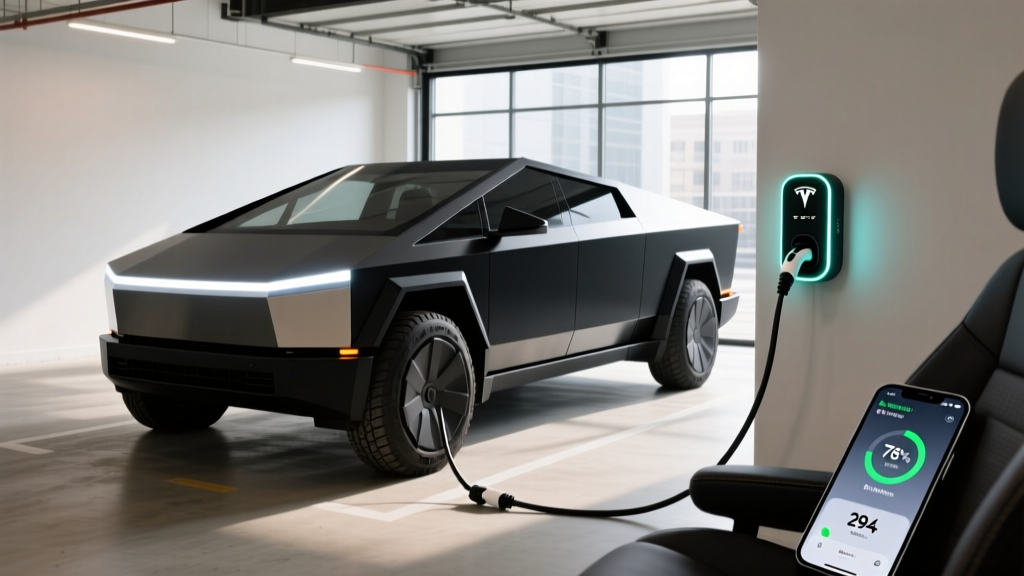
At home, the Cybertruck accepts up to 11.5 kW on Level 2 (48 amps on a 60-amp circuit). That adds roughly 34 miles of range per hour of charging, meaning a full depleted-to-full charge takes about 11 hours. Most owners who charge overnight from 20–80% will wake up to a full daily allotment without issue. Installation of a Tesla Wall Connector or equivalent NACS Level 2 unit typically costs $800–$2,000 depending on your electrical panel capacity — factor this into your first-year budget.
Performance and Driving Dynamics
The Cyberbeast's 2.6-second 0–60 mph time is supercar territory in a 6,800-pound truck. The dual-motor AWD's 4.1 seconds is equally absurd by truck standards. Tesla's instant torque delivery and low center of gravity (battery pack under the floor) make the Cybertruck feel quicker than its mass suggests.
But performance isn't just acceleration. The steer-by-wire system — which replaces the mechanical connection between steering wheel and wheels with electronic signals — remains polarizing. At low speeds, the variable ratio is nimble. At highway speeds, some drivers report a disconnected, video-game-like feel that takes weeks to acclimate to. The 48-volt electrical architecture enables this system and the rear-wheel steering, which gives the 20-foot-long truck a surprisingly tight turning radius.
Ride quality is firm. The adaptive air suspension offers adjustable ride height (up to 16 inches of ground clearance for off-road use), but the stainless-steel body and heavy curb weight mean you feel sharper impacts more than in an F-150 Lightning or Rivian R1T. The stainless panels also show fingerprints and smudges relentlessly — a practical annoyance for anyone parking outdoors.
Pricing, Trims, and Federal Tax Credit Status
| Trim | Base MSRP | Federal §30D Credit | Effective Price (if eligible) |
|---|---|---|---|
| AWD (Dual-Motor) | $79,990 | $0 — exceeds MSRP cap | $79,990 |
| Cyberbeast (Tri-Motor) | $99,990 | $0 — exceeds MSRP cap | $99,990 |
Here's a critical factor in the "Marques Brownlee sold his Cybertruck" conversation: the Cybertruck does not qualify for the $7,500 federal EV tax credit under IRS §30D. The reason is straightforward — the Inflation Reduction Act caps eligible trucks at an MSRP of $80,000. The AWD trim starts at $79,990, but once you add the mandatory destination fee ($1,995) and any configuration options, the final MSRP exceeds the cap. The Cyberbeast at $99,990 is far above it.
Additionally, §30D imposes buyer income limits ($150,000 single / $300,000 joint modified AGI) and battery critical-mineral sourcing requirements that change annually. Even if a future base-model Cybertruck were priced below the cap, buyers should verify current-year rules at IRS.gov before counting on the credit. The Cybertruck's pricing places it firmly in the luxury truck segment, competing against the Rivian R1T (which in certain trims does qualify for the credit when priced under $80,000).
Brownlee's original Cybertruck was a Foundation Series model priced above $100,000 — well beyond credit eligibility and in a price range where depreciation becomes a real concern. The Cybertruck's resale values have softened since the initial delivery frenzy of 2024, with used examples trading at or below original MSRP by late 2025.
Cargo, Interior Space, and Daily Practicality
The Cybertruck offers a 6-foot composite bed with a powered tonneau cover that Tesla rates for 300 pounds of load on top. The bed includes built-in 120V and 240V outlets (NEMA 14-50), enabling job-site tool use or tailgate power — a genuine differentiator. Under-bed storage is limited by the rear motor and inverter placement.
Interior space is adequate but not generous for a truck of this size:
- Front legroom: 41.5 inches
- Rear legroom: 38.2 inches
- Front headroom: 40.8 inches
- Rear headroom: 38.5 inches (sloping roofline cuts into space)
- Bed volume: ~67 cu ft (with tonneau closed)
- Frunk (front trunk): ~7 cu ft — small, fits a charging cable bag and groceries
The rear seat is where practicality frays. The sloping roofline limits headroom for passengers over 6 feet, and the seat cushion is relatively flat and firm. For a family with older children or occasional rear passengers, it works. For regular carpool duty or long road trips with four adults, the Rivian R1T and F-150 Lightning both offer more comfortable rear accommodations.
The 18.5-inch front touchscreen runs Tesla's latest software, which is responsive and feature-rich. The rear passengers get a dedicated 9.4-inch touchscreen for climate and entertainment. However, nearly all vehicle controls are screen-based — no physical buttons for climate, glovebox, or mirror adjustment. This minimalist approach appeals to some and frustrates others, particularly when you need to adjust a mirror while driving.
Driver Assistance: Autopilot and FSD (Supervised)
Tesla Autopilot and Full Self-Driving (Supervised) are Level 2 driver-assistance systems. The driver must remain fully engaged, hands on the steering wheel (or applying torque), and eyes on the road at all times. These are not self-driving systems. Tesla's naming convention ("Full Self-Driving") is marketing, not a technical classification. Only Level 4 services like Waymo operate without a human driver in defined areas.
The Cybertruck ships with Tesla's latest Hardware 4 (HW4) sensor suite and runs the current FSD (Supervised) software. On divided highways, Autopilot handles lane-keeping and adaptive cruise competently. FSD (Supervised) adds automatic lane changes, traffic-light recognition, and city-street navigation — but requires constant driver oversight and occasionally makes unpredictable routing decisions.
FSD (Supervised) costs $8,000 as a one-time purchase or $99/month. Whether it's worth the premium is highly personal. For daily commuters on predictable routes, it reduces fatigue. For the price, it does not eliminate the need to drive. The Cybertruck's steer-by-wire system integrates with FSD differently than Tesla's conventional rack-and-pinion setups, and some owners report less smooth automated steering inputs than in the Model Y or Model S.
Who Should Buy the Cybertruck — And Who Shouldn't
- You want a statement vehicle with genuine 11,000-lb towing capability and 240V bed power
- You live in the Tesla Supercharger ecosystem and value network reliability
- You want tri-motor performance (Cyberbeast) and don't need the $7,500 tax credit
- You value stainless-steel durability and don't mind the maintenance aesthetic
- You need a family truck with comfortable rear seats and easy ingress/egress
- You want federal tax credit eligibility — consider the Rivian R1T or F-150 Lightning
- Most of your driving is highway commuting where aerodynamic efficiency matters
- You prefer physical controls and a conventional steering feel
Marques Brownlee's decision to sell likely reflects a convergence of these factors: a $100,000+ vehicle with no tax credit, real-world highway range below 270 miles, polarizing steer-by-wire dynamics, and a resale market that was correcting from early markups. For a tech creator who tests dozens of vehicles, the Cybertruck's novelty may have worn off against its daily practicality limitations.
Pros and Cons: The Honest Summary
- 11,000-lb towing with integrated trailer brake controller
- 240V bed outlets for job-site and camping power
- Cyberbeast's 2.6-sec 0–60 is absurdly quick
- Tesla Supercharger network reliability
- Stainless-steel body resists dents and corrosion
- Adaptive air suspension with 16" ground clearance
- OTA updates continue adding features post-purchase
- No federal tax credit eligibility (MSRP exceeds $80K cap)
- Highway range drops 15–20% below EPA due to aerodynamics
- Rear seat headroom and comfort are compromised
- Steer-by-wire feel is polarizing and takes acclimation
- Stainless panels show fingerprints and smudges constantly
- No physical buttons — all controls are touchscreen
- Depreciation risk as resale market normalizes
- 400V architecture limits DC fast-charge ceiling vs. 800V rivals
Frequently Asked Questions
What is the real-world range of the Tesla Cybertruck?
The EPA rates the dual-motor AWD at 340 miles and the Cyberbeast at 320 miles. In real-world highway driving at 70+ mph, expect 260–290 miles. In cold weather below freezing, plan for 210–250 miles. City driving with regenerative braking recovers energy more effectively and can approach EPA numbers.
How fast does the Cybertruck charge at home and on the road?
On DC fast charging, the Cybertruck peaks at 250 kW and charges from 10–80% in approximately 28 minutes, though sustained rates taper significantly above 50% state of charge. At home on a Level 2 (240V, 48A) charger, it adds about 34 miles of range per hour, reaching a full charge in roughly 11 hours.
Does the Tesla Cybertruck qualify for the federal EV tax credit?
No. Under IRS §30D rules, the Cybertruck's MSRP (starting at $79,990 before destination fees) exceeds the $80,000 cap for trucks. The Cyberbeast at $99,990 is well above the threshold. Even if a future base trim were priced below the cap, buyers must also meet income limits ($150K single / $300K joint) and battery sourcing requirements. Verify current rules at IRS.gov.
Is the Cybertruck worth buying over the Rivian R1T or F-150 Lightning?
It depends on your priorities. The Rivian R1T (Dual-Motor, Standard Pack, starting ~$69,900) qualifies for the $7,500 credit, offers better rear-seat comfort, and has a more conventional driving feel. The F-150 Lightning (Extended Range, ~$62,000) provides a more traditional truck experience with strong range and credit eligibility. The Cybertruck wins on raw performance (Cyberbeast), bed power outlets, and Supercharger network access — but loses on tax credits, rear-seat practicality, and highway efficiency.
What are the biggest reasons owners sell the Cybertruck?
Based on owner forums and resale data, the top reasons include: rear-seat discomfort for families, highway range falling short of expectations, the polarizing steer-by-wire system, no federal tax credit offsetting the high purchase price, and depreciation as the initial hype cycle cooled. The stainless-steel finish's high-maintenance appearance and screen-only controls also factor into resale decisions.
What is the Cybertruck's battery warranty?
Tesla covers the Cybertruck's battery and drive unit for 8 years or 120,000 miles, whichever comes first, with a minimum 70% capacity retention threshold. This is competitive with the segment — Rivian offers 8 years/175,000 miles, and Ford covers the Lightning's battery for 8 years/100,000 miles.