What the Marques Brownlee Rivian R1T Quad Leak Tells Us About the 2026 Truck
Tech creator and EV reviewer Marques Brownlee (MKBHD) recently shared early details about the refreshed Rivian R1T Quad-Motor configuration, sending search interest surging for the Marques Brownlee Rivian R1T Quad leak. The information points to a substantially updated 2026 model year for Rivian's flagship electric pickup — one that pushes peak output past the 1,000-horsepower mark, extends EPA range, and refines the charging architecture that already made the Gen 2 R1T one of the most capable electric trucks on the market.
Below, we break down every confirmed and reported specification from the leak, reconcile the numbers with Rivian's official Gen 2 platform data, and tell you exactly what this truck costs, how it charges, and whether it earns a spot in your garage versus the Tesla Cybertruck, Ford F-150 Lightning, or Chevrolet Silverado EV.
| Spec | Value |
|---|---|
| Drivetrain | Quad-Motor AWD (one motor per wheel) |
| Horsepower | 1,025 hp (peak) |
| 0–60 mph | ~2.5 seconds |
| Battery (usable) | 149 kWh (Max Pack, NMC lithium-ion) |
| EPA Range (est.) | 420 miles (Max Pack) |
| Max DC Fast Charge | 220 kW (peak) |
| 10–80% DC Charge | ~42 minutes |
| Level 2 Home Charge | 11.5 kW / ~25 mi/hr |
| Towing Capacity | 11,000 lbs |
| Base MSRP (Quad-Motor) | $99,900 |
| Federal Tax Credit (§30D) | Up to $7,500 (eligibility varies) |
| Battery Warranty | 8 years / 175,000 miles |
Range, Efficiency, and What the Real World Actually Delivers
EPA Estimated Range: 420 miles (Max Pack, Quad-Motor)
Real-World Expectation: Plan for 330–360 miles at sustained highway speeds (70–80 mph). In freezing temperatures (below 32°F), expect a 20–30% reduction, bringing usable range to roughly 290–340 miles depending on cabin heat and terrain.
Rivian's Max Pack uses a 149 kWh usable NMC (nickel-manganese-cobalt) battery — the same chemistry the Gen 2 platform introduced but with revised cell-level energy density improvements from Samsung SDI. The 420-mile EPA figure represents a meaningful bump over the previous-generation Max Pack's 352-mile rating, driven by both the larger battery and the Gen 2 vehicle's reduced mass and improved thermal management.
Efficiency for a vehicle this size is inherently constrained by physics. The Quad-Motor R1T is rated at approximately 70 MPGe combined, which translates to roughly 48 kWh per 100 miles. That is thirsty by EV standards — for comparison, a Tesla Model Y manages 28 kWh/100 mi — but it is competitive within the full-size electric truck segment. The Ford F-150 Lightning Extended Range returns about 49 kWh/100 mi, and the Cybertruck AWD sits around 50 kWh/100 mi.
The quad-motor system's efficiency penalty is real but modest. Each motor operates independently, and Rivian's torque-vectoring software can shut down individual motors under light-load cruising to reduce parasitic losses. In practice, the efficiency gap between the Dual-Motor and Quad-Motor R1T narrows on highway drives where only the rear axle is doing most of the work.
Charging Speed: DC Fast Charging and Home Level 2
Charging speed remains one of the most practical concerns for any EV buyer, and the R1T Quad-Motor inherits the Gen 2 platform's upgraded electrical architecture. The peak DC fast-charge rate is 220 kW — a figure Rivian achieved by moving to a higher-voltage battery pack design and improved cooling loops around the battery modules.
| Charging Level | Power | Speed / Time |
|---|---|---|
| Level 1 (120V household) | ~1.4 kW | ~3 mi/hr |
| Level 2 (240V, 48A) | 11.5 kW | ~25 mi/hr (full charge in ~13 hrs) |
| DC Fast Charge (peak) | 220 kW | 10–80% in ~42 min |
| DC Fast Charge (sustained avg) | ~160 kW | 10–80% realistic average |
Here's what the numbers mean in practice: the 220 kW figure is a peak, not a sustained rate. As with all NMC packs, the charge curve tapers significantly above 80% state of charge (SoC) to protect cell longevity. The 10–80% time of roughly 42 minutes reflects this taper. On a road trip, you'll typically charge from 10% to about 65% in the first 20 minutes at or near peak power, then watch the rate decline. This is why Rivian's navigation system preconditions the battery when you route to a charger — warming the pack to its optimal charging temperature before you arrive.
For home charging, the 11.5 kW Level 2 rate (via a 60-amp circuit / 48-amp continuous charger like the Rivian Wall Connector or a ChargePoint Home Flex) adds about 25 miles of range per hour. A full 0–100% charge from empty takes roughly 13 hours — feasible overnight for most daily driving needs. If your electrical panel supports a 100-amp circuit, the R1T can accept up to 19.2 kW, cutting that time to under 8 hours, but this requires a significant panel and wiring upgrade. Always consult a licensed electrician for final installation specifications.
Performance: 1,025 Horsepower and the Quad-Motor Advantage
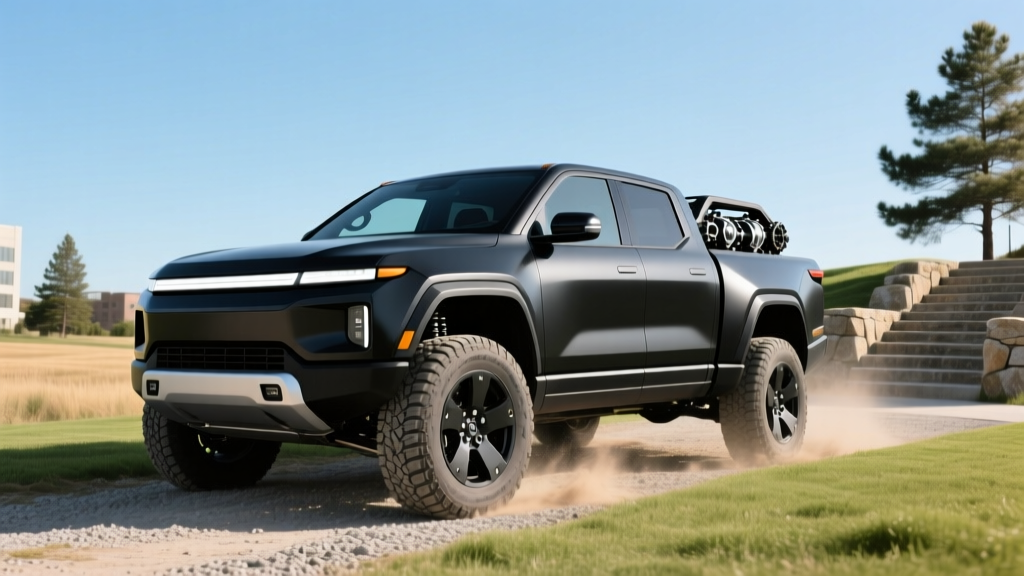
The headline number from the Marques Brownlee Rivian R1T Quad leak is the 1,025-horsepower output — a figure that places the R1T Quad-Motor among the most powerful production pickups ever sold. Each wheel gets its own dedicated drive unit with a dedicated inverter, enabling true torque vectoring: the truck can send more torque to the outside wheels in a corner, or brake individual wheels to simulate a locking differential off-road.
The 0–60 mph time of approximately 2.5 seconds is supercar territory in a vehicle that weighs over 7,000 pounds. Rivian achieves this through the instant torque delivery of four independent motors — there is no transmission to shift, no turbo to spool, no drivetrain lag.
Beyond straight-line speed, the quad-motor system's real advantage is off-road capability. Rivian's Quad-Motor Drive Mode includes Tank Turn functionality (spinning the truck 360° in place by driving left and right wheels in opposite directions), a feature that has limited practical use but demonstrates the platform's flexibility. More useful daily: the system provides exceptional traction control on loose surfaces, as each wheel's slip is managed independently without the latency of a mechanical differential.
The R1T retains its adjustable air suspension with up to 14.9 inches of ground clearance in Off-Road mode, a 45-degree approach angle, and the ability to wade through 36+ inches of water. Towing capacity holds at 11,000 pounds — competitive with the F-150 Lightning's 10,000-pound max but below the Silverado EV's 12,500-pound rating.
Pricing, Trim Levels, and Federal Tax Credit Eligibility
The 2026 Rivian R1T Quad-Motor is positioned as the top-tier performance configuration. Here's how the pricing structure breaks down across the R1T lineup:
| Trim / Configuration | Base MSRP | Est. §30D Credit | Effective Price |
|---|---|---|---|
| Dual-Motor Standard Pack | $69,900 | Up to $7,500 | ~$62,400 |
| Dual-Motor Max Pack | $79,900 | Up to $7,500 | ~$72,400 |
| Performance Dual-Motor | $84,900 | Up to $7,500 | ~$77,400 |
| Quad-Motor (as leaked) | $99,900 | Up to $7,500 | ~$92,400 |
Federal tax credit caveats: Under IRS §30D rules, the $7,500 credit is not automatic. Eligibility depends on several factors that change periodically:
- MSRP cap: Pickup trucks must have an MSRP at or below $80,000 to qualify. At $99,900, the Quad-Motor R1T exceeds this cap and would not qualify for the new-vehicle §30D credit. The Dual-Motor trims at or below $80,000 may qualify.
- Buyer income limits: Modified adjusted gross income (MAGI) must not exceed $300,000 (joint filers), $225,000 (head of household), or $150,000 (single filers).
- Battery sourcing: A portion of the credit depends on critical minerals and battery components being sourced from the U.S. or free-trade-agreement countries. Rivian has been working to localize its supply chain, but exact qualification percentages vary by model year and batch. Check the latest IRS clean vehicle credit page for current eligibility.
- Point-of-sale transfer: As of 2024, eligible buyers can transfer the credit to the dealer at purchase, reducing the out-of-pocket price immediately rather than waiting for a tax refund.
For the Quad-Motor specifically, the MSRP cap disqualification means buyers should budget the full $99,900+ (before destination and options) without counting on the federal credit. State-level incentives may still apply — check your local energy agency or DMV for details.
Cargo, Passenger Space, and Daily Practicality
The R1T's compact-by-full-size dimensions (217.1 inches long, roughly the footprint of a midsize truck) create a unique packaging story. The bed is 4.5 feet long — shorter than a traditional full-size pickup — but the R1T compensates with the Gear Tunnel, a 1.8-meter-long pass-through storage compartment between the cab and bed that holds up to 11 cubic feet of cargo. Combined bed and tunnel volume gives the R1T roughly 30 cubic feet of lockable, weather-sealed storage.
The front trunk (frunk) adds another 11 cubic feet, making the R1T one of the most storage-dense vehicles in its class. Total lockable, enclosed storage (frunk + Gear Tunnel + bed with tonneau) approaches 50+ cubic feet — a figure no conventional pickup can match without an aftermarket cap.
Inside the cabin, the R1T seats five with 41.3 inches of front legroom and 37.1 inches of rear legroom. The rear seats fold flat for extended cargo. Interior materials are premium vegan leather and sustainably sourced wood trim, consistent with Rivian's brand positioning.
The 15.6-inch center touchscreen runs Rivian's proprietary infotainment OS — no Apple CarPlay or Android Auto. This is a deliberate choice by Rivian, which argues its native software provides tighter integration with vehicle systems (range prediction, charging management, off-road modes). For buyers who consider phone mirroring essential, this is a notable drawback. The system supports over-the-air (OTA) updates, and Rivian has been steadily adding features with each software release.
Driver Assistance, Safety, and Standout Technology
The R1T comes equipped with Rivian's Driver+ suite, which includes adaptive cruise control, lane-centering assist, automatic emergency braking, and blind-spot monitoring. This is an SAE Level 2 driver-assistance system — meaning the driver must remain fully engaged with hands on the wheel and eyes on the road at all times. It is not a self-driving system.
Important: Rivian Driver+ is a Level 2 ADAS feature. It does not replace the driver. Hands-on-wheel monitoring is enforced via a torque sensor and camera-based attention system. Hands-free driving is not supported. For reference, only geofenced Level 4 robotaxi services (Waymo, Zoox) operate without a human driver.
The R1T earned top marks from the Insurance Institute for Highway Safety (IIHS), including a Top Safety Pick+ designation for the current generation. The NHTSA has awarded the R1T a 5-star overall safety rating.
Standout technology features include:
- Rivian Waypoints Navigation: Integrated route planning that factors in charger availability, elevation changes, and weather to predict range and schedule charging stops.
- Camp Mode: Maintains climate control and powers 120V/240V outlets overnight, turning the R1T into a mobile power station for camping.
- Vehicle-to-Load (V2L): The R1T can supply up to 7.2 kW of AC power through its bed and cabin outlets — enough to power tools, appliances, or even a small home during an outage.
- Powered Gear Guard: A motorized, lockable tonneau cover integrated into the bed design.
Warranty and Long-Term Ownership
Rivian backs the R1T with a comprehensive warranty package:
- Battery warranty: 8 years / 175,000 miles, with a guaranteed minimum 70% capacity retention over that period. This is among the most generous mileage limits in the segment.
- Powertrain warranty: 8 years / 175,000 miles (covers all four drive units, inverters, and associated electronics).
- Bumper-to-bumper: 5 years / 60,000 miles.
- Roadside assistance: 5 years / unlimited miles.
For a 149 kWh NMC battery, degradation expectations based on industry data suggest approximately 10–15% capacity loss over 150,000 miles under normal use (avoiding frequent 100% charges, minimizing DC fast-charging in extreme heat). Rivian's 70% retention guarantee at 175,000 miles is conservative — most NMC packs in liquid-cooled configurations retain 80%+ at that mileage based on fleet data from similar platforms.
Pros, Cons, and the Verdict
Pros
- 1,025 hp and 2.5-second 0–60 in a practical pickup
- 420-mile EPA range (Max Pack) is class-leading for trucks
- Quad-motor torque vectoring and Tank Turn are genuinely useful off-road
- Gear Tunnel + frunk provide unmatched enclosed storage
- 7.2 kW V2L capability for worksite and camping use
- 8-year/175,000-mile battery warranty
- Strong OTA update track record
Cons
- Quad-Motor at $99,900 exceeds the §30D $80,000 MSRP cap — no federal credit
- No Apple CarPlay or Android Auto
- 4.5-foot bed is short for full-size truck duties
- 48 kWh/100 mi efficiency means expensive long-distance charging
- 220 kW peak DC charge rate trails Hyundai/Kia's 350 kW E-GMP platform
- Rivian's service center network is still expanding in rural areas
- Weight (~7,150 lbs) increases tire wear and reduces payload
Who Should Buy the Rivian R1T Quad-Motor?
Choose the R1T Quad-Motor if: You want the most powerful electric pickup available, prioritize off-road capability and torque vectoring, need V2L power for worksite or camping use, and can absorb a ~$100,000 price tag without relying on the federal tax credit.
Choose the R1T Dual-Motor instead if: You want R1T practicality and range at a lower price point, need to stay under the $80,000 MSRP cap for §30D eligibility, and don't need 1,000+ horsepower for daily driving.
Look at the Ford F-150 Lightning if: You need a full 5.5- or 6.5-foot bed, prefer a traditional truck layout, and want broader dealership service coverage.
Look at the Tesla Cybertruck if: You want a stainless-steel exoskeleton, integrated Tesla Supercharger access, and a starting price well below $80,000 for the Dual-Motor variant.
Frequently Asked Questions
What is the real-world range of the Rivian R1T Quad-Motor?
The EPA estimates 420 miles for the Max Pack Quad-Motor. In real-world highway driving at 75 mph, expect 330–360 miles. In sub-freezing temperatures, that drops to approximately 290–340 miles. Preconditioning the battery and using seat heaters instead of cabin heat can recover some of that loss.
How fast does the R1T Quad-Motor charge?
On a DC fast charger, the R1T peaks at 220 kW and charges from 10–80% in approximately 42 minutes. At home on a 240V Level 2 charger (11.5 kW), it adds about 25 miles of range per hour, with a full charge taking roughly 13 hours.
Does the Rivian R1T Quad-Motor qualify for the federal EV tax credit?
Likely not. Under current IRS §30D rules, pickup trucks must have an MSRP at or below $80,000. The Quad-Motor's reported $99,900 price exceeds this cap. Lower-priced Dual-Motor trims may qualify, subject to income limits and battery-sourcing requirements. Always verify current rules on irs.gov.
Is the Rivian R1T worth buying versus the Tesla Cybertruck or Ford F-150 Lightning?
The R1T Quad-Motor is the performance and off-road leader in the electric truck segment. If you value independent motor torque vectoring, the Gear Tunnel, and premium build quality, it justifies its premium. The Cybertruck wins on charging network access (Superchargers) and price. The F-150 Lightning wins on bed length, dealer service access, and fleet/commercial practicality.
What battery chemistry does the R1T use?
The R1T Max Pack uses NMC (nickel-manganese-cobalt) lithium-ion cells supplied by Samsung SDI. NMC offers higher energy density than LFP (lithium iron phosphate), which is why the Max Pack can store 149 kWh in a package that fits the R1T's skateboard platform. The trade-off is that NMC cells degrade slightly faster than LFP and should not be held at 100% SoC for extended periods.
Does the R1T have Apple CarPlay or Android Auto?
No. Rivian uses its own proprietary infotainment system. The company has stated it prefers native software integration for range prediction, charging, and vehicle controls. Third-party phone mirroring is not available as of the 2026 model year.
What is the R1T's towing range impact?
Towing at the 11,000-pound max capacity roughly halves the R1T's range. Expect approximately 200–220 miles when towing a heavy trailer at highway speeds. This is consistent across all electric trucks and is a function of the aerodynamic drag and rolling resistance a trailer adds. Plan charging stops accordingly.
Specifications based on reported data from the Marques Brownlee Rivian R1T Quad leak and Rivian's official Gen 2 platform disclosures. Final production specs, pricing, and tax-credit eligibility may differ. Verify all figures with fueleconomy.gov and Rivian's configurator before purchasing.