What Is Tesla's Magic Dock and Why It Matters for Non-Tesla EVs
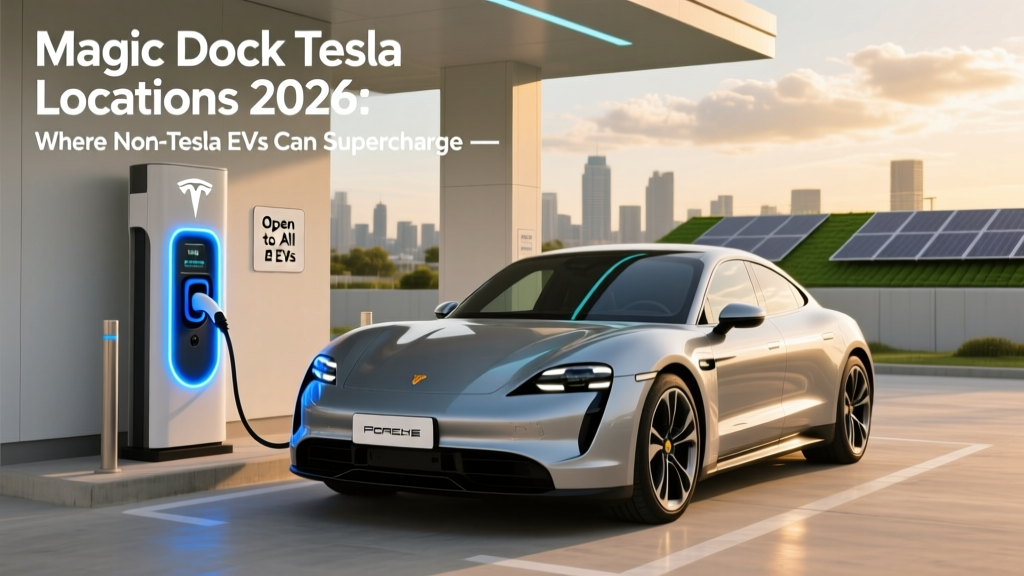
Tesla's Magic Dock is a built-in CCS adapter integrated directly into select Supercharger stalls, allowing any CCS-equipped electric vehicle — not just Teslas — to access the most reliable DC fast-charging network in North America. Rather than requiring non-Tesla drivers to carry a separate NACS-to-CCS adapter, the Magic Dock lives at the stall itself: a NACS connector housed inside a CCS-compatible sleeve that detaches when a non-Tesla vehicle plugs in.
As of early 2026, Tesla has opened portions of its Supercharger network to non-Tesla EVs through two mechanisms: the Magic Dock at specific stations, and the broader NACS adoption by Ford, GM, Rivian, Hyundai, and others via manufacturer-supplied adapters. This guide focuses specifically on Magic Dock Tesla locations — the stations where any CCS1-equipped EV can pull up, plug in, and charge without needing to buy or carry additional hardware.
Where Are Magic Dock Tesla Locations in 2026?
Tesla does not publish a single static list of Magic Dock stations. Instead, Magic Dock-equipped Superchargers are identified within the Tesla app (under "Charge Your Non-Tesla") and on third-party apps like PlugShare, where they are typically tagged as "Tesla Supercharger — Open to Non-Tesla EVs (CCS)."
As of Q1 2026, Magic Dock stations are concentrated in the following regions:
- Northeast Corridor: New York, New Jersey, Connecticut, Massachusetts — particularly along I-95 and I-87 corridors where state NEVI (National Electric Vehicle Infrastructure) funding required non-Tesla access.
- California: Select urban and highway stations in the Bay Area, Los Angeles metro, and along Highway 101 and I-5.
- Mid-Atlantic: Maryland, Virginia, and Pennsylvania stations near major interstate routes.
- Mountain West: Limited stations in Colorado (Denver metro, I-70 corridor) and Utah.
- Pacific Northwest: A handful of stations in Oregon and Washington.
The total count of Magic Dock-equipped stations remains a subset of Tesla's roughly 6,000+ North American Supercharger stations. Most Magic Dock sites have between 2 and 8 stalls equipped with the dock, not the entire station. Always verify in the Tesla app before routing to a station.
Charging Speed at Magic Dock Stations: What Non-Tesla EVs Actually Get
Magic Dock stalls are typically V3 Superchargers, which deliver a peak output of 250 kW. However, your actual charge speed depends entirely on your vehicle's onboard charge acceptance rate, battery state of charge (SoC), and battery temperature.
| Vehicle | Peak DC Acceptance | 10–80% Time (est.) | Notes |
|---|---|---|---|
| Hyundai Ioniq 5 (2025+) | ~240 kW | ~18 min | 800V architecture; precondition via route nav |
| Ford F-150 Lightning (extended range) | ~150 kW | ~35–41 min | Heavy battery = longer sustained charge |
| BMW i4 eDrive40 | ~200 kW | ~25–31 min | Good curve; precondition recommended |
| VW ID.4 (2025+) | ~175 kW | ~28–34 min | Improved over earlier 125 kW cap |
| Chevrolet Equinox EV | ~150 kW | ~30–35 min | GM's NACS transition; CCS via Magic Dock works |
Charging-curve reality check: No EV sustains its peak kW for the entire session. A vehicle rated at 240 kW peak will typically hold that rate from roughly 10–30% SoC, then taper progressively — dropping to ~100 kW by 60% and ~50 kW by 80%. The 10–80% time is the practical metric to watch, not the peak number.
At a Magic Dock V3 stall, the 250 kW ceiling is sufficient for virtually every CCS1 EV on the road today. The bottleneck is your car, not the station. One important caveat: Magic Dock stalls are not V4 Superchargers (which support up to 350+ kW and feature a separate cable/connector design). If you drive a future 800V+ vehicle capable of 350 kW charging, Magic Dock V3 stalls will cap you at 250 kW.
How to Use a Magic Dock Station: Step-by-Step
The process is slightly different from standard Supercharging because Tesla's payment system requires account setup before you arrive.
- Download the Tesla app (iOS or Android) and create a Tesla account if you don't already have one.
- Add a payment method in the app under your account settings.
- Navigate to a Magic Dock station using the "Charge Your Non-Tesla" map in the app or PlugShare.
- Pull up to a stall marked with Magic Dock signage. These stalls typically have a small sign or different-colored cable housing.
- Open the Tesla app and select the stall number displayed on the pedestal.
- Press the button on the Magic Dock connector — the CCS adapter sleeve will release, exposing the CCS1-compatible plug.
- Plug into your vehicle's CCS port. The connector locks in place.
- Initiate the session in the Tesla app. Charging begins within ~30 seconds.
- Monitor your session in the Tesla app. Unplug when complete and return the connector to the holster.
Cost to Charge at Magic Dock Tesla Locations
Tesla charges non-Tesla vehicles a premium at Magic Dock stations compared to Tesla owners. Pricing varies by location, time of day, and local utility rates, but here is the typical structure as of 2026:
| Rate Type | Tesla Owners | Non-Tesla (Magic Dock) | Non-Tesla w/ Membership |
|---|---|---|---|
| Per kWh (typical range) | $0.25–$0.40 | $0.40–$0.65 | $0.30–$0.50 |
| Idle fee (per minute, after charge completes) | $0.50–$1.00 | $0.50–$1.00 | $0.50–$1.00 |
| Membership cost | N/A | N/A | $12.99/month |
For a typical 60 kWh charge session (roughly 10–80% on a mid-size EV), expect to pay $24–$39 without membership or $18–$30 with the $12.99/month membership. If you charge at Magic Dock stations more than twice a month, the membership pays for itself.
Compared to Electrify America or EVgo, Magic Dock pricing is often competitive — and the reliability is substantially higher. Tesla's Supercharger uptime consistently exceeds 95%, while third-party networks average 70–85% uptime according to J.D. Power EV Experience Index data.
Magic Dock vs. Carrying Your Own NACS Adapter
With Ford, GM, Rivian, and most other automakers transitioning to native NACS ports starting in model year 2025–2026, many newer EVs can access the full Supercharger network directly — no Magic Dock needed. But millions of CCS1-equipped EVs from model years 2018–2025 are still on the road.
For those vehicles, there are two options:
| Factor | Magic Dock (No Adapter Needed) | Aftermarket CCS-to-NACS Adapter |
|---|---|---|
| Station access | Magic Dock stalls only (~hundreds of stations) | All open Supercharger stalls (thousands of stations) |
| Upfront cost | $0 (pay per kWh) | $150–$250 for adapter |
| Per-kWh cost | Non-Tesla premium rate | Non-Tesla premium rate (same) |
| Convenience | Nothing to carry; limited locations | Must carry adapter; full network access |
| Warranty risk | None (Tesla-provided hardware) | Some OEMs void warranty with 3rd-party adapters |
Bottom line: If you drive a CCS1 EV and road-trip frequently, buying a manufacturer-approved CCS-to-NACS adapter (Ford, GM, and Rivian sell them for ~$200) gives you access to the entire open Supercharger network, not just Magic Dock stalls. The Magic Dock is best as a backup option or for drivers who charge at Superchargers occasionally and don't want to invest in an adapter.
Tesla Supercharger Network Reliability: Why Non-Tesla Drivers Want In
The primary reason non-Tesla EV owners seek out Magic Dock Tesla locations is reliability. According to J.D. Power's 2025 U.S. Electric Vehicle Experience (EVX) Public Charging Study, Tesla Superchargers scored significantly higher in satisfaction and uptime than all other DC fast-charging networks combined.
Key reliability advantages at Supercharger stations:
- Uptime >95%: Stalls that are listed as available almost always work. Payment processing is seamless through the app.
- Consistent power delivery: V3 stalls deliver their rated 250 kW without the power-sharing drops common at older CCS stations.
- Plug-and-charge simplicity: No RFID cards, no multiple app accounts, no broken screens.
- Station amenities: Tesla increasingly locates Superchargers near restrooms, food, and WiFi.
For a deeper look at how Tesla's network compares, the EPA's fueleconomy.gov provides efficiency data that helps you calculate exactly how many kWh — and dollars — you'll need for any given trip.
What This Means for Your EV: Compatibility and Practical Tips
Not every non-Tesla EV can use a Magic Dock station. Here is the compatibility checklist:
- Required: CCS1 (DC fast-charge) port. This is standard on virtually all EVs sold in the US from 2019–2025 (Hyundai, Kia, Ford, GM, VW, BMW, Mercedes, Rivian, etc.).
- Not compatible: CHAdeMO vehicles (Nissan Leaf, older Mitsubishi), Tesla vehicles (use native connector), and vehicles with no DC fast-charge capability.
- NACS-native vehicles (2025+): Ford, GM, Rivian, and others with native NACS ports do not need the Magic Dock — they can use any open Supercharger stall directly.
Frequently Asked Questions
How do I find the nearest Magic Dock Tesla location?
Open the Tesla app, tap "Charge Your Non-Tesla," and browse the map. You can also check PlugShare and filter for Tesla Superchargers with CCS compatibility. The station listings will show how many stalls have the Magic Dock. Always confirm in the Tesla app before driving there, as availability can change.
Do I need a Tesla account to use a Magic Dock?
Yes. You must create a Tesla account in the Tesla app and add a payment method before you can initiate a charging session. The account is free to create.
Is Magic Dock charging slower than a regular Supercharger for Teslas?
No. Magic Dock stalls are V3 Superchargers capable of 250 kW, the same as standard V3 stalls. Your actual charge speed depends on your vehicle's peak DC acceptance rate, not the Magic Dock hardware itself.
Can I use a Magic Dock if my EV has a NACS port?
You don't need to. Vehicles with native NACS ports (2025+ Ford, GM, Rivian, and others) can use any Tesla Supercharger stall that's been opened to non-Tesla vehicles — not just Magic Dock stalls. Magic Dock exists specifically for CCS1-equipped vehicles.
Are Magic Dock stations covered by Tesla's idle fees?
Yes. Once your vehicle reaches its charge limit or the session ends, idle fees of $0.50–$1.00 per minute apply if you don't move your vehicle. This is enforced for all vehicles, Tesla and non-Tesla alike.
Will Magic Dock locations expand in 2026?
Tesla has been gradually adding Magic Dock stalls, particularly where NEVI federal funding requires non-Tesla access. However, the broader trend is the industry-wide shift to NACS ports — as more vehicles ship with native NACS, the strategic importance of Magic Dock diminishes. Expect slow growth in Magic Dock locations, with the focus shifting to opening more standard Supercharger stalls to NACS-equipped non-Tesla vehicles.
Does using a Magic Dock affect my vehicle's battery warranty?
No. The Magic Dock is Tesla-provided hardware at a Tesla-operated station. It delivers standard DC fast charging within your vehicle's specifications. There is no warranty concern, unlike some third-party adapters where OEM policies vary.