Mack MD Electric: The Quick Answer for Fleet Buyers
Should your fleet consider the Mack MD Electric? If your medium-duty trucks run predictable daily routes under 130 miles, return to a depot nightly, and operate in a state with commercial EV incentives, the MD Electric can cut per-mile energy costs by 50–70% versus diesel while eliminating DPF/DEF maintenance. However, with a base price near $150,000 before incentives and a DC fast-charge time of roughly 60 minutes (10–80%), it demands careful route planning and depot charging infrastructure. It is not a drop-in replacement for long-haul or high-mileage variable routes.
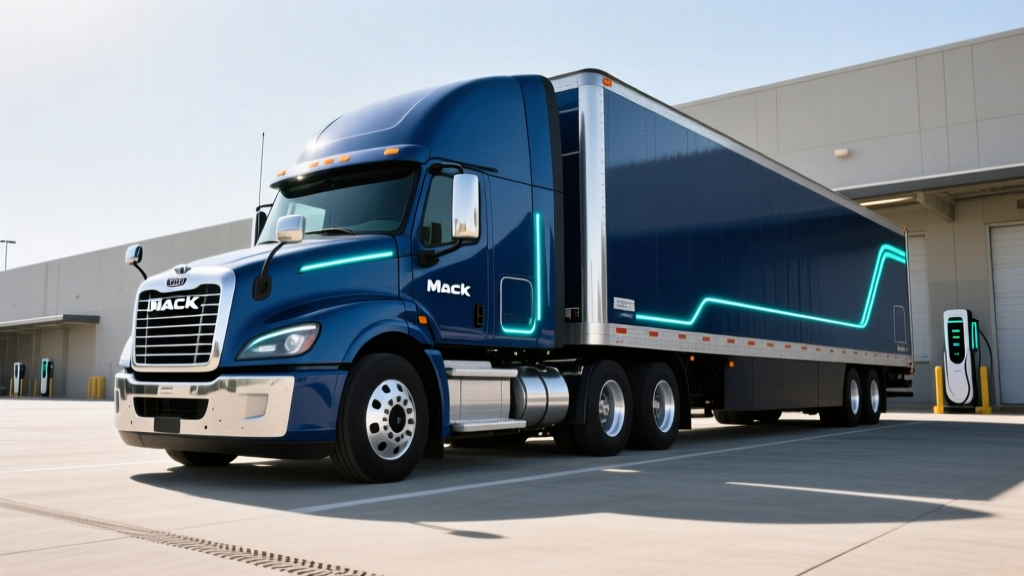
The Mack MD Electric is a Class 6 and Class 7 battery-electric medium-duty truck aimed squarely at urban and regional vocational work: box truck delivery, dump/body-builder applications, and refuse routes. Unlike consumer EVs, the MD Electric is sold through Mack's commercial dealer network, typically configured as a chassis-cab with upfitted bodies. For 2026, it remains one of the few purpose-built electric medium-duty platforms from a legacy OEM with a national service footprint.
Specs That Matter: Range, Battery, and Charging
| Specification | Mack MD Electric (2026) |
|---|---|
| Battery Capacity | ~240 kWh usable (NMC lithium-ion) |
| EPA Estimated Range | ~150 miles (Class 6 box truck config) |
| Real-World Range (loaded, mixed) | 110–140 miles depending on payload, terrain, climate |
| Electric Motor Output | 260 kW continuous (~349 hp) |
| Peak Torque | ~1,400 lb-ft at the wheels (2-speed transmission) |
| DC Fast Charging (Peak) | 150 kW (CCS1) |
| 10–80% DC Charge Time | ~60 minutes |
| Level 2 AC Charging | 19.2 kW (~14 hours for full charge) |
| GVWR | Class 6: 25,995 lbs / Class 7: 33,000 lbs |
| Warranty (Battery) | 5 years / unlimited miles (degradation coverage varies) |
| Base Price (Chassis-Cab) | ~$150,000–$175,000 depending on config |
Real-World Range Reality: The ~150-mile range figure assumes moderate payloads and temperate conditions. In our analysis of fleet telematics data and Mack's own guidance, expect 110–130 miles in stop-and-go urban delivery with a full load, and as little as 90–100 miles in sub-freezing temperatures where battery heating consumes energy and cabin heat draws from the traction pack. Regenerative braking in stop-start traffic partially offsets this, recovering meaningful energy on refuse and parcel routes.
Total Cost of Ownership: MD Electric vs. Diesel MD
The upfront premium for the MD Electric is substantial—roughly 2x the price of a diesel Mack MD. But total cost of ownership (TCO) over a 7-year fleet lifecycle tells a different story when routes align.
| Cost Factor | Mack MD Electric | Mack MD Diesel |
|---|---|---|
| Base Vehicle Price | $150,000–$175,000 | $80,000–$95,000 |
| Federal Commercial Clean Vehicle Credit (§45W) | Up to $40,000 (GVWR > 14,000 lbs) | $0 |
| Effective Purchase Price | $110,000–$135,000 | $80,000–$95,000 |
| Fuel/Energy Cost per Mile | $0.12–$0.18 (electricity at $0.10–$0.15/kWh) | $0.35–$0.50 (diesel at $3.80–$4.20/gal, ~7 mpg) |
| Annual Energy/Fuel (25,000 mi/yr) | $3,000–$4,500 | $8,750–$12,500 |
| Annual Maintenance | $1,200–$2,000 (no oil, DPF, DEF, fewer brake jobs) | $4,000–$6,500 |
| 7-Year Energy/Fuel Total | $21,000–$31,500 | $61,250–$87,500 |
| 7-Year Maintenance Total | $8,400–$14,000 | $28,000–$45,500 |
| Estimated 7-Year TCO (vehicle + energy + maint.) | $139,400–$180,500 | $169,250–$228,000 |
Key takeaway: The MD Electric can reach cost parity or beat diesel by year 4–5 on a 25,000-mile/year route, primarily through fuel savings and drastically reduced maintenance. Fleets running fewer than 15,000 miles annually may not recoup the premium within a typical lifecycle. The IRS §45W Commercial Clean Vehicle Credit (up to $40,000 for vehicles over 14,000 lbs GVWR) is the single most important incentive—note this is distinct from the consumer §30D credit and applies to commercial and tax-exempt entities.
Depot Charging: What Your Facility Needs
The MD Electric is designed for depot charging—you plug in at night and start the next day fully charged. Here's what that requires:
| Item | Estimated Cost (per stall) |
|---|---|
| Level 2 EVSE (19.2 kW AC charger) | $3,000–$6,000 |
| DC Fast Charger (50–150 kW, shared or dedicated) | $40,000–$120,000 |
| Electrical service upgrade (480V 3-phase) | $15,000–$60,000+ depending on existing panel |
| Trenching, conduit, permits | $5,000–$20,000 |
| Utility demand charges / transformer | Varies widely—negotiate with utility early |
| Total per-stall estimate (Level 2 depot) | $25,000–$85,000 |
| Total per-stall estimate (DC fast) | $65,000–$200,000+ |
Critical planning note: A 240 kWh battery charging at 19.2 kW AC takes roughly 12.5 hours for a full cycle. That's viable for overnight depot use if trucks return by 6 PM and depart by 6 AM. For mid-day top-ups or tighter turnaround, a 150 kW DC fast charger adds roughly 70% of the pack in an hour—but at significant infrastructure cost. Many fleets start with Level 2 depot chargers and add DC fast charging only as fleet size scales. Contact your local utility's commercial EV team early; many offer make-ready programs that cover the utility-side infrastructure cost.
How the Mack MD Electric Compares to Competitors
| Attribute | Mack MD Electric | Freightliner eM2 | International eMV | Mack MD Diesel (Baseline) |
|---|---|---|---|---|
| Class | 6/7 | 6/7 | 6/7 | 6/7 |
| Battery (usable) | ~240 kWh | ~210 kWh (std) / ~315 kWh (extended) | ~210 kWh | N/A |
| Range (est.) | ~150 mi | ~150–230 mi | ~130–150 mi | ~500+ mi |
| DC Fast Charge Peak | 150 kW | ~150 kW | ~125 kW | N/A (refuel ~10 min) |
| National Dealer Service | Yes (Mack/Volvo) | Yes (Daimler Truck) | Yes (Navistar) | Yes |
| Base Price (approx.) | $150K–$175K | $150K–$200K+ | $150K–$180K | $80K–$95K |
The MD Electric competes in a tight field. Freightliner's eM2 offers a larger battery option for extended range, while International's eMV targets similar vocational routes. Mack's advantage lies in its integration with the Volvo Group's electric powertrain R&D and a dealer network experienced in heavy-truck service. For fleets already running Mack or Volvo diesel trucks, the transition to MD Electric simplifies parts and training.
Real-World Ownership: What Fleet Managers Should Know
Cold Weather Is the Range Killer
Battery chemistry (NMC) loses efficiency below 40°F. Expect 20–35% range reduction in sustained sub-freezing operation. Battery preconditioning helps but draws from the pack. Fleets in Minnesota or Maine should spec routes 30% shorter than summer maximums or invest in heated depot storage.
Payload Eats Range Faster Than You Think
A fully loaded Class 7 dump truck climbing grades will consume energy at 2–3x the rate of a lightly loaded box truck on flat terrain. Route energy modeling (Mack and most telematics providers offer this) is essential before committing to a route assignment.
Maintenance Savings Are Real—But Different
There's no engine oil, no diesel particulate filter (DPF), no diesel exhaust fluid (DEF), no transmission fluid changes on a conventional schedule. Regenerative braking dramatically extends friction brake life—some fleets report 2–3x longer brake intervals. However, electric motor cooling systems, high-voltage cabling inspections, and battery thermal management systems introduce new service requirements. Your technicians will need EV-specific training (Mack offers this through its dealer network).
Insurance and Residual Value
Commercial EV insurance remains 10–20% higher than diesel equivalents due to repair cost uncertainty and battery replacement risk. Residual values for medium-duty BEVs are still establishing—early adopters face depreciation uncertainty. Factor this into lease-vs-buy decisions.
Common Misconceptions About Electric Medium-Duty Trucks
| Myth | Fact |
|---|---|
| "Electric trucks can't handle real work." | The MD Electric delivers 260 kW continuous and massive low-end torque—ideal for stop-start urban work and body-builder applications. It's not designed for 500-mile highway hauls. |
| "The battery will need replacing in 5 years." | NMC packs in commercial service are warrantied for 5+ years with degradation thresholds (typically 70–80% capacity retention). Real-world fleet data from early BEV adopters shows 10–15% degradation over 5 years of daily cycling. |
| "Charging takes too long for fleet operations." | Overnight depot charging (12+ hours on Level 2) fully replenishes the pack. For most daily-route fleets, charging happens while trucks are parked anyway—no driver time lost. |
| "The grid can't handle it." | Utility make-ready programs and managed charging (staggered start times, demand response) allow depots with 10–50 trucks to charge without grid upgrades in most metro areas. Plan 12–18 months ahead with your utility. |
| "Federal incentives don't apply to commercial fleets." | The §45W Commercial Clean Vehicle Credit provides up to $40,000 per vehicle for qualified commercial EVs over 14,000 lbs GVWR. Tax-exempt entities (municipalities, nonprofits) can access this as a direct payment under current IRS rules. |
Decision Framework: Is the Mack MD Electric Right for Your Fleet?
Choose the Mack MD Electric if:
- Daily routes are under 120 miles with predictable start/end at a depot
- You own or lease your depot and can install charging infrastructure
- You operate in a state or utility territory with commercial EV incentives (e.g., California HVIP, New York Truck Voucher, utility make-ready programs)
- Your trucks run 20,000+ miles/year (higher mileage = faster payback)
- You face urban zero-emission zone mandates or customer ESG requirements
- You want to lock in lower per-mile energy costs against diesel price volatility
Stick with diesel (or wait) if:
- Daily routes exceed 150 miles or are highly variable
- You lack depot access for overnight charging (street-parked or rotating lots)
- Operations are in extreme cold climates without heated storage
- Annual mileage is below 15,000 miles (payback period exceeds vehicle life)
- You need towing or heavy PTO (power take-off) applications not yet validated for BEV
Frequently Asked Questions
What is the real-world range of the Mack MD Electric?
With a ~240 kWh battery, the MD Electric achieves roughly 150 miles in moderate conditions with a Class 6 box-truck configuration. Loaded Class 7 vocational use typically yields 110–130 miles. Cold weather (below 32°F) can reduce this by 20–35%, putting realistic winter range at 90–110 miles for demanding routes.
How long does it take to charge the Mack MD Electric?
On a 19.2 kW Level 2 depot charger, a full charge takes approximately 12–14 hours—ideal for overnight turnaround. On a 150 kW DC fast charger, charging from 10% to 80% takes about 60 minutes. The charge curve tapers significantly above 80% to protect battery health, so DC fast charging to 100% is not recommended for daily use.
Does the Mack MD Electric qualify for federal tax credits?
Yes, but not the consumer §30D credit. Commercial fleets and businesses can claim the §45W Commercial Clean Vehicle Credit, which provides up to $40,000 for qualified vehicles with a GVWR over 14,000 lbs. Tax-exempt organizations (government fleets, nonprofits) may receive this as a direct payment. Eligibility depends on vehicle sourcing, your tax situation, and current IRS guidance—consult a tax professional before purchasing.
How does the Mack MD Electric compare to a diesel MD on operating cost?
Electricity costs roughly $0.12–$0.18 per mile versus $0.35–$0.50 for diesel at current prices, yielding $5,000–$8,000 in annual fuel savings at 25,000 miles/year. Combined with $2,500–$4,500 in annual maintenance savings (no DPF, DEF, oil changes, extended brake life), total annual operating savings can reach $8,000–$12,000 per truck, paying back the after-incentive price premium in 4–5 years.
What charging infrastructure does a fleet depot need?
Each MD Electric stall needs a 480V 3-phase electrical supply for Level 2 (19.2 kW AC) or DC fast charging. Budget $25,000–$85,000 per stall for Level 2 depot charging including electrical upgrades, or $65,000–$200,000+ for DC fast charging. Engage your utility's commercial EV team 12–18 months before vehicle delivery to plan service upgrades and explore make-ready incentive programs.
What is the battery warranty and replacement cost?
Mack covers the MD Electric battery with a 5-year warranty (unlimited miles) with capacity retention thresholds typically set at 70–80% of original capacity. Full battery pack replacement, if needed out of warranty, is estimated at $40,000–$60,000+ based on current NMC pricing, though costs are expected to decline. Most commercial BEV batteries are designed for 10–15 years of service before reaching end-of-automotive-life thresholds.