Quick Answer: Is a Mack Electric Truck Right for Your Fleet?
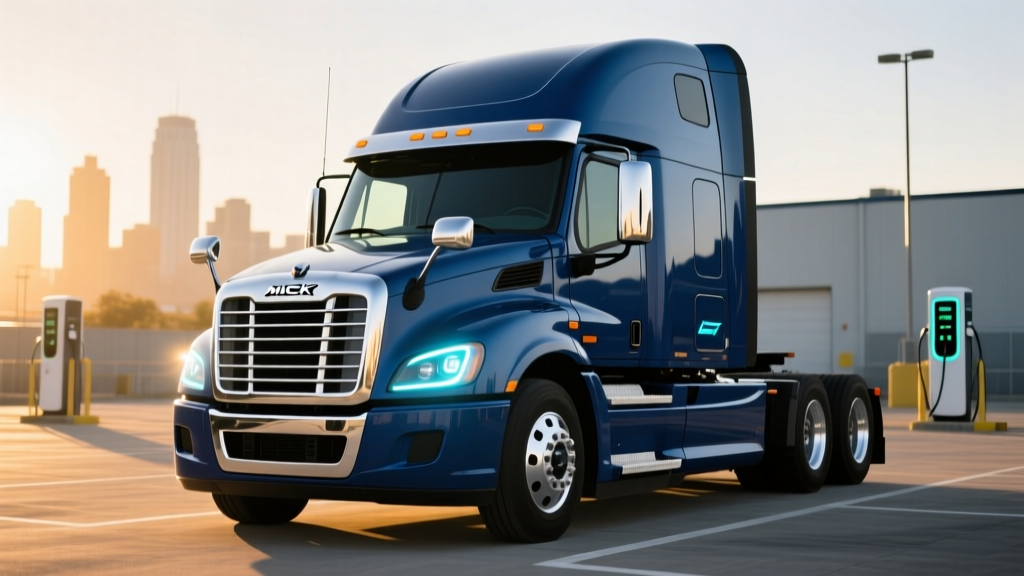
Mack's current electric lineup centers on two Class 8 models: the LR Electric (refuse/vocational) and the MD Electric (medium-duty delivery). The LR Electric carries up to 376 kWh of NMC battery across a 4-pack configuration, delivering an estimated 150 miles of real-world range under loaded refuse-cycle duty. The MD Electric offers up to 240 kWh and approximately 130–150 miles in delivery applications. Base pricing typically starts in the $350,000–$450,000 range before federal and state incentives. These trucks are purpose-built for depot-based, return-to-base routes under 150 miles — not long-haul. If your fleet operates predictable daily cycles with overnight depot charging, the TCO math favors electric. If you run irregular long routes or lack depot charging infrastructure, diesel remains the practical choice for now.
Mack's Electric Truck Lineup: LR Electric and MD Electric at a Glance
Mack Trucks, a subsidiary of Volvo Group, entered the battery-electric commercial vehicle space with a focused strategy: electrify vocational and medium-duty routes where diesel's advantages are weakest and electricity's advantages are strongest. Unlike Tesla's Semi or Freightliner's eCascadia targeting regional and long-haul, Mack's electric trucks are engineered for stop-and-go, low-speed, high-idle-duty cycles — think municipal refuse collection, food distribution, and local delivery.
The two-model lineup reflects this targeted approach:
| Specification | Mack LR Electric | Mack MD Electric |
|---|---|---|
| Vehicle Class | Class 8 (Vocational/Refuse) | Class 6–7 (Medium-Duty) |
| Battery Chemistry | NMC (Nickel Manganese Cobalt) | NMC |
| Battery Capacity (max config) | 376 kWh (4-pack) | 240 kWh (3-pack) |
| EPA Range Estimate | ~150 mi (loaded refuse cycle) | ~130–150 mi (delivery cycle) |
| Electric Motors | 2 × integrated e-axle motors | Single electric motor |
| Peak Power | 448 hp (continuous) / 751 hp (peak) | ~260 hp |
| Peak Torque | 4,270 lb-ft | ~1,800 lb-ft |
| DC Fast Charge (peak) | Up to 150 kW (CCS1) | Up to 150 kW (CCS1) |
| 10–80% DC Charge Time | ~2.5 hours (376 kWh pack) | ~1.5 hours (240 kWh pack) |
| Level 2 AC Charging | Up to 19.2 kW | Up to 19.2 kW |
| GVWR | Up to 80,000 lbs | Up to 33,000 lbs |
| Estimated Base Price | $400,000–$450,000 | $350,000–$400,000 |
| Warranty (battery) | 5 years / unlimited miles | 5 years / unlimited miles |
Specs reflect Mack's published data and industry reporting as of early 2026. Actual range varies significantly with payload, ambient temperature, route topography, and auxiliary load (e.g., hydraulic systems on refuse bodies).
Real-World Range vs. Sticker Numbers: What Fleet Managers Actually See
Mack LR Electric: Published range ~150 miles (refuse cycle). In cold-weather operations (below 32°F), expect a 20–35% reduction, bringing usable range to approximately 100–120 miles. Highway-speed operation (sustained 55+ mph) also reduces range versus low-speed stop-and-go cycles where regenerative braking recovers significant energy.
Mack MD Electric: Published range ~130–150 miles (delivery cycle). Urban delivery routes with frequent stops maximize regen recovery; suburban or highway-heavy routes will trend toward the lower end.
Commercial EV range is fundamentally different from passenger-car range. A refuse truck's duty cycle involves hundreds of stops, heavy hydraulic body operation, and low average speeds — conditions that favor electric drivetrains because regenerative braking recaptures energy at each stop and electric motors don't idle-fuel like diesels. Mack's published ranges reflect these specific duty cycles, not highway cruising.
Key variables that shift real-world range:
- Payload weight: A fully loaded LR Electric at 80,000 lbs GVWR consumes significantly more energy per mile than a partially loaded truck.
- Auxiliary loads: Refuse body hydraulics, lift gates, and refrigeration units draw from the same battery pack, reducing driving range.
- Ambient temperature: NMC batteries lose efficiency below freezing. Battery thermal management systems mitigate this but consume energy themselves. Expect 20–35% range loss in winter in northern climates.
- Route topography: Hilly routes drain batteries faster, though downhill segments recover energy via regen.
- Driver behavior: Aggressive acceleration and high speeds reduce range; smooth driving with regen maximization extends it.
Charging Infrastructure: What Depot Charging Actually Requires
Unlike passenger EVs that can rely on public charging networks, Mack electric trucks require purpose-built depot charging infrastructure. This is the single largest barrier to adoption and the most underestimated cost in fleet electrification.
| Charging Level | Power (kW) | Connector | Approx. Time (10–80%) | Best Use Case |
|---|---|---|---|---|
| Level 2 AC | 19.2 kW | J1772 / CCS1 AC pins | 12–18 hours (376 kWh) | Overnight depot top-off |
| DC Fast Charge | Up to 150 kW | CCS1 | ~2.5 hours (376 kWh) | Mid-day opportunity charging |
| DC Fast Charge (shared) | 50–100 kW | CCS1 | 3.5–6 hours (376 kWh) | Lower-cost depot installs |
Depot charging installation costs are substantial and vary widely based on site conditions:
| Component | Estimated Cost Range (per charger) |
|---|---|
| DC fast charger hardware (50–150 kW) | $40,000–$120,000 |
| Electrical service upgrade (transformer, switchgear) | $25,000–$150,000 |
| Utility demand charges & interconnection | $10,000–$75,000 |
| Site work (conduit, trenching, pads) | $15,000–$60,000 |
| Permitting & engineering | $5,000–$25,000 |
| Total per DC charger installed | $95,000–$430,000 |
Fleets deploying multiple trucks should plan for managed charging software to stagger charge sessions and avoid utility demand-charge spikes. Mack supports integration with major fleet charging management platforms. According to the U.S. Department of Energy's Alternative Fuels Data Center, many utilities offer commercial EV rate structures and infrastructure rebates that can offset 30–50% of installation costs — but application timelines can extend 6–18 months.
Critical planning note: Utility service upgrades for a multi-truck depot can require new transformers, medium-voltage service drops, and utility coordination that takes 12–24 months. Start infrastructure planning before ordering trucks.
Total Cost of Ownership: Mack Electric vs. Diesel — The Numbers
The purchase price of a Mack electric truck is roughly 2–3× that of a comparable diesel model. The ownership case depends entirely on whether fuel savings, maintenance savings, and incentives close that gap over the vehicle's service life (typically 10–15 years for vocational trucks).
| Cost Factor | Mack LR Electric (Est.) | Mack LR Diesel (Est.) |
|---|---|---|
| Purchase Price (base) | $400,000–$450,000 | $180,000–$220,000 |
| Federal Tax Credit (§45W Commercial) | Up to $40,000 | $0 |
| State/Local Incentives (varies) | $50,000–$150,000+ | $0 |
| Fuel/Energy Cost per Mile | $0.25–$0.45 (electricity) | $0.65–$1.00 (diesel) |
| Annual Fuel/Energy (12,000 mi/yr) | $3,000–$5,400 | $7,800–$12,000 |
| Annual Maintenance | $3,000–$5,000 | $8,000–$15,000 |
| 10-Year Fuel/Energy Total | $30,000–$54,000 | $78,000–$120,000 |
| 10-Year Maintenance Total | $30,000–$50,000 | $80,000–$150,000 |
| 10-Year Operating Cost | $60,000–$104,000 | $158,000–$270,000 |
Key TCO insight: Over 10 years, operating cost savings of $70,000–$166,000 can offset a significant portion of the higher purchase price. When combined with the federal §45W commercial clean vehicle credit (up to $40,000 for vehicles over 14,000 lbs GVWR) and state incentives — such as California's HVIP or New York's Truck Voucher Incentive Program — TCO parity or advantage is achievable for the right duty cycle.
Important: The §45W commercial credit has different rules than the consumer §30D credit. It applies to qualified commercial vehicles, has no MSRP cap or buyer income limit, but requires the vehicle to be placed in service for business use and meet domestic battery-sourcing requirements. Always consult a tax professional and verify current-year rules on IRS.gov.
Common Misconceptions About Mack Electric Trucks — Fact vs. Fiction
| Myth | Fact |
|---|---|
| "Electric trucks can't handle heavy loads." | The LR Electric is rated to 80,000 lbs GVWR — the same as its diesel counterpart. Electric motors deliver peak torque from zero RPM, which actually improves low-speed pulling power for refuse and vocational work. |
| "The battery will need replacing in 5 years." | Mack warranties the battery pack for 5 years with no mile limit. NMC commercial packs are engineered for 2,000–3,000+ charge cycles before reaching 80% State of Health. At one cycle per day, that's 5.5–8+ years before meaningful degradation, and the pack doesn't "die" — it gradually loses capacity. |
| "Charging takes too long for commercial use." | For return-to-base fleets, overnight Level 2 charging (8–12 hours) fully replenishes the pack during non-operational hours. DC fast charging at 150 kW adds ~100 miles of range in about 90 minutes for mid-day top-offs. |
| "Electric trucks are unreliable in cold weather." | Cold weather reduces range by 20–35% — this is real and must be planned for. However, electric drivetrains have fewer cold-start failures than diesels (no glow plugs, no diesel exhaust fluid, no fuel gelling). Mack's thermal management system preconditions the battery to mitigate cold losses. |
| "There are no incentives for commercial EVs." | The federal §45W credit provides up to $40,000 per vehicle. Many states offer additional vouchers of $50,000–$200,000+. Utility companies frequently provide infrastructure rebates. The incentive landscape is robust but varies by jurisdiction. |
Maintenance and Reliability: Fewer Moving Parts, Different Skill Sets
Electric trucks eliminate the maintenance categories that dominate diesel fleet budgets: engine oil changes, diesel particulate filter (DPF) cleaning/replacement, selective catalytic reduction (SCR) system service, transmission overhauls, and fuel system repairs. Mack estimates 50–60% lower maintenance costs for electric versus diesel over the vehicle life.
However, electric trucks introduce new maintenance requirements:
- Battery health monitoring: Fleet managers need telematics dashboards tracking State of Health (SoH), cell balancing, and thermal events.
- High-voltage system safety: Technician training for HV systems is mandatory. Mack provides certified training programs, but shops need HV-rated tools, PPE, and lockout/tagout procedures.
- Cooling system maintenance: Battery thermal management systems require coolant service and pump inspections.
- Brake wear: Regenerative braking significantly reduces service brake wear — many fleets report 2–3× longer brake life on electric trucks.
Fleets transitioning to electric should budget for technician upskilling in year one. The long-term maintenance savings are real, but the transition period carries training and tooling costs.
Decision Framework: Should Your Fleet Go Electric with Mack?
Choose the Mack LR Electric or MD Electric if:
- Your routes are predictable and under 120 miles per day (leaving a cold-weather buffer)
- Trucks return to a central depot nightly for 8+ hours of charging time
- Your duty cycle involves frequent stops and low average speeds (refuse, delivery, distribution)
- You operate in a state or municipality with EV incentive programs and/or zero-emission fleet mandates
- Your fleet size justifies the infrastructure investment in depot charging
- You plan to hold vehicles 8+ years, allowing operating savings to offset higher purchase price
Stick with diesel (or wait) if:
- Your routes regularly exceed 150 miles per day or are unpredictable
- Trucks operate from multiple locations without depot charging access
- Your duty cycle is primarily highway-speed, long-haul operation
- Your utility cannot provide adequate electrical service for depot charging within your timeline
- You need immediate vehicle replacement and cannot accommodate 12–24 month infrastructure lead times
- Your operation is in a region with extreme cold (consistent sub-zero temperatures) where range loss makes daily operations marginal
What First-Time Commercial EV Fleet Buyers Need to Know
Transitioning a fleet from diesel to electric is more complex than buying a single passenger EV. Here's the operational reality:
- Start with infrastructure, not trucks. Contact your utility 18–24 months before planned truck delivery. Electrical service upgrades, utility interconnection agreements, and permitting are the longest lead-time items.
- Right-size the battery. More battery means more range but also more weight (reducing payload capacity) and higher cost. Mack offers 2-pack, 3-pack, and 4-pack configurations — choose based on your actual daily mileage plus a 30% cold-weather buffer, not maximum possible range.
- Plan for managed charging. If deploying 5+ trucks, fleet charging management software is essential to avoid simultaneous charging sessions that trigger utility demand charges (which can double your electricity bill).
- Budget for the full transition. Beyond truck and charger costs, budget for technician training, HV safety equipment, facility modifications, and software subscriptions.
- Track incentives early. Federal §45W credits, state voucher programs, and utility rebates each have separate applications, timelines, and eligibility requirements. Some programs require pre-approval before vehicle purchase.
Frequently Asked Questions
What is the range of a Mack electric truck?
The Mack LR Electric offers approximately 150 miles of range in a 4-pack (376 kWh) configuration under loaded refuse-cycle conditions. The MD Electric provides roughly 130–150 miles with its 240 kWh pack. Real-world range drops 20–35% in cold weather and varies with payload, route topography, and auxiliary loads.
How long does it take to charge a Mack electric truck?
On a 150 kW DC fast charger, the LR Electric's 376 kWh pack charges from 10–80% in approximately 2.5 hours. The MD Electric's smaller 240 kWh pack charges in roughly 1.5 hours. On Level 2 AC at 19.2 kW, a full overnight charge takes 12–18 hours — sufficient for return-to-base fleets.
How much does a Mack electric truck cost?
The Mack LR Electric is estimated at $400,000–$450,000 and the MD Electric at $350,000–$400,000 before incentives. The federal §45W commercial clean vehicle credit can provide up to $40,000 per truck, and state incentive programs (such as California's HVIP) can add $50,000–$200,000+. Final pricing varies by configuration and dealer.
Does the Mack electric truck qualify for federal tax credits?
Yes, under the §45W Commercial Clean Vehicle Credit (not the consumer §30D credit). Eligible commercial vehicles over 14,000 lbs GVWR can receive up to $40,000. The credit requires the vehicle to meet battery component and critical minerals sourcing requirements. Consult the IRS §45W guidance and a tax professional for your specific eligibility.
Can Mack electric trucks operate in cold weather?
Yes, but with reduced range. NMC batteries lose efficiency in freezing temperatures, resulting in 20–35% range reduction. Mack's battery thermal management system includes preconditioning capability to mitigate this. Fleets in cold climates should spec an extra battery pack or plan routes with a larger range buffer.
What charging connector does the Mack electric truck use?
Mack electric trucks use the CCS1 (Combined Charging System Type 1) connector, which is the standard for commercial electric vehicles in North America. This enables compatibility with public DC fast-charging networks and commercial depot chargers from multiple manufacturers.
How long will the battery last before replacement?
Mack warranties the battery for 5 years with no mileage limit. NMC commercial battery packs are typically rated for 2,000–3,000+ full charge cycles to 80% State of Health. At one cycle per day, this translates to roughly 5.5–8+ years of service before capacity degrades to 80%. The battery does not fail at that point — it simply holds less energy. Battery replacement costs for Class 8 packs are estimated at $80,000–$150,000 depending on configuration, though costs are projected to decline through the decade.