The Ford Mustang Mach-E has evolved considerably since its launch, and the 2026 model year brings meaningful updates to battery chemistry, infotainment software, and interior material quality. For shoppers researching the Mach-E Mustang interior, the cabin story is one of spaciousness, a dominant vertical touchscreen, and Ford's ongoing effort to reconcile Mustang branding with practical electric crossover utility. Below, we break down every dimension, material choice, and technology feature — alongside the range, charging, and pricing data you need to make a purchase decision.
Quick Verdict: Who the Mach-E Interior Actually Suits
The Mach-E cabin works best for tech-forward commuters and small families who prioritize screen-centric infotainment, generous front-row space, and hatchback cargo versatility. It does not cater to buyers seeking traditional luxury materials or analog controls. If you want a physical gauge cluster, abundant soft-touch surfaces, or three-across rear seating, look at the Hyundai Ioniq 5 or Tesla Model Y instead.
Interior Dimensions, Materials, and Build Quality
Ford designed the Mach-E on its dedicated BEV platform, which eliminates the transmission tunnel and allows a flat floor. The result is impressive passenger volume for a midsize crossover:
| Measurement | Specification |
|---|---|
| Front headroom | 40.4 in |
| Front legroom | 43.3 in |
| Rear headroom | 38.9 in |
| Rear legroom | 38.9 in |
| Passenger volume | 104.5 cu ft |
| Cargo (rear seats up) | 29.7 cu ft |
| Cargo (rear seats folded) | 59.7 cu ft |
| Front trunk (frunk) | 4.7 cu ft (drainable) |
The 2026 model year carries over Ford's ActiveX synthetic leather upholstery across most trims, with genuine leather reserved for the Premium and GT trims. Material quality is solidly mainstream — hard plastics appear on the lower door panels and center console sides, which is typical for the $40,000-$55,000 price band. The headliner is a cloth material that feels slightly thin compared to European competitors, and some owners report minor rattles from the rear cargo cover on rough pavement.
The drainable frunk deserves special mention. At 4.7 cubic feet with a built-in drain plug, it doubles as a cooler for tailgating — a practical feature Ford pioneered in this segment and one that competitors like the Tesla Model Y still lack.
Infotainment and the 15.5-Inch SYNC Screen
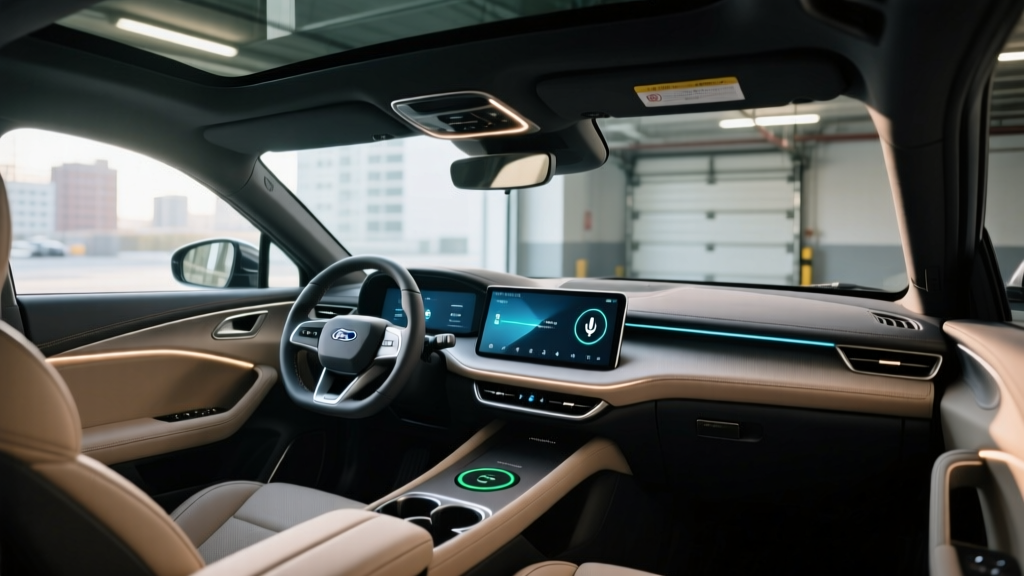
The centerpiece of the Mach-E Mustang interior is the portrait-oriented 15.5-inch touchscreen running Ford's SYNC 4A system. The interface uses large, smartphone-style tiles for navigation, media, climate, and phone functions. A physical rotary volume knob sits at the bottom of the screen — a welcome holdover that avoids the frustration of touchscreen-only volume adjustment.
For 2026, Ford has updated SYNC 4A with wireless Apple CarPlay and Android Auto as standard across all trims, along with an improved native navigation system that integrates real-time DC fast-charger availability and battery preconditioning. The system supports over-the-air (OTA) updates, and Ford has been diligent about pushing feature improvements — the 2025 software cycle added customizable ambient lighting profiles and improved voice recognition accuracy.
Behind the steering wheel, a compact 10.2-inch digital cluster replaces a traditional instrument panel. It displays speed, range, navigation prompts, and driver-assist status. Some buyers migrating from conventional vehicles find the small cluster disorienting at first, but most adapt within a week.
Range, Battery, and Real-World Efficiency
The 2026 Mach-E is offered with two battery packs across Select, Premium, and GT trims. Ford continues to use NMC (nickel manganese cobalt) lithium-ion chemistry, which provides higher energy density than LFP but is more sensitive to sustained high state-of-charge storage.
- Select RWD (Standard Range, 75.7 kWh usable): EPA 250 miles — expect ~210-225 miles highway, ~180-195 miles in cold weather (below 32°F).
- Premium RWD (Extended Range, 91 kWh usable): EPA 320 miles — expect ~270-290 miles highway, ~230-250 miles in cold weather.
- GT AWD (Extended Range, 91 kWh usable): EPA 280 miles — expect ~240-255 miles highway, ~200-220 miles in cold weather.
Highway driving at 75+ mph and cold temperatures reduce range 15-30%. Use the vehicle's built-in route planner for accurate trip estimates.
| Trim / Drivetrain | Battery (kWh usable) | Chemistry | EPA Range | MPGe (combined) | kWh/100 mi |
|---|---|---|---|---|---|
| Select RWD | 75.7 | NMC | 250 mi | 101 MPGe | 33 |
| Premium RWD | 91.0 | NMC | 320 mi | 103 MPGe | 32 |
| Premium AWD | 91.0 | NMC | 290 mi | 96 MPGe | 35 |
| GT AWD | 91.0 | NMC | 280 mi | 84 MPGe | 40 |
Efficiency figures sourced from fueleconomy.gov confirm the Mach-E Extended Range RWD as one of the more efficient midsize electric crossovers on the market, trailing the Hyundai Ioniq 5 RWD (114 MPGe combined) but ahead of the Volkswagen ID.4 (101 MPGe combined).
Charging Speed: DC Fast, Level 2, and Home Setup
Charging performance is where the Mach-E shows its age relative to 800V competitors. The 2026 model peaks at 150 kW on DC fast charging — adequate for road trips but noticeably slower than the Hyundai Ioniq 5 (peak 240 kW) or Tesla Model Y (peak 250 kW).
| Charging Level | Power | Speed | Notes |
|---|---|---|---|
| Level 1 (120V household) | 1.4 kW | ~3-4 mi/hr | Emergency/trickle only |
| Level 2 (240V home, 48A) | 11.5 kW | ~30-34 mi/hr | Full charge overnight (~9-10 hrs for ER battery) |
| DC Fast Charge (peak) | 150 kW | 10-80% in ~41 min | Peak rate sustained to ~55% SoC, then tapers |
The 10-80% DC fast-charge time of approximately 41 minutes is the Mach-E's most significant competitive disadvantage. At a typical highway rest stop, you'll spend 10-15 minutes longer plugged in compared to an Ioniq 5 or Kia EV6. Ford's charging curve is conservative — the battery management system prioritizes long-term battery health over peak speed, tapering aggressively above 55% state of charge.
For home charging, the Mach-E's onboard charger accepts up to 11.5 kW (48 amps) on a Level 2 circuit, which is competitive. A full charge of the Extended Range 91 kWh battery takes roughly 9-10 hours on a properly installed 60-amp dedicated circuit. Ford includes a mobile charge cord with every Mach-E that handles both 120V and 240V outlets, though most owners install a dedicated Level 2 wall connector for daily use.
Performance: Acceleration, Drivetrain, and Ride
| Trim | Drivetrain | Horsepower | Torque (lb-ft) | 0-60 mph |
|---|---|---|---|---|
| Select RWD | Rear-wheel drive | 266 hp | 387 | 6.3 sec |
| Premium RWD | Rear-wheel drive | 290 hp | 387 | 5.8 sec |
| Premium AWD | Dual-motor AWD | 346 hp | 428 | 5.1 sec |
| GT | Dual-motor AWD | 480 hp | 634 | 3.5 sec |
The GT trim's 3.5-second 0-60 time is legitimately quick and justifies the Mustang badge from a performance standpoint. The dual-motor AWD system provides confident traction in rain and light snow, though the Mach-E's 4,400-4,900 lb curb weight is noticeable during aggressive cornering. Ride quality is firm but compliant — Ford tuned the suspension for a sporty feel without the harshness that plagued early 2021-2022 models.
Regenerative braking offers two modes: a traditional coasting feel or one-pedal driving that brings the vehicle to a complete stop. The one-pedal mode is well-calibrated and avoids the abrupt deceleration that some early EVs exhibited.
Pricing, Trims, and Federal Tax Credit Eligibility
| Trim | Base MSRP | Est. As-Tested (AWD, popular options) |
|---|---|---|
| Select RWD | $36,495 | $39,500 |
| Premium RWD | $42,995 | $46,500 |
| Premium AWD | $45,995 | $49,800 |
| GT AWD | $54,495 | $58,200 |
All 2026 Mach-E trims fall under the IRS §30D MSRP cap of $80,000 for SUVs/trucks. However, federal tax credit eligibility depends on multiple factors that change annually. Per IRS guidelines, the full $7,500 credit requires:
- Buyer income caps: $150,000 (single), $225,000 (head of household), $300,000 (joint)
- MSRP caps: $80,000 for SUVs (all Mach-E trims qualify)
- Battery sourcing: Critical minerals and battery components must meet escalating domestic/free-trade-partner thresholds
- Point-of-sale transfer: Buyers can apply the credit at the dealership to reduce the purchase price directly
For the 2026 tax year, the Mach-E's battery sourcing compliance has been a moving target. Ford has worked to shift supply chains, but buyers should verify current eligibility on the IRS clean vehicle credit page or with their tax professional before relying on the credit in their budget. Never assume the full $7,500 applies to your situation without checking.
Warranty Coverage and Long-Term Battery Outlook
Ford provides competitive warranty coverage for the Mach-E:
- Bumper-to-bumper: 3 years / 36,000 miles
- Powertrain (including electric motors): 5 years / 60,000 miles
- Battery pack: 8 years / 100,000 miles (capacity retention ≥ 70%)
The 8-year/100,000-mile battery warranty with a 70% capacity retention threshold is standard for the industry and matches competitors like Hyundai, Kia, and Tesla. Real-world degradation data from early 2021-2022 Mach-E owners suggests NMC battery packs lose approximately 8-12% capacity over the first 100,000 miles under normal use patterns — well within the warranty threshold. Ford's battery thermal management system uses liquid cooling and heating, which helps mitigate extreme-temperature degradation.
Pros, Cons, and Competitive Position
Pros
- Spacious cabin with flat floor and generous rear legroom (38.9 in)
- Drainable frunk (4.7 cu ft) — unique in segment
- Competitive EPA range up to 320 miles (Premium RWD)
- GT trim delivers genuine sports-car acceleration (3.5s 0-60)
- BlueCruise hands-free driving on qualified highways
- Strong OTA update track record from Ford
Cons
- DC fast charging limited to 150 kW peak — slower than Ioniq 5, EV6, Model Y
- 10-80% charge time of ~41 min adds road-trip downtime
- Interior hard plastics noticeable at this price point
- No traditional instrument cluster — small 10.2" screen only
- NMC battery chemistry requires more careful SoC management than LFP
- Tax credit eligibility uncertain due to battery sourcing rules
Is the 2026 Mach-E Worth Buying Over Key Competitors?
Choose the Mach-E if: You want a spacious interior with a drainable frunk, prefer Ford's dealer network for service, value BlueCruise for highway commuting, and mostly charge at home (where the 150 kW DC limitation rarely matters).
Choose the Hyundai Ioniq 5 if: Road-trip charging speed is a priority (240 kW peak, ~18 min 10-80%), you want 800V architecture, or you prefer more distinctive retro-futuristic styling.
Choose the Tesla Model Y if: You need Supercharger network access without adapters, want the most energy-efficient midsize electric SUV, or prioritize minimalist interior design.
Frequently Asked Questions
What is the real-world range of the Mach-E on a road trip?
For the Extended Range RWD (EPA 320 miles), plan for approximately 270-290 miles at highway speeds of 70-75 mph in mild weather. In winter conditions below freezing, expect 230-250 miles. Always use the built-in navigation preconditioning to warm the battery before DC fast charging.
Does the Mach-E qualify for the $7,500 federal EV tax credit?
All trims meet the $80,000 MSRP cap, but eligibility also depends on your income, battery component sourcing, and critical mineral requirements per IRS §30D rules. Verify your specific eligibility with a tax professional or the IRS clean vehicle portal before purchasing.
How does the Mach-E interior compare to the Tesla Model Y?
The Mach-E offers more traditional crossover styling with physical climate vents, a rotary volume knob, and a more conventional dashboard layout. The Model Y is more minimalist with nearly all controls on the 15-inch landscape screen. The Mach-E has slightly more rear legroom (38.9 vs 41.6 in for Model Y — note: Tesla claims 41.6 in, but independent measurements vary) and a drainable frunk the Model Y lacks.
Is the Mach-E good for families with car seats?
Yes. The flat floor and 38.9 inches of rear legroom accommodate rear-facing car seats without pushing the front passenger's seat uncomfortably forward. The LATCH anchors are easily accessible, and the 29.7 cu ft cargo area handles a full-size stroller with room remaining.
What does home Level 2 charging cost to install?
A dedicated 60-amp circuit with a 48-amp Level 2 charger typically costs $800-$2,000 installed, depending on your electrical panel capacity and the distance from panel to garage. Homes with older 100-amp panels may need a $1,500-$3,000 panel upgrade. Always get a quote from a licensed electrician.
Can the Mach-E tow?
Yes. When equipped with the factory tow package, the Mach-E is rated for up to 1,500 lbs (Select/Premium) or 1,000 lbs (GT). This is sufficient for a small utility trailer or a pair of dirt bikes but not a boat or camper. Towing reduces range by approximately 25-40%.