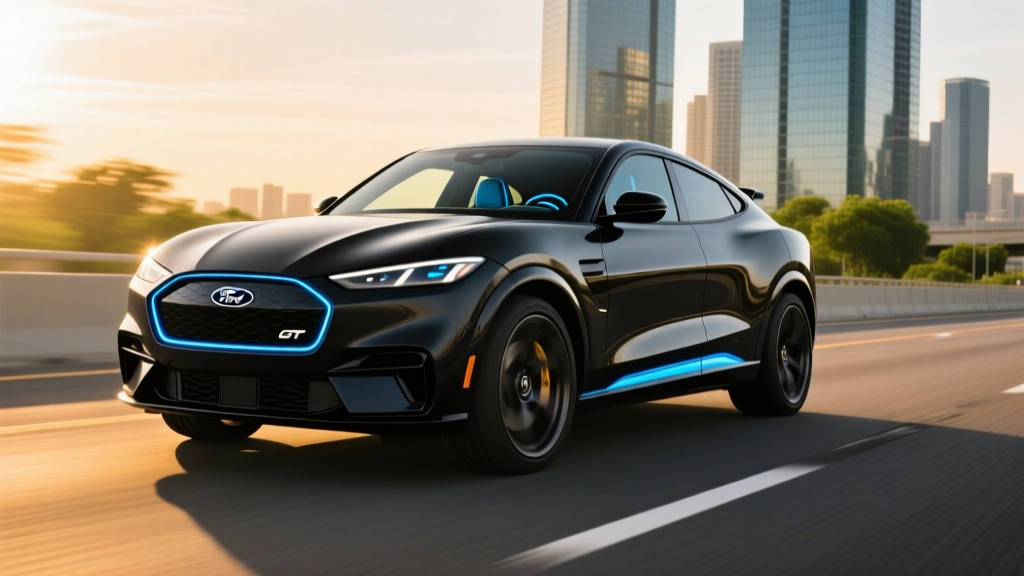
The Ford Mustang Mach-E GT has always been the answer to a specific question: what happens when you bolt serious electric torque to a crossover wearing a pony-car badge? For 2026, the GT variant continues to lean hard into performance, delivering dual-motor all-wheel drive, a sub-3.5-second 0-60 time, and enough highway pull to make passing maneuvers feel effortless. But beyond the headline numbers, how does the Mach-E GT stack up as a daily driver, a road-trip companion, and a value proposition in an increasingly crowded electric SUV segment?
We spent time with the 2026 Mustang Mach-E GT to break down every spec that matters—from real-world range and charging curves to cabin practicality and federal tax credit eligibility. Here's the full, number-driven picture.
2026 Mach-E GT Horsepower and Performance Specs
The headline figure that draws buyers to the GT trim is the powertrain. The 2026 Mustang Mach-E GT uses a dual-motor all-wheel-drive setup producing 536 horsepower and 634 lb-ft of torque when equipped with Ford's GT Performance Upgrade package (included on the Rally variant and available as an option on the standard GT). Without the upgrade, the GT produces 480 hp and 600 lb-ft—still formidable, but noticeably softer off the line.
| Spec | GT (Standard) | GT w/ Performance Upgrade |
|---|---|---|
| Horsepower | 480 hp | 536 hp |
| Torque | 600 lb-ft | 634 lb-ft |
| 0-60 mph | 3.8 seconds | 3.3 seconds |
| Drivetrain | AWD (dual-motor) | AWD (dual-motor) |
| Battery (usable) | 91 kWh (NMC) | 91 kWh (NMC) |
| EPA Range | 280 miles | 260 miles |
| MPGe (combined) | 84 MPGe | 77 MPGe |
| Efficiency | 40 kWh/100 mi | 44 kWh/100 mi |
| Top Speed | 124 mph | 130 mph |
That 3.3-second 0-60 time with the Performance Upgrade puts the Mach-E GT in territory occupied by the Tesla Model Y Performance (3.5s) and well ahead of the Hyundai Ioniq 5 N's claimed 3.25s. In real-world driving, the instant torque delivery makes the GT feel even quicker than the stopwatch suggests—there's no spool-up, no gear hunt, just a seamless surge that pins you back at any speed below 80 mph.
Ford equips the GT with MagneRide adaptive dampers, a sport-tuned suspension, and larger front brake rotors. The result is a crossover that genuinely handles back roads with composure, though the 4,900-pound curb weight is always present during aggressive direction changes. This is a fast, competent machine—not a track car, and it doesn't pretend to be one.
Real-World Range vs. the EPA Sticker
EPA Estimated Range: 280 miles (GT standard) / 260 miles (GT w/ Performance Upgrade)
Real-World Expectation: Plan for 230–255 miles in mixed highway driving at 70-75 mph. In cold weather (below 35°F), expect a 15–25% reduction, bringing usable range to roughly 190–220 miles before you'll want to find a charger.
The 91 kWh usable battery pack uses NMC (nickel manganese cobalt) chemistry, which prioritizes energy density and performance over the cycle-life longevity of LFP (lithium iron phosphate) cells. That's the right trade-off for a performance-oriented variant, but it means you'll want to follow best charging practices—avoiding frequent 100% charges and minimizing prolonged storage at low SoC—to preserve long-term capacity.
In our experience, the Mach-E GT's range prediction algorithm is reasonably accurate once it learns your driving style over the first few hundred miles. The "Intelligent Range" system factors in ambient temperature, terrain, and recent driving behavior, which helps reduce the guesswork on longer trips. That said, the GT's 280-mile EPA rating trails competitors like the Tesla Model Y Long Range (320+ miles) and the Hyundai Ioniq 5 Long Range AWD (290 miles). If maximizing range is your top priority, the GT is not the trim to choose—the Select or Premium trims with the extended-range battery push past 300 miles.
Charging Speed: DC Fast Charging and Home Level 2
Charging speed is where the Mach-E GT's performance story gets more nuanced. The GT supports a peak DC fast-charge rate of 150 kW on CCS1-equipped chargers (or NACS, as Ford has transitioned to the Tesla-style connector for 2025+ models, granting access to Tesla Supercharger V3 and V4 stalls via the built-in NACS port).
| Charging Level | Power | Speed | Notes |
|---|---|---|---|
| Level 1 (120V) | ~1.4 kW | ~3 miles/hour | Emergency/trickle only |
| Level 2 (240V, 48A) | 11.5 kW | ~28 miles/hour | Full charge in ~9 hours |
| DC Fast (peak) | 150 kW | 10–80% in ~41 minutes | Tapers significantly above 80% |
| DC Fast (Tesla V3 Supercharger via NACS) | Up to 150 kW | 10–80% in ~41 minutes | Precondition battery via nav for best speed |
The 10-80% DC fast-charge time of approximately 41 minutes is the Mach-E GT's most notable competitive weakness. Rivals like the Hyundai Ioniq 5 (800V architecture, 10-80% in ~18 minutes at 240 kW) and the Kia EV6 (similarly ~18 minutes) leave the Ford behind on road trips. The Mach-E's charge curve peaks early and tapers aggressively—expect speeds to drop below 50 kW once you pass 70% SoC. If you frequently take 300+ mile trips, this slower charging will add real time to your journey.
For home Level 2 charging, the Mach-E GT's 11.5 kW onboard charger is a strong point. On a 48-amp Level 2 circuit (the most common home installation), you'll add roughly 28 miles of range per hour, meaning an overnight session from 20% to full takes about 8–9 hours. Ford's Mobile Power Cord is included and can handle both 120V and 240V outlets, though most buyers will want a dedicated wall connector for daily convenience.
Preconditioning matters: Always route through the built-in navigation to a DC fast charger, even if you know the way. This triggers battery preconditioning—warming or cooling the pack to the optimal temperature for fast charging. Skipping this step in cold weather can cut your peak charge rate by 30–50%.
Interior, Cargo, and Daily Practicality
The Mach-E GT's cabin balances sport intent with crossover practicality. Heated and ventilated sport front seats with ActiveX synthetic leather are standard on the GT, along with a heated steering wheel, a panoramic fixed glass roof, and a 15.5-inch vertically oriented touchscreen running Ford's SYNC 4A infotainment system. Wireless Apple CarPlay and Android Auto are standard.
The large portrait screen dominates the dash and handles most climate and vehicle functions, which some drivers find distracting compared to physical knobs. Ford has improved the software responsiveness for 2026, and the interface is more logical than earlier model years, but it still requires more tapping than we'd like for simple adjustments.
| Measurement | Value |
|---|---|
| Front headroom | 40.4 inches |
| Front legroom | 43.3 inches |
| Rear headroom | 38.9 inches |
| Rear legroom | 38.9 inches |
| Cargo (behind rear seats) | 29.7 cu ft |
| Cargo (rear seats folded) | 59.7 cu ft |
| Frunk (front trunk) | 4.7 cu ft (drainable) |
The 29.7 cubic feet of rear cargo space is competitive with the Tesla Model Y (30.2 cu ft) and significantly larger than the Hyundai Ioniq 5 (27.2 cu ft). The drainable frunk is a clever touch—useful for storing wet gear, a charging cable, or groceries that might leak. Rear-seat passengers get generous legroom, though the sloping roofline cuts into headroom for taller riders compared to boxier SUVs.
Pricing, Trims, and Federal Tax Credit Eligibility
The 2026 Mustang Mach-E GT starts at an MSRP of approximately $57,995 (including destination). With the GT Performance Upgrade and common option packages, most buyers will land in the $60,000–$64,000 range before incentives.
| Trim | MSRP | Est. Federal Credit | Effective Price |
|---|---|---|---|
| GT (standard) | $57,995 | Up to $7,500* | ~$50,495 |
| GT w/ Performance Upgrade | ~$62,495 | Up to $7,500* | ~$54,995 |
| GT Rally | ~$63,495 | Up to $7,500* | ~$55,995 |
*Federal tax credit (§30D) eligibility requires meeting several conditions:
- MSRP cap: The vehicle's MSRP must not exceed $80,000 for SUVs/pickups (the Mach-E GT qualifies).
- Buyer income cap: Modified adjusted gross income must not exceed $150,000 (single), $225,000 (head of household), or $300,000 (joint filers).
- Battery sourcing: A percentage of critical minerals and battery components must be sourced from the U.S. or free-trade-agreement countries. These thresholds increase annually—check current-year requirements at IRS.gov §30D.
- Point-of-sale transfer: As of 2024+, you can transfer the credit to the dealer at purchase, effectively reducing your out-of-pocket cost at the dealership rather than waiting for a tax refund.
The Mach-E GT's eligibility for the full $7,500 credit has varied by model year due to battery component and critical-mineral sourcing rules. Ford has worked to shift supply chains toward compliance, but buyers should verify current-year eligibility with their dealer and a tax professional before assuming the full credit applies. The fueleconomy.gov tax credit tracker is a reliable starting point.
Driver Assistance and Technology
The Mach-E GT comes equipped with Ford Co-Pilot360 Assist 2.0, which includes adaptive cruise control with stop-and-go, lane centering, evasive steering assist, and intersection assist. The available BlueCruise system enables hands-free driving on over 130,000 miles of pre-mapped divided highways in the U.S. and Canada.
SAE Automation Level: BlueCruise is a Level 2 driver-assistance system. Despite the hands-free capability on approved roads, you must remain attentive and ready to take over at any moment. The driver-facing camera monitors your eyes and will issue escalating warnings—and eventually bring the vehicle to a stop—if it detects inattention. This is not "self-driving" (Level 4); it is supervised automation.
In practice, BlueCruise performs competently on well-marked interstates, handling lane changes (with turn-signal activation) and maintaining smooth following distance. However, it struggles with construction zones, faded lane markings, and complex merges—situations where you need to take over promptly. Compared to GM's Super Cruise, BlueCruise's approved road network is broader, but its lane-change confidence feels slightly less polished. Against Tesla's Autopilot, BlueCruise is more geofenced but arguably more predictable in its limitations.
Other tech highlights include a digital instrument cluster, over-the-air software updates, FordPass app connectivity for remote preconditioning and charge monitoring, and a 560-watt B&O sound system with 10 speakers.
Warranty and Ownership Costs
Ford backs the 2026 Mach-E GT with a competitive warranty package:
- Basic warranty: 3 years / 36,000 miles
- Powertrain warranty: 5 years / 60,000 miles
- Battery warranty: 8 years / 100,000 miles (covers capacity loss below 70% of original)
- Corrosion perforation: 5 years / unlimited miles
The 70% capacity retention threshold on the battery warranty is industry standard, matching Tesla, Hyundai, and most other EV makers. Ford's NMC pack has demonstrated reasonable degradation in real-world fleet data—most owners report losing 5–8% capacity over the first 50,000 miles, with the curve flattening afterward.
Insurance costs for the GT trim run higher than the base Mach-E due to the performance output and repair costs. Expect quotes in the $2,200–$3,000 annually range depending on your profile—roughly 15–25% above the Select trim. Maintenance costs, however, are minimal: no oil changes, no spark plugs, and brake wear is dramatically reduced thanks to regenerative braking. Ford recommends cabin air filter replacement and tire rotation as the primary scheduled service items.
Pros, Cons, and the Competition
Pros
- 536 hp and 3.3s 0-60 make it genuinely thrilling
- MagneRide suspension balances comfort and sport
- Generous rear legroom and practical cargo space
- NACS port provides native Tesla Supercharger access
- Strong 11.5 kW Level 2 home charging
- BlueCruise hands-free highway driving
- Drainable frunk is a smart utility touch
Cons
- 150 kW peak DC charging is slow vs. 800V rivals
- 41-minute 10-80% time adds up on road trips
- 280-mile range trails Model Y and Ioniq 5 Long Range
- Portrait touchscreen overloads climate/vehicle controls
- Performance Upgrade required for the 536 hp headline figure
- Higher insurance premiums than non-GT trims
Choose the Mach-E GT if: You want a fast, engaging electric crossover with real back-road composure, appreciate the Mustang branding, need NACS Supercharger access, and your typical trips are under 250 miles between charges.
Look elsewhere if: You road-trip frequently and need 20-minute fast-charge stops (consider the Ioniq 5 or EV6), you prioritize maximum range over performance (Model Y Long Range or Mach-E Premium Extended Range), or you prefer physical controls over a touchscreen-dominant cabin.
Frequently Asked Questions
What is the real-world range of the 2026 Mustang Mach-E GT?
The EPA rates the standard GT at 280 miles and the Performance Upgrade version at 260 miles. In real-world highway driving at 70-75 mph, expect 230–255 miles. Cold weather (below 35°F) can reduce range by 15–25%, so plan for 190–220 miles in winter conditions.
How fast does the Mach-E GT charge?
On a DC fast charger, the Mach-E GT peaks at 150 kW and charges from 10–80% in approximately 41 minutes. At home on a 48-amp Level 2 charger (11.5 kW), it adds about 28 miles of range per hour, with a full charge taking 8–9 hours. The 150 kW peak rate is slower than 800V competitors like the Ioniq 5, which can hit 240 kW.
How much does the Mach-E GT cost after tax credits?
The GT starts at $57,995 MSRP. If you qualify for the full $7,500 federal tax credit under §30D (subject to income caps, battery sourcing rules, and MSRP limits), the effective price drops to approximately $50,495. The point-of-sale transfer option lets you apply the credit as a down-payment reduction at the dealer.
Does the 2026 Mach-E GT qualify for the federal EV tax credit?
The Mach-E GT's MSRP falls well under the $80,000 SUV cap. Eligibility for the full $7,500 depends on your income, the vehicle's battery component and critical-mineral sourcing for the specific model year, and your tax liability. Verify current eligibility at IRS.gov and with your tax professional before purchasing.
Is the Mach-E GT worth buying over the Tesla Model Y Performance?
The Model Y Performance offers more range (~303 miles), faster Supercharging, and access to the broader Supercharger network—though the Mach-E GT now has native NACS access to those same stations. The Mach-E GT counters with a more engaging driving experience, better ride quality via MagneRide, a more traditional cabin layout, and Ford dealer service support. If driving dynamics and comfort matter more than maximizing range, the GT is a compelling alternative. If efficiency and charging speed are paramount, the Model Y still leads.
How much Mach-E GT horsepower do you actually get?
The standard GT produces 480 hp and 600 lb-ft of torque. To reach the advertised 536 hp and 634 lb-ft, you need the GT Performance Upgrade package, which also includes a higher top speed (130 mph vs. 124 mph) and the quickest 0-60 time of 3.3 seconds. The Rally trim includes this upgrade as standard.
The 2026 Mustang Mach-E GT remains one of the most engaging electric crossovers you can buy—fast, composed, and practical enough for daily life. Its 536 hp headline is real, but so are the trade-offs: slower charging and shorter range than key rivals. For buyers who value the drive as much as the destination, those compromises are easy to live with. For road-trip warriors, the math gets harder. Either way, the GT proves that Ford's EV ambitions still have teeth.