Quick Verdict: The Value Play in Ford's EV Lineup
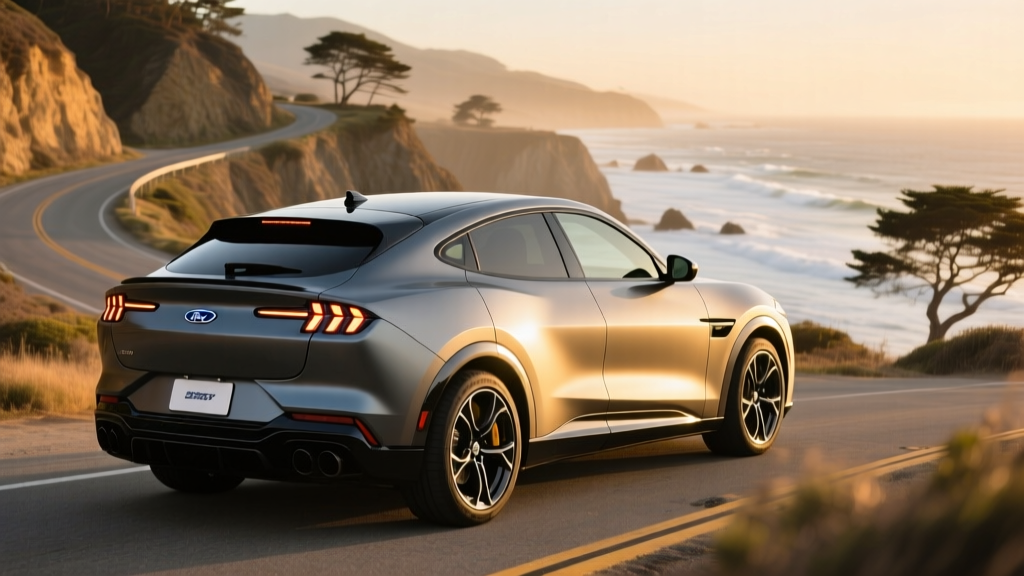
The Ford Mustang Mach-E California Route 1 occupies a specific niche: it's the extended-range, rear-wheel-drive variant designed to maximize miles per dollar. For 2026, Ford continues this trim as the efficiency-focused option in the Mach-E lineup, pairing a larger battery with a single rear motor to deliver the longest range in the family. If you're cross-shopping the EPA's EV database for a mid-size electric crossover that prioritizes distance over dual-motor acceleration, the California Route 1 demands a closer look — but its charging behavior and cold-weather reality tell a more nuanced story than the sticker suggests.
Range Reality Check
EPA Estimated Range: 320 miles (Select trim with Extended Range battery, RWD)
Real-World Expectation: Plan for 260–280 miles on sustained highway driving at 70+ mph. In freezing temperatures (below 32°F), expect a 25–35% reduction, dropping effective range to roughly 210–240 miles. City driving with regenerative braking recovers closer to the EPA figure.
Battery, Chemistry, and What It Means for Longevity
The California Route 1 with the Extended Range battery pack carries a usable capacity of approximately 91 kWh (gross capacity is slightly higher, with a buffer to protect long-term health). Ford has transitioned select trims to LFP (lithium iron phosphate) chemistry for the standard-range pack, but the Extended Range variants continue to use NMC (nickel manganese cobalt) cells, which offer higher energy density at the cost of slightly faster degradation over time.
| Attribute | LFP (Standard Range) | NMC (Extended Range) |
|---|---|---|
| Energy Density | Lower | Higher |
| Cycle Life | 3,000+ cycles | 1,500–2,000 cycles |
| Cold Performance | Weaker below freezing | Better cold-weather output |
| Recommended Charge | 100% OK daily | 80% daily, 100% for trips |
| Cost to Replace | Lower | Higher ($12,000–$18,000 est.) |
This matters practically: if you're a daily commuter who can charge to 80% each night and only top off for road trips, the NMC pack's higher energy density gives you the range advantage. If you prefer the simplicity of charging to 100% without worrying about accelerated degradation, the Standard Range LFP variant may be a better fit — though you sacrifice roughly 70 miles of EPA range.
Charging Speed: The Curve Tells the Real Story
Ford rates the Mach-E Extended Range for a peak DC fast-charge rate of 150 kW. In controlled testing with a preconditioned battery, the Mach-E sustains close to peak rate from 10% to roughly 55% state of charge, then tapers progressively. The official 10–80% charge time is approximately 45 minutes on a 150+ kW charger.
| Charging Level | Power (kW) | Speed (miles of range per hour) | Notes |
|---|---|---|---|
| Level 1 (120V household) | ~1.4 kW | ~3–4 mi/hr | Emergency/trickle only |
| Level 2 (240V home/public) | ~10.5 kW | ~28–32 mi/hr | Full charge in ~9–10 hours |
| DC Fast Charge (CCS/NACS) | Peak 150 kW | Up to ~59 mi in 10 min | Tapers above 55% SoC |
Home Charging Reality: With a 48-amp Level 2 home charger on a 240V/60A circuit, you'll add roughly 30 miles of range per hour. An overnight session (8–10 hours) easily replenishes a full day's driving. Installation costs for a dedicated 60A circuit with a hardwired charger typically run $800–$2,000 depending on panel proximity and local permitting. Always have a licensed electrician assess your panel capacity — older homes may require a 200A service upgrade ($2,000–$4,000 additional).
Connector Note: The 2026 Mach-E ships with the NACS (North American Charging Standard) port natively, giving you direct access to Tesla Superchargers (now 20,000+ stalls in the U.S.) without an adapter. This is a major advantage over 2023 and earlier models that required a CCS-to-NACS adapter.
Performance and Drivetrain
The California Route 1 is exclusively rear-wheel drive with a single permanent-magnet synchronous motor producing 290 horsepower and 317 lb-ft of torque. The 0–60 mph time clocks in at approximately 6.1 seconds — respectable for a 4,600-lb crossover, but noticeably slower than the dual-motor GT variants (3.5 seconds).
| Spec | California Route 1 (Extended Range, RWD) |
|---|---|
| Drivetrain | Rear-wheel drive (single motor) |
| Horsepower | 290 hp |
| Torque | 317 lb-ft |
| 0–60 mph | ~6.1 seconds |
| EPA Range | 320 miles |
| Battery (usable) | ~91 kWh, NMC |
| Efficiency | 101 MPGe combined / 33 kWh/100 mi |
| Max DC Charge Rate | 150 kW peak |
| 10–80% DC Charge | ~45 minutes |
| Level 2 Charge Rate | 10.5 kW |
| Cargo Volume | 29.7 cu ft (rear seats up) / 59.7 cu ft (folded) |
| Frunk | 4.7 cu ft |
| Rear Legroom | 38.9 inches |
| Towing Capacity | Not rated for towing |
The RWD layout gives the California Route 1 a slight efficiency edge over AWD variants (roughly 10–15 more miles of EPA range) and reduces mechanical complexity. For buyers in mild climates who don't need all-wheel traction, this is the pragmatic choice. In snow-belt states, the trade-off is traction confidence — though winter tires on an RWD EV still outperform all-season tires on AWD in deep snow.
Pricing, Trims, and Federal Tax Credit Eligibility
The 2026 Mustang Mach-E California Route 1 Extended Range starts at an MSRP of approximately $43,995 (including destination). Adding the Ford Co-Pilot360 Active 2.0 package (BlueCruise hands-free highway driving) runs an additional $2,100. A well-equipped example with premium paint, panoramic roof, and upgraded audio lands around $48,000–$50,000 before incentives.
| Trim/Configuration | MSRP | Est. Federal Credit | Effective Price |
|---|---|---|---|
| Select RWD (Standard Range, LFP) | $38,995 | Up to $7,500* | ~$31,495 |
| California Route 1 RWD (Extended Range, NMC) | $43,995 | Up to $7,500* | ~$36,495 |
| Premium AWD (Extended Range) | $51,995 | Up to $7,500* | ~$44,495 |
| GT AWD (Performance) | $59,995 | $0 (above MSRP cap) | $59,995 |
*Federal Tax Credit (§30D) Eligibility Caveats: The full $7,500 credit is not automatic. Under current IRS rules, you must meet:
- MSRP Cap: SUVs must be below $80,000 (Mach-E qualifies)
- Buyer Income Cap: AGI ≤ $150,000 single / $300,000 joint filers
- Battery Sourcing: Critical minerals and battery components must meet escalating domestic/free-trade-ally thresholds — verify VIN eligibility at fueleconomy.gov before purchase
- Point-of-Sale Transfer: You can transfer the credit to the dealer for an immediate price reduction, but you must still file IRS Form 8936 to reconcile
The GT trim exceeds the $80,000 MSRP cap when optioned, disqualifying it from the federal credit. The California Route 1 sits comfortably under the cap, making it a strong credit candidate — but always confirm battery sourcing compliance for your specific model year and build date.
Interior, Tech, and Daily Livability
The Mach-E's cabin is dominated by a 15.5-inch vertical touchscreen running Ford's SYNC 4A system. Wireless Apple CarPlay and Android Auto are standard. The interface is responsive, though the heavy reliance on touchscreen controls (climate, drive modes) can frustrate drivers who prefer physical buttons.
Driver Assistance: Ford Co-Pilot360 2.0 includes adaptive cruise control, lane centering, evasive steer assist, and intersection assist. The optional BlueCruise (SAE Level 2) enables hands-free driving on pre-mapped divided highways — but you must remain attentive, with a driver-monitoring camera tracking eye gaze. This is not autonomous driving; it's supervised highway assist.
SAE Automation Level: Level 2
BlueCruise and Ford Co-Pilot360 are SAE Level 2 systems — the driver must remain engaged and ready to take over at any moment. The vehicle handles steering and speed on qualified roads, but does not navigate complex urban environments, construction zones, or unmapped routes autonomously.
Cargo and Passenger Space: With 29.7 cubic feet behind the rear seats and 59.7 cu ft with the 60/40 split folded, the Mach-E matches competitors like the Hyundai Ioniq 5 (27.2 / 59.3 cu ft) and edges past the Tesla Model Y's rear cargo area (though the Model Y's frunk is larger). Rear legroom of 38.9 inches is comfortable for adults on longer trips. The 4.7 cu ft frunk is useful for charging cables or small groceries but won't replace a traditional trunk.
Pros, Cons, and Who Should Buy
Pros
- 320-mile EPA range is among the best in its class
- Native NACS port (2025+) unlocks Tesla Supercharger network
- Comfortable ride quality and quiet cabin at highway speeds
- Federal tax credit eligible (verify VIN sourcing)
- Strong cargo capacity for a mid-size crossover
- BlueCruise is one of the better Level 2 highway assist systems
Cons
- 150 kW peak charge rate lags Hyundai/Kia's 800V architecture (240+ kW)
- 10–80% charge time of 45 min is slower than Ioniq 5 (~18 min)
- RWD-only limits appeal in snow-belt states
- Touchscreen-heavy interface lacks physical climate controls
- Not rated for towing (competitors like Model Y tow up to 3,500 lbs)
- NMC battery requires 80% daily charge discipline for longevity
Who This EV Suits Best
Buy the California Route 1 if: You're a commuter or light road-tripper in a mild climate who prioritizes range over acceleration, values Supercharger access, and can charge at home. The 320-mile EPA range and $36,500 effective price (after credit) make it one of the best value-per-mile EVs available.
Look elsewhere if: You need AWD for snow, tow regularly, or frequently road-trip in cold weather where the range penalty and slower charging curve become painful. The Hyundai Ioniq 5 Long Range AWD charges faster and offers AWD, though with slightly less range.
Warranty and Long-Term Ownership
Ford covers the Mach-E's battery and electric powertrain for 8 years or 100,000 miles, whichever comes first. The battery warranty guarantees retention of at least 70% of original capacity — if degradation drops below that threshold, Ford will repair or replace the pack. The basic vehicle warranty is 3 years/36,000 miles.
Real-world degradation data from early 2021–2023 Mach-E owners (tracked via Recurrent and owner forums) suggests NMC packs lose roughly 8–12% capacity over the first 3 years / 60,000 miles, with degradation slowing significantly thereafter. This is within industry norms and well above the 70% warranty floor. LFP packs (Standard Range) show even slower degradation but start with less total capacity.
Frequently Asked Questions
What is the real-world highway range of the Mach-E California Route 1?
On a 70-mph highway loop in moderate temperatures (60–75°F), expect roughly 260–280 miles before needing to charge. In winter conditions (below 32°F), that drops to 210–240 miles due to battery heating demands and reduced regenerative braking efficiency.
How fast does the Mach-E charge on a road trip?
Peak rate is 150 kW, but sustained rate from 10–80% averages closer to 90–100 kW due to taper. Plan for 45-minute stops at DC fast chargers. This is slower than the Hyundai Ioniq 5 (18 minutes, 10–80%) but comparable to the Volkswagen ID.4.
Does the 2026 Mach-E qualify for the $7,500 federal tax credit?
The California Route 1 Extended Range (MSRP ~$43,995) is under the $80,000 SUV cap and should qualify — but battery sourcing requirements (critical minerals and component manufacturing) must be met for your specific VIN. Confirm at fueleconomy.gov and with your dealer before purchase. Income caps also apply ($150K single / $300K joint AGI).
Is the Mach-E better than the Tesla Model Y?
It depends on priorities. The Model Y Long Range AWD offers more range (330 mi EPA), faster Supercharging (250 kW peak), and more cargo space, but at a higher price and with Tesla's more polarizing interface. The Mach-E wins on ride comfort, physical button availability (minimal as it is), and BlueCruise's driver monitoring. Neither is objectively "better" — they optimize for different buyers.
Can I tow with the Mach-E California Route 1?
No. Ford does not rate the Mach-E for towing. If you need to pull a trailer, consider the Tesla Model Y (3,500 lbs), Ford F-150 Lightning (7,700–10,000 lbs), or Rivian R1S (7,700 lbs).
How does cold weather affect the Mach-E's range and charging?
Below freezing, expect a 25–35% range reduction and significantly slower DC fast charging unless you precondition the battery (using the FordPass app or navigation to a charger). The Mach-E has a heat pump, which mitigates cabin heating losses, but battery chemistry still suffers in extreme cold.