Why the LVMPD Cybertruck Is Making Headlines
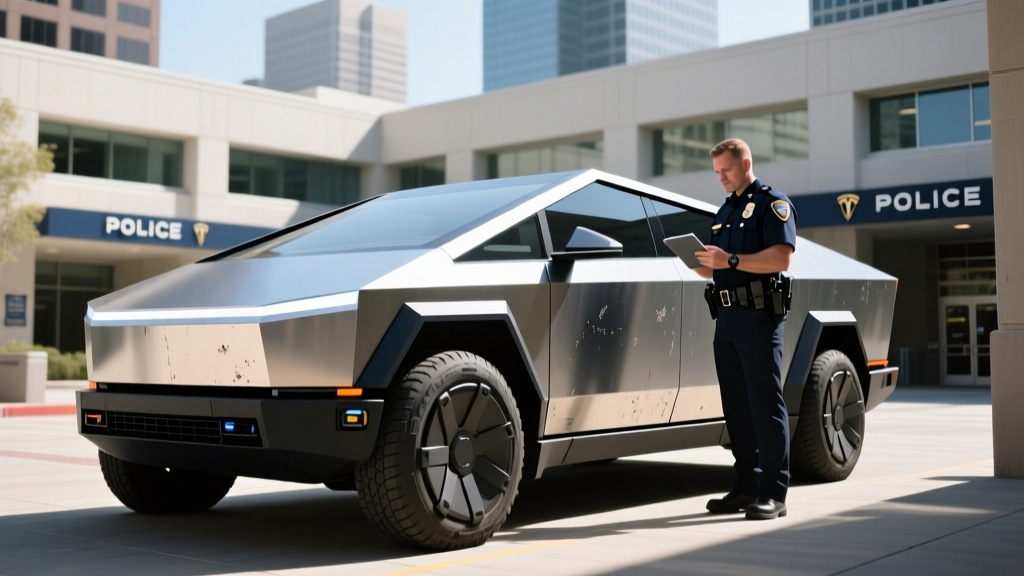
The Las Vegas Metropolitan Police Department made national news when it began evaluating the Tesla Cybertruck as a potential patrol and specialty-response vehicle. The LVMPD Cybertruck pilot program isn't about replacing every Crown Vic successor in the fleet — it's about testing whether a stainless-steel, dual-motor electric pickup can handle the unique demands of urban law enforcement: high-speed pursuits, long idling shifts, equipment-heavy payloads, and 24/7 operational readiness in Mojave Desert heat.
For civilian EV shoppers, the LVMPD's real-world stress test offers something rare: a high-mileage, extreme-condition evaluation of the Cybertruck AWD that goes far beyond what any individual owner accumulates in the first year. We've compiled the specs, charging data, and operational realities to help you understand what this truck actually delivers — and whether those same strengths and weaknesses apply to your driveway.
| Spec | Value |
|---|---|
| EPA Range | 340 miles |
| Battery (usable) | ~123 kWh, NMC (4680 cells) |
| Drivetrain | Dual-motor AWD |
| Horsepower | 600 hp |
| 0–60 mph | 4.1 seconds |
| Max DC Fast Charge | 250 kW (peak) |
| 10–80% DCFC Time | ~20 minutes |
| Level 2 Charge Rate | 11.5 kW (~37 mi/hr) |
| MPGe (combined) | 72 MPGe |
| Efficiency | 47 kWh/100 mi |
| Towing Capacity | 7,500 lbs |
| Payload | 2,500 lbs |
| Cargo Bed Length | 6 ft (74.3 cu ft volume) |
| Base MSRP (AWD) | $81,895 |
| Battery/Drive Unit Warranty | 8 years / 120,000 miles |
Range Reality: What 340 EPA Miles Means on Patrol (and on the Highway)
The Cybertruck AWD carries an EPA-estimated 340 miles of range from its roughly 123 kWh usable battery pack built around Tesla's 4680 NMC (nickel manganese cobalt) cells. That's a credible number for mixed driving, but the LVMPD's operational environment — and any buyer's real-world experience — tells a more nuanced story.
- EPA Sticker: 340 miles
- Highway (70–80 mph, no wind): ~260–285 miles
- City/Stop-and-Go (regen-heavy): ~300–320 miles
- Desert Summer (110°F+, A/C max): ~270–290 miles
- Cold Weather (30°F, cabin heat): ~220–250 miles
- With upfitting (light bar, radios, computers, cage): subtract 5–10%
The Cybertruck's angular stainless-steel exoskeleton creates a drag coefficient that hurts at highway speeds. At 80 mph, aerodynamic losses dominate, and efficiency drops to roughly 50–55 kWh/100 mi — a significant penalty compared to the EPA's 47 kWh/100 mi combined figure. For LVMPD highway-interdiction units, this means realistic range on a pursuit-capable shift is closer to 260 miles before you need to plan a charge stop.
Conversely, urban patrol with frequent stops lets regenerative braking recover energy, pushing real-world range closer to 320 miles in moderate temperatures. Las Vegas's extreme summer heat forces the thermal management system to work overtime cooling both the cabin and the battery pack, which consumes additional energy even at idle — a factor that traditional patrol vehicles don't face to the same degree since engine-driven A/C is "free" when the engine is running.
Charging Speed: 250 kW Peak, but the Curve Matters
The Cybertruck supports DC fast charging at up to 250 kW on Tesla's V3 Superchargers and V4 Supercharger posts (using the integrated CCS/NACS adapter architecture). Tesla quotes a 10–80% charge time of approximately 20 minutes. But as any experienced EV owner knows, peak kW is not sustained kW.
| Charging Level | Power (kW) | Miles Added/Hour | Notes |
|---|---|---|---|
| Level 1 (120V) | 1.4 kW | ~3 mi/hr | Emergency/trickle only |
| Level 2 (240V/48A) | 11.5 kW | ~37 mi/hr | Full overnight charge in ~11 hrs |
| DCFC (V3 Supercharger) | 250 kW peak | ~170 mi in 15 min | Peak below 30% SoC; tapers sharply above 60% |
| DCFC (CCS station w/ adapter) | Up to 250 kW | Varies | Depends on station max output |
The charge curve is the critical detail: the Cybertruck sustains its highest charge rates (200–250 kW) only between roughly 10–35% state of charge. From 35–60%, power steps down to 150–180 kW. Above 60%, it tapers further to under 100 kW, and above 80%, charging slows to a crawl as the battery management system protects cell longevity.
For a police fleet depot, the practical implication is that Level 2 overnight charging at 11.5 kW is the backbone of daily operations — a dead battery reaches 100% in about 11 hours, which fits a standard shift-cycle rotation. DC fast charging serves as a mid-shift top-up, not a primary fueling strategy. For civilian owners, this same pattern applies: install a Level 2 Tesla Wall Connector at home and treat Supercharging as a road-trip tool.
Performance and Capability: The Pursuit Question
The dual-motor AWD Cybertruck produces 600 horsepower and hits 60 mph in 4.1 seconds. That's quicker than any current production police interceptor — the Ford Police Interceptor Utility (the hybrid V6 AWD workhorse of most departments) runs 0–60 in approximately 5.5 seconds. In a straight-line pursuit scenario, the Cybertruck has a decisive acceleration advantage.
But pursuit capability isn't just about acceleration. The Cybertruck's 6,800-pound curb weight, high center of gravity relative to a sedan, and steer-by-wire system raise questions about sustained high-speed cornering, PIT-maneuver durability, and the kind of abuse that comes from jumping curbs, traversing medians, and bulling through obstacles. The stainless-steel exoskeleton is dent-resistant — an advantage in parking-lot incidents and low-speed contacts — but repair complexity after major body damage remains a concern, as panel replacement requires specialized Tesla-approved body shops.
The 7,500-pound towing capacity and 2,500-pound payload are relevant for specialty units: towing disabled vehicles, hauling evidence-equipment trailers, or supporting search-and-rescue deployments. The 6-foot bed with powered tonneau cover provides 74.3 cubic feet of lockable storage — useful for SWAT gear, drones, or K9 transport modules that would otherwise require a separate upfit.
Pricing, Trims, and the Federal Tax Credit Question
The Cybertruck AWD starts at $81,895 (2025 MSRP, before destination). The higher-output Cyberbeast trim, with its tri-motor powertrain and 845 horsepower, starts at $101,895. A fully optioned AWD with Foundation Series package can exceed $100,000 before any fleet or government procurement discount.
| Trim | MSRP | §30D Credit Eligible? | Notes |
|---|---|---|---|
| AWD | $81,895 | Partial — up to $7,500 | MSRP under $80K truck cap; income/sourcing rules apply |
| Cyberbeast | $101,895 | No — exceeds $80K MSRP cap | Over the §30D truck MSRP limit |
Under current IRS §30D rules, the Cybertruck AWD qualifies as a pickup truck, which carries an $80,000 MSRP cap for credit eligibility. The base AWD at $81,895 technically exceeds this threshold, though certain configurations and dealer pricing adjustments can bring it under. The Cyberbeast at $101,895 is categorically ineligible.
Even if the MSRP requirement is met, buyers must satisfy additional hurdles:
- Income caps: $300,000 joint / $225,000 head of household / $150,000 single filer
- Battery component sourcing: Phase-in requirements for North American assembly and critical mineral sourcing (the 4680 cells are produced at Tesla's Texas Gigafactory, which helps domestic-content compliance)
- Point-of-sale transfer: Eligible buyers can apply the credit as a down-payment reduction at the dealer, subject to IRS registration
For the LVMPD specifically, the federal consumer tax credit is irrelevant — government fleet purchases follow different procurement rules, and the department evaluates total lifecycle cost rather than tax-credit-adjusted sticker price. For civilian buyers, consult a tax professional and verify current-year eligibility on the IRS clean vehicle credit page before committing.
Tech, Interior, and Patrol-Specific Considerations
The Cybertruck's interior is minimalist by design: an 18.5-inch front touchscreen handles virtually all vehicle controls, navigation, and infotainment. A 9.4-inch rear touchscreen serves back-seat passengers (or, in a police context, could be repurposed for CAD/MDT integration). Tesla's Autopilot driver-assistance system is included; Full Self-Driving (Supervised) is a $8,000 add-on or $99/month subscription.
Tesla Autopilot and FSD (Supervised) are SAE Level 2 driver-assistance systems. The driver must remain fully engaged, hands on or near the wheel, and eyes on the road at all times. These systems do not make the Cybertruck self-driving. Only Level 4 services like Waymo operate without a human driver.
For police use, the steer-by-wire system (no mechanical connection between the steering yoke and the wheels) is a double-edged sword. It enables variable steering ratios — very quick at low speeds for parking-lot maneuvering, more stable at highway speeds — but introduces a single point of electronic failure that fleet maintenance teams need to evaluate against redundancy requirements.
Notable drawbacks for any buyer:
- Visibility: The angular A-pillars and small rear window create significant blind spots; the digital rear-view mirror helps but requires adaptation
- Ride quality: The adaptive air suspension smooths rough pavement, but the heavy, stiff body structure transmits sharp impacts more than a body-on-frame truck
- Bed access: The powered tonneau is lockable and motorized, but the bed sides are high, and the sloped bed floor (for aerodynamics) makes loading flat items awkward
- Repair network: Tesla's collision repair network is still limited compared to Ford or Chevrolet; fleet downtime for body repairs can be measured in weeks, not days
Cargo, Passenger Space, and Daily Usability
The Cybertruck seats five across two rows. Front-seat legroom is generous at 41.5 inches; rear legroom measures 34.7 inches — adequate for adults but tighter than a Ford F-150 Lightning's 39.1 inches of rear space. The rear bench is relatively flat and firm, which works for short rides but isn't ideal for long shifts.
Cargo volume breaks down as follows:
- Bed (tonneau closed): 74.3 cu ft
- Front trunk (frunk): 7.1 cu ft (lockable, good for laptop bags or small equipment cases)
- Rear under-seat storage: Limited; the 4680 battery pack sits beneath the floor
For civilian families, the Cybertruck works as a daily driver if you don't regularly haul more than four adults or need a full 8-foot bed. For the LVMPD, the bed accommodates modular upfitting (K9 cages, equipment racks, mobile command modules) that would require a dedicated SUV or van in a traditional fleet.
Pros, Cons, and the Verdict
- 340-mile EPA range is competitive for a full-size electric truck
- 4.1-second 0–60 mph outpaces every current police interceptor
- 250 kW DCFC capability with access to Tesla's Supercharger network
- Stainless-steel body resists dents, scratches, and minor impacts
- Low per-mile "fuel" cost vs. gasoline interceptors (~$0.04/mi electricity vs. ~$0.18/mi gas at fleet scale)
- Minimal scheduled maintenance (no oil, filters, belts, exhaust)
- $81,895+ MSRP is 2–3x the cost of a Ford PIU
- Real-world highway range drops to ~260 miles; further reduced with upfitting
- Repair network and body-shop turnaround times remain a fleet risk
- Steer-by-wire is unproven at police-abuse duty cycles
- High curb weight (6,800 lbs) increases tire wear and limits off-road agility
- Visibility and rear-seat comfort trail conventional crew-cab trucks
Who Should Actually Buy the Cybertruck?
For law enforcement fleets: The LVMPD Cybertruck evaluation is a proof-of-concept, not a wholesale replacement strategy. The truck makes sense for specialty units — highway interdiction where acceleration matters, K9 or drone teams needing bed storage, and community-engagement visibility. It does not yet replace the versatile, upfitter-supported, lower-cost Ford PIU or Chevrolet Tahoe PPV for general patrol.
For civilian buyers: The Cybertruck AWD is best suited for owners who want a statement vehicle with genuine truck capability, have home Level 2 charging access, and primarily drive in urban or suburban environments where regenerative braking maximizes range. If you need a work truck with easy bed access, established repair infrastructure, and proven fleet durability, the Ford F-150 Lightning or Rivian R1T remain more pragmatic choices. If you want the fastest, most attention-grabbing electric truck on the road — and can absorb the premium — the Cybertruck delivers.
What is the real-world range of the Cybertruck AWD?
The EPA rates it at 340 miles, but expect 260–285 miles at sustained highway speeds, 300–320 miles in city driving, and as low as 220 miles in cold weather. Police upfitting (light bars, computers, cage) can reduce range by an additional 5–10%.
How fast does the Cybertruck charge?
On a V3 Supercharger, it peaks at 250 kW and can add roughly 170 miles in 15 minutes (10–80% in about 20 minutes). On a home Level 2 charger at 11.5 kW, it adds about 37 miles per hour, fully recharging overnight in ~11 hours.
Does the Cybertruck qualify for the $7,500 federal EV tax credit?
The base AWD at $81,895 is at the edge of the §30D truck MSRP cap of $80,000, making eligibility configuration-dependent. The Cyberbeast at $101,895 is ineligible. All buyers must also meet income caps and battery-sourcing requirements. Verify current rules at irs.gov before purchasing.
Is the LVMPD Cybertruck program replacing all police vehicles?
No. The LVMPD is evaluating a small number of Cybertrucks for specialty and pilot use. General patrol vehicles require lower cost, established upfitter support, and proven long-term durability that the Cybertruck hasn't yet demonstrated at fleet scale.
How does the Cybertruck compare to the Ford F-150 Lightning?
The F-150 Lightning offers more rear-seat room, a larger frunk (14.1 cu ft), an established dealer/repair network, and a lower starting price (~$55,000). The Cybertruck counters with faster acceleration, a stainless-steel body, and access to the Supercharger network. For pure utility and fleet practicality, the Lightning has the edge; for performance and novelty, the Cybertruck wins.