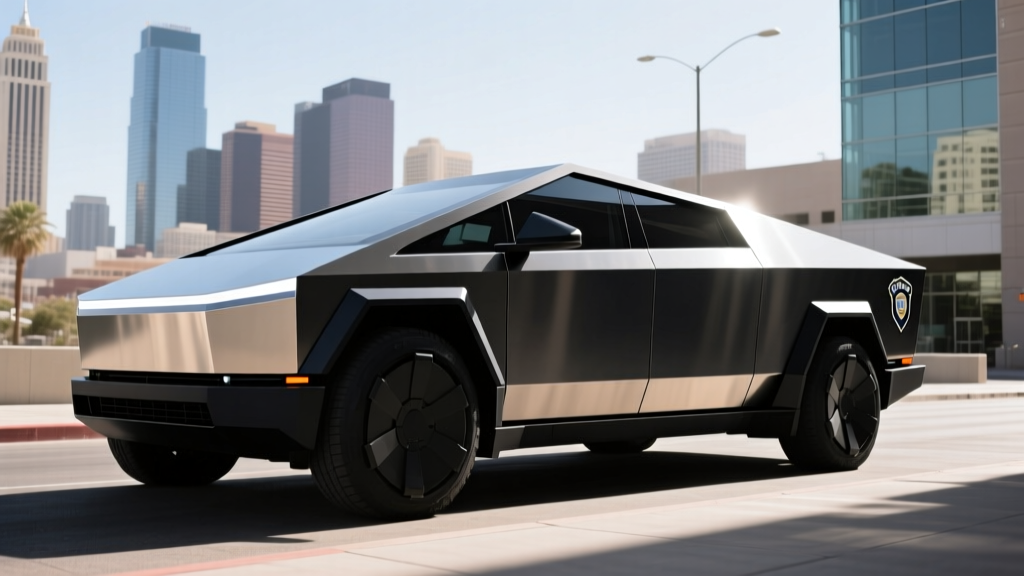
When the Las Vegas Metropolitan Police Department (LVMPD) accepted a donated Tesla Cybertruck, it made headlines far beyond the EV world. For fleet managers, municipal procurement officers, and private buyers watching from the sidelines, the LVMPD Cybertruck donation raised a practical question: Is this angular, stainless-steel electric pickup actually viable as a working vehicle — or is it more of a publicity prop?
As an EV analyst who has tracked the Cybertruck since its 2023 launch and driven multiple production units, I'll answer that question with hard data. Below is a full profile of the 2026 Tesla Cybertruck — its real-world range, charging behavior, pricing after tax credits, and whether its strengths translate from a police parking lot to your driveway or job site.
Cybertruck at a Glance: 2026 Specs
| Spec | Dual Motor AWD | Cyberbeast (Tri-Motor) |
|---|---|---|
| EPA Range | 340 miles | 320 miles |
| Battery (usable) | ~123 kWh, NMC (4680 cells) | ~123 kWh, NMC (4680 cells) |
| Peak DC Fast Charge | 250 kW | 250 kW |
| 10–80% DCFC Time | ~28 min | ~28 min |
| Level 2 Home Charge | 11.5 kW (~44 mi/hr) | 11.5 kW (~44 mi/hr) |
| 0–60 mph | 3.9 sec | 2.6 sec |
| Horsepower | 600 hp | 845 hp |
| Drivetrain | Dual-Motor AWD | Tri-Motor AWD |
| Towing Capacity | 11,000 lbs | 11,000 lbs |
| Payload | 2,500 lbs | 2,500 lbs |
| MPGe (combined) | ~67 MPGe | ~61 MPGe |
| Efficiency | ~50 kWh/100 mi | ~55 kWh/100 mi |
| Base MSRP | $79,990 | $99,990 |
| Battery Warranty | 8 yr / 120,000 mi | 8 yr / 120,000 mi |
Source: fueleconomy.gov and Tesla's official spec sheet. Specs reflect 2026 model year.
Real-World Range: What the EPA Sticker Doesn't Tell You
The Dual Motor Cybertruck carries an EPA-estimated 340 miles of range. In real-world driving, expect the following:
- City / suburban mixed: 310–330 miles (regen braking helps recover energy)
- Highway (70–80 mph sustained): 250–280 miles — the Cybertruck's slab-sided, 6,600+ lb profile creates enormous aerodynamic drag
- Cold weather (below 32°F): 220–260 miles — NMC chemistry loses 20–30% capacity in deep cold, and cabin/battery heating draws additional power
- Towing (5,000+ lb trailer): 150–180 miles — towing effectively halves range
The Cybertruck's range story is one of physics, not battery failure. Its 8,000+ lb gross weight and brick-like coefficient of drag (~0.34 Cd) mean highway efficiency suffers badly compared to a sedan like the Model S or even a smoother SUV like the Rivian R1S. For LVMPD's use case — mostly urban patrol with depot charging — range is more than adequate. For a cross-country road trip, plan your Supercharger stops carefully.
Charging Speed: 250 kW Peak, but Watch the Curve
| Level | Power (kW) | Miles Added / Hour | Notes |
|---|---|---|---|
| Level 1 (120V outlet) | ~1.4 kW | ~3 mi/hr | Emergency/trickle only |
| Level 2 (240V / 48A) | 11.5 kW | ~44 mi/hr | Full charge in ~11 hours |
| DC Fast Charge (Supercharger V3) | 250 kW peak | ~200+ mi in 15 min | 10–80% in ~28 min; tapers sharply above 80% |
| DC Fast Charge (CCS adapter, non-Tesla) | ~150–200 kW peak | Varies by station | Requires Tesla CCS adapter (included) |
A critical detail many spec sheets omit: the charge curve. The Cybertruck's 4680 NMC cells can accept 250 kW at a low state of charge (SoC ~10–20%), but power tapers to ~100 kW by 60% SoC and drops below 50 kW past 85%. That 10–80% time of roughly 28 minutes is achievable at a V3 Supercharger with battery preconditioning enabled (the truck does this automatically when you navigate to a charger).
For fleet operators like LVMPD, depot-based Level 2 charging at 11.5 kW is the practical backbone. A Cybertruck arriving at 30% SoC at 10 PM will be at 100% by 6 AM — perfect for shift-based use. Public DC fast charging is best reserved for road trips or mid-shift top-ups.
Pricing, Trims, and Federal Tax Credit Eligibility
| Trim | Base MSRP | As-Tested (typical options) | §30D Federal Credit Eligible? |
|---|---|---|---|
| Dual Motor AWD | $79,990 | $82,000–$86,000 | No — exceeds $80,000 MSRP cap for trucks |
| Cyberbeast (Tri-Motor) | $99,990 | $102,000–$108,000 | No — exceeds $80,000 MSRP cap |
This is where the LVMPD Cybertruck donation becomes especially relevant for private buyers: because the vehicle was donated, LVMPD didn't need to worry about purchase price or tax credits. You do.
Under current IRS §30D rules, new clean vehicle credits are capped at $80,000 MSRP for trucks and SUVs. The Cybertruck's starting price of $79,990 (Dual Motor) appears to squeak under — but any factory options, destination charges, or trim upgrades push the MSRP above the threshold. Additionally, buyer income caps apply ($150,000 single / $300,000 joint AGI), and battery critical-mineral sourcing requirements must be met.
Bottom line: Most Cybertruck configurations will not qualify for the $7,500 federal tax credit. Consult a tax professional and verify current-year IRS guidance before assuming eligibility. Point-of-sale transfer is available for qualifying vehicles, but the MSRP cap is a hard ceiling.
Performance and Drivetrain: Brutal Acceleration, Serious Capability
The Cybertruck's performance numbers are supercar-adjacent in the Cyberbeast trim: 2.6 seconds to 60 mph with 845 horsepower from three motors. The Dual Motor AWD still manages 3.9 seconds — faster than most sports sedans. Torque vectoring across the rear axle (Cyberbeast) provides exceptional cornering grip for a vehicle weighing over 6,600 lbs.
Towing capacity is rated at 11,000 lbs, competitive with full-size ICE pickups like the Ford F-150. However, as noted above, towing at capacity will crush range to roughly 150 miles. For fleet and commercial users who tow short distances and return to base, this is manageable. For long-haul towing, it's a significant limitation.
The 48-volt electrical architecture (a first for a production vehicle at this scale) enables steer-by-wire steering, four-wheel steering for a tight turning circle (~35 ft), and rapid torque response. Steer-by-wire takes adjustment — there's no mechanical connection between the yoke and the wheels — but it's precise and eliminates kickback over rough terrain.
Cargo, Interior, and Practicality
The Cybertruck's 6-foot bed (with the tailgate up) offers ~67 cu ft of cargo volume. With the tailgate down and the mid-gate folded, bed length extends to accommodate longer items. The powered tonneau cover (standard) is lockable and supports up to 300 lbs of distributed weight — useful for rooftop tent mounting or gear staging.
Interior space accommodates six passengers (3-across bench front and rear). Rear legroom measures ~41 inches — adequate for adults but tighter than a Ford F-150 Lightning's back seat. The 18.5-inch center touchscreen dominates the dash; there are no physical buttons for climate or audio, which is a distraction concern for fleet drivers and a usability gripe for many owners.
The frunk (front trunk) offers ~7 cu ft of sealed storage — enough for charging cables, a tool kit, or groceries. The vault (bed) includes built-in 120V and 240V outlets, enabling V2L (vehicle-to-load) capability for running power tools, job-site equipment, or emergency backup power.
Technology, Driver Assistance, and Safety
The Cybertruck ships with Tesla's latest hardware suite (HW4/AI5 cameras and processors). Standard features include:
- Autopilot (SAE Level 2): Adaptive cruise, lane centering, auto emergency braking, blind-spot cameras
- Full Self-Driving (Supervised) (SAE Level 2, optional ~$8,000): Navigate on Autopilot, auto lane change, traffic light/stop sign recognition, city street driving — driver must remain fully engaged at all times
- Surround-view cameras with dashcam recording
- Over-the-air software updates
- Stainless-steel exoskeleton with no paint (dent-resistant but fingerprint-prone)
Safety ratings from NHTSA show the Cybertruck earning a 5-star overall rating, though its aggressive front-end geometry has drawn scrutiny from pedestrian-safety advocates. IIHS testing is pending as of early 2026.
Pros and Cons: The Honest Scorecard
- Class-leading acceleration and performance (2.6s 0–60 Cyberbeast)
- 11,000-lb towing + V2L power export for job sites
- Stainless-steel body resists dents and eliminates paint maintenance
- 340-mi EPA range adequate for most daily and fleet use
- Access to Tesla Supercharger network (17,000+ stalls in North America)
- 48V architecture enables advanced steer-by-wire and 4-wheel steering
- Highway range drops to ~250 mi due to aero drag and weight
- MSRP exceeds §30D tax credit cap — no $7,500 federal credit for most buyers
- Steer-by-wire and yoke steering polarizing; not ideal for all drivers
- No physical controls for climate/audio — all touchscreen
- Towing halves range (~150 mi practical limit)
- Cold-weather range loss significant (20–30% below freezing)
- Pedestrian safety concerns over sharp front-end geometry
Who Should Buy the Cybertruck — and Who Shouldn't?
Best for:
- Fleet operators (like LVMPD) who charge at depot, drive urban routes, and value V2L capability
- Performance-oriented truck buyers who want supercar acceleration with utility
- Tech-forward owners who embrace steer-by-wire and a minimalist cabin
- Job-site users needing 240V power export and a lockable, weather-sealed bed
Not ideal for:
- Long-distance highway commuters (real-world highway range is mediocre)
- Buyers counting on the $7,500 federal tax credit (MSRP cap disqualifies most configs)
- Traditional truck buyers who prefer physical controls, conventional steering, and proven dealer service networks
- Frequent heavy towers on long routes (range with a trailer is limiting)
Consider the Ford F-150 Lightning or Rivian R1T if: You need a more conventional truck layout, better highway range efficiency, physical controls, or a lower MSRP that can qualify for the federal tax credit.
Frequently Asked Questions
What is the real-world range of the Tesla Cybertruck?
The EPA estimates 340 miles for the Dual Motor AWD and 320 miles for the Cyberbeast. In real-world conditions, expect ~310–330 miles in city driving, ~250–280 miles on the highway, and ~220–260 miles in cold weather (below 32°F). Towing reduces range to approximately 150–180 miles.
How fast does the Cybertruck charge at home and on DC fast chargers?
At home on a Level 2 (240V/48A) charger, the Cybertruck charges at 11.5 kW, adding roughly 44 miles of range per hour — a full charge takes about 11 hours. On a Tesla V3 Supercharger, it peaks at 250 kW and charges from 10–80% in approximately 28 minutes, though the charge curve tapers significantly above 80% SoC.
Does the Cybertruck qualify for the federal EV tax credit?
Most configurations do not. Under IRS §30D, trucks must have an MSRP at or below $80,000 to qualify. The Dual Motor AWD starts at $79,990 but options and destination fees push it over. The Cyberbeast at $99,990 is well above the cap. Buyer income limits and battery-sourcing rules add further restrictions. Always verify with a tax professional.
Why did LVMPD receive a donated Cybertruck?
The LVMPD Cybertruck donation was made by a private donor. Police departments occasionally accept vehicle donations for community relations, parades, recruitment events, or limited patrol use. A donated vehicle bypasses procurement budgets and tax-credit concerns entirely — an advantage not available to private buyers.
Is the Cybertruck worth buying vs. the Ford F-150 Lightning or Rivian R1T?
It depends on your priorities. The Cybertruck wins on raw performance (2.6s 0–60), V2L power export, and Supercharger network access. The F-150 Lightning offers a more conventional truck experience, lower starting prices, potential tax-credit eligibility, and better highway range efficiency. The Rivian R1T provides superior interior refinement, a gear tunnel for storage, and strong off-road capability. Cross-shop all three based on your actual use case.
What are the biggest drawbacks of owning a Cybertruck?
The top complaints from owners include: steep highway range loss due to aerodynamics, the polarizing yoke steering with no round-wheel option, all-touchscreen controls with zero physical buttons, poor rear visibility, and the inability to claim the $7,500 federal tax credit on most builds. Cold-weather range degradation and tire cost (35-inch all-terrains are expensive to replace) are also ownership realities.
For the latest EPA efficiency data, visit fueleconomy.gov. For current federal tax credit rules, see IRS.gov §30D guidance. Always verify specs with Tesla's official configurator before purchasing, as pricing and features may change mid-model-year.