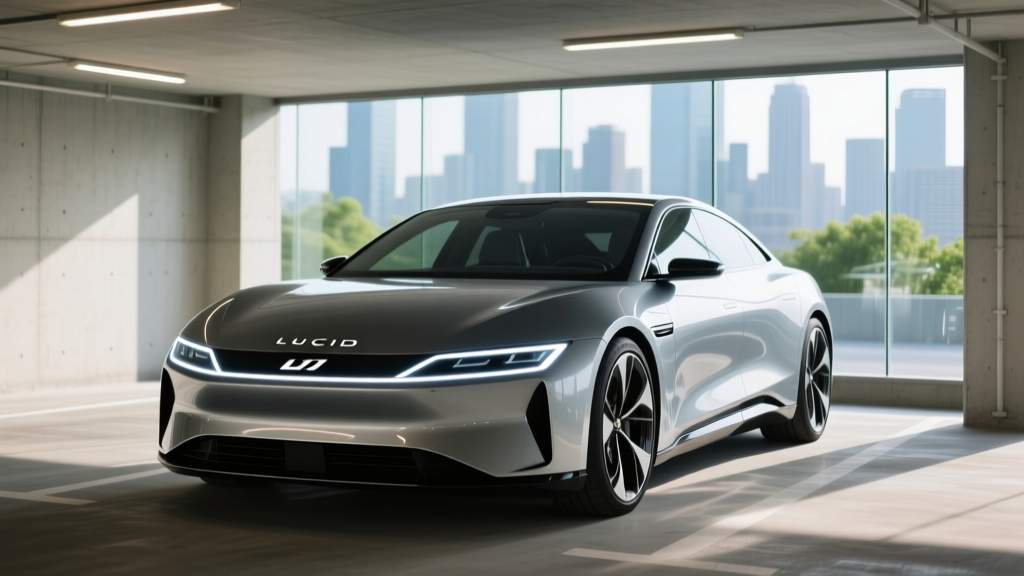
If you're researching the Lucid Air, you've likely seen the headline numbers: 516 miles of EPA range, sub-three-second 0-60 sprints, and a luxury sedan that rivals the Mercedes EQS and Tesla Model S. But for a vehicle starting near $70,000 and climbing past $250,000, the Lucid warranty is what protects that investment over time. This guide dissects every layer of Lucid's warranty coverage, then pairs it with the real-world specs — range, charging, efficiency, and pricing — you need to evaluate whether the Air earns a spot in your garage.
Lucid Warranty at a Glance: Coverage by the Numbers
Lucid structures its warranty in three tiers: a basic limited warranty, a powertrain warranty, and a high-voltage battery warranty. Here's how the 2026 coverage breaks down for the Air lineup:
| Warranty Type | Duration | Mileage Limit | What's Covered |
|---|---|---|---|
| Basic Limited (Bumper-to-Bumper) | 4 years | 50,000 miles | Most vehicle components, infotainment, suspension, interior, exterior |
| Powertrain | 8 years | 100,000 miles | Electric motors, inverter, reduction gearbox, onboard charger |
| High-Voltage Battery | 8 years | 100,000 miles | Battery pack capacity retention (threshold: 70% of original capacity) |
| Corrosion Perforation | 12 years | Unlimited miles | Body panel rust-through from inside out |
| Roadside Assistance | 4 years | 50,000 miles | Towing, flat tire, lockout, dead 12V battery |
The battery warranty is the one most buyers scrutinize. Lucid guarantees that the high-voltage battery will retain at least 70% of its original usable capacity over 8 years or 100,000 miles, whichever comes first. If degradation exceeds that threshold, Lucid will repair or replace the pack to bring it back above the 70% line. This 70% retention floor is consistent with industry norms — Tesla, Rivian, and BMW all use the same benchmark for their EV battery warranties as referenced on fueleconomy.gov.
How the Lucid Warranty Compares to Key Competitors
Warranty coverage is only meaningful in context. Here's how Lucid stacks up against the luxury EV sedans it competes with directly:
| Brand / Model | Basic | Powertrain | Battery (Capacity Threshold) |
|---|---|---|---|
| Lucid Air | 4 yr / 50k mi | 8 yr / 100k mi | 8 yr / 100k mi (70%) |
| Tesla Model S | 4 yr / 50k mi | 8 yr / 150k mi | 8 yr / 150k mi (70%) |
| Mercedes-Benz EQS | 4 yr / 50k mi | 4 yr / 50k mi | 8 yr / 100k mi (70%) |
| BMW i7 | 4 yr / 50k mi | 4 yr / 50k mi | 8 yr / 100k mi (70%) |
| Porsche Taycan | 4 yr / 50k mi | 4 yr / 50k mi | 8 yr / 100k mi (70%) |
Lucid's battery and powertrain coverage matches or exceeds most German rivals, though Tesla offers 50,000 additional miles on both powertrain and battery for the Model S. For the average luxury-sedan driver covering 12,000–15,000 miles annually, Lucid's 100,000-mile ceiling provides roughly 7–8 years of protection — adequate for most first owners, but worth noting if you drive significantly above average.
2026 Lucid Air: Range, Battery, and Real-World Efficiency
The Air lineup for 2026 spans four trims, each with distinct battery and drivetrain configurations:
| Trim | EPA Range | Battery (Usable kWh) | Chemistry | Drivetrain | HP | 0-60 mph |
|---|---|---|---|---|---|---|
| Air Pure | 419 mi | 88 kWh | NMC | RWD | 430 | 5.0 sec |
| Air Touring | 425 mi | 92 kWh | NMC | AWD (Dual Motor) | 620 | 3.4 sec |
| Air Grand Touring | 516 mi | 112 kWh | NMC | AWD (Dual Motor) | 819 | 3.0 sec |
| Air Sapphire | 427 mi | 118 kWh | NMC | AWD (Tri-Motor) | 1,234 | 1.89 sec |
Real-World Range Expectations
EPA Sticker: Up to 516 miles (Grand Touring).
Real-World Highway (70 mph): Expect approximately 400–440 miles in moderate temperatures. The Air's slippery 0.197 Cd drag coefficient helps, but sustained highway speeds consume energy faster than the EPA mixed cycle.
Cold Weather (Below 32°F): Plan for a 15–25% reduction depending on cabin heating demands. The Grand Touring's heat pump mitigates this, but 516 EPA miles can shrink to roughly 380–420 miles in freezing conditions.
City / Moderate Climate: The Air's regenerative braking and efficiency shine here — many owners report meeting or slightly exceeding EPA estimates in stop-and-go driving at 50–65°F.
All Air trims use NMC (nickel manganese cobalt) lithium-ion cells. NMC chemistry offers higher energy density than LFP, which is how Lucid achieves its class-leading range in a sedan footprint. The trade-off: NMC cells benefit from daily charging limits around 80–90% to maximize longevity, whereas LFP packs tolerate daily 100% charges. Lucid's battery management system includes a buffer to protect against deep discharge and overcharge, and the vehicle's thermal management system actively conditions the pack in extreme temperatures.
Efficiency figures from fueleconomy.gov show the Grand Touring achieving approximately 146 MPGe combined (23 kWh/100 mi), making it one of the most energy-efficient luxury sedans in its weight class. The RWD Pure trim pushes closer to 150 MPGe combined thanks to lower mass and single-motor drivetrain losses.
Charging Speed: DC Fast Charging and Home Level 2
Lucid equips the Air with a 900V+ electrical architecture — one of the highest-voltage platforms in production. This enables exceptionally fast DC charging when paired with compatible hardware.
| Charging Method | Max Power | Speed / Notes |
|---|---|---|
| DC Fast Charge (350 kW station) | ~300 kW peak | 10–80% in approximately 20 minutes (Grand Touring); taper begins above 60% SoC |
| DC Fast Charge (150 kW station) | ~150 kW sustained | 10–80% in approximately 35–40 minutes |
| Level 2 Home (48A / 11.5 kW) | 11.5 kW | ~36–40 miles of range per hour; full charge in 10–12 hours (Grand Touring) |
| Level 2 Home (32A / 7.7 kW) | 7.7 kW | ~25 miles of range per hour; adequate for daily commuters adding 100–150 mi overnight |
| Level 1 (120V / 12A) | 1.4 kW | ~4–5 miles per hour; emergency/trickle only |
The 900V architecture means the Air sustains higher charge rates deeper into the session than 400V competitors. On a 350 kW Electrify America or Ionity charger, you'll see peak rates near 300 kW in the 10–40% SoC window, with a gradual taper. The charge curve flattens meaningfully above 80% — this is standard for NMC chemistry and protects cell longevity. For road trips, plan your stops around the 10–80% window for the fastest turnaround.
The Air uses the NACS (North American Charging Standard) connector as of the 2025 model year refresh, granting native access to the Tesla Supercharger network. CCS adapters are no longer needed for the vast majority of public charging infrastructure in the U.S.
Interior Space, Cargo, and Technology
The Air's cabin is designed around Lucid's "Space Concept" philosophy — compact motor and battery packaging that frees up interior volume. Key dimensions:
- Rear legroom: 41.1 inches (class-leading for the segment; exceeds Model S and EQS)
- Front headroom: 39.6 inches
- Trunk (rear): 22.1 cu ft
- Frunk (front): 10.0 cu ft
- Total cargo: 32.1 cu ft combined
The rear-seat space is where the Air genuinely differentiates from the Tesla Model S. Adults over six feet can sit behind a similarly-sized driver without compromise — a direct result of Lucid's miniaturized rear drive unit.
On the technology front, the Air features a 34-inch curved glass cockpit display (dubbed the "glass canopy") spanning the driver's instrument cluster and central infotainment. A retractable lower touchscreen handles climate and secondary controls. The infotainment system runs Lucid's proprietary OS — responsive, but it lacks Apple CarPlay and Android Auto, which remains a notable drawback for buyers accustomed to phone projection. Wireless phone charging, a 21-speaker Surreal Sound Pro audio system (Sapphire/Touring), and over-the-air updates are included.
Driver assistance comes via Lucid DreamDrive Pro, which includes adaptive cruise control, lane centering, automatic emergency braking, blind-spot monitoring, and a 3D surround-view camera. DreamDrive Pro is a SAE Level 2 system — it requires continuous driver supervision and does not permit hands-off or eyes-off operation. Lucid has indicated future hands-free highway capability via OTA, but as of 2026, active steering input is required.
Driver Assist Limitation
Lucid DreamDrive Pro is an SAE Level 2 driver-assistance system. It is not autonomous or self-driving. The driver must keep hands on the wheel and eyes on the road at all times. The system will issue escalating alerts and eventually bring the vehicle to a stop if driver engagement is not detected.
Pricing, Trims, and Federal Tax Credit Eligibility
| Trim | 2026 Base MSRP | As-Tested (Typical Options) | §30D Federal Credit Eligibility |
|---|---|---|---|
| Air Pure | $69,900 | $72,000–$75,000 | Eligible for up to $7,500 (subject to income, sourcing, and MSRP caps) |
| Air Touring | $87,400 | $90,000–$95,000 | Eligible for up to $7,500 (sedan MSRP cap is $55,000 — see note below) |
| Air Grand Touring | $125,600 | $130,000–$140,000 | NOT eligible — exceeds $55,000 sedan MSRP cap |
| Air Sapphire | $249,000 | $249,000 | NOT eligible — exceeds $55,000 sedan MSRP cap |
Critical tax credit note: Under IRS §30D rules, the federal clean vehicle credit for sedans is capped at vehicles with an MSRP of $55,000 or less. This means only the Air Pure (at $69,900) falls into a gray area — Lucid has classified the Air Pure as eligible under certain configurations, but buyers should verify the specific VIN's eligibility via the IRS's seller-reporting tool at the point of sale. In practice, most Air trims do not qualify for the $7,500 federal credit due to the sedan MSRP cap.
Additional §30D requirements include:
- Buyer income caps: Modified AGI must not exceed $150,000 (single), $225,000 (head of household), or $300,000 (joint filers)
- Battery sourcing: Critical minerals and battery components must meet phased domestic-content thresholds that tighten annually through 2029
- Point-of-sale transfer: Eligible buyers can transfer the credit to the dealer at purchase, reducing the out-of-pocket price immediately
Given the MSRP cap issue, most Lucid Air buyers will pay full sticker. Consult a tax professional and check the official IRS clean vehicle credit page before assuming credit eligibility.
Who the Lucid Air Suits Best
Choose the Lucid Air If:
- You prioritize maximum range in a luxury sedan and want to minimize charging stops on long road trips
- Rear-seat passenger space is a priority (the Air's 41.1" legroom beats the Model S and EQS)
- You value understated, tech-forward luxury over brand cachet
- You have reliable Level 2 home charging and want a vehicle that recovers 250+ miles overnight
Look Elsewhere If:
- You need Apple CarPlay / Android Auto (not available on the Air)
- Federal tax credit eligibility is a dealbreaker (most trims exceed the MSRP cap)
- You want the longest powertrain warranty mileage (Tesla Model S offers 150,000 miles)
- You prefer a service-center network with physical locations in every metro (Lucid's service footprint is still expanding)
Pros and Cons
Pros
- Class-leading EPA range (516 mi Grand Touring)
- Exceptional rear-seat legroom for the segment
- 900V architecture enables ~300 kW peak DC charging
- NACS connector — native Supercharger access
- Impressive efficiency: 146+ MPGe combined
- Strong 8-year/100,000-mile battery warranty at 70% retention
Cons
- No Apple CarPlay or Android Auto
- Most trims ineligible for $7,500 federal tax credit (MSRP cap)
- Limited service center network vs. Tesla or legacy luxury brands
- DreamDrive Pro requires hands-on supervision (Level 2 only)
- Air Pure's 430 HP feels modest vs. the dual-motor trims' performance
- Cargo volume (32.1 cu ft total) trails some SUV competitors
Frequently Asked Questions
What is the real-world range of the Lucid Air?
The Grand Touring's 516-mile EPA estimate translates to roughly 400–440 miles at sustained highway speeds in mild weather, and 380–420 miles in freezing conditions. The Pure and Touring trims deliver approximately 340–380 real-world highway miles. City driving with regenerative braking often meets or slightly exceeds EPA figures.
How fast does the Lucid Air charge at home and on the road?
On a 350 kW DC fast charger, the Air peaks near 300 kW and charges from 10–80% in about 20 minutes. At home on a 48-amp Level 2 circuit (11.5 kW), you'll add roughly 36–40 miles per hour, fully replenishing the Grand Touring's 112 kWh pack in 10–12 hours.
Does the Lucid Air qualify for the federal EV tax credit?
Most trims do not. The §30D credit caps sedan eligibility at $55,000 MSRP, which excludes the Touring, Grand Touring, and Sapphire. The Pure trim's eligibility depends on specific VIN sourcing compliance and should be verified at point of sale. Buyer income limits and battery-component sourcing rules also apply per IRS guidelines.
What does the Lucid battery warranty actually cover?
Lucid warrants the high-voltage battery against capacity loss below 70% of original usable capacity for 8 years or 100,000 miles. If your battery degrades beyond that threshold under normal use, Lucid will repair or replace modules to restore capacity above 70%. The warranty does not cover damage from accidents, misuse, or unauthorized modifications.
Is the Lucid Air worth buying vs. the Tesla Model S or Mercedes EQS?
The Air wins on range, efficiency, and rear-seat space. The Model S offers a denser Supercharger network (though NACS narrows this gap), longer powertrain warranty mileage (150k), and a more mature service infrastructure. The EQS provides stronger brand prestige and dealer support but trails significantly on EPA range (350 mi for the EQS 450+). Your decision likely hinges on whether range and cabin space outweigh service-network maturity and brand cachet.
How long do Lucid Air batteries last beyond the warranty period?
While long-term data is still accumulating (the Air launched for the 2022 model year), NMC cells in thermally-managed packs with conservative charge buffers typically retain 80–85% capacity at 150,000 miles based on industry-wide degradation studies. Lucid's active liquid thermal management and relatively low C-rate charging profile are favorable for long-term cell health. Expect the pack to remain functional well beyond the 8-year warranty window, albeit with gradual capacity loss.