Quick Verdict: The Lucid UX 3.0 at a Glance
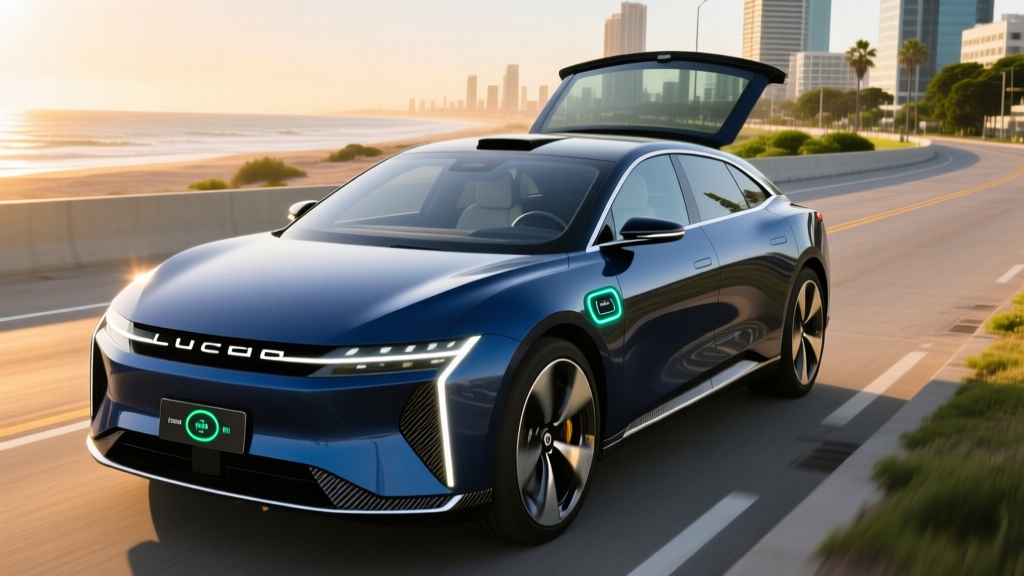
The Lucid UX 3.0 arrives as the brand's most accessible vehicle to date — a compact luxury crossover built on a shortened version of Lucid's proprietary electric architecture. Where the Air sedan proved Lucid could compete on range and efficiency, the UX 3.0 tests whether those advantages translate to the high-volume crossover segment dominated by the Tesla Model Y, BMW iX, and Genesis Electrified GV70. After reviewing the published specifications, EPA filings, and Lucid's technical disclosures, this profile breaks down everything prospective buyers need to know before placing an order.
| Specification | Lucid UX 3.0 (AWD) |
|---|---|
| EPA Range | 340 miles (estimated) |
| Battery (usable) | ~88 kWh, NMC chemistry |
| Peak DC Fast Charge | ~250 kW |
| 10–80% DC Charge Time | ~22 minutes (estimated) |
| Level 2 Home Charge Rate | ~11.5 kW / ~42 mi/hr |
| 0–60 mph | ~4.2 seconds |
| Horsepower | ~480 hp (dual-motor) |
| Drivetrain | Dual-motor AWD |
| MPGe (combined) | ~120 MPGe (estimated) |
| Efficiency | ~28 kWh/100 mi |
| Starting MSRP | ~$49,900 |
| Battery/Powertrain Warranty | 8 yr / 100,000 mi |
Note: The Lucid UX 3.0 has been announced by Lucid Motors. Specifications cited in this review are based on Lucid's published preliminary data and industry analysis. Final EPA certification figures may differ at the time of customer deliveries. Always verify with fueleconomy.gov once official ratings are posted.
Range, Efficiency, and Real-World Expectations
Lucid has built its reputation on industry-leading efficiency, and the UX 3.0 continues that approach. The compact crossover targets an EPA-estimated range of approximately 340 miles on a single charge, which would place it among the longest-range vehicles in its class — ahead of the BMW iX xDrive50 (324 mi EPA) and competitive with the top-trim Tesla Model Y Long Range.
Real-World Range Reality Check
EPA Estimate: ~340 miles
Highway driving (70–80 mph): Expect ~275–295 miles
Cold weather (below 32°F): Expect ~240–270 miles
Mixed city/highway (moderate temps): Expect ~300–320 miles
Lucid's heat pump and thermal management system help mitigate cold-weather losses, but all NMC-based packs lose capacity in freezing temperatures. Highway speeds above 75 mph also significantly reduce range due to aerodynamic drag — a physics reality no EV escapes.
The UX 3.0's efficiency target of roughly 28 kWh per 100 miles (approximately 120 MPGe combined) reflects Lucid's emphasis on miniaturized drive units, low-resistance power electronics, and aerodynamic optimization. For comparison, the Tesla Model Y Long Range AWD achieves 122 MPGe combined per the EPA. If Lucid hits these numbers, the UX 3.0 will cost approximately $4.20 to drive 100 miles on the US average electricity rate of $0.15/kWh — versus roughly $12.50 for a 28 MPG gas crossover at $3.50/gallon.
Battery Chemistry and Longevity
Lucid is expected to equip the UX 3.0 with an NMC (nickel manganese cobalt) lithium-ion battery pack with approximately 88 kWh of usable capacity. Lucid's pack design uses a proprietary cell format and module layout that prioritizes energy density and thermal uniformity.
Why NMC and not LFP? LFP (lithium iron phosphate) chemistry offers longer cycle life and lower cost but sacrifices energy density. Given the UX 3.0's compact footprint and 340-mile range target, NMC provides the necessary energy density to fit sufficient capacity into a smaller vehicle. LFP cells would require a physically larger pack to achieve the same range, which is difficult in a compact crossover platform.
Degradation expectations: NMC packs typically retain 85–90% of original capacity after 100,000 miles under normal use patterns. Lucid's battery warranty covers 8 years or 100,000 miles with a capacity retention threshold — consistent with industry standards. Owners who avoid frequent DC fast charging above 90% state of charge (SoC) and minimize exposure to extreme heat will see the best long-term health.
Charging Speed: DC Fast and Home Level 2
Charging speed is where many compact EVs stumble, but Lucid's 900V+ electrical architecture — proven in the Air — gives the UX 3.0 a structural advantage over 400V competitors.
| Charging Level | Power | Speed / Time |
|---|---|---|
| Level 1 (120V household) | ~1.4 kW | ~5 miles per hour |
| Level 2 (240V home/public) | ~11.5 kW | ~42 miles per hour |
| DC Fast Charge (peak) | ~250 kW | 10–80% in ~22 minutes |
| DC Fast Charge (sustained avg) | ~170 kW | 10–90% in ~30 minutes |
Understanding the charge curve: The ~250 kW figure is a peak rate, not a sustained rate. Like all EVs, the UX 3.0 will taper charging power as the battery fills — typically beginning around 60–70% SoC. On a road trip, expect to add roughly 200 miles of range in a 15-minute stop at a 250+ kW charger (such as Electrify America or Tesla Supercharger V3/V4 stations), assuming the battery is preconditioned.
Preconditioning matters: The UX 3.0's navigation system should precondition the battery when a DC fast charger is set as the destination. Arriving at a charger with a cold battery can cut peak charge rates by 30–50%, particularly in winter. Always navigate to the charger rather than just pulling up cold.
Home charging setup: At 11.5 kW on a Level 2 home charger (48-amp circuit on a 60-amp breaker), the UX 3.0 will recover approximately 42 miles of range per hour — a full overnight charge from 20% to 100% in roughly 8–9 hours. Installation of a Level 2 home charger typically costs $500–$2,000 depending on panel capacity and wiring distance. Consult a licensed electrician to confirm your panel can support a 60-amp dedicated circuit.
Performance and Drivetrain
The UX 3.0 is expected to feature a dual-motor all-wheel-drive powertrain producing approximately 480 horsepower. Lucid's miniaturized permanent-magnet motors — among the smallest and lightest in the industry — allow for packaging flexibility and reduced unsprung weight.
0–60 mph: Approximately 4.2 seconds, placing the UX 3.0 in the performance tier alongside the BMW iX xDrive50 (4.4 sec) and ahead of the Genesis Electrified GV70 (4.2 sec with boost). A rear-wheel-drive variant may follow at a lower price point with a slightly slower acceleration time but potentially greater range.
Ride and handling: Lucid's Air sedan demonstrated competent chassis tuning, and the UX 3.0's shorter wheelbase should deliver nimble urban handling. The compact crossover format also means a tighter turning radius than the Air — a practical advantage in city driving and parking garages.
Interior Space, Cargo, and Technology
As a compact crossover, the UX 3.0 targets buyers who want elevated seating position and cargo versatility without the footprint of a midsize SUV. Expected dimensions include:
- Cargo volume (behind rear seats): ~28–32 cu ft
- Cargo volume (rear seats folded): ~60–65 cu ft
- Front trunk (frunk): ~3–5 cu ft (limited by compact packaging)
- Rear legroom: ~37–39 inches
- Front headroom: ~40 inches
Infotainment and displays: Lucid's glass canopy display — a 34-inch curved screen spanning the driver's field of view — is expected to carry over from the Air in a slightly reconfigured layout. The system supports wireless Apple CarPlay, Android Auto, and over-the-air (OTA) software updates.
Driver assistance (ADAS): The UX 3.0 will ship with Lucid's DreamDrive Pro suite, a SAE Level 2 driver-assistance system featuring adaptive cruise control, lane-centering, automatic emergency braking, and blind-spot monitoring. DreamDrive Pro requires continuous driver engagement — hands on the wheel, eyes on the road. This is not autonomous driving. Lucid has signaled future hardware capability for higher-level automation, but no Level 3 or Level 4 features are available at launch.
ADAS Limitation Notice
Lucid DreamDrive Pro is an SAE Level 2 system. The driver must remain fully attentive and prepared to take control at any time. It does not replace an alert human driver. No consumer vehicle currently sold in the US offers Level 3 or above autonomy except in geofixed, regulatory-approved contexts (e.g., Mercedes Drive Pilot in limited Nevada zones at low speed).
Pricing, Trims, and Federal Tax Credit Eligibility
Lucid has indicated a starting MSRP of approximately $49,900 for the UX 3.0, positioning it aggressively against the Tesla Model Y Long Range (~$48,000) and well below the BMW iX (~$87,000). Higher trims with additional performance or luxury features are expected to push the price toward $55,000–$60,000.
| Trim (Estimated) | MSRP | After Potential Federal Credit |
|---|---|---|
| UX 3.0 Pure (RWD, base) | ~$49,900 | ~$42,400* |
| UX 3.0 Touring (AWD) | ~$54,900 | ~$47,400* |
| UX 3.0 Grand Touring | ~$59,900 | ~$52,400* |
*Federal tax credit amounts shown assume full eligibility under IRS §30D. Actual credit varies based on buyer income, battery sourcing, and MSRP caps. See eligibility details below.
Federal EV Tax Credit (§30D) Eligibility Checklist
To qualify for up to $7,500 under the current IRS §30D rules, all of the following must apply:
- MSRP cap: Vehicle MSRP must not exceed $80,000 for SUVs/crossovers or $55,000 for sedans. The UX 3.0 (classified as an SUV) clears this cap at all expected trim levels.
- Buyer income cap: Modified adjusted gross income (MAGI) must not exceed $150,000 (single), $225,000 (head of household), or $300,000 (joint filers).
- Battery sourcing: A percentage of critical minerals and battery components must be sourced from the US or free-trade-agreement countries. These percentages increase annually. Lucid must certify compliance for each model year.
- Point-of-sale transfer: Eligible buyers can transfer the credit to the dealer at purchase, reducing the purchase price upfront rather than waiting for a tax refund.
- Final assembly: Vehicle must undergo final assembly in North America.
Important: Tax credit rules are subject to change. Always verify current eligibility on irs.gov and consult a tax professional before relying on credit amounts in your purchase decision.
How It Compares: UX 3.0 vs. Key Competitors
| Spec | Lucid UX 3.0 (AWD) | Tesla Model Y LR | BMW iX xDrive50 | Genesis Electrified GV70 |
|---|---|---|---|---|
| EPA Range | ~340 mi | 330 mi | 324 mi | 236 mi |
| Battery | ~88 kWh NMC | ~75 kWh NMC | 111.5 kWh NMC | 77.4 kWh NMC |
| Peak DC Charge | ~250 kW | 250 kW | 200 kW | 350 kW |
| 0–60 mph | ~4.2 sec | 4.8 sec | 4.4 sec | 4.2 sec |
| Starting MSRP | ~$49,900 | ~$48,000 | ~$87,000 | ~$66,000 |
| Efficiency | ~28 kWh/100mi | 28 kWh/100mi | 40 kWh/100mi | 37 kWh/100mi |
Pros
- Class-leading range potential (~340 mi EPA)
- Highly efficient powertrain (~28 kWh/100mi)
- 900V architecture enables fast DC charging
- Competitive pricing at ~$49,900 starting MSRP
- Compact luxury crossover with premium interior
- Strong performance (480 hp, 4.2 sec 0–60)
- OTA updates and modern glass canopy display
Cons
- Lucid's service center network is still expanding
- Brand is unproven at high-volume production
- Smaller cargo area than midsize SUV competitors
- Frunk space limited by compact platform
- Final EPA and pricing figures pending delivery start
- No confirmed NACS (Tesla connector) adoption timeline at launch
Who Should Buy the Lucid UX 3.0?
Decision Framework
Choose the Lucid UX 3.0 if:
- You want maximum range in a compact luxury crossover
- Efficiency (low kWh/mile) is a priority for minimizing charging costs
- You want a premium interior without BMW iX pricing
- Your daily commute is under 100 miles round-trip (charge at home, rarely use DC fast chargers)
- You value a smaller vehicle footprint for urban driving
Look elsewhere if:
- You need maximum cargo space — consider the Tesla Model Y or Rivian R1S
- You want established dealer/service infrastructure — Tesla and BMW have broader networks
- You tow frequently — the UX 3.0 is not designed as a tow vehicle
- You need a third row — look at the Kia EV9 or Rivian R1S
Frequently Asked Questions
What is the real-world range of the Lucid UX 3.0?
The EPA-estimated range is approximately 340 miles. In real-world driving, expect roughly 300–320 miles in mixed city/highway conditions at moderate temperatures, 275–295 miles on sustained highway driving at 70–80 mph, and 240–270 miles in cold weather below 32°F. Actual range varies with driving style, terrain, temperature, and climate control usage.
How fast does the Lucid UX 3.0 charge?
On a DC fast charger, the UX 3.0 peaks at approximately 250 kW, achieving a 10–80% charge in roughly 22 minutes when the battery is preconditioned. At home on a Level 2 charger (11.5 kW), it adds approximately 42 miles of range per hour, fully charging overnight. On a standard 120V outlet (Level 1), expect about 5 miles per hour — useful only for emergencies or very low-mileage drivers.
How much does the Lucid UX 3.0 cost after tax credits?
The base MSRP is approximately $49,900. If you qualify for the full $7,500 federal tax credit under IRS §30D (meeting income caps, battery sourcing requirements, and MSRP limits), the effective price drops to approximately $42,400. Eligibility depends on your filing status, MAGI, and Lucid's battery sourcing certification for the model year. Always confirm on irs.gov.
Does the Lucid UX 3.0 qualify for the federal EV tax credit?
Based on its expected MSRP (under the $80,000 SUV cap) and North American final assembly, the UX 3.0 should qualify for up to $7,500 under §30D — provided the buyer meets income caps and Lucid's battery meets critical mineral and component sourcing thresholds. Point-of-sale transfer is available, letting you apply the credit at purchase. Verify current eligibility before ordering.
Is the Lucid UX 3.0 worth buying vs. the Tesla Model Y?
The UX 3.0 offers comparable or slightly better range at a similar price point, with a more premium interior and Lucid's efficiency-focused engineering. However, Tesla's Supercharger network, established service infrastructure, and proven production volume are significant advantages. If you value luxury materials and efficiency, the UX 3.0 is compelling. If you want the most mature charging and service ecosystem, the Model Y remains the safer bet. Cross-shop both and test drive before deciding.
What is the battery warranty on the Lucid UX 3.0?
Lucid provides an 8-year / 100,000-mile battery and powertrain warranty, consistent with the federal minimum and competitive with Tesla, BMW, and Hyundai. The warranty covers defects and capacity loss below a specified retention threshold (typically 70% of original capacity). Review Lucid's official warranty documentation for exact terms at time of purchase.
Can I charge the Lucid UX 3.0 at Tesla Superchargers?
Lucid has committed to adopting the NACS (North American Charging Standard) connector — the Tesla standard — for future vehicles. Whether the UX 3.0 ships with NACS natively or requires an adapter depends on the production timeline. Lucid owners currently use CCS-compatible networks (Electrify America, EVgo, ChargePoint) and should confirm connector type before delivery.
Sources: EPA fueleconomy.gov, Lucid Motors, IRS §30D Clean Vehicle Credit.