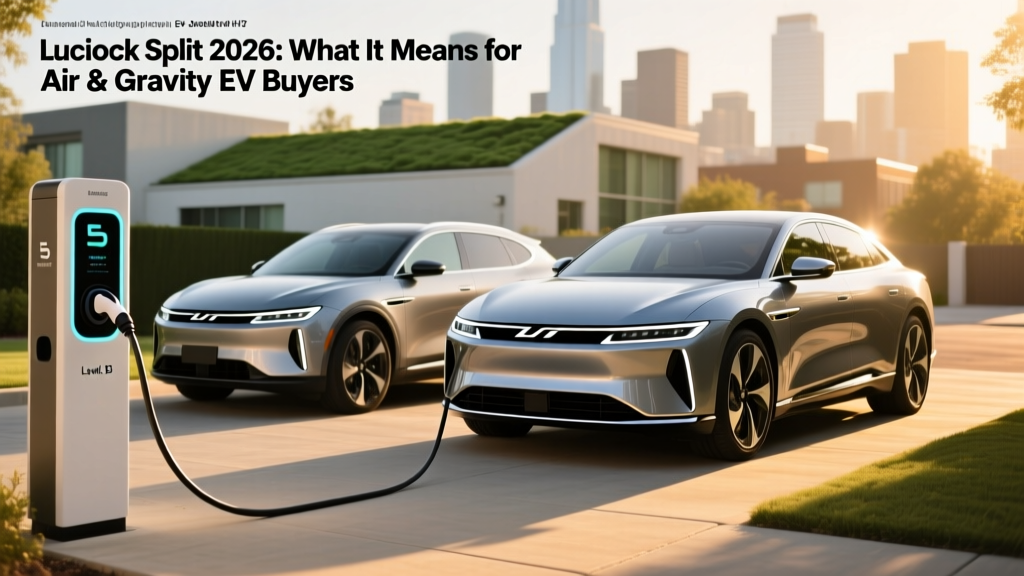
When a publicly traded EV automaker restructures its shares, car shoppers rarely pay attention — but they should. The conversation around a potential Lucid stock split isn't just Wall Street noise; it signals how the company plans to fund production scaling, expand its model lineup, and compete on price against Tesla, Rivian, and legacy luxury brands. For buyers eyeing the Lucid Air sedan or the upcoming Gravity SUV, understanding Lucid's financial positioning directly informs questions about long-term support, warranty honoring, and resale value.
This guide bridges the financial headline with what matters to EV buyers: real-world range, charging speeds, pricing after federal incentives, and whether a Lucid vehicle is a smart purchase in 2026.
Why a Lucid Stock Split Matters to EV Buyers
A stock split doesn't change a company's market capitalization or the fundamental value of its shares. If Lucid Motors (NASDAQ: LCID) executes a forward split — say 2-for-1 or 3-for-1 — each existing share becomes multiple shares at a proportionally lower price. The company's total equity remains the same.
So why should a car buyer care? Three reasons:
- Liquidity and retail investor access. A lower per-share price broadens the investor base, which can stabilize Lucid's ability to raise capital for new model development and factory expansion at its Casa Grande, Arizona facility.
- Production confidence. Stock splits are typically executed by companies expecting growth. For buyers, this signals that Lucid intends to scale production of the Air and Gravity rather than remain a low-volume boutique automaker.
- Long-term ownership risk. Buying from a financially strained startup carries warranty and service-network risk. A well-capitalized Lucid means better odds that your 8-year battery warranty will actually be honored by a thriving company.
As of early 2026, Lucid has not announced a specific stock split date or ratio. Investors and buyers should monitor Lucid's investor relations page for official filings. What we can evaluate today is whether the vehicles Lucid currently produces justify a purchase regardless of share structure.
2026 Lucid Air: Range, Efficiency, and Real-World Expectations
The Lucid Air remains one of the most range-efficient sedans ever produced. The lineup spans from the entry-level Air Pure to the performance-oriented Air Sapphire, each with distinctly different range profiles.
| Trim | EPA Range | Battery (kWh) | Chemistry | MPGe (Combined) | kWh/100 mi |
|---|---|---|---|---|---|
| Air Pure (RWD) | 419 mi | 88 kWh usable | NMC | 140 MPGe | 24 |
| Air Touring (AWD) | 406 mi | 112 kWh usable | NMC | 130 MPGe | 26 |
| Air Grand Touring (AWD) | 516 mi | 112 kWh usable | NMC | 131 MPGe | 26 |
| Air Sapphire (AWD) | 427 mi | 118 kWh usable | NMC | 110 MPGe | 30 |
Lucid uses nickel-manganese-cobalt (NMC) lithium-ion cells across the Air lineup, sourced primarily from Samsung SDI and LG Energy Solution. NMC chemistry offers higher energy density than LFP (lithium iron phosphate), which is how Lucid achieves over 500 miles in the Grand Touring without an impossibly heavy pack. The trade-off: NMC cells are more sensitive to sustained high-state-of-charge storage and carry a higher per-kWh replacement cost.
Charging Speed: DC Fast Charging and Home Level 2
Lucid's 900-volt electrical architecture enables some of the fastest DC charging in the industry, but sustained speeds depend on battery preconditioning and charger capability.
| Charging Method | Max Rate | 10–80% Time | Miles Added per Hour |
|---|---|---|---|
| DC Fast Charge (peak) | 300 kW (GT/Sapphire) | ~15 min (10-80%) | N/A (session-based) |
| DC Fast Charge (Pure/Touring) | 220 kW | ~20 min (10-80%) | N/A (session-based) |
| Level 2 Home (19.2 kW onboard) | 19.2 kW | ~6–7 hours (full) | ~65–75 mi/hr |
| Level 2 Home (11.5 kW) | 11.5 kW | ~10–11 hours (full) | ~40–45 mi/hr |
| Level 1 (120V) | 1.4 kW | Multiple days | ~4–5 mi/hr |
The Grand Touring and Sapphire can accept up to 300 kW at compatible chargers (such as Electrify America's 350 kW stations), adding roughly 200 miles in 10 minutes under optimal conditions. However, the charge curve tapers significantly above 80% state of charge — a session from 80–100% can take as long as the 10–80% portion. This is standard for NMC chemistry and thermal management protection.
At home, the Air's 19.2 kW onboard charger is among the most powerful in any production EV, meaning a properly equipped Level 2 wall connector (on a 100-amp circuit) can replenish roughly 75 miles of range per hour. Most residential installations use a 48-amp circuit delivering 11.5 kW, which still fully recharges an Air overnight. According to fueleconomy.gov, the Air Grand Touring's combined efficiency of 26 kWh/100 mi makes home charging costs roughly $0.04–$0.06 per mile depending on local electricity rates.
Performance, Drivetrain, and the Sapphire Benchmark
Every Lucid Air benefits from the company's proprietary compact drive units — each roughly the size of a carry-on suitcase yet producing up to 670 horsepower per unit.
- Air Pure (RWD): 430 hp, 0–60 mph in 5.0 seconds. Single rear motor.
- Air Touring (AWD): 620 hp, 0–60 mph in 3.4 seconds. Dual motor.
- Air Grand Touring (AWD): 819 hp, 0–60 mph in 3.0 seconds. Dual motor.
- Air Sapphire (AWD): 1,234 hp, 0–60 mph in 1.89 seconds. Tri-motor (one front, two rear).
The Sapphire competes directly with the Tesla Model S Plaid and Porsche Taycan Turbo GT, delivering sub-2-second acceleration with a full luxury interior. But even the base Pure's 5.0-second 0–60 time outpaces most gas-powered luxury sedans, and its rear-wheel-drive layout contributes to the Air Pure's class-leading efficiency.
2026 Pricing, Tax Credits, and Total Purchase Cost
Lucid has adjusted pricing multiple times since launch, and 2026 MSRPs reflect a more competitive posture against the Tesla Model S, BMW i5, and Mercedes EQE.
| Trim | Base MSRP | Federal §30D Credit | Effective Price |
|---|---|---|---|
| Air Pure | $69,900 | $7,500 (if eligible) | ~$62,400 |
| Air Touring | $77,900 | $7,500 (if eligible) | ~$70,400 |
| Air Grand Touring | $109,900 | $7,500 (if eligible) | ~$102,400 |
| Air Sapphire | $249,000 | $0 (MSRP cap) | $249,000 |
Federal tax credit eligibility (IRS §30D) requires careful evaluation:
- MSRP cap: Sedans must have an MSRP at or below $55,000 to qualify. This means no current Lucid Air trim qualifies for the new-vehicle §30D credit as sedans, because all exceed the $55,000 sedan cap. (SUVs/vans have a higher $80,000 cap, which affects the Gravity differently.)
- Income limits: Buyers must have an adjusted gross income at or below $150,000 (single), $225,000 (head of household), or $300,000 (joint filing).
- Battery sourcing: Critical mineral and battery component sourcing requirements from IRS qualified vehicle lists must be met, and these change frequently.
The Air Pure's $69,900 MSRP exceeds the $55,000 sedan cap, making it ineligible for the $7,500 new-vehicle federal credit. However, buyers should check whether Lucid's point-of-sale transfer option or state-level incentives (California's CVRP, for instance) can offset cost. The upcoming Lucid Gravity SUV, classified as an SUV, falls under the $80,000 MSRP cap and may qualify depending on trim and sourcing compliance.
Interior, Cargo, Technology, and Drawbacks
The Air's cabin prioritizes space and glass. Rear legroom measures 41.7 inches — limousine territory — and the curved 34-inch Glass Cockpit display spans the dash without the touchscreen-only minimalism that frustrates some Tesla and Polestar owners. Physical buttons exist for climate and volume.
Cargo: 32.1 cubic feet combined (trunk + frunk). The trunk alone offers 22.1 cu ft with a wide opening, and the frunk adds 10.0 cu ft — enough for a full carry-on bag.
Driver Assistance: Lucid's DreamDrive Pro uses 32 sensors including LiDAR (on Grand Touring and above) for adaptive cruise, lane centering, and automated parking. This is an SAE Level 2 system — the driver must remain attentive and hands must be on or near the wheel. It is not autonomous driving.
Pros
- Best-in-class EPA range (Grand Touring at 516 mi)
- 900V architecture with up to 300 kW DC charging
- Class-leading rear legroom and combined cargo space
- 19.2 kW onboard Level 2 charging (fastest in segment)
- LiDAR-equipped ADAS on higher trims
- Exceptional efficiency (24–26 kWh/100 mi)
Cons
- No federal §30D credit eligibility (sedan MSRP cap)
- Limited service center network outside major metros
- NMC battery chemistry requires charge-habit discipline
- Infotainment app ecosystem less mature than Tesla's
- No NACS port standard (CCS1 with adapter)
- Resale value uncertainty given startup status
Lucid Air vs. Key Competitors: Is It Worth Buying?
The Air competes in a narrowing luxury EV sedan segment. Here's how it stacks up against the most relevant alternatives:
- vs. Tesla Model S Long Range: The Model S offers 402 EPA miles, NACS Supercharger access, and a lower $74,990 base price, but significantly less rear legroom (35.4 in vs 41.7 in) and no LiDAR. The Air Grand Touring beats it on range and interior quality; the Model S wins on charging infrastructure and software polish.
- vs. BMW i5 eDrive40: The i5 starts at ~$57,000 and may qualify for the federal credit (under the $55K sedan cap on base trims), but offers only 295 EPA miles. The Air Pure gives 124 more miles for ~$13,000 more, though the credit changes the math.
- vs. Mercedes-Benz EQE 350+: The EQE delivers 305 EPA miles at ~$74,900. The Air Touring offers 100 more miles, more cargo room, and similar luxury for roughly the same price.
Choose a competitor if: You need the broadest fast-charging network (Tesla/NACS), you want to maximize federal incentive eligibility (BMW i5 base), or you prefer an established dealer service network in a smaller metro area.
Warranty Coverage and Long-Term Ownership
Lucid provides a competitive warranty package, though the company's relative youth (first Air deliveries in late 2021) means long-term reliability data remains limited.
- Basic vehicle warranty: 4 years / 50,000 miles
- Battery and powertrain: 8 years / 100,000 miles (with a minimum 70% capacity retention threshold)
- Roadside assistance: 4 years / 50,000 miles
The 70% capacity retention floor is standard for the industry. If your Grand Touring's 112 kWh usable pack drops below 78.4 kWh within 8 years/100,000 miles, Lucid is obligated to repair or replace it. Real-world data from early Air owners suggests degradation of roughly 5–8% over the first 50,000 miles, which is within the expected NMC curve. Following best practices — avoiding sustained 100% charges, using preconditioning before DC fast charging, and minimizing Level 3 charging in extreme heat — can help preserve state of health (SoH).
Lucid's mobile service fleet handles many repairs at your home or office, but fixed service centers are concentrated in California, Arizona, Texas, Florida, New York, and a handful of other states. Buyers in the Mountain West, rural Midwest, or Southeast should factor in potential service travel.
Frequently Asked Questions
What is the real-world range of the Lucid Air?
The Air Grand Touring's 516 EPA miles drops to roughly 380–420 miles in real-world highway driving at 75 mph, and 300–340 miles in cold weather below 30°F. The Air Pure delivers approximately 320–350 real-world highway miles from its 419 EPA rating.
How fast does the Lucid Air charge at home and on the road?
On a DC fast charger, the Grand Touring peaks at 300 kW, achieving 10–80% in approximately 15 minutes. At home on a 19.2 kW Level 2 charger, the Air gains roughly 65–75 miles of range per hour. On a standard 48-amp (11.5 kW) home charger, expect 40–45 miles per hour.
Does the Lucid Air qualify for the federal EV tax credit?
As of 2026, no Lucid Air sedan qualifies for the $7,500 federal §30D new-vehicle credit. The sedan MSRP cap is $55,000, and the least expensive Air Pure starts at $69,900. The Lucid Gravity SUV, classified under the $80,000 SUV cap, may qualify on lower trims — check the IRS qualified vehicles list for the latest sourcing compliance.
How much does a Lucid Air cost after incentives?
Without federal credit eligibility, buyers pay full MSRP: $69,900 (Pure), $77,900 (Touring), $109,900 (Grand Touring), and $249,000 (Sapphire). State incentives (California's CVRP offers up to $7,000 for income-eligible buyers, for example) and Lucid's periodic lease incentives can reduce the effective cost. Always verify current state programs.
Is Lucid a risky purchase compared to Tesla or BMW?
Lucid carries higher startup risk: a smaller service network, less proven long-term reliability, and uncertain resale values. However, its Saudi Arabia Public Investment Fund backing provides substantial financial support, and a potential stock split would further signal growth confidence. If you live near a Lucid service center and can install home charging, the Air's range and efficiency advantages are tangible. If you need maximum infrastructure certainty, Tesla's Supercharger network remains unmatched.
What's the biggest drawback of owning a Lucid Air?
Service access. Outside major coastal metros and Arizona, finding a Lucid-certified technician can require a significant drive. Combined with the lack of federal tax credit eligibility and a CCS1 charge port (requiring an adapter for Tesla Superchargers), ownership demands more planning than a Tesla or legacy luxury EV.