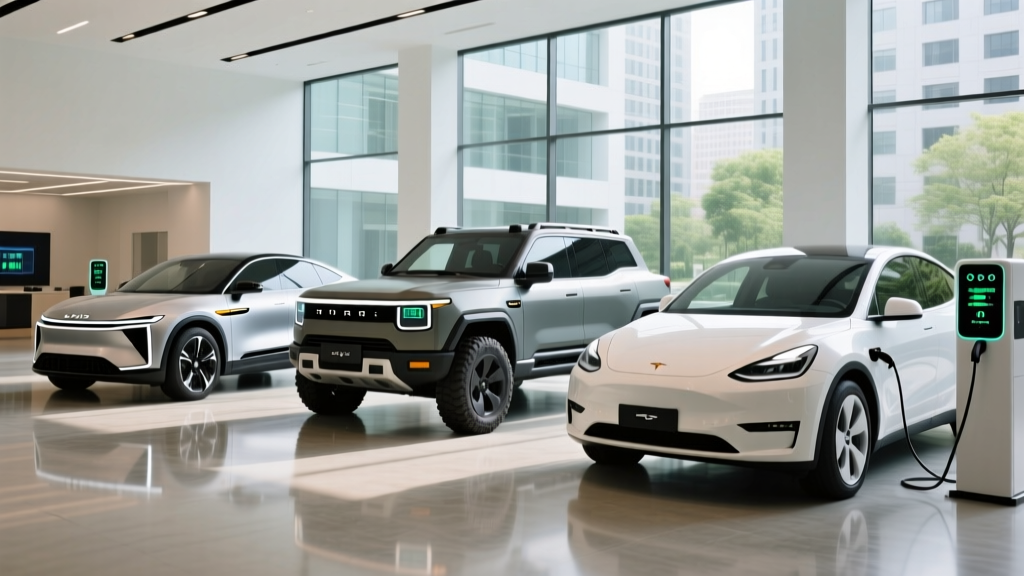
If you are browsing lucid rivian tesla trade-ins in 2026, you are likely weighing three very different philosophies of electric-vehicle ownership: Lucid's efficiency-first luxury sedans, Rivian's adventure-ready SUVs and trucks, and Tesla's tech-dense mass-market lineup. Each brand has distinct strengths in range, charging architecture, and long-term value — and the gaps between them matter far more than marketing brochures suggest.
This guide breaks down the current-model-year specs, real-world range expectations, charging realities, and federal tax credit eligibility across the three brands most frequently cross-shopped on the premium EV trade-in market. We will use the Lucid Air Pure, Rivian R1S (Dual-Motor), and Tesla Model Y Long Range AWD as representative benchmarks, since these are the highest-volume trade-in candidates in each lineup.
Quick Verdict: Which Brand Fits Your Trade-In Strategy?
Choose Lucid Air if: You prioritize maximum EPA range per kWh, sedan comfort, and the lowest energy cost per mile — and you can install a home Level 2 charger to avoid sparse public DC coverage.
Choose Rivian R1S/R1T if: You need three-row seating or a truck bed, plan to tow, value off-road capability, and want access to the expanding Rivian Adventure Network plus Tesla Superchargers via NACS.
Choose Tesla Model Y if: You want the lowest entry price after tax credits, the most reliable DC fast-charging network (Superchargers), and the strongest resale value in the EV segment.
Side-by-Side Spec Comparison
| Spec | 2026 Lucid Air Pure | 2026 Rivian R1S Dual-Motor | 2026 Tesla Model Y LR AWD |
|---|---|---|---|
| EPA Range | 419 mi | 330 mi (Max Pack: 410 mi) | 320 mi |
| Battery (usable) | 88 kWh, NMC | 106 kWh (Standard) / 141 kWh (Max), NMC | 75 kWh, NMC |
| Efficiency | 146 MPGe / 23 kWh/100mi | 86 MPGe / 39 kWh/100mi | 122 MPGe / 28 kWh/100mi |
| Max DC Fast Charge | 200 kW (peak) | 220 kW (peak) | 250 kW (peak) |
| 10–80% DC Time | ~25 min | ~27 min (Standard) / ~36 min (Max) | ~22 min |
| Level 2 Home Rate | 19.2 kW (80 mi/hr) | 11.5 kW (25 mi/hr) | 11.5 kW (44 mi/hr) |
| 0–60 mph | 5.0 sec | 4.5 sec | 4.8 sec |
| Horsepower | 430 hp | 533 hp | 384 hp |
| Drivetrain | RWD (single motor) | AWD (dual motor) | AWD (dual motor) |
| Cargo Volume | 32 cu ft (trunk+frunk) | 105 cu ft (behind 1st row) | 76 cu ft (behind 1st row) |
| Base MSRP | $69,900 | $79,900 | $47,990 |
| Battery Warranty | 8 yr / 100,000 mi | 8 yr / 175,000 mi | 8 yr / 120,000 mi |
Real-World Range: What the EPA Sticker Doesn't Tell You
Lucid Air Pure: EPA 419 mi — Real-world highway (70 mph, 75°F): ~350–370 mi. Cold weather (32°F, highway): ~280–310 mi. Lucid's class-leading efficiency means less cold-weather percentage loss than competitors, but highway speeds still cut 10–15% from the sticker.
Rivian R1S Dual-Motor (Standard Pack): EPA 330 mi — Real-world highway: ~260–280 mi. Cold weather: ~210–240 mi. The R1S's boxy aerodynamics and 6,800+ lb curb weight hit range hard above 65 mph. Towing a 5,000-lb trailer can cut range by 40–50%.
Tesla Model Y LR AWD: EPA 320 mi — Real-world highway: ~270–290 mi. Cold weather: ~220–250 mi. Tesla's heat pump and integrated thermal management help mitigate winter losses better than most non-Lucid competitors.
The single biggest variable in real-world range is sustained speed. All three vehicles lose roughly 15–20% of their EPA rating at a steady 75 mph compared to mixed city/highway driving. Cold weather compounds this: battery chemistry slows lithium-ion diffusion, cabin heating draws 3–6 kW continuously, and regenerative braking is restricted until the pack warms. For road-trip planning, budget 70–80% of the EPA number in winter and 85–90% in summer highway driving. According to fueleconomy.gov, these reductions are typical across the EV segment, not unique to any one brand.
Charging Speed and Network Access
| Charging Level | Lucid Air Pure | Rivian R1S | Tesla Model Y |
|---|---|---|---|
| Level 1 (120V, 1.4 kW) | ~4 mi/hr | ~3 mi/hr | ~5 mi/hr |
| Level 2 (240V, home) | 19.2 kW / 80 mi/hr | 11.5 kW / 25 mi/hr | 11.5 kW / 44 mi/hr |
| DC Fast (peak kW) | 200 kW | 220 kW | 250 kW |
| DC 10–80% time | ~25 min | ~27 min (Std) | ~22 min |
| Connector (2026) | CCS (NACS adapter avail.) | NACS (native) | NACS (native) |
| Primary DC Network | Electrify America + Supercharger (adapter) | Rivian Adventure Network + Supercharger | Tesla Supercharger |
Charging curve reality: Peak kW is not sustained kW. The Tesla Model Y peaks at 250 kW but tapers sharply above 50% SoC, averaging closer to 130–150 kW across a full 10–80% session. The Lucid Air holds its 200 kW peak longer (through ~40% SoC) thanks to a 900V-class architecture, resulting in competitive 10–80% times despite a lower peak number. The Rivian R1S Standard Pack charges briskly to 60%, then tapers to protect the large NMC pack; the Max Pack takes longer overall due to sheer battery volume.
Network advantage: Tesla's Supercharger network remains the most reliable DC fast-charging infrastructure in the US, with 99%+ uptime at most stations. Rivian owners gained Supercharger access via the NACS transition, but the Rivian Adventure Network (exclusively at adventure-destination locations) remains limited to roughly 60+ sites. Lucid owners rely primarily on Electrify America and third-party CCS networks, though a NACS adapter unlocks Supercharger stalls — at the cost of slightly reduced peak charge rates due to adapter protocol overhead.
For home charging, the Lucid Air's 19.2 kW onboard charger is a standout: it requires a 100-amp dedicated circuit and a hardwired wall connector, adding $800–$2,500 to electrical installation costs (panel upgrades may push this higher). The Rivian and Tesla both max out at 11.5 kW on a standard 48-amp Level 2 circuit, which is easier and cheaper to install in most homes.
Pricing, Tax Credits, and Trade-In Economics
| Model | Base MSRP | Federal §30D Credit | Effective Price | Eligible? |
|---|---|---|---|---|
| Lucid Air Pure | $69,900 | $0 (exceeds $55K sedan cap) | $69,900 | No — over MSRP cap |
| Rivian R1S Dual-Motor | $79,900 | $0 (exceeds $80K SUV cap on some configs; sourcing issues) | $79,900–$83,900 | Trim-dependent — see IRS rules |
| Tesla Model Y LR AWD | $47,990 | Up to $7,500 (point-of-sale transfer available) | ~$40,490 | Yes — if buyer income qualifies |
Federal EV tax credit eligibility under IRS §30D is the single biggest financial differentiator among these three brands. The credit has three hard gates:
- MSRP caps: $55,000 for sedans (Lucid Air is excluded), $80,000 for SUVs and trucks (Rivian R1S base qualifies, but loaded trims exceed the cap).
- Buyer income caps: $150K single / $225K head-of-household / $300K joint (modified AGI).
- Battery sourcing: Increasing percentages of critical minerals and battery components must be sourced from US free-trade-agreement partners — this requirement tightens annually and can disqualify otherwise eligible vehicles mid-year.
The Tesla Model Y is the only vehicle in this comparison that reliably qualifies for the full $7,500 credit in 2026, and it can be applied as a point-of-sale rebate at the dealer, reducing your out-of-pocket cost immediately. The Lucid Air Pure, as a sedan over $55K, does not qualify at all. The Rivian R1S is a moving target: base Dual-Motor trims under $80K may qualify, but adding the Max Pack or premium packages pushes the MSRP above the SUV cap. Always verify current eligibility on fueleconomy.gov before purchasing, as battery-sourcing compliance can change quarterly.
Trade-in implications: Tesla vehicles historically hold 55–65% of their MSRP after three years, driven by Supercharger network value and high demand in the used-EV market. Rivian resale values are strong for adventure-oriented buyers but soften for non-off-road owners who find the ride firm and efficiency poor. Lucid resale is the weakest of the three — the luxury sedan segment depreciates faster, and Lucid's smaller service network adds uncertainty for second-owners. If you plan to trade in within 3–5 years, the Model Y's lower entry price plus credit plus stronger retention produces the lowest total cost of ownership by a wide margin.
Performance, Cargo, and Daily Usability
The three vehicles serve fundamentally different use cases, which is why spec-sheet comparisons only go so far:
Lucid Air Pure (RWD, 430 hp): 0–60 in 5.0 seconds is quick for a sedan, but the real story is the Space Concept interior — rear legroom of 36.5 inches rivals a Mercedes S-Class, and the 32 cu ft combined trunk/frunk is generous for the segment. The 19.2 kW AC charger means a full overnight charge from 20% in roughly 4 hours. The glass canopy roof creates an airy cabin but increases solar heat load in summer (preconditioning helps). Drawbacks: no AWD option on the Pure, limited service centers outside major metros, and the infotainment system, while beautiful, lacks Apple CarPlay/Android Auto — a dealbreaker for some luxury buyers accustomed to phone projection.
Rivian R1S Dual-Motor (AWD, 533 hp): 0–60 in 4.5 seconds in a 6,800-lb three-row SUV is genuinely quick. Ground clearance adjusts from 6.2 to 14.9 inches via air suspension, and the R1S can tow up to 7,700 lbs — more than most body-on-frame SUVs. Cargo volume reaches 105 cu ft behind the first row, and the frunk adds another 11 cu ft. The camp kitchen accessory and Gear Tunnel (on the R1T truck) are legitimately useful for overlanding. Drawbacks: energy consumption is the worst in this comparison at 39 kWh/100mi, meaning higher charging costs per mile. The third row fits children only. And highway road noise is noticeable above 70 mph due to the squared-off body.
Tesla Model Y LR AWD (384 hp): 0–60 in 4.8 seconds, 76 cu ft of cargo space, and a usable (if tight) third-row option for small children. The 15-inch touchscreen handles everything — no physical buttons — which some love and others find distracting. Tesla's FSD (Supervised) remains a SAE Level 2 driver-assist system requiring full driver engagement, despite the "Full Self-Driving" name. The panoramic glass roof, minimal sound deadening, and firm ride are common complaints. But the Supercharger network, over-the-air updates, and lowest cost-per-mile in this group make it the pragmatic winner for commuters and small families.
Battery Longevity and Warranty Coverage
All three manufacturers use NMC (nickel-manganese-cobalt) lithium-ion chemistries in the trims profiled here. NMC offers higher energy density than LFP (lithium iron phosphate), which is why these longer-range variants use it — but NMC degrades slightly faster over time and is more sensitive to sustained high SoC storage.
| Factor | Lucid Air | Rivian R1S | Tesla Model Y |
|---|---|---|---|
| Chemistry | NMC (2170 cells) | NMC (2170 cells, Samsung) | NMC (4680 cells, Tesla) |
| Battery Warranty | 8 yr / 100,000 mi | 8 yr / 175,000 mi | 8 yr / 120,000 mi |
| Capacity Threshold | 70% retention | 70% retention | 70% retention |
| Estimated Replacement | $18,000–$25,000 | $20,000–$30,000 | $12,000–$16,000 |
| Real-World Degradation (3yr/45K mi) | ~5–7% loss | ~6–8% loss | ~5–8% loss |
Rivian offers the strongest battery warranty mileage at 175,000 miles — meaningful for high-mileage drivers and commercial use. Tesla's 4680 cell architecture is designed for lower manufacturing cost and improved thermal management, though long-term degradation data on 4680 packs is still accumulating compared to the proven 2170 format used by Lucid and Rivian. For all three, keeping daily charge between 20–80% SoC and avoiding repeated DC fast-charging to 100% will extend pack life well beyond the warranty period.
Driver Assistance and Smart Features
Important: All three brands offer SAE Level 2 driver-assist systems. This means the driver must remain fully attentive, with hands on or near the wheel, at all times. None of these vehicles are "self-driving." Only Level 4 services like Waymo operate without a human driver, and those are limited to geofixed robotaxi zones.
Tesla Autopilot / FSD (Supervised): The most capable and most controversial. FSD handles highway lane changes, off-ramps, and city intersections with increasing competence, but still requires active supervision and can make unpredictable decisions at construction zones or unmapped intersections. Monthly subscription ($99/mo) or $8,000 outright purchase. Autopilot (basic adaptive cruise + lane centering) is included standard.
Rivian Driver+: Adaptive cruise with lane centering, automatic lane changes on highways, and a driver-monitoring camera. Less aggressive than Tesla's FSD in city scenarios — Rivian limits hands-off-highway features and focuses on reliability over feature breadth. Included with the vehicle, no subscription.
Lucid DreamDrive Pro: 32 sensors including LiDAR (a hardware advantage Tesla lacks), excellent highway cruising, and smooth lane-keeping. City-street automation is more limited. The LiDAR provides superior depth perception in rain and low-light conditions. Included on higher trims, subscription-based on Air Pure.
Pros and Cons at a Glance
Lucid Air Pure
Pros:
- Best-in-class efficiency (23 kWh/100mi)
- 419 mi EPA range — longest of any production sedan
- 19.2 kW AC charging — fastest home charge in the segment
- Luxury sedan rear-seat comfort and quietness
Cons:
- No federal tax credit (over $55K sedan cap)
- RWD only on Pure trim — no AWD option
- Sparse service center network outside major metros
- No Apple CarPlay or Android Auto
Rivian R1S Dual-Motor
Pros:
- Three rows, 7,700-lb towing, air suspension off-road capability
- 175,000-mi battery warranty — best in class
- NACS native — full Supercharger access
- Adventure-ready accessories and community
Cons:
- Worst efficiency in the group (39 kWh/100mi)
- Real-world highway range drops sharply above 70 mph
- Heavy — 6,800+ lbs affects tire wear and braking
- Tax credit eligibility is trim-dependent and sourcing-variable
Tesla Model Y LR AWD
Pros:
- ~$40,490 after $7,500 federal credit (if eligible)
- Supercharger network — best DC reliability in the US
- Strongest EV resale value in the segment
- OTA updates continuously add features
Cons:
- Firm ride, minimal sound deadening
- No Apple CarPlay / Android Auto
- FSD requires subscription and constant supervision
- Build quality inconsistency (panel gaps, trim rattle)
Frequently Asked Questions
What is the real-world range of these EVs on a road trip?
At sustained 70–75 mph highway speeds in moderate weather, expect ~350–370 mi from the Lucid Air Pure, ~260–280 mi from the Rivian R1S Standard Pack, and ~270–290 mi from the Tesla Model Y LR. In winter (below freezing), subtract another 15–25%. Plan charging stops around 200–250 mi apart for comfort.
How fast do they charge at home overnight?
The Lucid Air charges fastest at home if you install a 19.2 kW hardwired station — roughly 80 miles of range per hour, or a full 10–100% charge in about 5 hours. The Tesla Model Y adds ~44 miles per hour on an 11.5 kW Level 2 (standard 48-amp circuit), enough for most daily needs. The Rivian R1S adds ~25 miles per hour at the same 11.5 kW — its large battery means a full charge takes 10+ hours.
Does the Lucid Air qualify for the $7,500 federal EV tax credit?
No. The Lucid Air Pure has an MSRP of $69,900, which exceeds the $55,000 sedan cap under IRS §30D. No Lucid Air trim currently qualifies for the federal new-vehicle credit. Used Lucid Air models may qualify for the $4,000 used-EV credit if the sale price is under $25,000 and buyer income limits are met.
Can I use Tesla Superchargers with a Rivian or Lucid?
Yes, with caveats. Rivian R1S and R1T vehicles built from 2025 onward ship with a native NACS port and full Supercharger access. Older Rivians require a Tesla-approved NACS adapter. Lucid Air vehicles use CCS and require a NACS adapter for Supercharger access; peak charge rates may be slightly reduced through the adapter.
Which holds its value best for a future trade-in?
Tesla Model Y leads in resale value retention, typically holding 55–65% of MSRP at three years. The Rivian R1S holds well among adventure-oriented buyers but depreciates faster for non-off-road use cases. The Lucid Air depreciates most steeply, consistent with the luxury sedan segment broadly — expect 40–50% retention at three years.
Is it worth buying a Rivian over a Tesla Model Y if I don't off-road?
Only if you need three-row seating, significant cargo/towing capacity, or prefer the SUV driving position. For pure commuting efficiency, charging convenience, and total cost of ownership, the Model Y wins decisively. The Rivian's energy consumption (39 kWh/100mi vs Tesla's 28) means ~40% higher electricity costs per mile.
What happens to the battery after the warranty expires?
NMC batteries in these vehicles typically retain 80–90% of original capacity at 100,000 miles based on current fleet data. Out-of-warranty replacement costs range from $12,000 (Tesla) to $30,000 (Rivian Max Pack), but full replacements are rare — individual module repairs are more common and significantly cheaper. Most EV batteries outlast the vehicles they are installed in.