Why EV Shoppers Are Searching for the Lucid Reverse Split Date
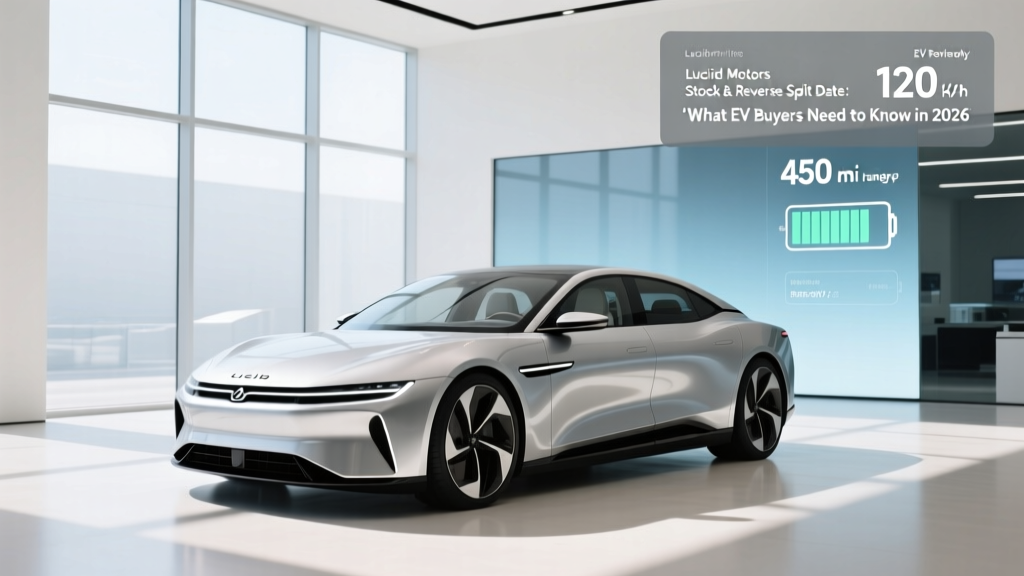
When a publicly traded automaker's stock price drops below exchange listing thresholds, a reverse stock split often follows. For Lucid Group (NASDAQ: LCID), investor attention has centered on the Lucid reverse split date — the point at which outstanding shares are consolidated to boost per-share price and maintain NASDAQ compliance. But if you're shopping for a Lucid Air in 2026, the financial mechanics matter less than the practical question: does a reverse split signal risk for the company's long-term viability, and should it affect your decision to buy one of the longest-range EVs on the market?
This guide breaks down what the reverse split means for buyers, then delivers a complete, spec-driven review of the 2026 Lucid Air lineup — range, charging, pricing, tax credits, and ownership realities — so you can evaluate the car on its merits while understanding the business context.
What a Reverse Stock Split Means for Lucid Buyers
A reverse stock split consolidates existing shares into fewer, higher-priced shares. For example, a 1-for-10 reverse split turns 10 shares priced at $1.50 into 1 share priced at $15.00. The company's total market capitalization doesn't change; only the share count and per-share price adjust.
Companies typically pursue reverse splits to:
- Regain compliance with NASDAQ's minimum bid-price rule (shares must close at $1.00+ for 30 consecutive days)
- Improve institutional investor perception (many funds avoid sub-$5 stocks)
- Reduce share count after dilution from capital raises
What it does NOT mean: A reverse split is not a bankruptcy filing, a recall, or a production shutdown. Lucid continues to manufacture the Air at its Casa Grande, Arizona factory and has delivered vehicles throughout periods of stock volatility. However, buyers should be aware that financial pressure can affect dealer expansion, service-center growth, software update cadence, and long-term parts availability.
Lucid's exact reverse split date depends on shareholder approval and board authorization. Investors should check Lucid's investor relations page for official filings. For car buyers, the more relevant metrics are whether Lucid can sustain production, honor warranties, and expand its service network — factors we'll evaluate below.
2026 Lucid Air: Full Model Lineup at a Glance
| Spec | Air Pure | Air Touring | Air Grand Touring | Air Sapphire |
|---|---|---|---|---|
| EPA Range | 410 mi | 425 mi | 516 mi | 427 mi |
| Battery (usable) | 88 kWh | 112 kWh | 112 kWh | 118 kWh |
| Chemistry | NMC | NMC | NMC | NMC |
| Drivetrain | RWD (single motor) | AWD (dual motor) | AWD (dual motor) | AWD (tri-motor) |
| Horsepower | 430 hp | 620 hp | 819 hp | 1,234 hp |
| 0-60 mph | 5.0 sec | 3.4 sec | 3.0 sec | 1.89 sec |
| Max DC Charge | 200 kW | 250 kW | 300 kW | 300 kW |
| 10-80% DC Time | ~30 min | ~25 min | ~20 min | ~22 min |
| Level 2 Rate | 19.2 kW (~70 mi/hr) | 19.2 kW (~70 mi/hr) | 19.2 kW (~70 mi/hr) | 19.2 kW (~70 mi/hr) |
| MPGe (combined) | 146 MPGe | 134 MPGe | 131 MPGe | 110 MPGe |
| Base MSRP | $69,900 | $87,400 | $125,600 | $249,000 |
Source: EPA fueleconomy.gov and Lucid Motors official specs. Figures reflect 2026 model year.
Real-World Range vs. EPA Estimates
EPA sticker: Up to 516 miles (Grand Touring with 19" Aero wheels).
Real-world highway (70-80 mph, moderate climate): Expect ~400-440 miles from the Grand Touring, ~330-360 from the Pure. Lucid's efficiency is best-in-class, but sustained high speeds reduce range by roughly 15-20%.
Cold-weather impact (below 32°F): Plan for a 20-30% range reduction. The Air's liquid thermal management and available heat pump mitigate losses, but sub-freezing temps still increase battery resistance and cabin heating draw. Preconditioning while plugged in recovers significant range.
Bottom line: The Grand Touring's real-world range still exceeds nearly every competitor's EPA sticker — but 516 miles requires ideal conditions (55 mph, 70°F, minimal HVAC).
Charging Speed: DC Fast Charging and Home Level 2
Lucid's 900-volt electrical architecture enables some of the fastest DC charging in the production EV market. Here's what that translates to at the plug:
| Charging Level | Pure | Touring | Grand Touring / Sapphire |
|---|---|---|---|
| DC Fast Charge (peak kW) | 200 kW | 250 kW | 300 kW |
| 10-80% Time (350 kW charger) | ~30 min | ~25 min | ~20 min |
| Miles Added in 15 Min | ~150 mi | ~200 mi | ~300 mi |
| Level 2 (Home, 19.2 kW) | ~70 mi/hr | ~70 mi/hr | ~70 mi/hr |
| Level 2 Full Charge (0-100%) | ~5.5 hr | ~7 hr | ~7 hr |
| Level 1 (120V, 12A) | ~3 mi/hr | ~3 mi/hr | ~3 mi/hr |
Charge-curve reality check: The Grand Touring's 300 kW peak is sustained only between roughly 10-40% State of Charge (SoC). Above 60%, the rate tapers significantly — typical of all lithium-ion batteries to protect cell longevity. If you arrive at a DC fast charger at 30% and charge to 80%, your average rate will be closer to 180-220 kW, not the 300 kW peak. This is normal, and the 20-minute 10-80% figure accounts for this taper.
Connector note: Lucid currently uses the CCS1 connector for DC fast charging. With the industry's shift to NACS (Tesla's connector), Lucid has announced NACS adoption for future models and will provide adapters for existing Air owners to access Tesla Supercharger stations. Check Lucid's charging page for the latest adapter availability timeline.
Home charging: The Air supports 19.2 kW Level 2 charging (80A), which requires a hardwired wall connector on a 100A dedicated circuit. Most homes need a panel upgrade (200A service minimum) and professional installation. Budget $1,200-$3,500 for the complete home charging setup, including the wall connector, electrical work, and permits. At 19.2 kW, you'll add roughly 70 miles of range per hour — enough to fully replenish even the Grand Touring overnight.
Pricing, Trims, and Federal Tax Credit Eligibility
The 2026 Lucid Air lineup spans from accessible luxury to hypercar territory. Here's the pricing breakdown and how IRS §30D tax credit rules apply:
| Trim | Base MSRP | As-Tested (typical options) | §30D Credit Eligible? |
|---|---|---|---|
| Air Pure | $69,900 | $72,000-$76,000 | Yes (meets MSRP cap) |
| Air Touring | $87,400 | $92,000-$98,000 | No (exceeds $55,000 sedan cap) |
| Air Grand Touring | $125,600 | $130,000-$140,000 | No (exceeds $55,000 sedan cap) |
| Air Sapphire | $249,000 | $255,000+ | No (exceeds $55,000 sedan cap) |
IRS §30D federal tax credit rules (2026): The Air Pure is the only trim that falls under the IRS clean vehicle credit MSRP cap of $55,000 for sedans. However, eligibility also depends on:
- Buyer income caps: AGI must not exceed $150,000 (single), $225,000 (head of household), or $300,000 (joint filing)
- Battery sourcing: Critical minerals and battery components must meet escalating domestic/FHA-partner sourcing percentages — Lucid's supply-chain compliance varies by production batch
- Point-of-sale transfer: Qualified buyers can apply the credit as an immediate price reduction at purchase rather than waiting for tax filing
Bottom line: Only the Air Pure has a realistic path to the full $7,500 credit, and even then, battery-sourcing rules may reduce the amount. Touring, Grand Touring, and Sapphire buyers should not factor the federal credit into their purchase budget. Consult a tax professional for your specific situation.
Interior, Technology, and Daily Livability
The Air's cabin is a study in minimalist luxury — a 34-inch curved glass cockpit display dominates the dash, with a retractable lower touchscreen for secondary controls. Build quality has improved markedly since early 2022 deliveries, though some reviewers note panel-gap variance between individual vehicles.
Cargo and passenger space:
- Rear trunk: 22.1 cu ft (32.1 cu ft with rear seats folded)
- Front trunk (frunk): 10.0 cu ft
- Total cargo: 32.1 cu ft behind rear seats
- Rear legroom: 41.3 inches (class-leading for the sedan segment)
- Front headroom: 39.3 inches
- Seating: 5-passenger capacity
Driver assistance: Lucid's DreamDrive Pro system uses lidar, radar, and cameras to provide adaptive cruise control, lane-centering, and automatic emergency braking. This is a SAE Level 2 driver-assistance system — the driver must remain fully engaged with hands on the wheel and eyes on the road. It is not autonomous driving. DreamDrive performs well on highways but does not offer hands-free operation like GM's Super Cruise or Ford's BlueCruise on mapped roads.
Notable tech features:
- Over-the-air (OTA) software updates for powertrain, infotainment, and ADAS improvements
- Native route planning with automatic battery preconditioning for DC fast charging
- HEPA air filtration with bioweapon-defense mode
- Available glass canopy roof (electrochromic dimming on upper trims)
- 21-speaker Surreal Sound Pro audio system (Touring and above)
Drawbacks worth noting:
- Infotainment lacks native Apple CarPlay / Android Auto (Lucid uses a proprietary system with phone-mirroring via a separate app)
- Service center footprint remains limited outside major metro areas — mobile service covers some regions but not all
- No official towing rating (the Air is a sedan, not designed for towing)
- Touchscreen-dependent climate controls can be distracting while driving
Warranty, Longevity, and Battery Degradation
Lucid backs the Air with competitive warranty coverage:
- Basic vehicle warranty: 4 years / 50,000 miles
- Battery and powertrain: 8 years / 100,000 miles (retains ≥70% capacity)
- Corrosion warranty: 5 years / unlimited miles
- Roadside assistance: 4 years / 50,000 miles
Battery chemistry and degradation: All Air trims use NMC (nickel manganese cobalt) lithium-ion cells, which offer higher energy density than LFP but are more sensitive to sustained high-SoC storage. Real-world data from early 2022-2023 Air owners suggests degradation of approximately 5-8% over the first 50,000 miles — within industry norms. Lucid's thermal management system actively cools and heats the pack to minimize wear.
Battery replacement cost: Out-of-warranty replacement for the 112 kWh pack is estimated at $20,000-$28,000 based on current industry pricing for packs of this capacity. This is a worst-case scenario — most owners will never need a full pack replacement within the vehicle's typical ownership period.
Pros
- Best-in-class EPA range (516 mi Grand Touring)
- Industry-leading efficiency (kWh per mile)
- 300 kW DC fast charging on GT/Sapphire
- Massive rear-seat legroom (41.3 in)
- 900V architecture future-proofs charging
- Smooth, quiet ride quality
Cons
- Only Air Pure qualifies for §30D credit (and only partially)
- Limited service-center network vs. Tesla, BMW
- No Apple CarPlay / Android Auto
- DreamDrive is Level 2 only — no hands-free driving
- Company financial uncertainty (reverse split context)
- High insurance premiums (luxury EV segment)
Lucid Air vs. Key Competitors
The Air competes against luxury electric sedans and performance-oriented EVs. Here's how it stacks up on the metrics that matter:
| Vehicle | EPA Range | Max DC kW | 0-60 mph | Starting MSRP |
|---|---|---|---|---|
| Lucid Air Grand Touring | 516 mi | 300 kW | 3.0 sec | $125,600 |
| Tesla Model S Long Range | 402 mi | 250 kW | 3.1 sec | $79,990 |
| BMW i7 xDrive50 | 318 mi | 195 kW | 4.5 sec | $120,295 |
| Mercedes EQS 580 | 345 mi | 200 kW | 4.1 sec | $108,550 |
| Porsche Taycan Turbo S | 283 mi | 320 kW | 2.4 sec | $195,900 |
The verdict: The Air Grand Touring leads on range and efficiency. The Tesla Model S wins on charging infrastructure (Supercharger network) and price. The BMW i7 and Mercedes EQS offer more traditional luxury dealer networks and service accessibility. The Porsche Taycan charges fastest but sacrifices range for performance. Your priority — range, infrastructure, service, or performance — determines the winner.
Who Should Buy the Lucid Air (and Who Shouldn't)
Choose the Lucid Air if:
- Maximum range is your top priority (Grand Touring's 516 mi EPA is unmatched)
- You have reliable home Level 2 charging and mostly drive within the car's single-charge envelope
- You value efficiency (kWh/mi) as much as performance
- You live near a Lucid service center or in a mobile-service coverage area
- You want a sedan with genuine rear-seat comfort for adults on long trips
Look elsewhere if:
- You need extensive public-charging infrastructure (Tesla's Supercharger network is more mature)
- You want hands-free highway driving (GM Super Cruise or Ford BlueCruise offer this on mapped roads)
- Service accessibility in rural areas is critical (BMW, Mercedes have broader dealer networks)
- Company financial stability concerns outweigh the product's merits for you
- You need Apple CarPlay or Android Auto integration
Frequently Asked Questions
What is the real-world range of the Lucid Air?
The Grand Touring achieves up to 516 miles EPA, but expect 400-440 miles in real-world highway driving at 70-80 mph. In cold weather (below 32°F), plan for 330-380 miles. The Air Pure delivers ~410 miles EPA, with real-world highway range around 330-360 miles. Lucid's efficiency is genuinely best-in-class, but physics still applies at speed and in extreme temperatures.
How fast does the Lucid Air charge at home and on the road?
At a 350 kW DC fast charger, the Grand Touring peaks at 300 kW and charges from 10-80% in approximately 20 minutes. At home on a 19.2 kW Level 2 charger, all trims add about 70 miles of range per hour, fully replenishing overnight. On a standard 120V outlet (Level 1), expect roughly 3 miles per hour — adequate for emergency top-ups only.
Does the Lucid Air qualify for the $7,500 federal EV tax credit?
Only the Air Pure ($69,900 MSRP) falls under the IRS §30D $55,000 sedan MSRP cap, and even then, eligibility depends on buyer income limits, battery-sourcing compliance, and AGI thresholds. The Touring ($87,400), Grand Touring ($125,600), and Sapphire ($249,000) all exceed the cap and do not qualify. Always verify current-year rules on irs.gov and consult a tax professional.
Is the Lucid Air worth buying despite the company's stock volatility?
The Air is an objectively excellent EV — class-leading range, fast charging, spacious cabin, and strong build quality. The reverse split and stock price reflect financial-market dynamics, not product defects. However, buyers should weigh the risk of a smaller service network, potential long-term parts availability concerns, and limited resale-value data compared to established luxury brands. If you can access service easily and the product merits outweigh business-side uncertainty, the Air is a compelling choice.
How does the Lucid Air compare to the Tesla Model S?
The Air Grand Touring offers 114 more miles of EPA range (516 vs 402) and faster DC charging (300 vs 250 kW peak). The Model S costs significantly less ($79,990 vs $125,600), has access to the mature Supercharger network, offers a more established service footprint, and provides a more feature-rich (if controversial) driver-assist system. Choose the Air for maximum range and efficiency; choose the Model S for infrastructure access and price.
What happens to my Lucid warranty if the company faces financial trouble?
Warranties are contractual obligations. Even in restructuring scenarios, warranty claims are typically honored or assumed by a successor entity. However, the practical ability to get warranty work done depends on service-center availability and parts supply. Buyers concerned about long-term support should factor this into their decision and consider purchasing from a brand with a larger service footprint if peace of mind is paramount.