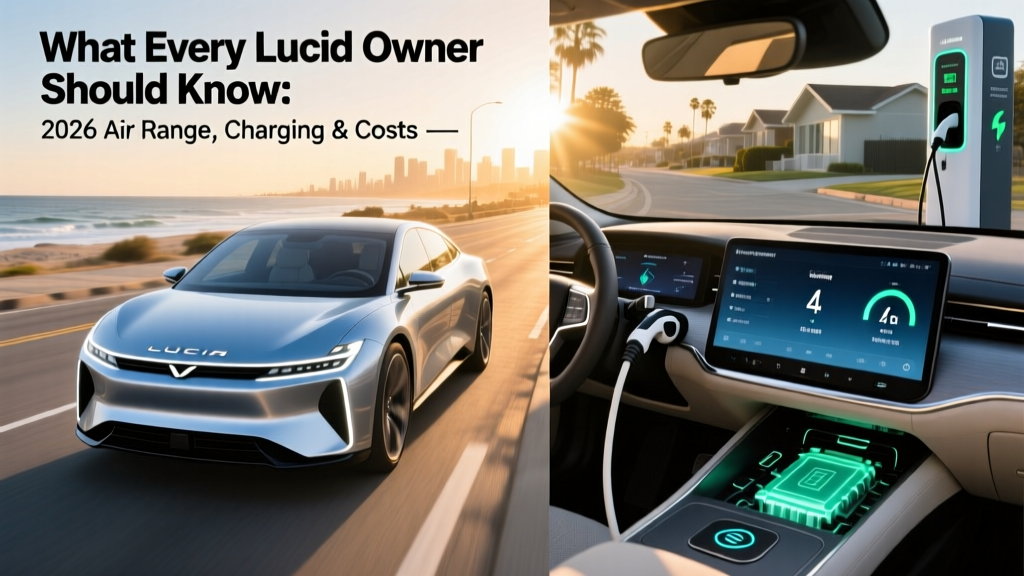
If you're researching life as a Lucid owner in 2026, you're likely weighing one of the most efficient luxury electric sedans on the market against established rivals from Tesla, Mercedes-Benz, and BMW. The Lucid Air earns its reputation on engineering density: class-leading range, a 900-volt architecture enabling some of the fastest DC charging available, and a cabin that punches above its price class in material quality. But ownership reality involves more than spec-sheet superlatives.
This guide breaks down what actual Lucid Air ownership looks like — from real-world range reconciliation and charging logistics to total cost of ownership, tax credit eligibility under current IRS §30D rules, and the practical trade-offs that don't appear in press releases. Whether you're considering the Air Pure, Touring, Grand Touring, or the Sapphire performance halo, here's the data you need.
Lucid Air Lineup at a Glance: 2026 Specs and Pricing
Lucid streamlined the Air lineup for the 2026 model year. The Pure serves as the value-oriented entry point with a single-motor RWD configuration, while the Touring and Grand Touring offer dual-motor AWD with increasing battery capacity and output. The Sapphire remains the limited-volume performance flagship.
| Spec | Air Pure | Air Touring | Air Grand Touring | Air Sapphire |
|---|---|---|---|---|
| Base MSRP | $69,900 | $87,400 | $112,900 | $250,500 |
| EPA Range | 419 mi | 425 mi | 516 mi | 427 mi |
| Battery (usable) | 88 kWh (NMC) | 112 kWh (NMC) | 112 kWh (NMC) | 118 kWh (NMC) |
| Drivetrain | RWD (single motor) | AWD (dual motor) | AWD (dual motor) | AWD (tri-motor) |
| Horsepower | 430 hp | 620 hp | 819 hp | 1,234 hp |
| 0–60 mph | 5.0 sec | 3.4 sec | 3.0 sec | 1.89 sec |
| EPA Efficiency | 146 MPGe / 23 kWh/100mi | 131 MPGe / 26 kWh/100mi | 130 MPGe / 26 kWh/100mi | 109 MPGe / 31 kWh/100mi |
| Max DC Charge Rate | 200 kW | 300 kW | 300 kW | 300 kW |
| 10–80% DC Time | ~28 min | ~22 min | ~25 min | ~24 min |
All trims share the same basic body structure and interior dimensions. The primary differentiators are powertrain output, battery capacity, and the software-defined feature set included at each tier. Destination charges add approximately $1,295 to every configuration.
Real-World Range: What the EPA Sticker Doesn't Tell You
EPA Estimated: 516 miles
Real-World Highway (70 mph, moderate climate): ~410–440 miles
Real-World Highway (cold weather, 30°F): ~340–380 miles
Mixed Commute (city/suburban): ~460–490 miles
Source: fueleconomy.gov EPA data; real-world estimates based on independent road testing and owner-reported data aggregated from Lucid community forums.
The Lucid Air Grand Touring's 516-mile EPA rating is the highest of any production EV sold in the United States. That number is achievable — but primarily in city-dominant driving at moderate speeds in temperate weather, where regenerative braking recovers energy and the heat pump minimizes cabin heating draw.
Highway driving changes the equation. At sustained 70–75 mph speeds, aerodynamic drag becomes the dominant energy consumer, and you should expect roughly 80–85% of the EPA sticker. In cold weather (below freezing), the battery's internal resistance increases and cabin heating demands rise even with Lucid's standard heat pump, pushing real-world range down to roughly 65–75% of the EPA figure on highway trips.
The Air Pure and Touring, with smaller batteries, see proportionally similar reductions. For road-trip planning, budgeting 350–380 miles between stops in the Grand Touring (and 280–320 in the Pure) provides a comfortable margin without pushing the battery to critically low states of charge.
Charging Speed and Infrastructure: The 900V Advantage
Lucid's 900-volt electrical architecture is one of the highest in the industry, matched only by Hyundai/Kia's E-GMP platform and the Porsche Taycan. Higher voltage enables faster charging at lower current, reducing heat generation and enabling sustained charge rates closer to the peak.
| Charging Level | Power / Rate | Miles Added per Hour | Notes |
|---|---|---|---|
| Level 1 (120V household) | ~1.4 kW | ~3–4 mi/hr | Emergency/trickle only |
| Level 2 (240V, 48A home charger) | 11.5 kW | ~36–40 mi/hr | Full overnight charge in 10–12 hrs |
| DC Fast Charge (Touring/GT/Sapphire) | Peak 300 kW | ~600+ mi/hr (peak) | 10–80% in ~22–25 min at compatible stations |
| DC Fast Charge (Pure) | Peak 200 kW | ~400 mi/hr (peak) | 10–80% in ~28 min |
A critical ownership note: achieving the peak 300 kW charge rate requires a DC fast charger capable of delivering that power — currently a limited subset of Electrify America's 350 kW stations, select Tesla Supercharger V4 stalls with the NACS adapter (included with 2026 models), and a growing number of high-power third-party chargers. On 150 kW chargers, expect 10–80% times closer to 35–40 minutes.
The charge curve on the Air is relatively flat compared to many competitors. Lucid sustains above 200 kW through approximately 55% state of charge before tapering, meaning the 10–80% time isn't front-loaded with a brief peak followed by a long tail. This matters practically: you spend less total time at the charger compared to vehicles that advertise high peak rates but can't hold them.
For home charging, Lucid recommends a 60-amp circuit with a 48-amp continuous charger (such as the Lucid Connected Home charger or a ChargePoint Home Flex). At 11.5 kW, even the 112 kWh battery in the Grand Touring reaches full charge overnight from near-empty. Most owners who charge at home daily never need to use DC fast charging except on road trips.
Driving Experience, Interior, and Technology
The Air's driving dynamics reflect its engineering origins. Lucid's CEO and CTO Peter Rawlinson previously served as chief engineer on the Tesla Model S, and the Air's motor and inverter technology is notably compact — the entire drive unit fits in a carry-on suitcase, freeing cabin and cargo space.
Performance: Even the base Pure delivers brisk acceleration at 430 hp and a 5.0-second 0–60 time. The Grand Touring's 819 hp and 3.0-second sprint place it in supercar territory, while the Sapphire's 1,234 hp and sub-2-second 0–60 make it one of the quickest production cars ever built. All trims feature adaptive air suspension with automatic ride-height adjustment.
Interior space: The Air offers 108.3 cubic feet of passenger volume with 41.3 inches of front legroom and 36.6 inches of rear legroom — competitive with the BMW 5 Series and Mercedes E-Class despite the Air's lower roofline. Cargo capacity totals 32 cubic feet combined (22.1 cu ft trunk, 10.0 cu ft frunk), enough for a week's luggage for four adults.
Infotainment: Lucid uses a 34-inch curved glass cockpit display (dubbed the "Canopy") that floats above the dashboard, supplemented by a lower retractable touchscreen for secondary controls. The system runs Lucid's proprietary software — responsive and visually clean, though the app ecosystem is smaller than Tesla's. Wireless Apple CarPlay and Android Auto are standard, as is a 21-speaker Surreal Sound Pro audio system on Touring and above.
Driver assistance: Lucid's DreamDrive Pro system uses a suite of cameras, radar, and LiDAR (a roof-mounted sensor unique in this class) to enable highway lane-centering, adaptive cruise, and automatic lane changes. This is an SAE Level 2 system — the driver must remain fully engaged and supervising at all times. It is not autonomous driving. DreamDrive Pro is competent on highways but doesn't yet match Tesla's FSD (Supervised) or GM's Super Cruise in hands-free operational design domains.
Pricing, Tax Credits, and Ownership Costs
The Lucid Air's value proposition depends heavily on federal tax credit eligibility and how you configure the vehicle. Here's how the 2026 pricing breaks down with potential incentives.
| Trim | Base MSRP | As-Tested (typical config) | §30D Credit Eligible? | Effective Price (after credit) |
|---|---|---|---|---|
| Air Pure | $69,900 | $72,500 | Partial — up to $3,750* | ~$68,750 |
| Air Touring | $87,400 | $92,000 | Partial — up to $3,750* | ~$88,250 |
| Air Grand Touring | $112,900 | $118,000 | Partial — up to $3,750* | ~$114,250 |
| Air Sapphire | $250,500 | $255,000 | No (MSRP cap exceeded) | $255,000 |
*Under current IRS §30D rules, the federal EV tax credit provides up to $7,500 for qualifying new EVs. However, sedans must have an MSRP at or below $55,000 to qualify for the full credit. The Air Pure's $69,900 base price exceeds this cap. As of 2026, certain Air configurations may qualify for the $3,750 critical minerals component if battery sourcing requirements are met, but full $7,500 eligibility is unlikely for sedan-priced Airs. Buyer income caps also apply ($150K single / $300K joint AGI). Always consult a tax professional and verify current rules at irs.gov before relying on credit projections. Point-of-sale transfer is available through participating dealers.
Five-year ownership cost estimate (Grand Touring, 15,000 mi/yr):
- Electricity (home charging at $0.14/kWh national avg): ~$4,200
- Maintenance (tire rotation, cabin filter, fluid top-off): ~$1,800
- Insurance (national avg for luxury EV sedan): ~$14,000
- Estimated depreciation (5-year): ~$52,000
- Total estimated 5-year cost: ~$72,000 (excluding purchase price, including depreciation)
Compared to a BMW i5 or Mercedes EQE, the Air's electricity costs are lower thanks to its superior efficiency (fewer kWh consumed per mile), but insurance premiums run 10–15% higher due to the Air's repair cost profile and limited body-shop network.
Pros and Cons of Lucid Ownership
Pros
- Class-leading EPA range (516 mi Grand Touring)
- Outstanding efficiency — fewer kWh per mile than any luxury EV sedan
- 300 kW peak DC charging with sustained charge curve
- Spacious interior with genuine adult rear-seat comfort
- Refined ride quality via standard adaptive air suspension
- LiDAR-equipped DreamDrive Pro sensor suite
- Over-the-air updates adding features post-purchase
Cons
- Limited service center network — many owners rely on mobile service or ship-to-factory repairs
- Infotainment app ecosystem smaller than Tesla or Android Automotive competitors
- DreamDrive Pro ADAS lags Tesla FSD and GM Super Cruise in hands-free capability
- Higher insurance premiums vs. German luxury EV rivals
- Brand-new company — long-term parts availability and resale value less proven
- Federal tax credit largely unavailable due to MSRP cap on sedans
- No Apple CarPlay-native deep integration (wireless projection only)
Lucid Air vs. the Competition: Which Luxury EV Sedan Wins?
The Air competes in a segment that now includes the Tesla Model S, BMW i5, Mercedes-Benz EQE, Audi e-tron GT, and Porsche Taycan. Each makes different trade-offs:
- Range champion: Lucid Air Grand Touring (516 mi) leads by a wide margin. The closest competitor, the Tesla Model S Long Range, achieves ~402 mi EPA.
- Charging speed: The Air's 300 kW peak is matched by the Porsche Taycan and Audi e-tron GT, but Lucid's sustained curve holds higher average power. Tesla's V4 Superchargers peak around 250 kW for Model S.
- Efficiency: The Air Pure at 23 kWh/100mi is the most efficient luxury sedan EV available. The BMW i5 eDrive40 achieves ~27 kWh/100mi.
- Driver assistance: Tesla FSD (Supervised) offers the broadest operational domain, though still Level 2. GM's Super Cruise offers hands-free on mapped highways. Lucid's DreamDrive Pro is competent but more conservative.
- Service network: BMW, Mercedes, and Audi have vast dealer networks. Tesla's mobile service fleet is large. Lucid's service footprint remains the smallest among these competitors — a genuine ownership consideration if you live outside a major metro area.
- Price: The Air Pure at $69,900 undercuts the Model S ($79,990), Taycan ($92,000+), and EQE ($76,000+). The value proposition is strongest at the Pure and Touring trims.
Who Should Buy the Lucid Air?
Choose the Air Pure if: You want maximum efficiency and range at the lowest entry price, primarily commute in moderate climates, and have reliable home charging.
Choose the Air Touring if: You need AWD for weather or prefer dual-motor acceleration, and want the 300 kW charging capability for frequent road trips.
Choose the Air Grand Touring if: Range is your top priority, you take regular 300+ mile road trips, and you value minimizing charging stops above all else.
Look elsewhere if: You need a robust local service network (consider BMW i5 or Tesla Model S), you prioritize hands-free highway driving (consider GM Super Cruise vehicles), or you want maximum tax credit eligibility (look at sub-$55K sedans or SUVs under the §30D MSRP cap).
Warranty and Long-Term Battery Confidence
Lucid provides the following warranty coverage for the 2026 Air:
- Basic vehicle warranty: 4 years / 50,000 miles
- Battery and drive unit: 8 years / 100,000 miles (whichever comes first), with a minimum 70% capacity retention threshold
- Corrosion warranty: 12 years / unlimited miles
- Roadside assistance: 4 years / 50,000 miles
The 8-year/100,000-mile battery warranty is standard for the luxury EV segment, matching BMW, Mercedes, and Tesla. The 70% retention threshold means Lucid will repair or replace the battery if it degrades below 70% of original capacity within the warranty period. Based on current NMC chemistry degradation data from similar platforms, most owners should expect 90–94% capacity retention at 100,000 miles under normal use patterns — well above the warranty threshold.
For owners concerned about long-term battery replacement cost out of warranty, Lucid's modular battery pack design theoretically allows individual module replacement rather than a full pack swap. However, out-of-warranty replacement pricing has not been publicly standardized, and the limited service network means most major battery work would require shipping to a Lucid facility.
Frequently Asked Questions
Does the Lucid Air qualify for the federal EV tax credit?
Partially, depending on configuration and buyer eligibility. Under IRS §30D rules, new sedans must have an MSRP at or below $55,000 to qualify for the full $7,500 credit. The Air Pure starts at $69,900, exceeding this cap. Some configurations may qualify for the $3,750 critical minerals portion of the credit if battery sourcing requirements are met. Buyer income limits ($150K single / $300K joint) also apply. Verify your eligibility with a tax professional before purchase.
What is the real-world range of the Lucid Air Grand Touring?
The EPA rates the Grand Touring at 516 miles. In real-world mixed driving, expect approximately 440–480 miles. On highway road trips at 70+ mph, plan for 380–440 miles in moderate weather and 340–380 miles in freezing conditions. The Air Pure delivers roughly 350–390 real-world highway miles.
How fast does the Lucid Air charge at home?
On a Level 2 home charger (240V, 48A), the Air charges at up to 11.5 kW, adding approximately 36–40 miles of range per hour. A full charge from near-empty takes 10–12 hours for the 112 kWh battery. Most owners charging overnight start each day with a full battery.
Is the Lucid Air worth buying over a Tesla Model S?
The Air offers superior range (516 vs. ~402 mi EPA), better efficiency, and a more traditional luxury interior at a lower starting price ($69,900 vs. $79,990). The Model S wins on Supercharger network access (though Lucid now includes a NACS adapter), FSD capability, and a far larger service network. If range and efficiency are paramount, the Air is the stronger choice. If service infrastructure and software ecosystem matter more, the Model S retains advantages.
What are the biggest concerns for Lucid owners?
The most commonly cited ownership challenges are the limited service center network (repairs can take longer, especially for body damage), software maturity (infotainment features still catching up to Tesla), and relatively high insurance premiums. On the positive side, owners consistently praise the driving refinement, range accuracy, and build quality.
Can I use Tesla Superchargers with a Lucid Air?
Yes. Beginning with 2025 models, Lucid includes a NACS (North American Charging Standard) adapter, enabling access to Tesla's Supercharger network. The 2026 Air ships with this adapter standard. Charging speeds at V3 Superchargers peak around 150 kW; at V4 stalls, speeds can be higher. The Air also retains its native CCS port for Electrify America and other networks.