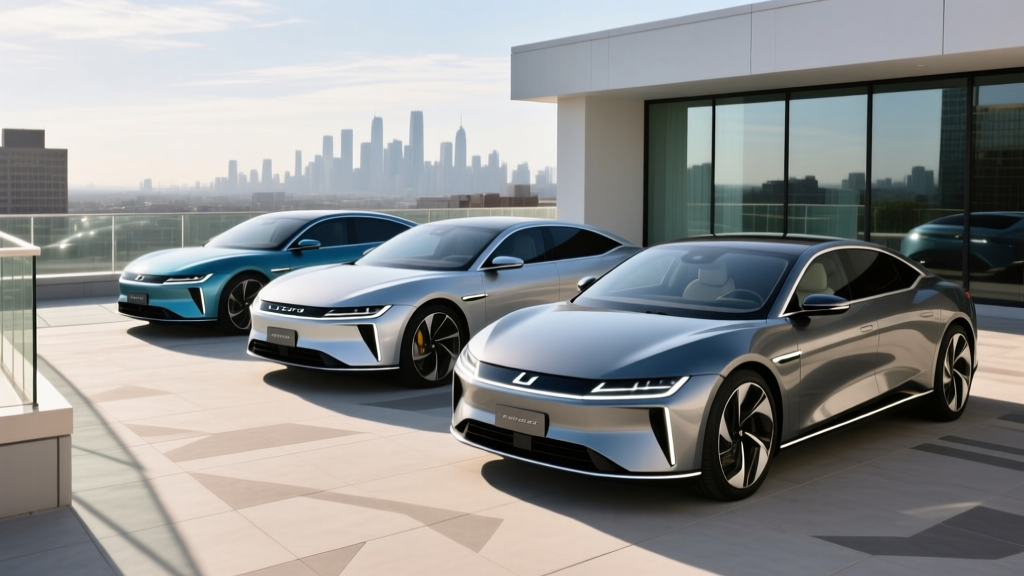
If you have been tracking LCID shares, you already know the narrative: Lucid Motors continues to post industry-leading efficiency and range numbers while burning cash and fighting for production scale. For EV buyers and investors alike, the real question heading into the second half of 2025 is whether the 2026 Lucid Air lineup — anchored by the Air Pure, Touring, Grand Touring, and Sapphire — represents a product portfolio strong enough to move the stock needle.
This article approaches that question the only way that matters at AutoEdgeView: by stress-testing the actual hardware, software, charging speeds, and ownership economics of the cars Lucid is selling right now. Stock tickers move on sentiment; EV buyers move on kilowatt-hours, miles per charge, and dollars per mile. Let us reconcile both.
2026 Lucid Air at a Glance: The Spec Sheet That Drives the Ticker
Before we evaluate LCID as an investment, here is the complete product picture. Lucid currently offers four Air trims for the 2026 model year, spanning a rear-wheel-drive entry point to the four-figure-horsepower Sapphire halo. The table below consolidates the numbers that matter to both buyers and analysts.
| Spec | Air Pure | Air Touring | Air Grand Touring | Air Sapphire |
|---|---|---|---|---|
| EPA Range | 419 mi | 425 mi | 516 mi | 427 mi |
| Battery (usable, kWh) | 88 kWh (NMC) | 112 kWh (NMC) | 112 kWh (NMC) | 118 kWh (NMC) |
| Drivetrain | RWD (single motor) | AWD (dual motor) | AWD (dual motor) | AWD (tri-motor) |
| Horsepower | 430 hp | 620 hp | 819 hp | 1,234 hp |
| 0-60 mph | 5.0 sec | 3.4 sec | 3.0 sec | 1.89 sec |
| Peak DC Fast Charge | 220 kW | 300 kW | 300 kW | 300 kW |
| 10-80% DCFC Time | ~25 min | ~15 min | ~15 min | ~18 min |
| Level 2 Home Charge | 19.2 kW (90 mi/hr) | 19.2 kW (90 mi/hr) | 19.2 kW (90 mi/hr) | 19.2 kW (90 mi/hr) |
| Efficiency (MPGe) | 146 MPGe | 134 MPGe | 131 MPGe | 110 MPGe |
| Base MSRP | $69,900 | $87,400 | $125,600 | $249,000 |
Source: fueleconomy.gov and Lucid Motors official specifications.
Range Reality Check: EPA Stickers vs. Real-World Miles
Air Grand Touring: EPA 516 mi | Expect ~420-460 mi highway, ~350-390 mi in sub-30°F cold
Air Pure: EPA 419 mi | Expect ~350-380 mi highway, ~300-340 mi in sub-30°F cold
Air Sapphire: EPA 427 mi | Expect ~340-370 mi highway (performance tire penalty)
The Grand Touring's 516-mile EPA figure remains the highest of any production sedan sold in the United States. Lucid achieves this through a combination of class-leading powertrain efficiency (the Air's motors and inverter are developed in-house), a drag coefficient of 0.197, and the 112 kWh usable NMC battery pack.
But EPA testing uses a specific drive-cycle mix. On sustained 75 mph highway runs — the scenario that actually matters for road-trip planning — expect to use about 300-330 Wh/mile in the Grand Touring, translating to roughly 420-460 miles before you need a charger. In cold weather (below 30°F), NMC chemistry loses roughly 15-25% of available capacity to internal resistance and cabin heating demands, even with the Air's standard heat pump. Plan for 350-390 miles in winter highway conditions.
The Pure's smaller 88 kWh pack delivers a remarkable 146 MPGe combined — a testament to the RWD powertrain's efficiency. Real-world highway drivers should budget 350-380 miles, which still outdistances most competitors' EPA stickers.
Charging Speed: 300 kW Peaks and the Curve That Follows
Charging infrastructure is where Lucid investors should pay close attention, because the Air's charging hardware tells a nuanced story.
| Charging Level | Power | Miles Added per Hour | Notes |
|---|---|---|---|
| Level 1 (120V) | ~1.4 kW | ~5 mi/hr | Emergency/trickle only |
| Level 2 (240V, 80A) | 19.2 kW | ~90 mi/hr | Requires hardwired Wallbox or equivalent; full overnight replenishment |
| DC Fast Charge (Touring/GT/Sapphire) | Peak 300 kW | Up to 300 mi in 15 min (10-80%) | Wunderbox 900V architecture; tapers above 80% SoC |
| DC Fast Charge (Pure) | Peak 220 kW | ~200 mi in 15 min | Lower peak due to smaller pack configuration |
Lucid's 900-volt electrical architecture (branded "Wunderbox") allows the Touring, Grand Touring, and Sapphire to accept up to 300 kW at compatible DC fast chargers. In practice, this means a 10-80% charge in roughly 15 minutes at a 350 kW Electrify America or Ionity station — provided you precondition the battery via the navigation system's charge-routing feature.
The critical caveat for buyers and analysts: the charge curve tapers significantly above 80% state of charge (SoC). The last 20% can take as long as the first 60%. This is standard for NMC lithium-ion chemistry at high charge rates, but it means real-world charging stops should target the 10-80% window for time efficiency. Plan road trips accordingly — you will not sit at a charger waiting for 100%.
At home, the Air's 19.2 kW onboard charger is among the fastest in the segment. A hardwired Level 2 station on a 100-amp circuit will add roughly 90 miles of range per hour, meaning a depleted Grand Touring refills overnight in about 6 hours. This requires a 240V/80A dedicated circuit — budget $1,200-$2,500 for professional installation depending on your electrical panel capacity (consult a licensed electrician for your specific setup).
Performance and Drivetrain: From Efficiency King to Hypercar Killer
The Air Pure's 430 hp and 5.0-second 0-60 time are brisk for any luxury sedan, let alone one that achieves 146 MPGe. But the performance story escalates quickly up the trim ladder.
The dual-motor Touring (620 hp, 3.4 seconds) and Grand Touring (819 hp, 3.0 seconds) deliver effortless passing power and all-weather traction. The tri-motor Sapphire is Lucid's engineering showcase: 1,234 hp, a 1.89-second 0-60 time, and a sub-9-second quarter mile — figures that rival the Bugatti Chiron at a fraction of the price.
For investors, the Sapphire serves a strategic purpose beyond sales volume. It establishes Lucid's powertrain credibility and generates halo effect. The real volume play is the Pure and Touring, where margins and production scalability determine LCID's financial trajectory.
Interior Space, Tech, and the Ownership Experience
The Air's cabin is designed around what Lucid calls "Space Concept" — a philosophy enabled by the compact motor and battery packaging. The result:
- Rear legroom: 45.4 inches (class-leading; exceeds the Mercedes EQS and BMW i7)
- Cargo volume: 32 cu ft total (22.1 cu ft trunk + 10.1 cu ft frunk)
- Infotainment: 34-inch curved Glass Cockpit display, running Lucid's proprietary UX with native Apple CarPlay/Android Auto
- Audio: 21-speaker Surreal Sound system by Mark Levinson (standard on Touring and above)
The driver-assistance suite, branded DreamDrive Pro, uses a lidar sensor (on Touring and above) plus cameras and radar. It is an SAE Level 2 system — meaning the driver must remain fully engaged, hands on or near the wheel, with eyes on the road. DreamDrive Pro handles adaptive cruise, lane centering, and automatic lane changes on mapped highways, but it is not autonomous driving. Lucid has signaled future Level 3 capabilities via over-the-air updates, but no timeline has been confirmed.
DreamDrive Pro is SAE Level 2 driver assistance. The driver is responsible for all vehicle operation at all times. This is not "self-driving" — it is an advanced cruise-and-steering assist comparable to Tesla Autopilot or GM Super Cruise. Hands-off systems like BlueCruise and Super Cruise operate on pre-mapped highways only and still require driver attention monitoring.
Notable drawbacks: The Glass Cockpit display, while visually striking, lacks haptic feedback and can be distracting to operate while driving. The center console storage is modest for the class. Service center availability remains limited outside major metro areas — a real concern for buyers in smaller markets and a risk factor for LCID's customer-satisfaction metrics.
Pricing, Tax Credits, and Total Cost of Ownership
Understanding the Air's pricing structure is essential for both buyers evaluating purchase decisions and investors assessing Lucid's revenue per vehicle.
| Trim | Base MSRP | §30D Credit Eligible? | Effective Price (if eligible) |
|---|---|---|---|
| Air Pure | $69,900 | Potentially (see rules below) | ~$62,400 |
| Air Touring | $87,400 | No (exceeds $55,000 sedan cap) | $87,400 |
| Air Grand Touring | $125,600 | No (exceeds $55,000 sedan cap) | $125,600 |
| Air Sapphire | $249,000 | No (exceeds $55,000 sedan cap) | $249,000 |
Under current IRS §30D Clean Vehicle Credit rules, the federal EV tax credit provides up to $7,500 — but only if the vehicle meets all of the following criteria:
- MSRP cap: Sedans must be priced at or below $55,000. The Air Pure at $69,900 exceeds this cap, making it ineligible under current rules.
- Buyer income limits: AGI must not exceed $150,000 (single), $225,000 (head of household), or $300,000 (joint).
- Battery sourcing: Critical minerals and battery components must meet phased-in domestic/FATB sourcing thresholds.
- Point-of-sale transfer: Eligible buyers can apply the credit as a down-payment reduction at the dealer.
Bottom line for 2026: No Lucid Air trim currently qualifies for the $7,500 federal credit due to the MSRP cap. This is a structural disadvantage against competitors like the Tesla Model S (starting at $74,990, also ineligible) and a key reason Lucid is pushing toward the upcoming mid-size platform (internally called "Midsize") to target the sub-$50,000 segment where credits apply. For investors, the inability to offer credit-eligible vehicles today is a headwind to volume growth.
5-year ownership cost (Air Pure, 15,000 mi/yr): Electricity at $0.14/kWh averages ~$1,050/year in fuel. Combined with estimated insurance (~$3,200/year for the Air), maintenance (~$400/year — no oil changes, minimal brake wear with regen), and depreciation, total 5-year cost lands near $72,000-$78,000 depending on your state and driving profile.
Warranty and Long-Term Battery Confidence
Lucid provides the following coverage on the 2026 Air:
- Battery and drive unit: 8 years / 100,000 miles (whichever comes first), covering defects and capacity loss below 70% of original capacity
- Basic vehicle: 4 years / 50,000 miles bumper-to-bumper
- Roadside assistance: 4 years / 50,000 miles
The 70% capacity retention threshold at 8 years is standard for the luxury EV segment (matching Tesla and BMW). Lucid's NMC cells are manufactured with a focus on longevity — the company claims its battery management system (BMS) actively manages cell balancing and thermal conditioning to minimize degradation. Real-world data from 2022-2024 Air owners suggests roughly 5-8% degradation over the first 50,000 miles, which is competitive with segment norms.
Battery replacement cost, should it be needed outside warranty, is estimated at $20,000-$30,000 depending on the pack size — a figure worth factoring into long-term ownership plans for high-mileage drivers.
Lucid Air vs. Key Competitors: Where the Product Stands
| Attribute | Lucid Air GT | Tesla Model S LR | Mercedes EQS 580 | BMW i7 xDrive60 |
|---|---|---|---|---|
| EPA Range | 516 mi | 402 mi | 371 mi | 318 mi |
| Efficiency (MPGe) | 131 | 124 | 97 | 82 |
| Peak DCFC | 300 kW | 250 kW | 200 kW | 195 kW |
| 0-60 mph | 3.0 sec | 3.1 sec | 4.1 sec | 4.5 sec |
| Rear Legroom | 45.4 in | 40.9 in | 42.0 in | 43.9 in |
| Base MSRP | $125,600 | $74,990 | $104,400 | $119,300 |
The Air Grand Touring wins on range, efficiency, and charging speed by a wide margin. Its 516-mile EPA figure is 28% higher than the next-closest competitor here. For buyers who prioritize maximum miles between charges and fastest road-trip replenishment, the Air is objectively the best sedan available.
Where competitors pull ahead: Tesla's Supercharger network remains the most reliable and extensive DC fast-charging ecosystem in the U.S. (though Lucid now has Supercharger access via NACS adapter). Mercedes and BMW offer more established dealer service networks and stronger brand cachet with traditional luxury buyers. The Model S undercuts the Air on price by over $50,000, though it sacrifices range, interior space, and ride refinement.
- Best-in-class EPA range (516 mi, Grand Touring)
- Industry-leading efficiency (up to 146 MPGe, Pure)
- 300 kW DC fast charging (Touring/GT/Sapphire)
- Massive rear legroom (45.4 in) — best in segment
- 900V architecture enables future-proof charging
- Sapphire halo builds brand credibility
- No trim qualifies for $7,500 federal tax credit
- Limited service center footprint outside major metros
- Infotainment lacks haptic feedback; learning curve
- Low production volume raises long-term support concerns
- Brand awareness trails Tesla, Mercedes, BMW
- Premium pricing without premium dealer experience
Who the 2026 Lucid Air Is For — and the Investor Takeaway
Choose the Air Pure if: You want maximum efficiency, 400+ mile range, and the lowest entry price in the lineup. Best for commuters and efficiency-focused buyers.
Choose the Air Touring if: You need AWD for all-weather driving and want the 300 kW charging speed without the Grand Touring premium. Best for four-season commuters and moderate road-trippers.
Choose the Air Grand Touring if: Range is your top priority and you regularly drive 300+ miles between stops. Best for road-trip enthusiasts and high-mileage drivers.
Choose the Air Sapphire if: You want hypercar performance in a four-door sedan and budget is not a constraint. Best for collectors and performance enthusiasts.
For the LCID investor, the product is undeniably impressive. The Air's engineering — its efficiency, range, 900V architecture, and in-house powertrain development — represents genuine technological differentiation. No competitor matches 516 miles of EPA range or 146 MPGe in a full-size luxury sedan.
The stock analysis, however, requires looking beyond the spec sheet. Lucid's production volumes remain low relative to its factory capacity. The company needs the upcoming Midsize platform (expected 2026-2027) to access the credit-eligible, higher-volume market segments. Until then, the Air serves as a proof-of-concept and brand builder, not a volume driver.
Buyers who value range above all else and can absorb the premium pricing will find the Air Grand Touring unmatched. Investors should watch production ramp rates, Midsize platform timelines, and service-network expansion as the key catalysts for LCID's next chapter.
Frequently Asked Questions
What is the real-world range of the 2026 Lucid Air?
The Grand Touring's EPA estimate is 516 miles. Real-world highway driving at 75 mph typically yields 420-460 miles. In cold weather below 30°F, expect 350-390 miles due to NMC battery chemistry losses and heating demand. The Air Pure (EPA 419 mi) delivers roughly 350-380 miles in real-world highway use.
How fast does the Lucid Air charge at home and on DC fast chargers?
At home on a Level 2 (240V/80A) station, the Air charges at up to 19.2 kW, adding about 90 miles of range per hour — a full overnight refill. On DC fast chargers, the Touring, Grand Touring, and Sapphire peak at 300 kW, achieving a 10-80% charge in roughly 15 minutes at compatible 350 kW stations. The Pure peaks at 220 kW with a 10-80% time of about 25 minutes.
Does the Lucid Air qualify for the $7,500 federal EV tax credit?
Under current IRS §30D rules, no. The federal credit for sedans requires an MSRP at or below $55,000. The least expensive Air (Pure at $69,900) exceeds this cap. Buyer income limits and battery-sourcing requirements add additional eligibility hurdles. Consult a tax professional and check IRS.gov for the latest rules.
Is the Lucid Air worth buying over a Tesla Model S or Mercedes EQS?
If maximum range and efficiency are your priorities, yes — the Air Grand Touring's 516-mile EPA rating and 131 MPGe lead the segment by a wide margin. However, Tesla offers a more mature Supercharger network and lower pricing, while Mercedes provides a stronger dealer-service footprint. The Air wins on paper and on the road; the competition wins on infrastructure and brand accessibility.
What is the battery warranty on the 2026 Lucid Air?
Lucid covers the battery and drive unit for 8 years or 100,000 miles, whichever comes first. The warranty covers defects and capacity degradation below 70% of original capacity. Out-of-warranty replacement is estimated at $20,000-$30,000 depending on pack size.
Is DreamDrive Pro self-driving?
No. DreamDrive Pro is an SAE Level 2 driver-assistance system. It provides adaptive cruise control, lane centering, and automated lane changes on compatible highways, but the driver must remain fully engaged and responsible for vehicle operation at all times. It is comparable to Tesla Autopilot or GM Super Cruise — not autonomous driving.