Why Lucid Motors in Southfield, MI Deserves a Test Drive
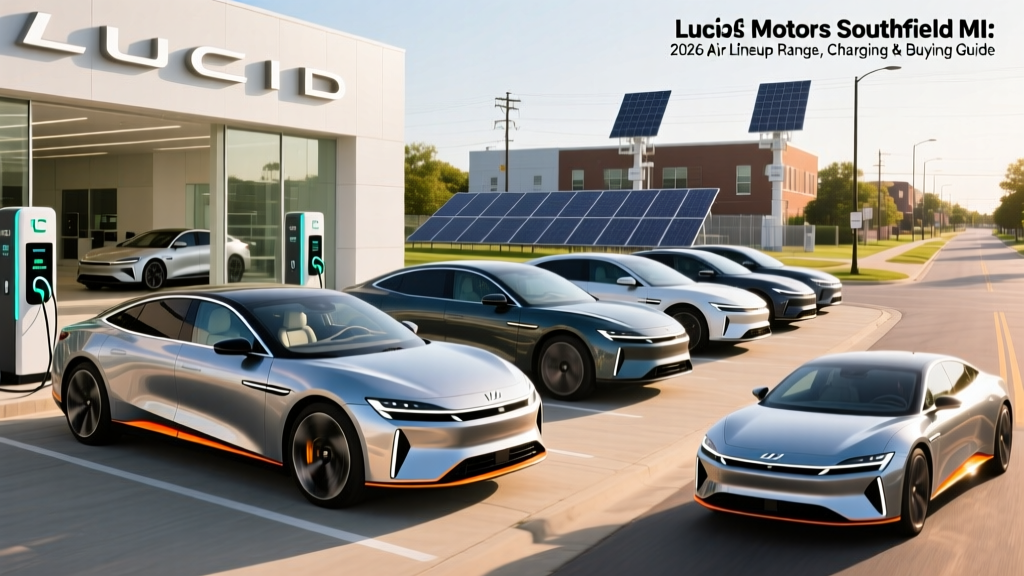
If you live in metro Detroit and are shopping for a luxury electric sedan, the Lucid Motors Southfield MI studio is one of the few places in the Midwest where you can experience the Lucid Air lineup in person before committing to a six-figure EV purchase. Located at the upscale Southfield retail corridor, the Lucid Studio operates differently from a traditional dealership — no haggling, no dealer markups, and a direct-to-consumer model that mirrors Tesla's approach. But with the 2026 Air lineup now spanning from the $69,900 Pure to the $249,000 Sapphire, understanding exactly what you're getting — and what you're not — is essential before you walk through those doors.
This review breaks down the full 2026 Lucid Air range with real-world ownership data: EPA range versus what you'll actually see on I-75 in January, charging speeds on Electrify America's 350 kW stalls, and the thorny question of federal tax credit eligibility under current IRS §30D rules.
2026 Lucid Air Lineup at a Glance
| Spec | Air Pure | Air Touring | Air Grand Touring | Air Sapphire |
|---|---|---|---|---|
| Base MSRP | $69,900 | $87,400 | $125,600 | $249,000 |
| Drivetrain | RWD (single motor) | AWD (dual motor) | AWD (dual motor) | AWD (tri-motor) |
| Horsepower | 430 hp | 620 hp | 819 hp | 1,234 hp |
| 0-60 mph | 5.0 sec | 3.4 sec | 3.0 sec | 1.89 sec |
| EPA Range | 419 mi | 425 mi | 516 mi | 427 mi |
| Battery (usable) | 88 kWh (NMC) | 112 kWh (NMC) | 112 kWh (NMC) | 118 kWh (NMC) |
| MPGe (combined) | 146 MPGe | 131 MPGe | 131 MPGe | 110 MPGe |
| EPA Efficiency | 23 kWh/100mi | 26 kWh/100mi | 26 kWh/100mi | 31 kWh/100mi |
| Max DC Fast Charge | 200 kW | 300 kW | 300 kW | 300 kW |
| 10-80% DCFC Time | ~25 min | ~20 min | ~20 min | ~22 min |
| Level 2 Home Charging | 19.2 kW / ~70 mi/hr | 19.2 kW / ~70 mi/hr | 19.2 kW / ~70 mi/hr | 19.2 kW / ~70 mi/hr |
Source: fueleconomy.gov and Lucid Motors official specifications. Real-world results may vary.
Real-World Range: What Michigan Drivers Actually Get
EPA sticker: 516 miles. Real-world expectation: ~390-430 miles on mixed highway/city driving at 70-75 mph. In Michigan winters (20-30°F), expect ~340-380 miles with cabin heating active and no preconditioning.
The Lucid Air Grand Touring's 516-mile EPA rating is the highest of any production sedan sold in the US. That number is earned through a combination of class-leading aerodynamics (a drag coefficient of 0.197), a 112 kWh usable NMC battery pack, and Lucid's proprietary miniaturized drive units that reduce parasitic losses.
But EPA range is measured on a controlled dynamometer cycle, not on I-94 between Ann Arbor and Kalamazoo at 75 mph in crosswinds. In independent real-world highway testing, the Grand Touring typically delivers between 390 and 430 miles at sustained highway speeds in moderate temperatures (55-75°F). That's still exceptional — enough to drive from Southfield to Chicago without stopping — but it's roughly 17-24% below the sticker.
Cold weather is the bigger concern for Michigan buyers. Lithium-ion NMC chemistry loses efficiency in sub-freezing temperatures, and cabin heating draws significant energy. Without preconditioning the battery (which the Air does automatically when a charge stop is navigated to), winter range can drop to 65-74% of the EPA figure. For the Grand Touring, that means roughly 340-380 usable miles. The Air Pure, with its smaller 88 kWh pack, will see winter ranges closer to 280-310 miles — still adequate for most commutes but worth planning around on longer trips.
Charging Speed and Infrastructure in Metro Detroit
The Lucid Air's 900V electrical architecture is one of its defining engineering advantages. Higher voltage means lower current for the same power output, which reduces heat generation in the battery and cables during fast charging. The practical result: the Air Touring, Grand Touring, and Sapphire can accept up to 300 kW at a compatible DC fast charger, while the Pure tops out at 200 kW.
| Charging Level | Power (kW) | Miles Added per Hour | Notes |
|---|---|---|---|
| Level 1 (120V household) | 1.4 kW | ~3-4 mi/hr | Emergency/trickle only |
| Level 2 (240V, 48A) | 11.5 kW | ~42 mi/hr | Standard home charger |
| Level 2 (240V, 80A) | 19.2 kW | ~70 mi/hr | Requires 100A circuit, Lucid Connected Home charger |
| DC Fast (200 kW station) | Up to 200 kW | ~200 mi in 15 min | Air Pure peak; Touring/GT limited at this station |
| DC Fast (350 kW station) | Up to 300 kW | ~300 mi in 20 min | Touring, GT, Sapphire; peak rate tapers above 80% SoC |
Charging curve reality: The 300 kW peak rate is sustained roughly between 10-55% state of charge. Above 55%, the curve tapers progressively — by 80% SoC, you're typically seeing 90-120 kW. This is standard behavior for NMC chemistry with active thermal management, but it means the advertised "10-80% in ~20 minutes" assumes ideal conditions: a preconditioned battery, a 350 kW-capable station, and ambient temperatures above 50°F.
For Southfield and greater Detroit area owners, the public charging landscape includes multiple Electrify America and EVgo stations with 350 kW CCS connectors. Lucid vehicles use the CCS1 connector natively, and Lucid has announced NACS adapter availability for Tesla Supercharger access. Home charging at 19.2 kW (the Air's onboard charger maximum) requires a dedicated 100-amp circuit and the Lucid Connected Home wall connector — budget $1,200-$2,500 for a professional installation depending on your electrical panel's capacity. Most Air owners charge overnight on Level 2 and add a full battery in roughly 6-7 hours.
Pricing, Trims, and Federal Tax Credit Eligibility
The 2026 Lucid Air lineup spans a wide price range, and understanding where each trim falls relative to federal incentive thresholds is critical.
| Trim | Base MSRP | §30D MSRP Cap ($55,000 sedans) | Eligible for $7,500 Credit? | Effective Price (if eligible) |
|---|---|---|---|---|
| Air Pure | $69,900 | Exceeds cap | No | $69,900 |
| Air Touring | $87,400 | Exceeds cap | No | $87,400 |
| Air Grand Touring | $125,600 | Exceeds cap | No | $125,600 |
| Air Sapphire | $249,000 | Exceeds cap | No | $249,000 |
The hard truth for Lucid buyers: Under current IRS §30D rules, the federal EV tax credit for new vehicles caps eligible sedans at an MSRP of $55,000. Every 2026 Lucid Air trim exceeds this threshold. Additionally, buyer income limits apply ($150,000 single / $300,000 joint AGI), and the vehicle must meet critical-mineral and battery-component sourcing requirements. Even if a hypothetical lower-priced Lucid existed, battery sourcing rules would need to be satisfied independently.
Michigan does not currently offer a state-level EV purchase incentive comparable to states like Colorado or California. However, some utility providers (DTE Energy, Consumers Energy) offer rebates for home Level 2 charger installation — typically $300-$500. Check with your local utility for current programs.
For buyers who can absorb the full MSRP, the Air Pure at $69,900 remains the value proposition in the lineup. It sacrifices dual-motor AWD and the larger battery but retains the Air's core strengths: class-leading interior space, the Glass Canopy roof, and a 419-mile EPA range that still outdistances most competitors.
Interior Space, Technology, and Daily Livability
The Lucid Air's packaging is genuinely remarkable. By shrinking the drive units and placing them strategically, Lucid created a full-size luxury sedan interior within a footprint closer to a midsize car. Key dimensions:
- Rear legroom: 45.3 inches (more than a Mercedes S-Class)
- Front trunk (frunk): 10.0 cu ft
- Rear cargo (trunk): 22.1 cu ft
- Total cargo volume: 32.1 cu ft
- Seating: 5 passengers standard
The Glass Canopy roof — a massive single-piece glass panel stretching from windshield to rear window — is standard on Touring and above and optional on the Pure. It creates an open, airy cabin but does increase solar heat gain in summer; the powered shade is a recommended option for Michigan's surprisingly intense July sun.
The infotainment system runs on Lucid's custom OS with a 34-inch curved glass cockpit display and a retractable central touchscreen. Wireless Apple CarPlay and Android Auto are standard. The 21-speaker Surreal Sound audio system (by Mark Levinson on upper trims) is among the best in any vehicle at any price point. However, the interface has a learning curve — some climate and vehicle functions are buried in submenus rather than accessible via physical controls, which can frustrate first-time users.
DreamDrive Pro is Lucid's Level 2 (SAE) driver-assistance suite. It includes adaptive cruise control, lane centering, automatic emergency braking, and a 32-sensor array (lidar, radar, cameras, ultrasonics). It's competent for highway cruising but requires continuous driver supervision — this is not a hands-off system. Lucid has not yet launched a hands-free driving feature comparable to GM's Super Cruise or Ford's BlueCruise, which is a notable gap at this price point.
Battery Warranty and Long-Term Ownership
Lucid provides the following warranty coverage for the 2026 Air:
- Battery & Drive Unit: 8 years / 100,000 miles (whichever comes first), with a minimum 70% capacity retention threshold
- Vehicle Limited Warranty: 4 years / 50,000 miles
- Roadside Assistance: 4 years / 50,000 miles
The 70% retention threshold is standard for the industry (Tesla, BMW, and Mercedes use the same benchmark). Lucid's NMC cells use a proprietary cell format co-developed with Samsung SDI. Long-term degradation data for Lucid vehicles is still limited — the Air only entered volume production in 2022 — but early fleet data suggests degradation curves in line with industry norms: roughly 5-8% loss over the first 50,000 miles, then a slower decline.
Out-of-warranty battery replacement for the 112 kWh pack is estimated at $20,000-$28,000 based on current parts and labor pricing. This is a critical cost to model if you plan to keep the vehicle beyond 100,000 miles. Lucid's service network in Michigan is currently limited to the Southfield studio and mobile service technicians; more complex repairs may require transport to a regional service center.
Lucid Air vs. Key Competitors
- Highest EPA range of any production sedan (516 mi, Grand Touring)
- Class-leading rear legroom and cargo versatility (32.1 cu ft total)
- 900V architecture enables 300 kW DC fast charging
- Exceptional efficiency: 131 MPGe combined (Grand Touring)
- Direct-to-consumer pricing — no dealer markups
- Sapphire variant offers hypercar performance (1.89s 0-60)
- No trim qualifies for the $7,500 federal tax credit (all exceed $55K MSRP cap)
- DreamDrive Pro lacks hands-free highway driving (no Super Cruise competitor)
- Service network in Michigan is thin — mostly mobile service
- Infotainment learning curve; limited physical climate controls
- High insurance premiums (luxury EV average: $2,800-$3,500/year)
- Cold-weather range loss is significant without preconditioning discipline
vs. Tesla Model S: The Model S Long Range ($74,990, 402 mi EPA) is the most direct competitor. Tesla wins on Supercharger network access, hands-free-capable FSD (Supervised), and service infrastructure. Lucid wins on interior space, ride refinement, and efficiency (kWh/100mi). If charging access and software ecosystem matter most, Tesla still leads. If cabin luxury and range are paramount, the Air Grand Touring has no equal.
vs. Mercedes EQS 450+: The EQS ($104,400, 390 mi EPA) offers a more traditional luxury dealership experience and a more polished infotainment system (MBUX Hyperscreen). But it trails the Air on range by 126 miles and on efficiency by a wide margin. The EQS also uses a 400V architecture, limiting DC fast charging to ~200 kW.
vs. BMW i7 xDrive60: The i7 ($119,300, 318 mi EPA) is a more conventional luxury flagship with excellent build quality and a more mature ADAS suite (Highway Assistant offers hands-free driving at up to 85 mph on divided highways). Range and efficiency favor the Lucid decisively.
Who Should Buy the Lucid Air in Southfield?
Choose the Lucid Air if:
- You prioritize maximum range and can charge at home nightly (the Air rewards Level 2 home charging with minimal public-charging dependency)
- You need full-size sedan rear-seat comfort with EV efficiency (executive transport, family road trips)
- You value a direct-purchase model with transparent, non-negotiable pricing
- You're comfortable with a developing service network and mobile-first maintenance
Look elsewhere if:
- You need a hands-free highway driving system today (consider BMW i7 or Mercedes EQS with Highway Assistant/Drive Pilot)
- You want the security of a dense dealer/service network (Tesla, BMW, Mercedes)
- Your budget requires a federal tax credit to make the numbers work
- You frequently tow — the Air is not rated for towing
For the Southfield/Metro Detroit buyer specifically, the Air Grand Touring makes the most sense if you regularly drive to Chicago, Indianapolis, or Columbus and want to minimize charge stops. The 516-mile EPA range (roughly 400 real-world miles on the highway) means most regional trips require a single 15-20 minute DC fast-charge stop. The Air Pure is the pragmatic pick for commuters who want the Air experience at the lowest entry price and charge primarily at home.
Frequently Asked Questions
What is the real-world range of the 2026 Lucid Air?
The EPA-rated range spans 419 miles (Pure) to 516 miles (Grand Touring). In real-world mixed driving at moderate temperatures, expect 80-85% of the EPA figure — roughly 340-430 miles depending on trim. In Michigan winters, plan for 65-74% of EPA, or 275-380 miles. Preconditioning the battery before driving and using seat heaters instead of cabin air heating can recover 5-10% of winter range.
How fast does the Lucid Air charge at home and on the road?
At home on a 240V Level 2 charger at 19.2 kW (80A circuit), the Air adds roughly 70 miles of range per hour, fully replenishing the 112 kWh pack in about 6-7 hours. On a 350 kW DC fast charger, the Touring/Grand Touring/Sapphire peak at 300 kW and can add up to 300 miles in approximately 20 minutes (10-80% SoC). The Pure peaks at 200 kW with a 10-80% time of roughly 25 minutes.
Does the Lucid Air qualify for the federal EV tax credit?
No. Under current IRS §30D rules, new sedans must have an MSRP at or below $55,000 to qualify for the up-to-$7,500 federal tax credit. The least expensive 2026 Air (Pure at $69,900) exceeds this cap by nearly $15,000. Buyer income limits and battery sourcing requirements would also need to be met independently. No Lucid Air trim currently qualifies.
Is the Lucid Air worth buying over a Tesla Model S or Mercedes EQS?
It depends on priorities. The Air Grand Touring offers the longest range, best efficiency, and most rear-seat space of any luxury EV sedan. The Tesla Model S wins on Supercharger network access, software, and hands-free-capable FSD (Supervised). The Mercedes EQS wins on dealership service infrastructure and MBUX polish. If range and cabin comfort are your top criteria, the Air is the strongest pick. If service accessibility or autonomous driving features matter more, the competition has advantages.
What is the battery warranty and replacement cost?
Lucid covers the battery and drive unit for 8 years or 100,000 miles with a guaranteed minimum 70% capacity retention. Out-of-warranty replacement for the 112 kWh NMC pack is estimated at $20,000-$28,000. Early degradation data suggests 5-8% loss over the first 50,000 miles, consistent with industry norms for NMC chemistry with active thermal management.
Can I visit the Lucid Motors Southfield MI studio for a test drive?
Yes. The Lucid Studio in Southfield offers walk-in visits and scheduled test drives. Unlike traditional dealerships, Lucid operates a direct-to-consumer model — pricing is fixed and orders are placed online or in-studio with a Lucid specialist. You can configure your Air, experience the interior, and take a test drive without sales pressure. Service is handled through mobile technicians and regional service centers.