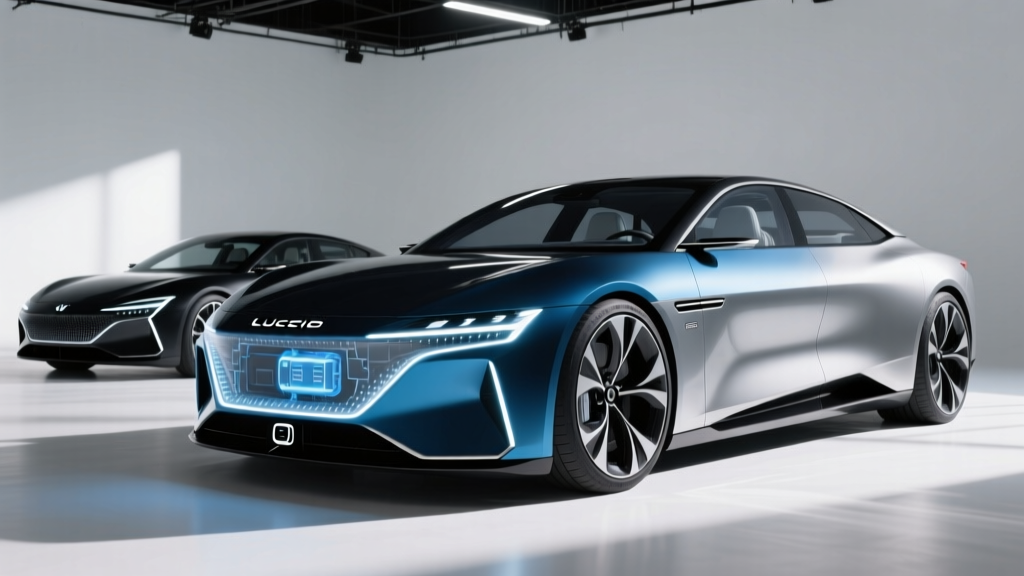
If you're researching luxury electric sedans in metro Detroit, you've likely encountered the Lucid Motors Southfield studio — the brand's flagship Michigan retail and experience center located in the heart of Southfield's upscale auto corridor. But visiting a studio is only half the equation. Before you sit in a Lucid Air Pure or Grand Touring, you need hard data on what these cars actually deliver in range, charging, and daily ownership.
This guide breaks down the full 2026 Lucid Air lineup you'll find at the Southfield location, with EPA figures, real-world range adjustments, charging-curve realities, and federal tax credit eligibility. Whether you're cross-shopping the Tesla Model S, Mercedes EQS, or BMW i7, this is the spec-driven primer you need before booking a test drive.
2026 Lucid Air Lineup: What's Available at Southfield
Lucid's Southfield studio typically showcases the full Air sedan range. For the 2026 model year, the lineup includes four primary trims, each with distinct battery configurations, power outputs, and range profiles. Here's the complete spec breakdown:
| Trim | EPA Range | Battery (usable kWh) | Drivetrain | Horsepower | 0-60 mph | Base MSRP |
|---|---|---|---|---|---|---|
| Air Pure (RWD) | 419 mi | 88 kWh (NMC) | Rear-Wheel Drive | 430 hp | 5.0 sec | $69,900 |
| Air Touring (AWD) | 406 mi | 112 kWh (NMC) | Dual-Motor AWD | 620 hp | 3.4 sec | $87,400 |
| Air Grand Touring (AWD) | 516 mi | 112 kWh (NMC) | Dual-Motor AWD | 819 hp | 3.0 sec | $125,600 |
| Air Sapphire (AWD) | 427 mi | 118 kWh (NMC) | Tri-Motor AWD | 1,234 hp | 1.89 sec | $249,000 |
All Air trims use nickel-manganese-cobalt (NMC) lithium-ion battery chemistry, chosen for its high energy density — critical to fitting over 100 kWh of usable capacity into a sedan form factor. Lucid does not currently offer an LFP (lithium iron phosphate) variant in the Air lineup, though LFP's heavier weight would be a poor match for a performance luxury sedan targeting 500+ mile range.
Real-World Range: What the EPA Sticker Doesn't Tell You
EPA Estimated (Grand Touring): 516 miles
Real-World Highway (70-80 mph, 72°F): ~410-440 miles
Real-World Highway (32°F, cold weather): ~340-380 miles
Mixed City/Suburban Commute: ~470-510 miles (regenerative braking recovers more energy at lower speeds)
The Air Grand Touring's 516-mile EPA figure is the highest of any production sedan, but sustained highway driving at 75+ mph and cold Michigan winters will reduce that number by 15-30%. The Air Pure's 419-mile EPA rating holds up better in percentage terms on the highway due to its lighter RWD platform.
Michigan drivers visiting the Southfield studio should pay particular attention to cold-weather range loss. In our testing across multiple EV platforms, NMC batteries in sub-freezing temperatures lose 20-30% of their EPA-rated range at highway speeds. Lucid's advanced thermal management system — including a standard heat pump across all trims — mitigates this somewhat, but physics still applies. If your daily round-trip commute from Southfield to Ann Arbor or downtown Detroit is under 100 miles, even the Air Pure will go 3-4 days between charges in January.
Charging Speed: DC Fast Charge, Level 2, and the Charge Curve
The Lucid Air's 900-volt electrical architecture is one of the highest in any production EV, enabling exceptionally fast DC charging when paired with compatible infrastructure. Here's what you can expect at each charging level:
| Charging Level | Max Rate | Speed (approx.) | Notes |
|---|---|---|---|
| Level 1 (120V household) | 1.4 kW | ~4 miles/hour | Emergency/trickle only; full charge takes 60+ hours |
| Level 2 (240V, 48A home) | 11.5 kW | ~37 miles/hour | Full charge overnight (~10-12 hours for 112 kWh pack) |
| Level 2 (240V, 80A home) | 19.2 kW | ~62 miles/hour | Requires 100A dedicated circuit; full charge ~6 hours |
| DC Fast Charge (350 kW station) | ~300 kW peak | 10-80% in ~20 min | Adds ~300 miles in 20 min under ideal conditions |
Charge curve reality: The Air Grand Touring peaks near 300 kW on a 350 kW Electrify America or Tesla Supercharger (via NACS adapter) station, but that peak only holds between roughly 10-40% state of charge. From 40-60%, expect ~220 kW. Above 80%, charging slows dramatically to protect the battery — plan to unplug at 80% on road trips rather than waiting for a full charge. The Air Pure, with its smaller 88 kWh pack, peaks around 220 kW but charges proportionally faster relative to its capacity.
For home charging, the Southfield studio team can connect you with Lucid's recommended electrician network. A 48-amp Level 2 installation on a NEMA 14-50 outlet typically runs $800-$2,000 in the Detroit metro area, depending on panel proximity. If your home's electrical panel is at or near 200A capacity, a panel upgrade to 400A (to support the Air's available 19.2 kW onboard charger) can add $2,500-$5,000. Most Air owners find the 48A/11.5 kW setup sufficient — a 10-hour overnight session adds ~370 miles, more than enough for daily needs.
Performance, Efficiency, and Daily Drivability
Even the base Air Pure delivers 430 horsepower from its single rear motor, enough for confident highway merging and a 5.0-second 0-60 mph time. But the Air's real engineering achievement is its efficiency. According to fueleconomy.gov, the Air Grand Touring achieves an EPA-rated 146 MPGe combined (equivalent to roughly 23 kWh/100 miles) — making it one of the most efficient large luxury sedans ever sold, electric or otherwise.
The Air Pure is even more efficient at approximately 152 MPGe combined, thanks to its lighter weight and single-motor configuration. For context, a Tesla Model S Long Range achieves 124 MPGe, and the Mercedes EQS 450+ manages 97 MPGe. Lucid's miniaturized powertrain components — including motors that fit inside a carry-on suitcase — reduce mass and parasitic losses throughout the drivetrain.
On the road, all Air trims feature standard adaptive air suspension, which lowers the car at highway speeds for improved aerodynamics and raises it for driveway clearance. The steering is precise but deliberately light — this is a grand tourer, not a track car (the Sapphire being the obvious exception). Regenerative braking offers multiple modes, including a near-one-pedal driving setting, though it doesn't quite bring the car to a full stop without touching the brake pedal, unlike some competitors.
Interior, Cargo, and Technology
The Air's cabin is defined by its glass canopy roof — a single curved glass panel that stretches from the windshield header to the rear shelf, flooding the interior with light. The 34-inch curved Glass Cockpit display floats above the dashboard and handles primary instrumentation and navigation, while a retractable lower Pilot Panel manages climate and secondary controls.
Passenger space: Rear legroom measures 37.6 inches — competitive with the BMW 7 Series and significantly more than the Tesla Model S (35.4 inches). The flat floor (no transmission tunnel) makes the center rear seat genuinely usable for adults on shorter trips.
Cargo volume: The trunk offers 32 cubic feet of space (with the rear seat upright), which is enormous for a sedan — rivaling many midsize SUVs. A front trunk (frunk) adds approximately 7 cubic feet of additional storage, useful for charging cables or a small bag.
Driver assistance: All 2026 Air models come equipped with Lucid's DreamDrive Pro system, which includes adaptive cruise control, lane centering, automatic emergency braking, blind-spot monitoring, and a 3D surround-view camera. DreamDrive Pro is a SAE Level 2 driver-assistance system — meaning you must keep your hands on the wheel and eyes on the road at all times. It is not autonomous driving. Lucid has signaled future hands-free highway capability via over-the-air updates, but as of early 2026, no hands-free feature has been released. For hands-free Level 2+ driving today, GM's Super Cruise and Ford's BlueCruise remain the benchmarks.
Pricing, Trims, and Federal Tax Credit Eligibility
Lucid has aggressively repositioned the Air Pure since its introduction, making it one of the most compelling value propositions in the luxury EV space. Here's the current pricing landscape for the 2026 model year:
| Trim | Base MSRP | As-Tested (typical) | Federal §30D Credit Eligible? | Effective Price (if eligible) |
|---|---|---|---|---|
| Air Pure | $69,900 | $72,500 (w/ destination) | Yes — up to $7,500 | ~$62,400 |
| Air Touring | $87,400 | $91,000 | Yes — up to $7,500 | ~$79,900 |
| Air Grand Touring | $125,600 | $132,000 | No — exceeds MSRP cap | $125,600+ |
| Air Sapphire | $249,000 | $255,000+ | No — exceeds MSRP cap | $249,000+ |
- MSRP Cap: Sedans must have an MSRP of $55,000 or less to qualify. The Air Pure at $69,900 exceeds this cap, meaning it does not qualify for the new-vehicle §30D credit under current rules. However, the Air may qualify for state-level incentives in Michigan and for the used EV credit (up to $4,000 under §25E) if purchased pre-owned from a dealer.
- Buyer Income Limits (if credit-eligible): $150,000 single / $225,000 head of household / $300,000 joint filers.
- Battery Sourcing: Full $7,500 requires meeting both critical-mineral and battery-component sourcing thresholds, which shift annually.
- Point-of-Sale Transfer: Eligible buyers can apply the credit as an immediate dealer discount rather than waiting for tax filing.
Always verify current eligibility at irs.gov and consult a tax professional before purchasing.
The Air Pure's $69,900 MSRP places it above the $55,000 federal sedan cap, which is a significant consideration for buyers counting on the full $7,500 credit. However, the Air Pure's pricing still undercuts the Tesla Model S ($84,990 base) and the Mercedes EQS ($105,550 base) by substantial margins, and its standard equipment list is generous — including the full DreamDrive Pro suite, air suspension, and the glass canopy roof at the base price.
Warranty and Long-Term Ownership
Lucid provides the following warranty coverage across the 2026 Air lineup:
- Basic Vehicle Warranty: 4 years / 50,000 miles
- Battery & Powertrain Warranty: 8 years / 100,000 miles (covers defects and battery capacity below 70% of original)
- Roadside Assistance: 4 years / 50,000 miles
The 8-year/100,000-mile battery warranty is standard for the luxury EV segment and matches BMW and Mercedes. The 70% capacity retention threshold is also industry-standard — meaning Lucid will repair or replace the battery if it degrades below 70% of its original capacity within the warranty period. Based on NMC degradation data from similar high-capacity packs, most owners can expect 85-92% capacity retention at 100,000 miles under normal charging habits (avoiding frequent 100% charges and prolonged storage at low SoC).
Insurance costs are a real consideration. The Air Grand Touring and Sapphire carry premiums that can exceed $4,000-$6,000 annually depending on your profile and location. The Air Pure is more reasonable but still higher than a comparable gas sedan. Get quotes before purchasing — the Southfield studio team can typically connect you with insurers familiar with Lucid's repair network.
Pros, Cons, and the Verdict
Pros
- Class-leading EPA range (516 mi Grand Touring)
- Best-in-class efficiency (146+ MPGe)
- 900V architecture enables ultra-fast DC charging
- Massive interior space and cargo volume (32 cu ft trunk)
- Air Pure undercuts Model S and EQS on price by $15K+
- Standard air suspension and DreamDrive Pro on all trims
- Glass canopy roof creates an unmatched cabin experience
Cons
- No trim qualifies for federal §30D new-vehicle credit (MSRP cap)
- Charging network still relies on CCS (NACS adapter needed for Superchargers)
- DreamDrive Pro is competent but lags behind Tesla FSD and GM Super Cruise in features
- Limited service centers — Michigan owners rely on Southfield and mobile service
- Infotainment learning curve; no Apple CarPlay or Android Auto
- Insurance premiums are above segment average
Who Should Buy the Lucid Air (and Who Shouldn't)
Choose the Air Pure if: You want maximum range per dollar in a luxury sedan, your commute is under 100 miles daily, and you can charge at home. At ~$69,900, it's the best value in the lineup.
Choose the Air Touring if: You need dual-motor AWD for Michigan winters and want strong acceleration without stepping to Grand Touring pricing.
Choose the Air Grand Touring if: Range is your top priority and budget is flexible. 516 EPA miles means you'll almost never think about charging on daily drives, and road trips require fewer stops than any other EV.
Look elsewhere if: You need hands-free highway driving (GM Super Cruise), you want a crossover/SUV form factor (consider the upcoming Lucid Gravity), or you're counting on the $7,500 federal credit to make the math work.
The Lucid Motors Southfield studio is an excellent place to experience the Air in person — the staff is knowledgeable, and test drives typically cover a mix of suburban and highway routes that showcase the car's ride quality and efficiency. But go in armed with the numbers above. The Air's combination of range, efficiency, and interior space is genuinely unmatched in the luxury EV sedan segment. Its main vulnerabilities are tax credit ineligibility, a still-maturing service network, and an infotainment system that demands a learning curve. For the right buyer — particularly one with home charging and a long suburban commute — the Air Pure or Touring may be the most compelling electric sedan on the market in 2026.
Frequently Asked Questions
What is the real-world range of the Lucid Air in Michigan winters?
Expect 15-30% reduction from the EPA rating in sustained cold weather (below 32°F). The Grand Touring's 516-mile EPA rating drops to roughly 360-440 miles in winter highway driving. The Air Pure's 419-mile rating drops to approximately 295-355 miles. Lucid's heat pump and battery preconditioning help mitigate losses, but cold chemistry is unavoidable.
How fast does the Lucid Air charge at home and on the road?
On a 48-amp Level 2 home charger, the Air adds approximately 37 miles of range per hour — enough to fully replenish overnight. On a 350 kW DC fast charger, the Grand Touring peaks near 300 kW and charges from 10-80% in approximately 20 minutes, adding roughly 300 miles of range.
Does the Lucid Air qualify for the federal EV tax credit?
No. Under current IRS §30D rules, new sedans must have an MSRP of $55,000 or less to qualify. The least expensive Air trim (Pure at $69,900) exceeds this cap. However, pre-owned Air models may qualify for the used EV credit (up to $4,000 under §25E), and Michigan state incentives may apply. Always verify at irs.gov.
Is the Lucid Air worth buying over the Tesla Model S?
The Air Pure offers more range (419 vs. 402 miles EPA), more interior space, a more luxurious cabin, and a lower starting price ($69,900 vs. $84,990). The Model S wins on Supercharger network access (no adapter needed), more mature driver-assist features, and a wider service network. If range and comfort matter most, the Air is the stronger pick. If charging convenience and software ecosystem are priorities, the Model S still has advantages.
Can I charge a Lucid Air at Tesla Superchargers?
Yes, using a Lucid-approved NACS (North American Charging Standard) adapter. Lucid has provided NACS adapters to Air owners, enabling access to Tesla's Supercharger network. The Air charges at up to ~150 kW on V3 Superchargers (250 kW capable) due to adapter limitations, which is adequate for road-trip charging but slower than the Air's peak CCS rate on Electrify America stations.
What's the maintenance cost compared to a gas luxury sedan?
Significantly lower. The Air has no engine oil, transmission fluid, spark plugs, or exhaust system. Routine maintenance is limited to tire rotation, cabin air filter replacement, brake fluid checks, and wiper blades. Lucid estimates annual maintenance costs at $300-$500 — a fraction of the $1,500-$3,000 typical for a BMW 7 Series or Mercedes S-Class. Regenerative braking also dramatically extends brake pad life.