Built in Newark, Engineered for Efficiency: The Lucid Air From Its Source
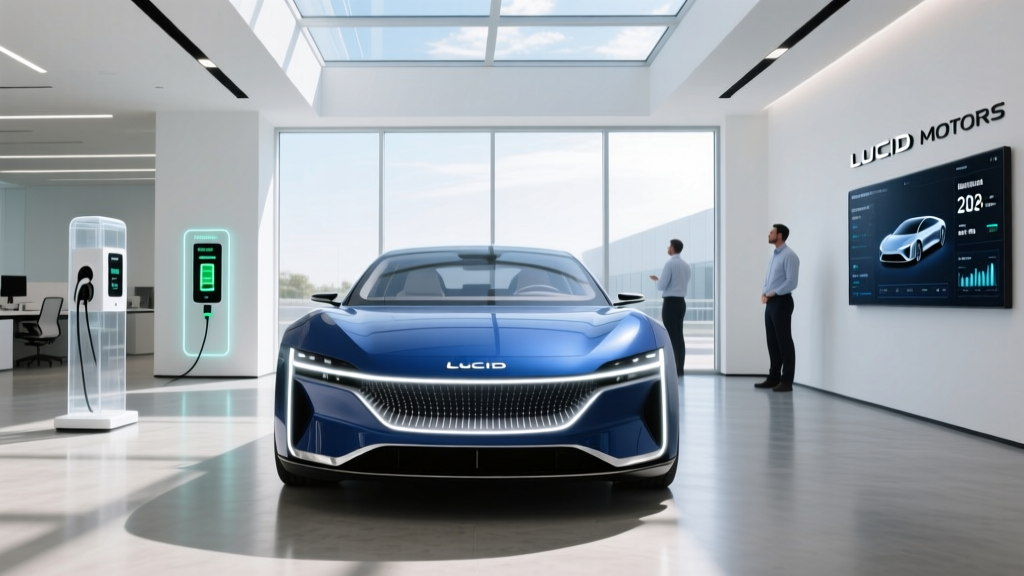
Lucid Motors headquarters and primary manufacturing facility sit in Newark, California — a repurposed AMPI factory that the company transformed into a vertically integrated EV plant. From this Fremont-adjacent campus, Lucid designs, engineers, and assembles the Air sedan and the Gravity SUV, controlling everything from motor winding to battery-pack integration under one roof. That vertical integration is the reason the Air still holds the production-sedan range crown years after its debut, and it shapes every spec we test below.
This review covers the 2026 Lucid Air lineup — Pure, Touring, and Grand Touring — with real-world range reconciliation, charging-curve data, pricing after the federal §30D tax credit, and a direct comparison to the Tesla Model S and Mercedes-Benz EQS.
2026 Lucid Air: Core Specifications at a Glance
| Spec | Air Pure | Air Touring | Air Grand Touring |
|---|---|---|---|
| Base MSRP | $69,900 | $87,400 | $125,650 |
| Drivetrain | RWD (single motor) | AWD (dual motor) | AWD (dual motor) |
| Horsepower | 430 hp | 620 hp | 819 hp |
| 0-60 mph | 5.0 sec | 3.4 sec | 3.0 sec |
| Usable Battery | 88 kWh (NMC) | 112 kWh (NMC) | 112 kWh (NMC) |
| EPA Range | 419 mi | 425 mi | 516 mi |
| EPA Efficiency | 136 MPGe / 25 kWh/100mi | 131 MPGe / 26 kWh/100mi | 131 MPGe / 24 kWh/100mi |
| Max DC Charge Rate | 220 kW | 300 kW | 300 kW |
| 10-80% DC Time | ~28 min | ~20 min | ~20 min |
| Level 2 (19.2 kW) | ~38 mi/hr | ~50 mi/hr | ~50 mi/hr |
| Battery/Powertrain Warranty | 8 yr / 100,000 mi | 8 yr / 100,000 mi | 8 yr / 100,000 mi |
Range Reality: What the EPA Sticker Doesn't Tell You
The Grand Touring's 516-mile EPA estimate is best-in-class, but real-world highway driving at 75 mph typically yields 410–450 miles. In cold weather (below 32°F), expect a 20–30% reduction — roughly 360–400 miles — due to battery-resistance increase and cabin-heating load. The Air's standard heat pump recovers some efficiency, but physics still governs. City driving with regenerative braking often exceeds EPA, hitting 480+ miles on the Grand Touring in mild conditions.
Lucid's efficiency advantage comes from its in-house motor design — a miniaturized permanent-magnet unit with integrated inverter, developed and wound at the Newark headquarters. The result is a sedan that extracts more miles per kilowatt-hour than rivals, even with a heavier dual-motor AWD layout. For context, the Tesla Model S Long Range (402 mi EPA) and Mercedes EQS 450+ (390 mi EPA) both trail the Grand Touring by over 100 miles on paper and roughly 80 miles in mixed highway testing.
Charging Speed: 300 kW Peaks and the Curve That Follows
The Air Touring and Grand Touring support up to 300 kW on DC fast chargers via their 900V+ electrical architecture — among the highest voltages in production. At a compatible Electrify America or Ionity station, you'll see peak rates near 280–300 kW from roughly 10% to 35% state of charge. The curve then tapers: 200 kW through 55%, 150 kW through 70%, and a steep drop above 80% to protect the NMC cells.
| Charge Level | Power / Voltage | Miles Added per Hour | Notes |
|---|---|---|---|
| Level 1 (120V) | 1.4 kW | ~3 mi/hr | Emergency/trickle only |
| Level 2 (240V, 48A) | 11.5 kW | ~30 mi/hr | Standard home charger |
| Level 2 (240V, 80A) | 19.2 kW | ~50 mi/hr | Requires hardwired install, 100A circuit |
| DC Fast (peak) | 300 kW (900V) | ~14 mi/min at peak | 10-80% in ~20 min; tapers above 55% |
Home charging at 19.2 kW — Lucid's onboard charger ceiling — demands a hardwired wall connector and a dedicated 100-amp circuit. Many homes with 200A service panels will need a panel upgrade ($1,500–$3,000) or a load-management device. Budget for $2,500–$4,500 total home-install cost including electrician labor, permit, and equipment. The Pure trim's 11.5 kW onboard charger is more forgiving on existing electrical infrastructure.
One ownership note: Lucid provides access to the Tesla Supercharger network via a NACS adapter (included since 2025). However, most Superchargers peak at 150–250 kW, meaning the Air's 300 kW capability is only fully realized at CCS-native stations with 350 kW dispensers.
Performance, Interior, and the Tech That Defines Lucid
The Grand Touring's 819 hp and 3.0-second 0-60 time place it in supercar territory, but the Air's character is grand-touring, not track-focused. Ride quality is composed, with standard air suspension that adjusts ride height for efficiency or clearance. The dual-motor AWD system can fully decouple the front motor for efficiency during light-load cruising — another Newark-engineered trick.
Inside, the cabin seats five adults with 37.9 inches of rear legroom (competitive with a BMW 5 Series) and 32 cubic feet of total cargo space across the trunk and front trunk (frunk). The glass canopy roof floods the cabin with light but lacks a shade — a common complaint in hot climates. The 34-inch curved glass cockpit display is visually striking, though the secondary lower touchscreen handles climate and media with occasional lag that software updates have improved but not eliminated.
DreamDrive Pro, Lucid's SAE Level 2 driver-assistance suite, includes adaptive cruise, lane-centering, and lane-change assist. It is not autonomous — hands-on-wheel supervision is mandatory. The system uses 32 sensors including lidar (a differentiator vs. Tesla's vision-only approach), but it trails GM's Super Cruise in hands-free highway coverage and Ford's BlueCruise in hands-free zone availability. Expect supervised driving assistance, not self-driving capability.
Pricing, Tax Credits, and What You'll Actually Pay
| Trim | Base MSRP | As-Tested (typical options) | §30D Eligible? | Est. After-Credit Price |
|---|---|---|---|---|
| Air Pure | $69,900 | $72,500 | Yes — under $55K sedan cap? No. Exceeds MSRP cap. | $69,900 (no credit) |
| Air Touring | $87,400 | $93,000 | No — exceeds $55K sedan MSRP cap | $87,400 (no credit) |
| Air Grand Touring | $125,650 | $138,000 | No — exceeds $55K sedan MSRP cap | $125,650 (no credit) |
The Lucid Air does not qualify for the $7,500 federal EV tax credit. Under current IRS §30D rules, sedans must have an MSRP at or below $55,000 to be eligible. Every Air trim exceeds this cap. Buyers with modified adjusted gross income above $150,000 (single) or $300,000 (joint) are further excluded regardless of vehicle price. Battery-critical-mineral and component sourcing requirements add another layer of restriction — always verify eligibility with a tax professional before purchase. Some state-level incentives (California's CVRP, for example) may still apply; check your state energy office for current programs.
Leasing is a workaround: the commercial clean-vehicle credit (§45W) allows the leasing company to claim the $7,500 credit and pass savings through as a capitalized-cost reduction. Lucid has periodically offered lease incentives that reflect this — check current offers directly with Lucid or a leasing partner.
Air vs. Model S vs. EQS: The Luxury EV Sedan Showdown
The Air's competitive set is narrow but fierce. Against the Tesla Model S Long Range ($79,990, 402 mi EPA, 124 MPGe), the Grand Touring trades 114 more miles of range and superior interior materials for Tesla's denser Supercharger network and more mature software ecosystem. The Model S also qualifies for no federal credit (same MSRP-cap issue).
The Mercedes-Benz EQS 450+ (~$104,400, 390 mi EPA, 97 MPGe) offers a more traditional luxury dealership experience and a quieter cabin, but it trails the Air in range by 126 miles and charges more slowly (200 kW peak). The EQS also lacks the Air's frunk, reducing total cargo utility.
For buyers prioritizing range above all else, the Air Grand Touring is unmatched. For those who value charging-network convenience and OTA software iteration, the Model S retains an edge. For traditional luxury service and dealer relationships, the EQS fills that role.
Pros
- 516-mile EPA range (Grand Touring) — best of any production sedan
- 300 kW DC fast-charge capability with 900V architecture
- Class-leading efficiency: 24 kWh/100 mi on Grand Touring
- Spacious rear seat and dual-trunk cargo layout (32 cu ft total)
- Air suspension standard; composed ride quality at highway speed
- Lidar-equipped DreamDrive Pro for robust sensor redundancy
Cons
- No federal §30D tax credit — all trims exceed $55K sedan MSRP cap
- Glass roof lacks retractable shade — cabin heat in summer climates
- Lower touchscreen responsiveness lags behind Tesla/BMW interfaces
- DreamDrive Pro offers no hands-free zones (unlike Super Cruise)
- Service-center footprint still limited outside major metro areas
- NACS adapter required for Supercharger access; not native port
Who Should Buy the Lucid Air?
Choose the Air Pure if: You want 419 miles of range and RWD efficiency under $70K, primarily commute solo or with one passenger, and have reliable home Level 2 charging. It's the value play in the lineup — no frills, maximum distance per dollar.
Choose the Air Touring if: You need dual-motor AWD for snow or mountain driving, want the 300 kW charging speed for frequent road trips, and can budget near $90K without expecting a tax credit. The 112 kWh pack gives flexibility for 350+ mile legs between fast-charge stops.
Choose the Air Grand Touring if: Range is your non-negotiable priority, you regularly drive 400+ miles between stops, and you value the 819 hp performance headroom. This is the halo trim — buy it for the engineering statement as much as the spec sheet.
Look elsewhere if: You need a federal tax credit to justify the purchase, require hands-free highway driving (consider Cadillac with Super Cruise), or live far from a Lucid service center and cannot tolerate mobile-ranger wait times for warranty work.
Frequently Asked Questions
What is the real-world range of the Lucid Air?
The EPA rates the Grand Touring at 516 miles, but sustained highway driving at 75 mph typically returns 410–450 miles. In freezing temperatures, expect 360–400 miles. The Pure (419 mi EPA) delivers roughly 340–380 miles highway. Always plan fast-charge stops at 20% SoC to preserve battery health and avoid range stress.
How fast does the Lucid Air charge at home and on the road?
On DC fast chargers, the Touring and Grand Touring peak at 300 kW, achieving 10-80% in approximately 20 minutes before the charge curve tapers. At home on a 19.2 kW Level 2 hardwired charger, the 112 kWh pack adds roughly 50 miles of range per hour — a full overnight session replenishes even a depleted pack. The Pure's 11.5 kW onboard charger adds ~30 mi/hr on Level 2.
Does the Lucid Air qualify for the federal EV tax credit?
No. Under current IRS §30D rules, new sedans must have an MSRP of $55,000 or less. The Air Pure starts at $69,900 — well above the cap. Buyer income limits ($150K single / $300K joint MAGI) and battery-sourcing requirements further restrict eligibility even for qualifying vehicles. Leasing may allow the lessor to claim the commercial credit and pass savings to you.
Is the Lucid Air worth buying vs. the Tesla Model S?
If range and efficiency are your top metrics, yes — the Air Grand Touring delivers 114 more EPA miles and better MPGe than the Model S Long Range. If charging-network convenience, software maturity, and hands-on-wheel Autopilot familiarity matter more, the Model S remains compelling. The Air wins on engineering; the Model S wins on ecosystem. Test-drive both before committing.
What are the biggest drawbacks of owning a Lucid Air?
The glass canopy roof lacks a shade, causing cabin heat buildup in southern climates. The lower infotainment touchscreen can lag during media or climate adjustments. Lucid's service-center network is still expanding — owners in rural or smaller metro areas may rely on mobile service rangers with multi-day wait times. And at $70K–$138K, the Air is a significant capital outlay with no federal purchase credit to offset cost.
Where is the Lucid Air built?
All Lucid Air sedans are manufactured at the company's vertically integrated factory in Newark, California — the same campus that houses Lucid Motors headquarters, R&D labs, and powertrain engineering. Battery cells are sourced from global suppliers (including Samsung SDI and LG Energy Solution), but pack assembly, motor winding, and final vehicle integration all happen under one roof in Newark.
What is the battery warranty on the Lucid Air?
Lucid covers the battery pack and drive units for 8 years or 100,000 miles, whichever comes first. The warranty guarantees the battery will retain at least 70% of its original capacity during the coverage period. The limited vehicle warranty is 4 years / 50,000 miles. These terms are competitive with BMW and Mercedes but trail Hyundai's 10-year/100,000-mile battery coverage.
Sources: EPA fuel-economy data via fueleconomy.gov; manufacturer specifications from Lucid Motors; IRS §30D guidance at irs.gov. Pricing and tax-credit rules reflect 2026 model-year information and are subject to change — verify with your dealer and tax advisor before purchase.